
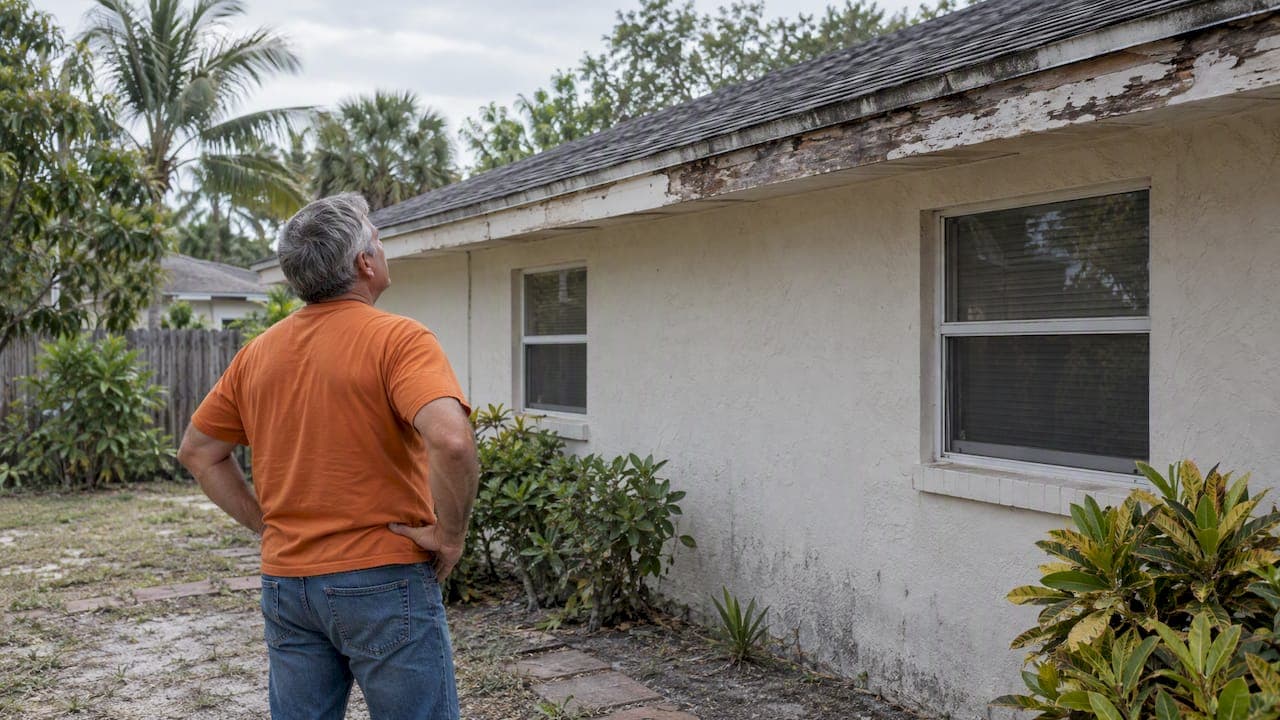
You can sell a house as-is in Florida. You don't have to repair anything, and you don't have to credit the buyer for what an inspection finds. What "as-is" does not do is let you stay quiet about problems you know about. Florida sellers must still disclose known defects the buyer can't see, and they must hand over a separate flood disclosure. Below is how the contract works, what you owe the buyer, what it costs you, and the two main ways to sell: on the open market or directly to a cash buyer.
TL;DR
- "As-is" in Florida means you won't make repairs. It does not cancel your duty to disclose known, hidden material defects.
- Sellers of residential property must give the buyer a flood disclosure at or before the contract is signed.
- In the standard Florida As Is contract, the buyer usually gets an inspection period and can cancel during it for any reason.
- Listing as-is saves repair money but not time or fees. A direct cash sale trades some price for speed, certainty and no commissions.
- Texas, Tennessee and New Jersey have their own disclosure rules. Don't assume Florida's apply there.
Table of Contents
- What "as-is" really means in a Florida sale
- What you still have to disclose
- How the Florida As Is contract works for sellers
- What selling as-is costs you in Florida
- Your options for selling as-is
- A practical checklist before you sell
- Our perspective on as-is sales
- If you want a cash offer instead
- Selling as-is in Texas, Tennessee and New Jersey
- FAQ
- Sources
What "as-is" really means in a Florida sale
Selling as-is means the buyer takes the property in its current condition. You aren't obligated to fix the roof, replace the air conditioner or patch the drywall. You also don't have to bargain over repair requests after an inspection.
It does not mean the buyer gives up all protection. In Florida the protection works in two layers:
- The contract. The Florida Realtors/Florida Bar AS IS residential contract is the form behind a large share of Florida home sales. Under it, the seller has no repair obligation, and the buyer's protection is an inspection period in which they can cancel for any reason.
- The law. Florida courts and statutes require honesty about what you know. That layer can't be signed away.
Most seller mistakes come from mixing these up. They hear "as-is" and assume "no questions asked." That assumption is what tends to end up in a lawsuit.
What you still have to disclose
Known latent defects: the Johnson v. Davis duty
In 1985 the Florida Supreme Court decided Johnson v. Davis. In that case the sellers told the buyers a window had a minor problem that had been corrected and that there were no roof problems. The buyers later found otherwise. The resulting rule is that a seller who knows of a latent, material defect and doesn't disclose it can be sued by the buyer. "Latent" means the buyer couldn't easily see it. "Material" means it affects the value of the property.
In practice, that covers things like:
- A past roof leak you patched but never fully repaired
- Foundation cracking or settlement you've seen
- Termite or rot damage hidden behind walls
- Plumbing failures, mold or prior fire damage
- Sinkhole activity or claims on the property
A visible stained ceiling or a missing fence board is different. The buyer can see it, so you don't need to point it out, though mentioning it costs you nothing. If your property has a sinkhole history, read our guide to selling a sinkhole house in Florida before you sign anything.
The practical rule: if you know about it and a buyer wouldn't spot it on a walkthrough, write it down and give it to them. A buyer who knew about a defect before signing has a hard time claiming you hid it. A buyer who found out afterward may seek damages or ask a court to undo the sale.
The flood disclosure
Florida Statute 689.302 requires a seller to complete and give the buyer a flood disclosure for residential property at or before the time the sales contract is signed. It is a standalone form, separate from the rest of your paperwork. It asks about flood damage during your ownership, insurance claims and federal assistance. You can read the full statute on the Florida Legislature's site.
Two habits keep you safe here:
- Gather your records first: insurance claims, FEMA correspondence, contractor invoices for water damage.
- Answer from your own knowledge even when no claim was ever filed. Damage you saw but never claimed still counts as something you know.
If your house took water in a storm, our page on selling a flood-damaged house explains how reports and documentation affect offers. For storm damage more broadly, see selling a hurricane-damaged house as-is without legal risk.
Other items to check
Depending on the property, you may also have to deal with HOA or condo disclosures, lead-based paint notices for homes built before 1978, and open permits or code violations. A Florida real estate attorney or your title company can tell you which apply. Open liens and code fines usually have to be resolved at or before closing, so find out the amounts early.
How the Florida As Is contract works for sellers

The buyer's side of this contract is built around time. According to a Florida real estate law firm's breakdown of the form, the inspection period is 15 days from the effective date if the blank is left empty, and parties can write in a shorter or longer period. During that window the buyer can inspect and cancel for any reason.
What that means for you:
- The deal isn't solid on day one. Even at full price, a buyer can walk away within the inspection period and get their deposit back if they cancel in writing on time.
- You can shorten the window. Negotiating a 7- or 10-day inspection period gets you to a firm contract sooner.
- Repairs are the buyer's problem, but price is not. Buyers who find big issues often cancel, or come back and ask for a lower price. You can say no, but then you may be back on the market.
- Deadlines bind you too. Written notices and delivery dates matter. Have a Florida attorney or your agent read the form before you sign.
For a closer look at how inspection timing changes outcomes, see our piece on how 7 to 10 day inspections shape a cash sale.
What selling as-is costs you in Florida
Skipping repairs saves money upfront. It rarely means a full-price sale. Buyers discount for the work they'll take on, and you should plan for that.
The discount
How big depends on the condition and the buyer. Our own analysis suggests a 15 to 25 percent as-is discount can leave sellers with more money than repairing and listing, once repair costs, carrying costs and time are counted. Run your own numbers with a contractor's written estimate before assuming either route wins.
Closing costs
Florida's documentary stamp tax on a deed is $0.70 per $100 of the sale price in every county except Miami-Dade, where the rate differs. In the standard contract the seller customarily pays it. On a $300,000 sale at the standard rate, that is $2,100. Add owner's title insurance in many counties, any real estate commission, and prorated taxes and HOA dues. Ask your title company for a net sheet before you accept any offer so you see what you would actually receive.
Time on the market
As of May 2026, Florida Realtors data shows a statewide median single-family sale price of $425,000, up 2.4% from a year earlier. Cash purchases accounted for 6,770 of 24,915 closed sales that month. Those figures cover the whole state and mostly homes in market condition. A house with a bad roof, a fire history or a tenant in place will usually behave differently from the median.
Your options for selling as-is
There are three realistic routes. Which is best depends on the property's condition, your deadline and your tolerance for uncertainty.
| Option | Repairs needed | Typical speed | Fees | Main risk |
|---|---|---|---|---|
| List with an agent, as-is | None required, but cosmetic fixes help | Varies with market and condition; buyer inspection period applies | Agent commission plus closing costs | Buyers cancel or renegotiate after inspection |
| For sale by owner | None required | Often slower, with more of the work on you | No listing agent, but you handle marketing, paperwork and negotiation | Mistakes in paperwork or disclosures |
| Direct cash sale to a buyer | None | Closing date set around your schedule | No agent commissions | Offer is below full retail value |
Listing with an agent
This can bring the highest price when the house is livable and the market is moving. The tradeoff is commissions, showings and financing contingencies. Many buyers need a mortgage, and lender appraisals can stall homes in poor condition.
Selling without an agent
Florida law lets you sell your home yourself, and nothing requires you to hire an agent. You then take on pricing, marketing, contract review and disclosures yourself. If you want to weigh it, this overview of for-sale-by-owner options in a major metro market shows what the process involves, though the specifics are for Michigan, not Florida. Pay for an attorney's review of the contract either way.
Selling directly to a cash buyer
A direct buyer purchases the house in its current condition, so there are no repairs, showings or lender delays. The offer is lower than a fully repaired retail sale, and that is the price of speed and certainty. This route is most useful when the house has problems that scare off financed buyers: foreclosure pressure, probate, code violations, liens, tenants who won't leave, or damage you can't afford to fix. For an explanation of how that works, see our guide on cash offers with no repairs.
A practical checklist before you sell
- Write down every defect you know of. Roof, plumbing, electrical, foundation, water intrusion, pests. Include repairs you did and didn't finish.
- Complete the flood disclosure. Pull insurance claim records and any FEMA paperwork.
- Check title. Look for mortgages, liens, code enforcement fines and unpaid property taxes. A title company can run a search.
- Get one repair estimate. Even if you don't plan to fix anything, a contractor's number shows you what the discount means.
- Request a net sheet. Compare what you'd receive from a listing, an owner sale and a cash offer after all costs.
- Set your deadline. A foreclosure sale date, a probate timeline or a carrying cost per month changes which option wins.
- Have an attorney read the contract. This matters most if you're facing foreclosure, an estate or a dispute with a tenant.
For a deeper walk-through, our selling a home without repairs guide covers the situations where skipping repairs makes the most sense.
Our perspective on as-is sales
We buy houses, land and small apartment buildings directly from owners, in whatever condition they're in. Most of the people who reach us aren't choosing between a perfect listing and a cash sale. They're dealing with something that stopped the normal process: a foreclosure notice, an inherited house nobody wants, a tenant who isn't paying, or repairs they can't afford.
Here is what we tell them. First, disclose honestly, whoever the buyer is. It protects you and shortens the conversation. Second, don't let anyone, including us, rush you. Ask for the offer in numbers you can follow, and compare it against a net sheet from a listing. Third, an as-is sale is a trade. You give up some price to get time, certainty and no repair bills. If your house is in good shape and you have months, a traditional listing may serve you better. If it isn't, or you don't, a straightforward cash sale often does.
We work nationwide, with a strong focus on New Jersey, Texas, Florida and Tennessee, and we keep every conversation confidential.
— Alek
If you want a cash offer instead
If your Florida property needs work, has a lien or tenant problem, or you just want a clear closing date, we'll look at it as-is. Our process has no agent fees or commissions, and you'll see how the offer is calculated. You can start on our Cash Offer Program page, see how our process works, or go to ExitVest to tell us about your property.
Selling as-is in Texas, Tennessee and New Jersey
The as-is concept is the same everywhere, but disclosure rules are set state by state. Our overview of as-is disclosure laws across the U.S. is a good starting point.
- Texas. The Seller's Disclosure Notice is required by the Texas Property Code and is tied to the property condition paragraph of the standard contract, according to the Texas Real Estate Research Center. A Texas bank's seller guide likewise notes that selling as-is doesn't remove disclosure obligations. For how Texas and Florida compare, see fast home sale markets in both states.
- Tennessee and New Jersey. Each has its own required forms and exceptions. Confirm current requirements with a local real estate attorney before you list or sign.
Do not apply Florida's flood statute or its Johnson duty to another state. They are Florida rules.
FAQ
Can you sell a house as-is in Florida?
Yes. Florida has a standard As Is residential contract, and you aren't required to make repairs. You must still disclose known defects that aren't readily visible to the buyer, and give the flood disclosure at or before signing.
Does as-is mean I don't have to disclose problems?
No. Under the Johnson v. Davis rule, a seller who knows of a hidden, material defect and doesn't tell the buyer can be sued for damages or face rescission of the sale. The as-is clause shifts repair costs to the buyer. It does not protect you from a nondisclosure claim.
Can a buyer back out of an as-is contract in Florida?
Often, yes, during the inspection period. In the standard As Is contract the buyer can cancel for any reason within that window, which is 15 days when the blank is left empty. After it expires, the buyer is generally committed unless another contingency applies.
Do I need a realtor to sell as-is?
No. Florida doesn't require you to use an agent, and you can also sell directly to a cash buyer. Whatever you choose, have a Florida real estate attorney or title company review the contract and closing costs.
Sources
- Florida Statute 689.302, flood disclosure
- The Florida Bar Journal: Johnson v. Davis, Redux
- Florida Realtors: Monthly Market Detail, May 2026
- Kelley, Grant & Tanis, P.A.: The Florida As Is Contract
- Barnes Walker: Florida documentary stamp tax
- Texas Real Estate Research Center: Navigating As-Is Sales
- Herring Bank: How to Sell a House As-Is in Texas