

A cash offer no repairs is an all-cash property purchase where the buyer agrees to buy your home in its current condition, with no repair demands, no renovation credits, and no lender-required upgrades. This type of sale, formally called an as-is sale in real estate contracts, removes the back-and-forth over inspection findings and lets sellers skip the time and expense of fixing up a property before listing. Cash buyers include investors, house flippers, and iBuyers who often prefer as-is homes to renovate themselves, making them the primary market for this type of transaction. For homeowners facing foreclosure, managing inherited property, or simply needing to move fast, understanding how this process works can mean the difference between a stressful sale and a clean exit.
What is a cash offer no repairs and how does it work?
A cash offer no repairs means a buyer purchases your property with their own funds, skipping mortgage financing entirely, and agrees upfront not to request repairs or price reductions based on the home's condition. The industry term for this arrangement is an as-is sale, and it is the standard contract language used when sellers want to transfer the property without taking on fix-up obligations. Exitvest, along with other cash buyers operating in markets like New Jersey, Texas, Florida, and Tennessee, structures offers this way to give sellers a predictable, low-friction path to closing.
The mechanics are straightforward. You receive an offer, review the terms, and if you accept, the buyer moves forward without requiring you to patch the roof, replace the HVAC, or repaint the walls. Because there is no lender involved, there is no appraisal contingency and no underwriter flagging deferred maintenance as a condition of funding. Cash buyers avoid appraisal contingencies and lender-imposed repair demands, which is what makes the process faster and simpler than a traditional financed sale.

How cash offers differ from traditional financed sales
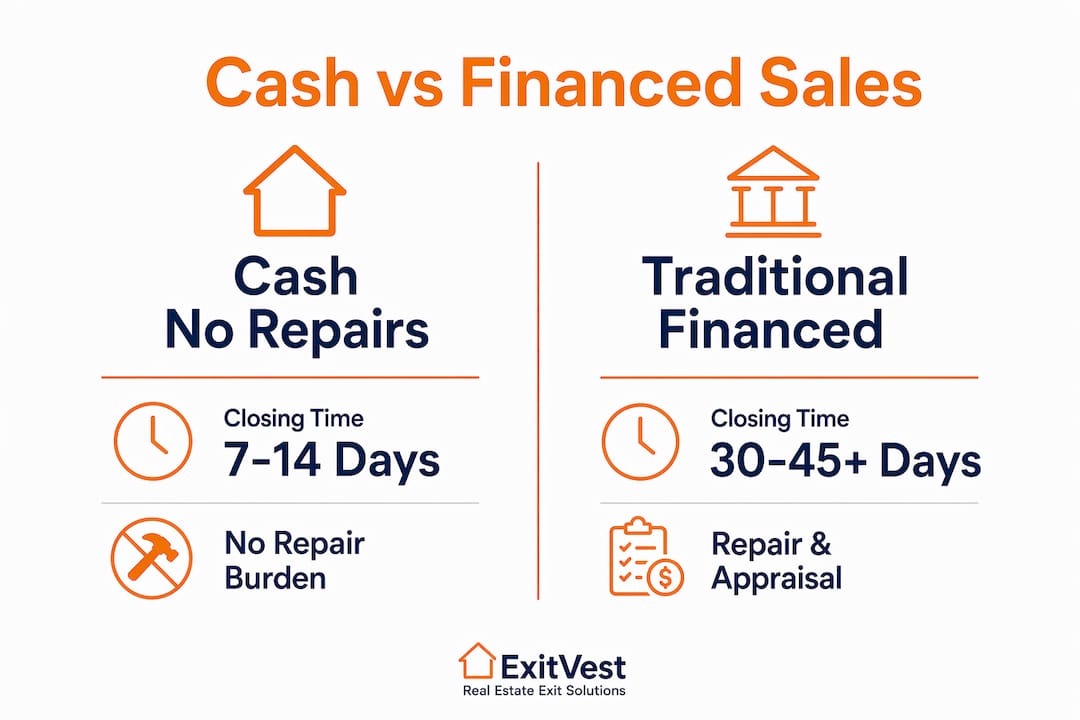
The most significant difference between a cash no repairs offer and a mortgage-backed sale is time. Cash transactions close in 7 to 14 days, while mortgage-backed purchases average around 41 days according to ICE Mortgage Technology. That gap matters enormously if you are behind on payments, relocating for work, or settling an estate with multiple heirs.
Beyond speed, the contingency structure is completely different. A financed buyer typically includes an appraisal contingency, a financing contingency, and an inspection contingency. Any one of those can kill a deal or force renegotiation weeks into the process. Cash offers carry far fewer conditions, which is why sellers in urgent situations consistently favor them even when the dollar amount is lower.
Here is a direct comparison of what each sale type typically involves:
| Factor | Cash no repairs offer | Traditional financed offer |
|---|---|---|
| Closing timeline | 7 to 14 days | 30 to 45+ days |
| Appraisal required | No | Yes |
| Repair negotiations | None | Common after inspection |
| Financing contingency | No | Yes |
| Seller prep required | Minimal | Staging, repairs, showings |
| Deal fall-through risk | Low | Higher |
Pro Tip: If you receive multiple offers, do not evaluate cash offers purely on price. Factor in the carrying costs of holding the property for an additional 30 to 60 days while a financed deal closes. Mortgage payments, taxes, insurance, and utilities add up fast.
What "as-is" actually means legally
"As-is" is a contract term that changes your repair obligations, not your disclosure obligations. Sellers often assume that listing a home as-is means they can stay silent about known problems. That assumption creates serious legal exposure. Nearly every state requires known material defect disclosures regardless of whether the sale is structured as-is, and failing to disclose can result in fraud liability even after closing.
What as-is actually means is this: after an inspection, the buyer cannot come back and demand you fix the leaking basement or replace the aging electrical panel. The as-is clause changes repair obligations post-inspection but does not eliminate the buyer's right to conduct an inspection in the first place. These are two separate contract provisions that sellers frequently confuse.
Here is what sellers must understand about the as-is condition:
- Disclosure forms are still required. You must complete your state's standard seller disclosure form, listing known defects like foundation cracks, water intrusion, mold, or roof damage.
- Inspection contingencies may still exist. Even in an as-is deal, buyers may request inspections and negotiate price reductions or closing credits after reviewing results.
- As-is does not mean no liability. The biggest legal risk in as-is cash sales is failure to disclose known defects truthfully. As-is clauses do not shield sellers from fraud or nondisclosure liability.
- Contract language varies. Some as-is contracts retain the buyer's right to terminate based on inspection findings. Review this clause carefully with a real estate attorney before signing.
"As-is clauses primarily affect repair obligations post-inspection and should not be conflated with inspection contingencies, which protect buyers' rights to terminate." — LegalClarity
For a detailed breakdown of the paperwork involved, as-is home sale documentation covers what sellers need to prepare before closing.
Benefits and downsides of accepting a cash offer with no repairs
The benefits of a no repair house sale are real, but so are the tradeoffs. Understanding both sides helps you make a decision based on your actual situation rather than assumptions.
The benefits:
- Speed. Closing in under two weeks is standard with cash buyers, not a special exception.
- No repair costs. You avoid contractor bids, permit delays, and the uncertainty of renovation timelines.
- Fewer contingencies. With no lender involved, the deal is far less likely to collapse at the last minute.
- Reduced stress. No open houses, no staging, no strangers walking through your home for weeks.
- Flexibility. Many cash buyers, including Exitvest, offer flexible closing dates to match your schedule.
The downsides:
- Lower offer price. Cash offers are generally below market value because buyers factor in the speed, convenience, and repair risks they are absorbing.
- Smaller buyer pool. Not every buyer has cash on hand, so you are marketing to a narrower group.
- Inspection risk remains. Even without a repair obligation, a buyer can still use inspection findings to negotiate a lower price or walk away if the contract allows it.
The sellers who benefit most from fast cash offers are those facing foreclosure, managing a property from out of state, dealing with problem tenants, or inheriting a home they do not want to maintain. For those sellers, the reasons to accept lower cash offers often come down to time, certainty, and the elimination of carrying costs rather than a failure to negotiate.
How to prepare for and accept a cash offer no repairs
Selling without repairs does not mean selling without preparation. A few focused steps protect you legally and financially.
- Verify proof of funds. Before accepting any offer, ask the buyer for a bank statement or letter from a financial institution confirming they have the cash available. Proof of funds verification is the single most important step to avoid a deal falling through at the last minute.
- Complete your disclosure forms honestly. List every known defect. This protects you from post-closing legal claims and builds trust with serious buyers who are not going to walk away over disclosed issues.
- Review the inspection contingency language. Ask your attorney or agent to confirm whether the buyer retains the right to terminate after an inspection. This clause determines how much negotiating leverage the buyer holds after the offer is accepted.
- Understand the closing timeline. Once you accept a cash offer, expect a title search, document preparation, and a final walkthrough before closing day. The full process typically runs 7 to 14 days with a motivated buyer.
- Consult a real estate attorney. Even a one-hour consultation before signing can prevent costly mistakes, especially if the property has liens, title issues, or multiple owners.
- Compare at least two or three offers. Getting a single cash offer and accepting it immediately is the most common mistake sellers make. Request offers from multiple buyers to establish a realistic price range.
Pro Tip: Ask each cash buyer whether their offer is subject to an inspection contingency. A buyer who waives the inspection contingency entirely gives you the cleanest, most certain path to closing.
Key takeaways
A cash offer no repairs is the fastest, lowest-friction way to sell a home, but sellers must still complete required disclosures and carefully review inspection contingency language to avoid legal and financial risk.
| Point | Details |
|---|---|
| Definition of as-is sale | Buyer purchases the home in current condition with no repair demands from seller. |
| Closing speed advantage | Cash deals close in 7 to 14 days versus 30 to 45+ days for financed offers. |
| Disclosure duty remains | Sellers must disclose known material defects in every state, regardless of as-is terms. |
| Price tradeoff is real | Cash offers are typically below market value to compensate buyers for speed and repair risk. |
| Proof of funds is critical | Always verify the buyer's liquidity before accepting an offer to prevent last-minute deal failures. |
When a cash no repairs sale actually makes sense
I have talked with a lot of sellers who came to the cash offer conversation with the wrong frame. They were comparing the cash offer price to their Zillow estimate and feeling shortchanged. That comparison misses the point entirely.
The right comparison is the cash offer price versus what you would actually net after repairs, agent commissions, carrying costs, and the very real possibility that a financed deal falls apart two weeks before closing. When you run those numbers honestly, the gap between a cash offer and a traditional sale narrows considerably. In some situations, particularly with distressed properties or sellers under time pressure, the cash offer nets more after all costs are accounted for.
What I have seen consistently is that sellers who struggle most with the cash offer decision are the ones who have not yet quantified their carrying costs. If you are paying $2,000 a month in mortgage, taxes, and insurance on a property you do not want, every 30-day delay costs you money. Speed has real dollar value.
The one caution I would offer: do not skip the disclosure step because you think as-is means you are off the hook. That assumption has cost sellers far more than any repair would have. Disclose what you know, get the contract reviewed, and verify proof of funds. Those three steps protect you regardless of how fast the deal moves.
— Alek
Sell your home as-is for cash with Exitvest

Exitvest provides fast, no-obligation cash offers for houses, land, and small apartment buildings across New Jersey, Texas, Florida, Tennessee, and nationwide. If you are dealing with foreclosure, an inherited property, problem tenants, or a home that needs more repairs than you want to take on, Exitvest buys properties in any condition without requiring you to fix a thing. The process is straightforward: you share your property details, receive a fair cash offer, and choose a closing date that works for your situation. No agent fees, no repair demands, no pressure. Get a cash offer today and see what your property is worth as-is, or learn more about how the process works before you decide.
FAQ
What does "cash offer no repairs" mean in real estate?
A cash offer no repairs means a buyer purchases your home with their own funds in its current condition, with no requirement for you to make repairs, offer credits, or update anything before closing. This is formally structured as an as-is sale in the purchase contract.
Will I still need to disclose defects in an as-is cash sale?
Yes. Nearly every state requires sellers to complete a property disclosure form listing known material defects, even in as-is sales. Failing to disclose known issues can result in fraud liability after closing, regardless of the as-is contract language.
How fast does a cash no repairs sale actually close?
Cash transactions typically close in 7 to 14 days, compared to 30 to 45 or more days for mortgage-backed purchases. The exact timeline depends on title search completion and how quickly both parties sign documents.
Can a cash buyer still negotiate after an inspection in an as-is deal?
Yes. An as-is clause removes your repair obligation but does not automatically eliminate the buyer's inspection contingency. If the contract retains that contingency, the buyer can still request a price reduction or walk away based on inspection findings.
Are cash offers always lower than financed offers?
Cash offers are generally below market value because buyers factor in the speed, convenience, and repair risk they absorb. However, when you subtract repair costs, agent commissions, and carrying costs from a higher financed offer, the net difference is often smaller than it appears.