

If you've ever waited two months for a financed buyer to close only to watch the deal fall apart at the last minute, you already understand why cash offers close faster and why that speed can mean everything. Cash transactions cut out the mortgage process entirely, removing the single biggest source of delays and deal failures in real estate. And while a financed offer might look more attractive on paper, the certainty and speed of a cash deal often deliver a better outcome when you look at the full picture.
Table of Contents
- Key takeaways
- Why cash offers close faster than financed deals
- Benefits of cash offers beyond speed
- Trade-offs to weigh before you accept
- Practical steps to leverage a cash offer
- My take on why sellers undervalue cash offers
- How Exitvest can help you close faster
- FAQ
Key takeaways
| Point | Details |
|---|---|
| No mortgage means no waiting | Cash offers skip underwriting and lender approval, cutting weeks off the closing timeline. |
| Closing in days, not months | Cash deals close in 7 to 14 days compared to 30 to 60 days for financed transactions. |
| Fewer ways for deals to collapse | With no financing contingency, the risk of a buyer backing out due to loan denial disappears. |
| Sell as-is, skip the prep | Cash buyers frequently purchase homes without requiring repairs, staging, or showings. |
| Speed benefits stressed sellers most | Foreclosure, divorce, relocation, and inherited properties all benefit most from a fast, certain close. |
Why cash offers close faster than financed deals
The core reason is simple: when a buyer uses cash, there is no mortgage lender in the picture. No lender means no underwriting, no loan approval timeline, and no waiting on a third-party institution to sign off before you can get to the closing table.
With a financed offer, the timeline looks something like this. The buyer submits a loan application, the lender orders an appraisal, the underwriting team reviews the buyer's income, debt, credit, and employment, and then everyone waits. That process alone typically takes three to six weeks. Add in back-and-forth requests for documentation, and you can easily stretch past 60 days. A cash buyer skips every single one of those steps.
- No mortgage underwriting. The lender's underwriting process is the biggest time drain in any financed deal. It can take two to four weeks just to get a clear-to-close decision, even when everything goes smoothly.
- No lender-required appraisal. Cash sales often skip lender-mandated appraisals entirely. This matters because appraisals can lag in rising markets, causing the appraised value to come in below the agreed price and triggering renegotiations or deal cancellations.
- Fewer contingencies. Most cash offers come with minimal contingencies. No financing contingency means the sale doesn't hinge on the buyer securing a loan. Many cash buyers also waive or limit inspection contingencies, further reducing the negotiation back-and-forth.
- Less paperwork, fewer parties. A financed closing involves the lender, the lender's attorney, a title company, appraisers, and more. A cash closing often involves just the buyer, the seller, and the title company. Fewer parties means fewer scheduling conflicts and fewer documents requiring approval.
Concrete numbers tell the story clearly. Cash deals close in 7 to 14 days, while financed transactions routinely take 30 to 60 days. For sellers in time-sensitive situations, that gap is not just convenient. It can be life-changing.
Pro Tip: Ask any cash buyer to provide proof of funds before you sign anything. A legitimate cash offer comes with a recent bank statement or letter from a financial institution confirming the buyer has the money available.
Benefits of cash offers beyond speed
Speed is the headline, but it's not the whole story. The advantages of cash offers stretch well beyond a faster closing date.
- Lower risk of the deal falling through. Cash transactions remove financial contingencies, which means the deal won't collapse because a buyer's loan was denied. With financed offers, roughly one in ten mortgage applications are denied during underwriting.
- No appraisal gaps eating into your proceeds. In a financed sale, if the home appraises below the agreed price, you either renegotiate down or the deal dies. Cash buyers are not bound by lender appraisal requirements, so this problem rarely surfaces.
- Sell the home as-is. Cash buyers typically purchase homes as-is, saving sellers one to three months of repair prep time and the associated costs. If your roof needs work or the kitchen is dated, you don't have to spend $15,000 before listing.
- You control the closing date. Cash offers allow you to choose your closing timeline and coordinate your move on your schedule. That kind of flexibility is nearly impossible with a financed buyer dependent on their lender's calendar.
- Reduced carrying costs. Every extra week a property sits unsold costs you money in mortgage payments, property taxes, utilities, and insurance. A fast cash close cuts those costs significantly.
"Sellers often confuse a higher offer price with higher actual proceeds. A financed offer at $300,000 that takes 60 days to close, requires $10,000 in repairs, and risks falling through is often a worse deal than a $275,000 cash offer that closes in ten days with zero prep costs." — Homes.com
The math changes when you account for carrying costs, repair expenses, and the real probability of a deal surviving to closing. Cash is rarely the whole story, but its advantages are frequently underestimated.
Trade-offs to weigh before you accept
Being honest about what you might give up with a cash offer is just as important as understanding what you gain.
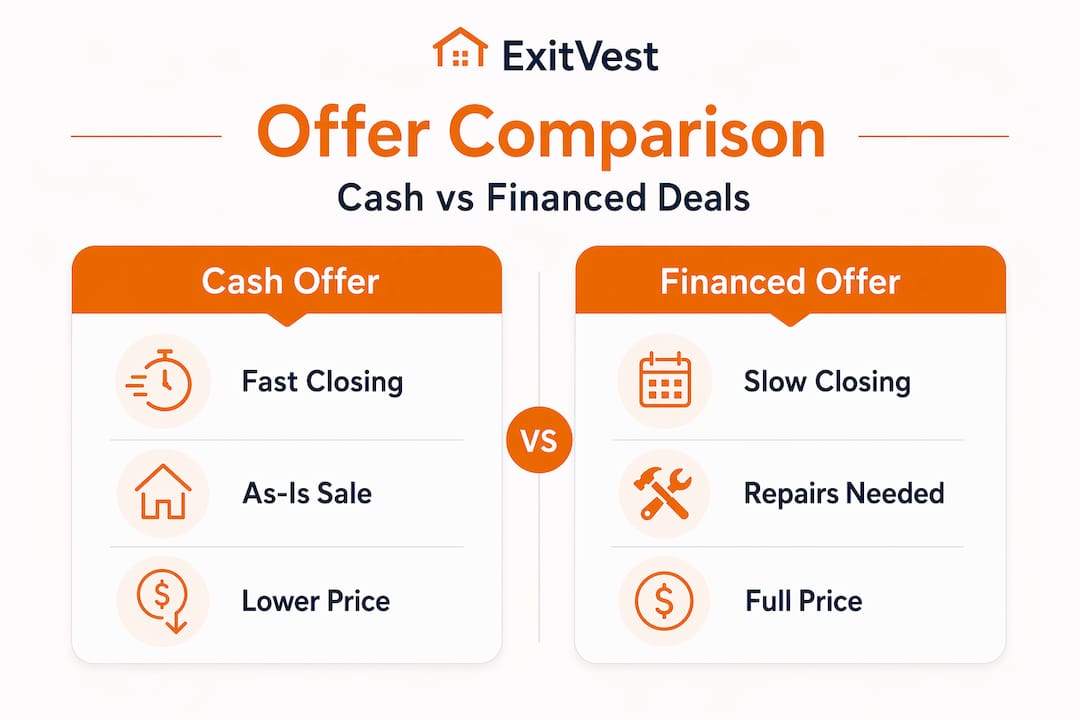
Cash offers tend to come in below full market value. Buyers factor in the convenience they're providing and the risk they're absorbing, especially when purchasing as-is. Average cash offer discounts have roughly doubled from about 4% to 9% in recent years. On a $350,000 home, that's a discount of up to $31,500 compared to what a competitive financed buyer might offer.

| Factor | Cash offer | Financed offer |
|---|---|---|
| Closing timeline | 7 to 14 days | 30 to 60 days |
| Deal fall-through risk | Very low | Moderate to high |
| Repairs required | Rarely | Often |
| Appraisal required | No | Yes |
| Carrying cost exposure | Minimal | Significant |
| Offer price | Below market | At or above market |
The right choice depends on your situation. If you have time, a buyer who can pay full price through financing may net you more. But if you're facing foreclosure, a job relocation deadline, a messy estate, or a property that would need significant work before listing, the speed and certainty of cash almost always wins.
Pro Tip: Before rejecting a cash offer because it seems low, calculate your actual net proceeds from both options. Subtract repair costs, carrying costs through the expected closing date, and the statistical risk of the financed deal falling apart. The numbers often shift in favor of cash.
Also, be cautious about who you're dealing with. Experienced cash buyers close faster with fewer complications. First-time cash buyers or investors without a track record may still attach contingencies or cause delays. Verify proof of funds and check references before committing.
Practical steps to leverage a cash offer
Knowing that cash offers close faster is one thing. Getting to that fast closing without a hitch requires a few deliberate moves on your part.
- Verify proof of funds first. Before accepting any offer, request a bank statement or letter from the buyer's financial institution. Working with verified cash buyers reduces the risk of fraud and deal complications significantly.
- Know your timeline priority. If closing in the next two to three weeks is critical for your situation, say so upfront. Buyers who can meet that timeline should move to the top of your list regardless of offer price.
- Understand what as-is means for your paperwork. An as-is sale still requires standard disclosures in most states, but it eliminates the buyer's ability to demand repairs after inspection. Make sure you and your attorney understand the terms before signing.
- Work with an agent who knows cash buyers. Not every agent has relationships with legitimate cash buyers or experience guiding sellers through fast closings. An agent who knows this space will help you spot red flags and negotiate better terms even within a cash deal.
- Align the deal with your financial goals. Cash offers are particularly strategic for sellers in transitions like relocation, divorce, or inheritance, where the value of time and certainty outweighs chasing the highest possible price. Be clear about what matters most to you before you enter negotiations.
If you're dealing with a vacant property or a home you simply want out of, you can also learn how to sell as-is without the usual stress of the traditional listing process.
My take on why sellers undervalue cash offers
I've seen sellers walk away from solid cash offers to chase financed buyers who looked better on paper, only to call back six weeks later after the deal collapsed. That pattern is more common than most people realize.
What I've found is that sellers consistently underestimate two things: the cost of carrying a property through a long closing, and the emotional toll of keeping a deal alive through underwriting. When you're trying to move on from a property tied to a difficult situation, every additional week is not just a financial cost. It's stress you carry with you.
The conventional wisdom says to always hold out for the highest offer. But in my experience, certainty has real value that never shows up in the headline number. A $285,000 offer that closes in ten days and requires nothing from you can absolutely beat a $310,000 offer with a 60-day close, repair requests, and a lender who may still say no.
There's also a deeper point about negotiation. Many sellers don't realize they can push back on the terms of a cash offer even when they accept a lower price. You can negotiate the closing date, ask for a larger earnest deposit to protect yourself, and request flexibility on your move-out timeline. Speed and certainty don't mean you have to hand over all leverage.
My advice: get both numbers on paper, run the actual math, and factor in your real deadline. Then decide.
— Alek
How Exitvest can help you close faster
When you need to sell and you need it done without a months-long process, Exitvest is built exactly for that situation.
Exitvest buys properties as-is, nationwide, with a focus on New Jersey, Texas, Florida, and Tennessee. Whether you're facing foreclosure, dealing with an inherited home, managing a vacant property, or simply ready to move on, the process is straightforward. You get a cash offer with no obligation, and you choose the closing date. No repairs, no staging, no endless showings. Exitvest has helped hundreds of property owners close on their own timeline without the uncertainty of traditional financing. If you want to stop the waiting and get a real number, explore how Exitvest works and take the first step today.
FAQ
How fast can a cash offer actually close?
Cash offers typically close in 7 to 14 days, compared to 30 to 60 days for financed deals. The exact timeline depends on how quickly the title search and paperwork are completed.
Will I get less money with a cash offer?
Cash offers often come in below full market value, with recent discounts averaging around 9%. However, when you factor in repair costs, carrying costs, and the risk of a financed deal falling through, the actual net proceeds from a cash sale can be competitive or better.
Do I have to make repairs before accepting a cash offer?
No. Most cash buyers purchase properties as-is, which means sellers save time and money on repairs, staging, and showings that a traditional listing would require.
How do I know if a cash buyer is legitimate?
Always request proof of funds before signing anything. Verified cash buyers will provide a recent bank statement or financial institution letter confirming they have the funds available to close.
When does accepting a cash offer make the most sense?
Cash offers make the most sense when speed and certainty matter more than squeezing out every dollar. Sellers facing foreclosure, relocation, or inherited properties benefit most from the fast, predictable close that cash transactions provide.