

Small apartment buildings are priced primarily by income: divide Net Operating Income (NOI) by a market-supported cap rate and you have your baseline value. That single formula drives nearly every cash offer a buyer will put in front of you.
- Primary formula: Property Value = NOI ÷ Cap Rate. A building generating $60,000 in NOI at a 7% cap rate implies a value of roughly $857,000.
- Expense reality: Normalized operating expenses typically run 35–50% of effective gross income; anything under 30% triggers buyer scrutiny.
- Who's behind this guide: Alek at Exitvest, which buys small apartment buildings as-is for cash nationwide with a strong focus on New Jersey, Texas, Florida, and Tennessee.
Table of Contents
- How small apartment building valuation actually works
- How to calculate NOI and estimate your building's value
- What cap rates are and what moves them in your market
- Why cash buyers offer less than theoretical market value
- Documents cash buyers will check before making an offer
- Worked example: valuing a 6-unit building and estimating a cash offer
- Key Takeaways
- What sellers often get wrong about cash offers
- Get a fast cash offer from Exitvest
- Useful sources
How small apartment building valuation actually works
Three approaches exist, but they don't carry equal weight for small multifamily properties.
| Method | Best use | Seller takeaway |
|---|---|---|
| Income (capitalization) | 5+ unit rentals with operating history | Your NOI and local cap rate set the price |
| Sales comparison | Thin markets, newer builds, 2–4 unit properties | Useful as a sanity check; rarely primary for 5+ units |
| Cost approach | New construction, unique or specialty buildings | Appraisers and insurers use it; rarely drives a cash offer |
The income capitalization approach dominates because buyers are purchasing a cash-flow stream, not a house. Curb appeal matters far less than rent roll stability. The sales comparison approach fills in when comps are plentiful and the building is small enough that owner-occupants compete with investors. The cost approach shows up mainly for insurance purposes or genuinely unique properties with no comparable sales.
Pro Tip: If your rents are below market, lead with that upside in conversations with buyers. A building running 15% below market rents can command a higher offer than its current NOI implies, because a buyer underwrites what the property can earn, not just what it earns today.
How to calculate NOI and estimate your building's value
Follow these steps before you contact any buyer. Sellers who arrive with verified numbers get faster offers and smaller discounts.
- Gross Potential Income (GPI): Add up 100% occupancy rent for all units plus any other income (laundry, parking, storage fees).
- Vacancy and credit loss: Subtract a market-supported vacancy allowance, typically 5–10% of GPI.
- Effective Gross Income (EGI): GPI minus vacancy equals EGI.
- Operating expenses: Subtract property taxes, insurance, utilities, repairs and maintenance, property management (typically 8–10% of collected rent), and reserves. Do NOT include mortgage principal or interest, income taxes, or depreciation.
- NOI: EGI minus operating expenses.
- Implied value: NOI ÷ your local market cap rate.
Common owner mistakes: understating repairs, omitting a management fee because you self-manage (buyers add it back), and skipping reserves. Inaccurate NOI creates large valuation gaps that slow or kill deals.
| Line item | Sample 6-unit building |
|---|---|
| Gross Potential Income | $60,000 |
| NOI | $45,310 |

What cap rates are and what moves them in your market
A cap rate is simply the market's required return on a property at a given risk level. Flip the formula: Cap Rate = NOI ÷ Price. When buyers know what return they need, they solve for price instead.
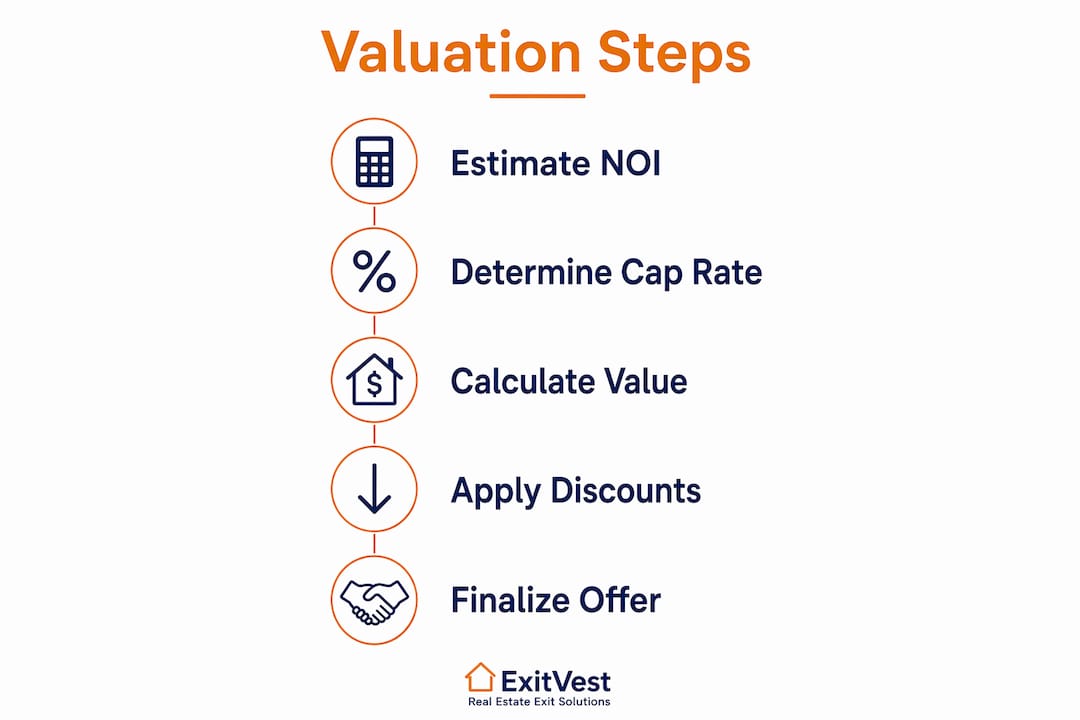
Several factors push cap rates up or down. Submarket demand is the biggest lever: prime locations trade at lower cap rates (higher prices per dollar of income) than secondary markets. Building condition, tenant mix, rent-control exposure, and deferred maintenance all push rates higher, meaning lower value. Financing availability matters too: when commercial loan rates rise, buyers need higher yields to make deals pencil, which compresses prices even when NOI holds steady.
For local cap-rate signals, pull recent closed sales of similar-sized buildings in your submarket, check broker market reports, or ask a local commercial appraiser. National averages are a starting point, not a pricing tool. Sellers who collect three to five recent local comps can defend an expected cap-rate range rather than accepting a buyer's assumption at face value.
Why cash buyers offer less than theoretical market value
Cash buyers apply a discount to the income-capitalization value for concrete reasons: they absorb risk you're offloading. Speed costs money. A buyer closing in two weeks skips months of due diligence, accepts title risk, and prices in carrying costs and rehab uncertainty. That's a service with a price tag.
Discount ranges vary with the severity of distress and market liquidity. A clean building with a verified rent roll and no title issues might see a 5–10% discount from market value. Code violations, problem tenants, deferred maintenance, or a clouded title can push that to 20–25%. The buyer's underwriting focuses on achievable post-rehab income, not current distressed cash flow, so a building that looks bad on paper can still attract a meaningful offer if the upside is real and supportable.
Three seller actions narrow the discount: produce a verified trailing-12 rent roll, resolve obvious title exceptions before listing, and make small repairs that signal the building has been maintained. You don't need to renovate. You need to reduce the buyer's perceived risk.
Documents cash buyers will check before making an offer
Assemble these before you reach out. Missing documents slow underwriting and give buyers a reason to widen their discount.
| Document | Why buyers need it |
|---|---|
| Trailing 12-month rent roll | Verifies actual collected income vs. scheduled rent |
| Signed leases for all units | Confirms lease terms, rent amounts, and tenant protections |
| Profit & loss statement (T12) | Shows operating expense history; buyers normalize from here |
| Recent utility bills | Identifies owner-paid utilities that affect NOI |
| Property tax bills | Confirms actual tax burden used in expense calculation |
| Certificate of occupancy / code notices | Flags violations that affect insurability and financing |
| Title report or prior title policy | Surfaces liens, easements, or ownership issues |
Pro Tip: Before any buyer sees your rent roll, audit it yourself. Confirm every unit's rent matches the signed lease, note any month-to-month tenants, and flag any rent-control exposure that limits future increases. Discrepancies discovered by a buyer mid-diligence reset the negotiation.
Worked example: valuing a 6-unit building and estimating a cash offer
Using the sample numbers from the NOI table above, NOI = $45,310.
Apply a cap-rate range reflecting a mid-tier U.S. submarket:
A small change in cap rate can cause a significant shift in property value for this building. On a larger asset, that sensitivity grows fast. Similarly, if NOI were $5,000 higher due to one vacancy filled, value at 6.5% would rise by about $77,000.
A cash buyer typically applies a discount to market value to account for speed and potential deferred maintenance. Add a code violation or a non-paying tenant and that range compresses further. Sellers who use a DSCR calculator to model their property's debt-service coverage can also anticipate how a financed buyer underwrites the deal and where their ceiling sits.
Key Takeaways
Income capitalization (NOI ÷ cap rate) is the primary valuation method for small apartment buildings, and the documents you assemble before listing directly determine the size of a cash buyer's discount.
| Point | Details |
|---|---|
| Primary valuation formula | Divide NOI by your local market cap rate to estimate value before contacting any buyer. |
| Expense ratio benchmark | Normalized expenses run 35–50% of effective gross income; anything under 30% triggers buyer scrutiny. |
| Cap rate sensitivity | A small change in cap rate can cause a significant shift in property value for this building. |
| Documents reduce discounts | A verified trailing-12 rent roll and clean title are the two fastest ways to narrow a cash buyer's haircut. |
| Exitvest cash offers | Exitvest buys small apartment buildings as-is nationwide and can provide a fast cash offer based on your actual NOI. |
What sellers often get wrong about cash offers
Most owners I talk to assume the cash buyer is lowballing them. Sometimes that's true. More often, the gap between what a seller expects and what a buyer offers comes down to one thing: the seller is pricing off their mortgage balance or what a neighbor sold for, while the buyer is pricing off normalized NOI and a market cap rate. Those two numbers rarely agree.
The other thing sellers underestimate is how much a clean document package changes the conversation. A buyer who can verify your rent roll in 48 hours doesn't need to build in a risk buffer for what they might find. That's real money back in your pocket, not a negotiating tactic.
Get a fast cash offer from Exitvest
Selling a small apartment building with problem tenants, deferred maintenance, code violations, or a timeline you can't stretch is exactly the situation Exitvest was built for. There are no commissions, no repair requirements, and no pressure to accept an offer that doesn't work for you.
The process is straightforward. Submit your property details at Exitvest's as-is cash purchase page, receive a cash offer based on your building's actual income and condition, and close on a timeline that fits your situation. Exitvest buys nationwide with concentrated activity in New Jersey, Texas, Florida, and Tennessee. If you want to understand how the process works before reaching out, that's there too.
Useful sources
- Appraisal Institute: Fundamentals of Apartment Appraising — the professional standard for small-to-mid apartment valuation methodology
- Appraisal Institute: The Valuation of Apartment Properties, Third Edition — in-depth treatment of income, sales comparison, and cost approaches for multifamily assets
- How to sell rental property as-is fast — practical steps for owners who need a quick exit
- Why cash buyers purchase apartment buildings — buyer motivations and how distress factors affect offers
- Exitvest: sell your property as-is for cash — get a no-pressure cash offer on your building