

Selling a commercial property and selling a home are not just different in scale. They operate under different rules, attract different buyers, use different valuation methods, and carry different legal obligations. The core distinction in U.S. real estate starts with a simple threshold: properties with 1–4 units are classified as residential; anything with 5 or more units, or any non-residential use, falls into commercial territory. That line determines which financing products apply, how the property gets valued, what sellers must disclose, and how long the whole process takes.
Here is a quick summary of where the two diverge most sharply:
- Financing: Residential buyers access government-backed mortgages with 15–25% down payments; commercial loans require 25–35% down and are custom-structured with no federal standardization.
- Valuation: Residential value comes from comparable sales; commercial value is driven by net operating income (NOI) divided by a capitalization rate.
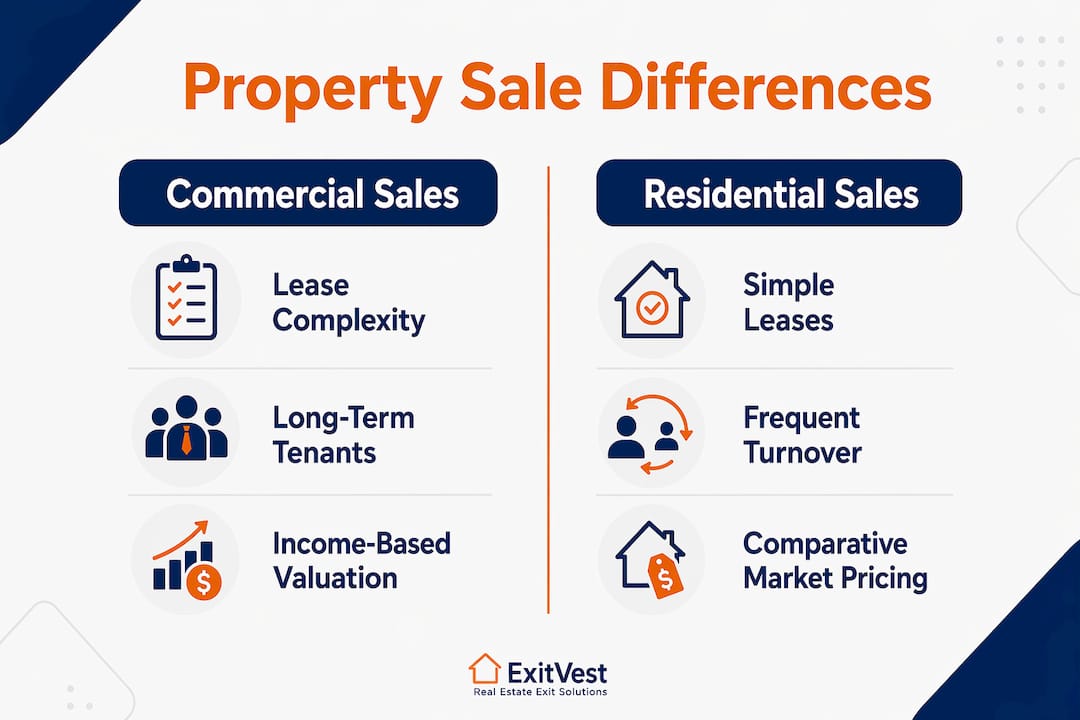
- Leases: Residential leases run about a year; commercial leases often span multiple years and frequently use triple-net structures that shift expenses to tenants.
- Disclosure: Residential sellers must disclose known defects by law; commercial sellers operate largely under caveat emptor, or "buyer beware."
- Timeline: Residential sales typically close in 30–60 days; commercial transactions routinely take 3–6 months or longer.
- Buyer profile: Residential buyers are individuals or families; commercial buyers are investors or businesses analyzing income potential and return on investment.
How lease structures and tenant expenses shape commercial vs residential sales
Lease terms are one of the most consequential differences between these two property types, and they directly affect how a property is priced and marketed when it goes up for sale.
Residential leases are straightforward. A standard 12-month gross lease has the landlord covering property taxes, insurance, and most maintenance. Tenants pay rent plus utilities. Turnover is frequent, and the landlord absorbs most operating costs regardless of occupancy.
Commercial leases work very differently. Triple-net leases push property taxes, insurance, and maintenance costs onto the tenant, which reduces the landlord's out-of-pocket expenses but also means the lease terms themselves become a core part of the property's value proposition. A buyer purchasing a commercial property is essentially buying the lease as much as the building.
Common commercial lease types include:
- Single-net lease: Tenant pays base rent plus property taxes.
- Double-net lease: Tenant covers taxes and insurance; landlord handles maintenance.
- Triple-net (NNN) lease: Tenant pays taxes, insurance, and maintenance. Most favorable for passive investors.
- Gross lease: Landlord covers all operating expenses. Less common in commercial deals.
- Modified gross lease: Expenses split between landlord and tenant by negotiation.
Tenant stability also differs sharply. Commercial tenants, particularly those on long-term NNN leases, tend to stay put because relocating a business is expensive. That stability translates to predictable income, which buyers price into their offers. Residential landlords, by contrast, face annual turnover cycles that create recurring vacancy risk and re-leasing costs.
What management and maintenance look like on each side
Day-to-day management demands differ considerably between residential and commercial properties, and those differences carry real weight when you are preparing to sell.

Residential properties require active, hands-on management. Tenant turnover happens often, sometimes every year, which means repeated screening, lease renewals, move-in inspections, and repair calls. Landlord-tenant law in most U.S. states is protective of residential tenants, adding regulatory complexity around security deposits, habitability standards, and eviction procedures.
Commercial properties generally involve less day-to-day landlord intervention, especially under net lease structures where tenants manage their own space. A business tenant in a retail strip or office building typically handles interior maintenance, cleaning, and minor repairs as part of the lease agreement. The landlord's role shrinks to structural upkeep and common-area management.
Key contrasts in management responsibility:
- Residential: Landlord handles appliance repairs, pest control, HVAC servicing, and habitability compliance.
- Commercial (gross lease): Landlord covers most operating expenses, similar to residential.
- Commercial (NNN lease): Tenant handles taxes, insurance, and maintenance; landlord's obligations are minimal.
- Vacancy impact: A vacant residential unit loses one rent check; a vacant commercial space can eliminate all income from a building for months.
For sellers, this matters because a well-managed commercial property with long-term tenants in place commands a premium. Buyers see lower management overhead and predictable cash flow. A residential rental with high turnover and deferred maintenance, on the other hand, signals risk and often requires price concessions.
Pro Tip: If you are preparing a commercial property for sale, get estoppel certificates from all tenants confirming lease terms, rent amounts, and any outstanding disputes. Buyers will ask for them, and having them ready shortens the due diligence period.
Valuation methods and risk profiles in commercial versus residential sales
The way a property gets priced is where the two markets diverge most fundamentally, and understanding this distinction is critical whether you are buying or selling.

Residential valuation relies on the sales-comparison approach. An appraiser finds recent sales of similar homes in the same area, adjusts for differences in size, condition, and features, and arrives at a market value. Emotion plays a real role here. A well-staged home in a desirable school district can sell above its appraised value because buyers are making a lifestyle decision, not just a financial one.
Commercial valuation is almost entirely income-driven. The formula is: Value = NOI ÷ Cap Rate. A property generating $300,000 in annual net operating income at a 6% cap rate is worth $5 million. Buyers do not care how the lobby looks if the numbers do not work. As one example from LegalClarity, a warehouse generating $200,000 in annual net income at a 7% cap rate would be valued at roughly $2.86 million.
Risk profiles also split along these lines:
- Residential risks: Interest rate sensitivity, local housing demand shifts, and tenant non-payment. Generally lower volatility and faster recovery.
- Commercial risks: Tenant vacancy, economic downturns reducing business demand, lease rollover risk, and environmental liability. Higher capital at stake, lower liquidity.
- Liquidity gap: Residential properties sell faster and attract a broader buyer pool. Commercial properties have a smaller investor pool and longer marketing periods due to high capital requirements.
Tenant quality and lease length directly affect commercial pricing. A property with a national credit tenant on a 10-year NNN lease trades at a lower cap rate (higher price) than the same building with a local tenant on a month-to-month arrangement. The income stream's reliability is the asset.
Legal differences and disclosure obligations sellers need to understand
The legal frameworks governing residential and commercial sales are not just different in degree. They are different in kind, and sellers who cross from one to the other without understanding this often get caught off guard.
Residential sellers carry an affirmative duty to disclose known material defects. Every U.S. state has its own disclosure form, but the principle is consistent: if you know about a leaky roof, foundation cracks, or a history of flooding, you must tell the buyer. Failure to disclose can result in rescission of the sale or a lawsuit after closing.
Commercial sellers operate under caveat emptor. The burden shifts almost entirely to the buyer to investigate the property's condition, zoning compliance, environmental status, and lease obligations. Sellers are not required to volunteer information about defects, though they cannot actively misrepresent facts.
Other legal distinctions worth knowing:
- Contracts: Residential transactions use standardized state-approved forms. Commercial contracts are custom-negotiated documents with bespoke representations, warranties, and contingencies.
- Entity sales: Commercial deals sometimes transfer ownership of an LLC holding the property rather than the property itself. This means the buyer inherits all of the entity's liabilities, requiring a full legal and financial audit.
- Time-is-of-the-essence clauses: Commercial contracts frequently include strict deadline language. Miss a due diligence deadline and the contract can terminate automatically.
- Environmental contingencies: Phase I environmental assessments are standard in commercial due diligence. Residential buyers rarely encounter this requirement.
- Zoning review: Commercial buyers verify that the property's current use is legally permitted and that any planned changes are achievable under local zoning codes.
For residential sellers with code violations or disclosure concerns, understanding your state's specific requirements is non-negotiable. Exitvest works with sellers in exactly these situations, including properties with code violations in New Jersey where disclosure rules can be particularly detailed.
Sales process complexity, timeline, and who actually buys each property type
The gap in transaction complexity between residential and commercial sales is wide, and it shows up most clearly in how long deals take and who is sitting across the table.
Residential sales move quickly by design. A typical transaction closes in 30–60 days from contract to closing. The lender drives most of the timeline, ordering an appraisal, processing underwriting, and delivering the Closing Disclosure at least three business days before signing. Buyers are usually individuals or families motivated by location, school districts, and how the home feels to live in.
Commercial sales are a different process entirely. Commercial sales routinely take 3–6 months or longer to close, reflecting the detailed due diligence and financing steps involved. The due diligence period alone can run 30–45 days, covering environmental assessments, ALTA surveys, tenant estoppel collection, and zoning review. Financing adds another 30–45 days because commercial lenders underwrite the property's financials, not just the borrower's credit score.
Key contrasts in the sales process:
- Buyer motivation: Residential buyers respond to emotional appeal and lifestyle fit; commercial buyers run spreadsheets and focus on cap rates, lease terms, and projected returns.
- Marketing channels: Residential listings go on the MLS and consumer-facing platforms. Commercial listings target investor networks, commercial brokers, and specialized databases.
- Negotiation style: Residential negotiations often hinge on price and repairs. Commercial negotiations cover price, lease assignments, rent adjustments, seller financing, and representations about income.
- Earnest money: Residential buyers typically deposit a small refundable earnest money amount. Commercial earnest money often becomes non-refundable in stages as transaction milestones pass.
- Auction use: Distressed commercial properties are more frequently sold at auction than residential homes, reflecting the smaller buyer pool and need for price discovery.
Understanding why cash buyers are drawn to apartment buildings and commercial assets comes down to this complexity. Cash removes the financing contingency and shortens the timeline dramatically, which is why sellers of commercial properties often accept a lower price for a cash offer.
How U.S. market definitions and financing shape commercial and residential sales
The 5-unit threshold is not arbitrary. It marks the point where federal financing programs stop applying, and that single line changes everything about how a property is bought, sold, and valued.
Properties with 1–4 units qualify for government-backed financing through Fannie Mae and Freddie Mac, with conforming loan limits, standardized underwriting under TILA/Reg Z, and typical down payments of 15–25%. These loans are widely available, competitively priced, and familiar to most buyers. That broad access is a major driver of residential liquidity.
Cross into 5+ units or non-residential use, and the financing landscape changes completely. Commercial loans require 25–35% down payments, carry variable rates with shorter fixed periods, and often include balloon payments. Products like CMBS (Commercial Mortgage-Backed Securities) and portfolio loans replace the standardized residential mortgage. Underwriting focuses on the property's income, not just the borrower's credit score.
What this means in practice:
- Buyer pool size: Residential properties attract a large pool of owner-occupants and investors. Commercial properties draw a narrower group of qualified investors with the capital and expertise to navigate complex financing.
- Loan terms: Residential buyers often lock in 30-year fixed rates. Commercial borrowers typically face 5–10 year fixed periods with amortization schedules of 20–25 years, followed by a balloon payment.
- Valuation shift: As financing moves from standardized to bespoke, valuation shifts from sales comps to income capitalization. Cap rates become the primary pricing language.
- Sales strategy: Sellers of commercial properties need to present clean financials, current rent rolls, and lease abstracts to give buyers the data they need to underwrite the deal.
Pro Tip: Before listing a commercial property, prepare a full rent roll, trailing 12-month operating statements, and copies of all leases. Buyers and their lenders will request these immediately, and delays in producing them stall deals.
For sellers navigating the financing gap between residential and commercial, understanding commercial loan rate differences is a useful starting point, particularly in markets like Florida where rate spreads between the two categories can be significant.
Tax implications specific to commercial vs residential property sales
Tax treatment is another area where the two property types diverge in ways that can meaningfully affect net proceeds.
Capital gains: Residential sellers who have lived in a home as their primary residence for at least 2 of the last 5 years can exclude up to $250,000 in capital gains ($500,000 for married couples filing jointly) under IRS Section 121. Commercial property sellers get no such exclusion. Every dollar of gain is taxable.
Depreciation recapture: Both property types allow depreciation deductions during ownership, but the recapture rules differ. Residential rental property depreciates over 27.5 years; commercial property depreciates over 39 years. When you sell, the IRS recaptures depreciation at a rate of up to 25% for real property. Commercial sellers with years of accumulated depreciation often face a substantial recapture bill at closing.
1031 exchanges: Both residential investment properties and commercial properties qualify for a 1031 exchange, which defers capital gains taxes by rolling proceeds into a like-kind replacement property. The rules are the same, but commercial deals benefit more in practice because the gains and depreciation recapture amounts are typically larger. The qualified intermediary must be in place before closing, and the replacement property must be identified within 45 days and closed within 180 days.
State and local taxes: Many states impose transfer taxes or documentary stamp taxes on real estate sales. Commercial transactions, with their higher sale prices, generate proportionally larger tax bills. Some states also impose additional taxes on entity sales used in commercial deals, since the transaction technically transfers LLC membership interests rather than real property.
Net Investment Income Tax (NIIT): Sellers with modified adjusted gross income above $200,000 (single) or $250,000 (married filing jointly) owe an additional 3.8% NIIT on net investment income, which includes gains from investment property sales. This applies to both property types but hits commercial sellers harder given the larger typical gain amounts.
Understanding these tax differences before you list is not optional. The difference between a well-planned exit and an unexpected tax bill can be tens of thousands of dollars, sometimes more. Consulting a CPA or tax attorney who specializes in real estate transactions before signing a listing agreement is money well spent.
Key Takeaways
Commercial and residential property sales follow fundamentally different rules across financing, valuation, legal obligations, and timeline, and sellers who treat them as interchangeable risk costly mistakes.
| Point | Details |
|---|---|
| Classification threshold | Properties with 1–4 units are residential; 5+ units or non-residential use is commercial, determining which financing and legal rules apply. |
| Financing gap | Residential loans require 15–25% down with federal backing; commercial loans demand 25–35% down with custom underwriting and no standardization. |
| Valuation method | Residential value comes from comparable sales; commercial value is NOI divided by cap rate, making income the primary pricing driver. |
| Disclosure obligations | Residential sellers must disclose known defects by law; commercial sellers operate under caveat emptor, shifting investigation burden to the buyer. |
| Transaction timeline | Residential sales typically close in 30–60 days; commercial deals routinely take 3–6 months or longer due to due diligence, financing, and lease complexity. |
Exitvest can help you move forward, whatever the property type
Whether you are sitting on a small apartment building, a piece of land, or a house you need to sell fast, Exitvest makes the process straightforward. We buy properties as-is, with no repairs required, no agent commissions, and no pressure. Our team works with sellers facing foreclosure, inherited properties, problem tenants, financial pressure, and everything in between. We operate nationwide, with deep roots in New Jersey, Texas, Florida, and Tennessee.
If you are ready to skip the uncertainty of a traditional listing, get a cash offer from Exitvest and close on your timeline.