

A fast inherited property sale is a cash transaction completed within 7–14 days after probate is granted, giving heirs a direct path out of a lengthy, costly estate process. The industry term for this is a probate cash sale, and understanding how it works legally and financially is the first step toward making a confident decision. Probate must be completed before any sale can legally close, but you can market the property and agree on a price while probate is still in progress. Executors, beneficiaries, and cash buyers are the three key players in every fast inherited property sale explained below.
What legal steps must be completed before a fast inherited property sale?
The Grant of Probate is the legal document that authorizes an executor to sell inherited property. Without it, no sale can legally complete. This single requirement shapes every timeline in the process.

The good news is that marketing during probate is allowed. You can list the property, accept an offer, and negotiate terms before the grant arrives. Once probate is granted, closing can happen almost immediately. This approach compresses the overall timeline significantly compared to waiting until after probate to start marketing.
The legal requirements differ depending on how the estate is structured:
- Probate estate: The executor must obtain the Grant of Probate before legal completion. This process typically takes several weeks to a few months.
- Living trust: Property held in a living trust bypasses probate entirely. The trustee can sell directly, which removes the main bottleneck.
- Joint tenancy: Property passes automatically to the surviving owner, again skipping probate.
Beyond probate, you will need to gather several documents before closing:
- Death certificate and will (or letters of administration if no will exists)
- Title deeds or title search confirming ownership
- Any mortgage statements showing outstanding balances
- Notifications to managing agents if the property is leasehold
Pro Tip: Start the probate application the same week you begin gathering sale documents. Running both processes in parallel is the single most effective way to cut weeks off your timeline.
Estate attorneys consistently recommend early legal preparation to clear titles and confirm sale authority before a buyer is even found. Delays at closing almost always trace back to paperwork that could have been prepared months earlier.
How does a fast cash sale compare to a traditional listing?
The core trade-off in any quick inherited property sale is speed and certainty versus maximum sale price. Both paths are legitimate. The right choice depends on your financial pressure, family situation, and the condition of the property.
Timeline and cost comparison
| Factor | Cash sale | Traditional listing |
|---|---|---|
| Time to close | 7–14 days after probate | 60–120+ days after probate |
| Agent commission | None | Typically 5–6% of sale price |
| Repair costs | None (sold as-is) | Often $10,000–$40,000+ |
| Certainty of closing | Very high | Moderate (buyer financing can fall through) |
| Sale price | 73–85% of market value | Closer to full market value |
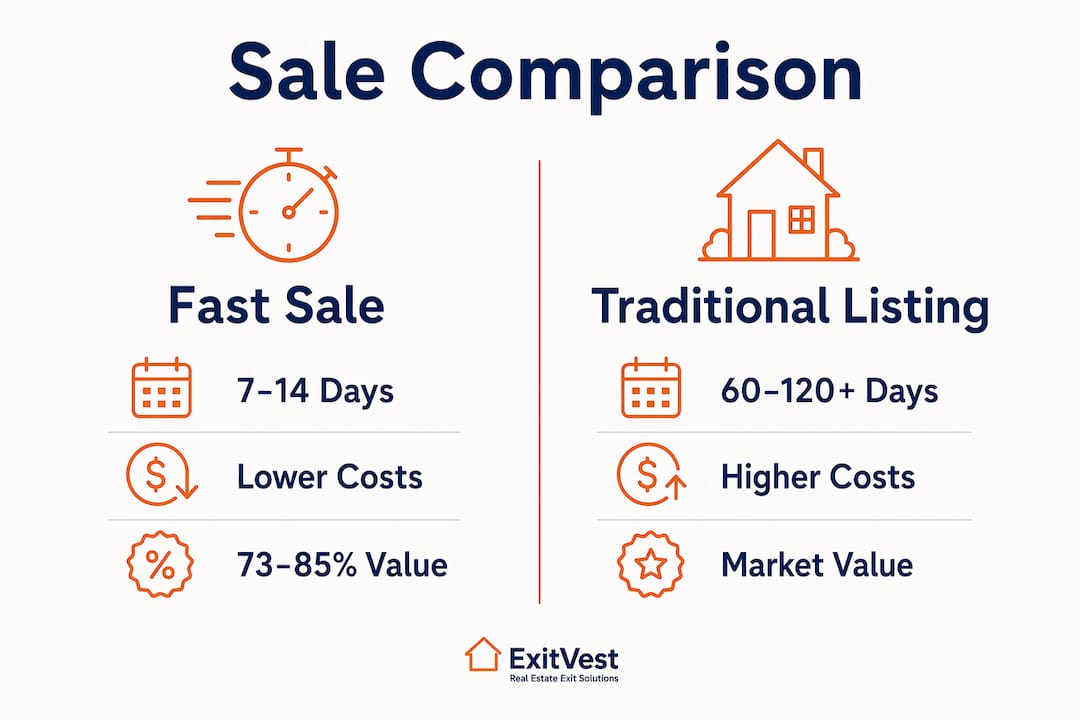
Cash sales close faster and cost less to execute, but they typically offer below market value. That gap is the price of speed and certainty.
A cash offer typically ranges from 73–85% of open market value. Cash buyers price in renovation costs, holding costs, and their own profit margin. For a property worth $300,000, that means an offer in the $220,000–$255,000 range. That is a real discount, but it must be weighed against what a traditional listing actually costs in time, commissions, repairs, and carrying costs.
Fast cash sales eliminate holding costs like maintenance, insurance, and ongoing tax liabilities that accumulate during long probate periods. On a vacant property, those monthly costs add up fast and quietly erode the advantage of waiting for a higher offer.
The strongest case for a cash sale is when the property needs significant repairs, when multiple beneficiaries need funds quickly, or when inheritance tax deadlines are approaching. The strongest case for a traditional listing is when the property is in good condition, the estate has no urgent financial pressure, and the beneficiaries agree on a patient strategy.
Pro Tip: Get at least two or three cash offers before accepting one. Cash buyer offers on the same property can vary by 10–15%, and the process of getting multiple quotes costs you nothing but a few phone calls.
What tax implications make a fast sale beneficial for executors?
Inheritance tax creates a hard deadline that many heirs underestimate. Inheritance tax must be paid within six months of the date of death. Miss that deadline and interest starts accruing on the unpaid balance. That interest compounds the financial pressure on the estate.
Here is how the tax timeline affects your sale decision:
- Month 1–2: Probate application is filed. The estate's assets are inventoried and valued. Inheritance tax liability is calculated.
- Month 3–4: Probate is typically granted. This is the window to begin marketing the property if you have not already.
- Month 5–6: The six-month deadline approaches. If the estate owes inheritance tax and the property has not sold, the executor faces a choice: pay from other estate funds, borrow against the estate, or accelerate the sale.
- Month 7+: Interest begins accruing on any unpaid inheritance tax. Every additional month increases the estate's liability.
A quick sale generates proceeds that can settle the tax bill before interest kicks in. This is one of the clearest financial arguments for choosing speed over maximum price. Paying 5–6% less on a sale price is often far cheaper than months of accruing interest on a six-figure tax bill.
Executors also carry a legal duty to act in the best interests of all beneficiaries. When accepting a below-market cash offer to meet a tax deadline or avoid carrying costs, that decision must be documented with clear rationale. A written record showing the tax deadline, the cost of delay, and the offers received protects the executor from future disputes.
Pro Tip: Ask your estate attorney to prepare a one-page summary of the estate's tax liability and monthly carrying costs. Sharing this document with all beneficiaries before accepting any offer prevents the most common source of family conflict in inherited property sales.
What practical steps help you execute a quick inherited property sale?
Preparation before probate is granted is what separates a 14-day closing from a 90-day one. Executors who treat the pre-probate period as active work time consistently close faster. Here is how to approach it:
Conduct a property inspection and valuation early
Order a professional valuation as soon as possible after the owner's death. This gives you a realistic price anchor for negotiating with cash buyers and satisfies probate court requirements. Document the property's condition with photos and a written inspection report.
Communicate clearly with all beneficiaries
Every beneficiary has a stake in the sale outcome. Hold a single group meeting or call to align on the sale strategy before approaching buyers. Disagreements discovered mid-sale cause delays that are entirely avoidable. Confirm in writing that all parties understand and accept the chosen approach.
Negotiate with cash buyers and document everything
When you receive a cash offer, do not accept the first number. Request a written breakdown of how the buyer calculated their offer. Compare it against your professional valuation. If the gap is larger than 20%, ask for justification or seek a competing offer.
Executors must justify fast sale decisions with documented evidence of tax burdens, maintenance costs, or other financial pressures. Keep every email, every offer letter, and every cost estimate in a single file.
Prepare for closing: title clearance and notifications
Clear title issues early and confirm your authority to sell before a buyer is under contract. Notify all relevant parties, including mortgage lenders, utility companies, and managing agents for leasehold properties. Unresolved title issues are the most common cause of last-minute closing delays in inherited property sales.
Pro Tip: If the property has a mortgage, contact the lender during probate to confirm the payoff amount and the process for releasing the lien at closing. Lenders have their own timelines, and waiting until closing day to start that conversation can add weeks.
Key takeaways
A fast inherited property sale succeeds when executors complete legal preparation during probate, choose the right sale method for the estate's financial position, and document every decision to protect all beneficiaries.
| Point | Details |
|---|---|
| Probate is the legal prerequisite | No sale can legally close without the Grant of Probate, but marketing can begin before it arrives. |
| Cash sales close in 7–14 days | Traditional listings take 60–120+ days and carry agent fees, repair costs, and financing risk. |
| Tax deadlines drive urgency | Inheritance tax is due within six months of death; interest accrues on any unpaid balance after that. |
| Cash offers are 73–85% of market value | That discount reflects renovation costs and buyer risk, not a low-ball tactic. |
| Documentation protects executors | Written rationale for below-market sales prevents legal disputes with beneficiaries. |
Why speed and duty are not opposites in inherited property sales
Executors often feel caught between two pressures: moving fast enough to meet tax deadlines and protect the estate, and moving carefully enough to honor their legal duty to every beneficiary. My experience is that these two goals are far more compatible than most people realize.
The mistake I see most often is treating the sale decision as a single moment rather than a process. Executors who start legal preparation early, communicate with beneficiaries before accepting any offer, and document their reasoning at every step can move quickly and fulfill their duty. Speed without documentation is the real risk, not speed itself.
Accepting a cash offer at 78% of market value is entirely defensible when the alternative is three more months of carrying costs, accruing interest on a tax bill, and a contested family process. What makes it defensible is the paper trail. A one-page memo showing the tax deadline, the monthly holding costs, and the three offers you received is worth more than any legal opinion after the fact.
The families I have seen struggle most are the ones who avoided the hard conversation with beneficiaries until a buyer was already waiting. That sequence creates pressure, resentment, and sometimes litigation. The families who moved fastest and with the least conflict were the ones who aligned early, even when the news was not what everyone hoped for.
If you are an executor facing a complex estate, treat transparency as your primary tool. It is faster than litigation and cheaper than delay.
— Alek
How Exitvest can help you sell an inherited property fast
Inheriting a property is already a lot to manage. Exitvest removes the hardest parts of the sale process so you can focus on settling the estate.

Exitvest makes fair cash offers on inherited houses, land, and small apartment buildings with no repairs required, no agent commissions, and no hidden fees. Closings can happen in as little as seven days after probate is granted, and Exitvest works around your timeline if you need more flexibility. Exitvest buys properties nationwide, with a strong focus on New Jersey, Texas, Florida, and Tennessee. If you are an executor or heir looking for a straightforward way to resolve an inherited property quickly and fairly, Exitvest is built for exactly that situation.
FAQ
What is a fast inherited property sale?
A fast inherited property sale is a cash transaction that closes within 7–14 days after the Grant of Probate is issued. It bypasses the traditional listing process, agent commissions, and repair requirements.
Can you sell an inherited property before probate is complete?
You can market the property and agree on a price during probate, but the sale cannot legally complete until the Grant of Probate is received. Starting marketing early is the most effective way to speed up the process.
How much less do cash buyers pay for inherited properties?
Cash offers typically range from 73–85% of open market value. The discount reflects renovation costs, holding costs, and buyer risk priced into the offer.
Why does inheritance tax create urgency to sell quickly?
Inheritance tax is due within six months of the date of death. After that deadline, interest accrues on the unpaid balance, increasing the estate's total liability with every passing month.
Does an executor have to accept the highest offer on an inherited property?
An executor must act in the best interests of all beneficiaries, but that does not always mean accepting the highest offer. A lower cash offer that closes quickly and avoids carrying costs can be the better financial outcome, provided the decision is documented with clear rationale.