

Selling an inherited house without probate delay is possible through specific legal paths, including joint tenancy with rights of survivorship, living trusts, transfer-on-death deeds, and streamlined processes like summary administration. Probate is the court-supervised process of validating a will and authorizing asset transfers. Probate delay is what happens when that process stalls a sale for months or years. The good news is that several legal mechanisms let you transfer title and close a sale before or entirely outside of full probate. Understanding which path applies to your property, your state, and your documentation situation is what separates a fast sale from a two-year wait.
What legal methods let you sell an inherited house without probate delay?
Four primary legal mechanisms allow heirs to sell inherited property without waiting through full probate administration. Each has specific prerequisites, and choosing the wrong one wastes time.
| Method | How it works | Best for |
|---|---|---|
| Joint tenancy with survivorship | Title transfers automatically at death, no court needed | Co-owned property |
| Living trust | Property held in trust passes directly to beneficiary | Pre-planned estates |
| Transfer-on-death deed | Deed names beneficiary who takes title at death | Single-owner property |
| Summary administration | Streamlined court process for qualifying small estates | Estates under value threshold |
Joint tenancy with rights of survivorship is the fastest method. When the deceased co-owned the property with another person under this title structure, ownership transfers to the surviving owner automatically. No court filing is required. The surviving owner records an affidavit of survivorship and a certified death certificate with the county recorder, and the title is clean.

Living trusts keep property out of probate entirely. If the deceased placed the home in a revocable living trust, the successor trustee named in the trust document can sell the property without any court involvement. This is one of the most effective pre-death planning tools for heirs who want a fast sell of an inherited home.
Transfer-on-death deeds, available in about half of U.S. states including Texas, Florida, and New Jersey, work similarly. The deed names a beneficiary who receives title automatically at the owner's death. The beneficiary records the deed and death certificate, then proceeds to sell.
Summary administration is the probate-exempt option when the estate does qualify for court involvement but on a compressed timeline. Florida's summary administration, for example, resolves in 2 to 4 months and as of July 1, 2026, applies to estates with non-exempt assets under $150,000. That threshold increase makes more estates eligible, which means faster closings for more Florida heirs.
Pro Tip: If you are unsure which method applies to your property, pull the current deed from the county recorder's office first. The vesting language on that deed tells you immediately whether joint tenancy, a trust, or full probate governs the transfer.
What documents do you need to sell quickly?
Document readiness is the single biggest factor separating a 30-day close from a 6-month delay. Title companies pause underwriting the moment a required document is missing, and missing court-issued authority can freeze a deal entirely. Gather these before you list or accept any offer.
Core documents every inherited property sale requires:
- Certified death certificate. Order at least four certified copies from the county vital records office. Title companies, banks, and buyers each keep one.
- Letters testamentary or letters of administration. These are court-issued documents proving the executor or personal representative has legal authority to sell. In New York, physical or certified copies are required before any closing can proceed. Letters testamentary are typically valid about six months and often need refreshing before closing if time has passed.
- The probated will or trust document. Buyers and title companies need to confirm the chain of authority from the deceased to the seller.
- Executor's deed or personal representative's deed. The signing executor must sign in their representative capacity, written as "Personal Representative of the Estate of [Name]," to avoid personal liability.
- Chain of title confirmation. A title search verifies that no liens, competing claims, or unresolved ownership gaps exist. In North Carolina, heirs can sell using an heirs' deed after two years of no probate, but only when the title work confirms the heirs and the buyer's title company accepts it.
- Estate filings and tax clearance. Some states require proof that estate taxes or creditor claims have been addressed before a deed can transfer.
Working with a real estate attorney at closing is not optional when inherited property is involved. They verify that your authority documents are current, that the deed is signed correctly, and that the title company has everything it needs before the closing date.
Pro Tip: Order letters testamentary the same week you decide to sell, not after you find a buyer. Probate courts can take weeks to issue them, and a buyer will not wait.
Step-by-step process to sell an inherited property fast
A structured sequence prevents the most common delays. Follow these steps in order to execute an expedited house sale process.
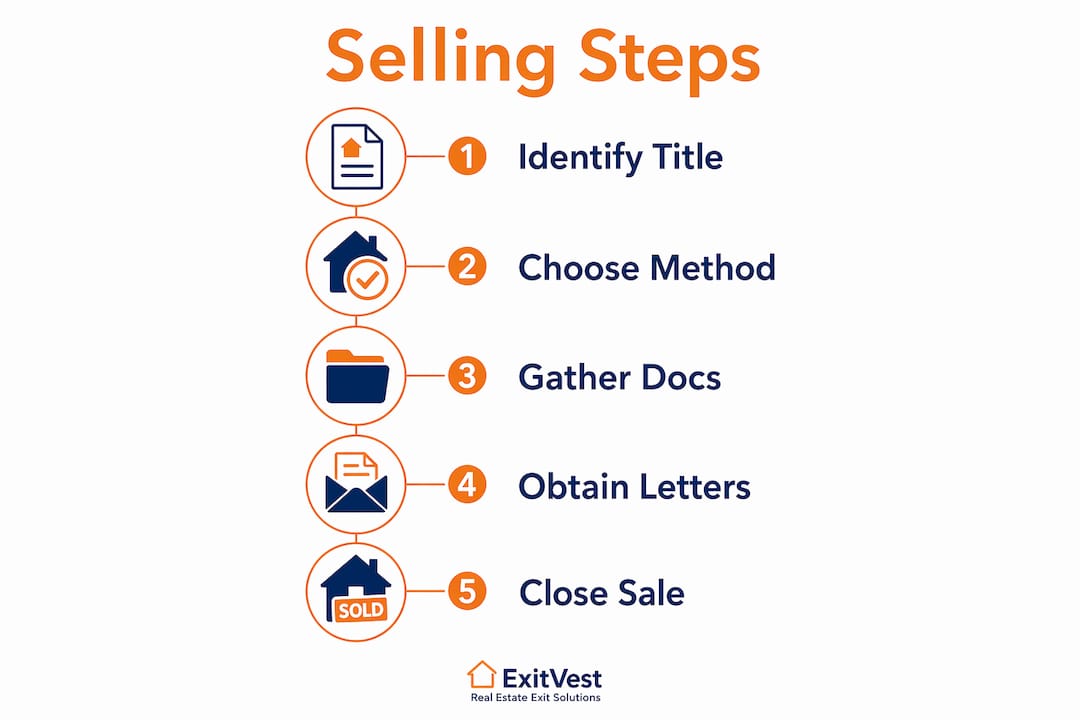
- Pull the current deed. Confirm how title is vested. Joint tenancy, trust, or sole ownership each triggers a different legal path.
- Identify the correct transfer method. Use the table in the first section to match your situation to the right mechanism. If full probate is unavoidable, determine whether summary administration or a simplified small estate process qualifies.
- Order death certificates and initiate letters testamentary immediately. Do not wait. Texas probate experts consistently identify delayed document assembly as the primary cause of year-long probate sales. Front-loading this step compresses the timeline significantly.
- Hire a probate real estate attorney. They confirm your legal authority, prepare the correct deed type, and coordinate with the title company. This is not a cost to skip.
- Order a title search. Identify any liens, unpaid taxes, or competing claims before you list. Surprises at closing kill deals.
- Target cash buyers. Cash buyers, including direct buyers like Exitvest, do not require mortgage underwriting, which removes one of the biggest closing delays. They also tend to be familiar with probate documentation requirements, which reduces back-and-forth with the title company.
- Coordinate closing logistics with the title company early. Share your authority documents before the closing date. Title companies that receive documents in advance can complete underwriting ahead of time, allowing same-week closings once a contract is signed.
The difference between a 3-week close and a 6-month ordeal almost always comes down to steps 3 and 7. Document readiness and early title company coordination are the two levers you control most directly.
Common mistakes that cause delays when selling an inherited house
Knowing what goes wrong is as useful as knowing what to do right. These are the mistakes that most reliably derail an inheritance property quick sale.
- Trying to sell before legal authority is established. No title company will close a sale if the executor has not been formally appointed and issued letters testamentary. Signing a contract before you have this authority wastes everyone's time and can expose you to personal liability.
- Letting letters testamentary expire. Letters are typically valid for about six months. If your sale takes longer than expected, you may need to return to probate court for a refreshed copy. Missing this detail stalls closings at the last minute.
- Ignoring estate debts and creditor claims. Estate proceeds must cover creditor claims and administration costs before heirs receive anything. Selling without accounting for these obligations can result in legal disputes over proceeds distribution and delay final payment to heirs.
- Assuming every buyer or title company accepts the same documentation. Some buyers refuse to close without a probated will, a court sale order, or executor's authority even when state law does not strictly require it. Confirm your buyer's title company requirements before signing a contract.
- Skipping chain of title verification. Selling without confirming all heirs and resolving any competing ownership claims creates post-sale title challenges that can unwind the deal or result in litigation.
- Choosing the wrong probate path. As Texas probate attorneys note, mismatched legal strategies are a leading cause of multi-year delays. Choosing between independent administration, summary administration, or a muniment of title requires professional guidance, not guesswork.
The biggest inherited property sales mistakes are not legal errors. They are preparation errors. Heirs who gather documents before listing close in weeks. Heirs who gather documents after accepting an offer close in months, if at all.
Key takeaways
Selling an inherited house without probate delay requires matching the correct legal transfer method to your property's title structure, assembling authority documents before listing, and working with cash buyers and title professionals who understand probate requirements.
| Point | Details |
|---|---|
| Match the transfer method to title | Joint tenancy, living trusts, and transfer-on-death deeds each bypass full probate when properly structured. |
| Front-load document preparation | Order letters testamentary and death certificates before listing, not after accepting an offer. |
| Letters testamentary expire | Refresh letters testamentary if more than six months have passed since issuance to avoid closing delays. |
| Cash buyers close faster | Cash buyers skip mortgage underwriting and are more familiar with probate documentation requirements. |
| State rules vary significantly | Florida summary administration now covers estates up to $150,000; North Carolina allows heirs' deeds after two years of no probate. |
What I've learned from watching inherited sales go sideways
Most inherited property sales do not fail because of legal complexity. They fail because heirs underestimate how much preparation is required before the first showing. I have seen sellers accept strong cash offers only to watch the deal collapse three weeks later because letters testamentary had expired or the title company flagged an unresolved lien from 1998. The buyer moved on. The seller spent another two months in probate court.
The counterintuitive truth is that selling an inherited house fast requires more upfront work, not less. The heirs who close quickest are the ones who spent two weeks before listing pulling documents, ordering title searches, and confirming their legal authority. By the time they accept an offer, the title company has everything it needs.
I also think heirs undervalue the importance of choosing the right buyer. A retail buyer with a conventional mortgage introduces underwriting timelines, appraisal contingencies, and lender requirements that have nothing to do with probate but add weeks to the process. A cash buyer who regularly purchases inherited property understands the documentation, works with probate-experienced title companies, and can close on a timeline that fits the estate's needs. For selling inherited property in Texas, for example, working with a buyer who knows Texas independent administration rules is a material advantage.
One more thing worth saying plainly: do not try to navigate this alone. A probate real estate attorney costs a few hundred to a few thousand dollars. The cost of a delayed or failed sale, including carrying costs, property taxes, insurance, and potential creditor claims, is almost always higher.
— Alek
Sell your inherited house fast and as-is with Exitvest
If you have inherited a property and want to sell without the uncertainty of a traditional listing, Exitvest buys houses directly for cash, as-is, with no repairs required and no pressure. You pick the closing timeline that works for your estate.

Exitvest works specifically with heirs, executors, and personal representatives navigating inherited property sales across New Jersey, Texas, Florida, and Tennessee, as well as nationwide. The team understands probate documentation requirements and works with title professionals who handle estate sales regularly. See how the process works or explore the situations Exitvest handles to find out whether a cash offer fits your timeline and needs.
FAQ
Can you sell an inherited house before probate closes?
Yes, in some cases. If the property was held in a living trust, under joint tenancy with rights of survivorship, or via a transfer-on-death deed, you can sell without waiting for probate to close at all. If full probate is required, some states allow a sale before the estate closes once the executor has court-issued authority.
What are letters testamentary and why do you need them?
Letters testamentary are court-issued documents that prove an executor has legal authority to manage and sell estate assets. Banks, title companies, and buyers require current certified copies before any sale can close, and they are typically valid for about six months.
How long does Florida summary administration take?
Florida summary administration typically resolves in 2 to 4 months, making it significantly faster than full probate administration. As of July 1, 2026, the non-exempt asset threshold increased to $150,000, expanding eligibility for more estates.
Do all buyers accept inherited property without full probate?
No. Some buyers and title companies require a probated will, executor's authority, or a court sale order even when state law permits a simpler transfer. Confirm your buyer's title company requirements before signing any contract.
What is the fastest way to sell an inherited house?
The fastest path combines a probate-exempt transfer method (living trust, joint tenancy, or transfer-on-death deed) with a cash buyer who understands estate sales. Gathering all authority documents before listing and coordinating early with a title company reduces closing time to as little as two to three weeks in straightforward cases.