

Selling a property with a non-paying tenant is legally permissible, but it demands careful handling to avoid financial loss and post-sale lawsuits. The industry term for this situation is "distressed tenancy sale," and it covers every scenario where rent arrears, active eviction proceedings, or tenant non-cooperation complicate a property transfer. Tenant-occupied properties sell at a 5–15% discount compared to vacant ones, with rent-controlled units seeing discounts above 20%. Your path forward depends on three factors: your legal obligations as a landlord, the negotiation options available before formal eviction, and the type of buyer you target.
What are your legal rights when selling property with a non-paying tenant?
Your rights as a landlord are real, but they come with firm boundaries set by state law. You can sell your property at any time, even with a non-paying tenant in place. What you cannot do is ignore the tenant's legal protections or hide the situation from buyers.

Notice requirements vary by state. State-specific "pay or quit" notices range from 3 to 14 days before you can file for eviction. Filing too early causes automatic court dismissal, which resets your timeline and adds cost. States like California, New Jersey, and Florida each have distinct notice periods, so confirm your state's requirement before taking any action.
Disclosure is non-negotiable. A non-paying tenant is a material fact that must be disclosed to any prospective buyer. Hiding active rent arrears or an ongoing eviction proceeding exposes you to post-sale fraud claims. That liability can cost far more than any price reduction you were trying to avoid.
Key legal boundaries every landlord must respect:
- No self-help eviction. Changing locks, removing belongings, or cutting utilities to force a tenant out is illegal in every U.S. state. Courts impose penalties and it delays your sale.
- Lease transfers with the property. If the tenant has an active lease, the buyer inherits it. Month-to-month tenancies give you more flexibility.
- Proper notice for showings. Most states require 24 to 48 hours of written notice before entering the property for showings or inspections.
- Eviction proceedings must be disclosed. Any active unlawful detainer action is a material fact that buyers and their title companies will discover anyway.
Pro Tip: Document every communication with your tenant in writing from the moment rent goes unpaid. Texts, emails, and certified mail receipts become critical evidence if the case reaches court.
How can cash-for-keys agreements speed up the process?
A cash-for-keys agreement is a voluntary deal where you pay the tenant a lump sum to vacate the property by a set date. It is the fastest legal method for removing a non-paying tenant without a court battle. Cash-for-keys deals can close in 2–4 weeks and cost less than formal eviction, saving landlords $3,500–$10,000 in legal fees and lost rent.
The math is straightforward. Every month a non-paying tenant stays, you lose rental income and delay your sale. A cash payment that gets the tenant out in three weeks is almost always cheaper than three months of court proceedings. Cash-for-keys buyouts average around $25,000 in Los Angeles in high-cost markets, but in most U.S. markets the figure runs between $4,000 and $10,000. Your local rental market and the tenant's situation determine the right number.
How to structure a cash-for-keys negotiation:
- Start with a written offer. State the amount, the required move-out date, and the condition you expect the property to be left in. Verbal agreements are unenforceable.
- Tie payment to performance. Pay a portion upfront and the remainder on the day the tenant hands over keys and the unit passes a walkthrough inspection.
- Include a release of claims. The agreement should state that both parties release each other from further claims related to the tenancy.
- Set a firm deadline. Give the tenant 7 to 14 days to accept. Open-ended offers drag out the process.
- Document everything. Effective cash-for-keys agreements require clear written terms, fair compensation, and documented tenant cooperation to avoid disputes later.
Pro Tip: Offer to write a neutral rental reference letter as part of the deal. Tenants who need to find new housing quickly respond well to this incentive, and it costs you nothing.
What is the step-by-step eviction process before selling?
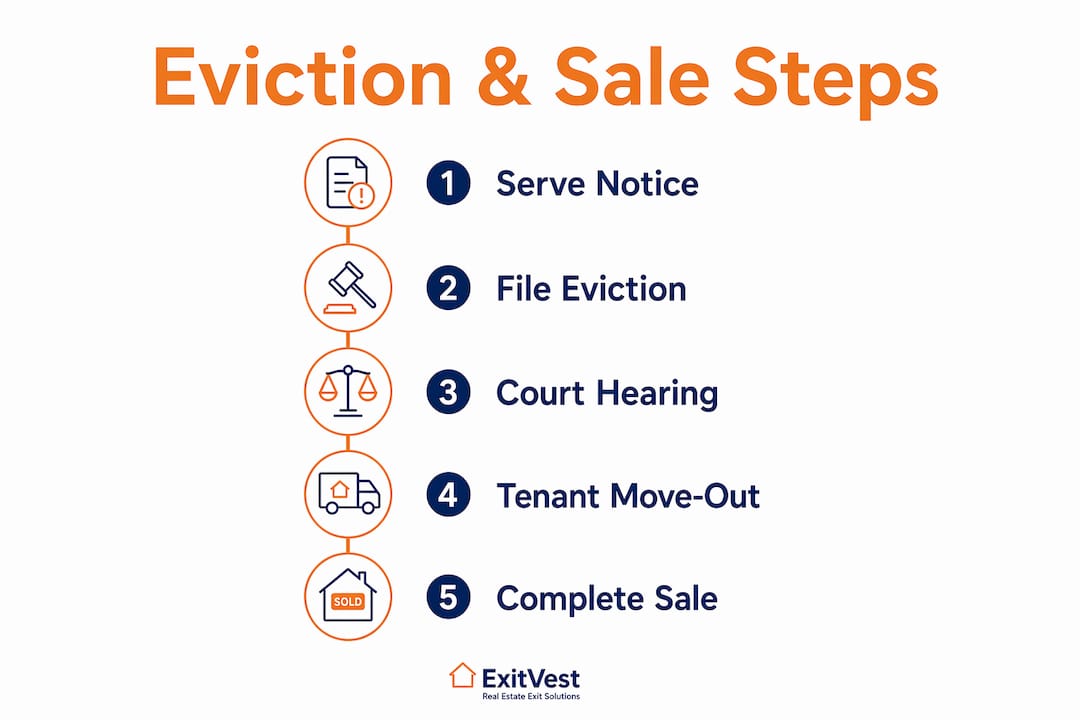
Formal eviction, legally called an unlawful detainer action, is the court-supervised process for removing a tenant who refuses to leave or negotiate. It is slower and more expensive than cash-for-keys, but it is sometimes the only option. Serving proper eviction notice and following legal procedures is critical. Skipping any step resets the clock.
- Serve the pay or quit notice. Deliver written notice demanding payment or vacancy within your state's required period (3–14 days). Use certified mail and personal delivery to create a paper trail.
- Wait out the notice period. Do not file in court before the notice period expires. Premature filing results in dismissal.
- File an unlawful detainer action. Submit the eviction complaint to your local court with proof of the served notice and the unpaid rent record.
- Attend the court hearing. Bring all documentation: the lease, rent ledger, notice proof, and any written communications. Judges move quickly when paperwork is complete.
- Obtain the writ of possession. If the court rules in your favor, a writ of possession authorizes the sheriff to remove the tenant.
- Coordinate with the sheriff. The sheriff schedules the lockout. You cannot change locks yourself before this step.
- Document the property condition. Photograph every room immediately after the tenant vacates. This protects you from damage claims and supports your sale listing.
The full eviction timeline runs 30 to 90 days in most states, though New Jersey and California can run longer due to tenant protection laws. Every additional month in court is a month your property sits off the market. That cost is why cash-for-keys, when feasible, wins on pure economics.
What are your options for selling an occupied property?
You have three realistic paths when the tenant remains in place: sell to an investor buyer, wait for the eviction to conclude, or negotiate tenant cooperation for a traditional sale. Each path carries different costs and timelines.
Investor buyers accept occupied properties but expect discounts because the lease and tenant issues transfer with the sale. That discount reflects their risk and the work they take on after closing. For landlords who need to exit fast, accepting that discount is often the right trade.
| Selling path | Typical timeline | Price impact | Best for |
|---|---|---|---|
| Sell to investor as-is | 2–4 weeks | 5–15% below market | Landlords who need speed |
| Traditional sale after eviction | 3–6 months | Near full market value | Landlords with time and capital |
| Traditional sale with tenant cooperation | 4–8 weeks | Minimal discount | Tenants willing to cooperate |
Tenant cooperation during a sale impacts property value nearly as much as payment status. A tenant who refuses showings, leaves the property in poor condition, or speaks negatively to buyers can cost you more than the rent arrears themselves. Small incentives, like covering moving costs or offering a rent credit, often flip a hostile tenant into a cooperative one.
Key factors that affect your occupied sale:
- Lease type matters. A fixed-term lease binds the new owner. A month-to-month tenancy can be terminated with proper notice in most states.
- Showing access is critical. Buyers and their agents need to view the property. A tenant who blocks access kills deals before they start.
- Property condition drives price. Investors price in repair costs. A well-maintained occupied property sells closer to market value than a neglected one.
For landlords who want to sell rental property as-is without waiting months for an eviction to resolve, the investor route is the most direct exit.
Key Takeaways
Selling a property with a non-paying tenant requires legal compliance, transparent disclosure, and a clear-eyed choice between eviction, cash-for-keys, or an as-is investor sale.
| Point | Details |
|---|---|
| Disclose tenant issues to buyers | Hiding rent arrears or active evictions exposes you to post-sale fraud claims. |
| Cash-for-keys saves time and money | Deals close in 2–4 weeks and cost less than the $3,500–$10,000 typical eviction expense. |
| Follow eviction steps exactly | Premature filing or self-help eviction resets your timeline and adds legal penalties. |
| Occupied properties sell at a discount | Expect 5–15% below market value; rent-controlled units can see discounts above 20%. |
| Tenant cooperation affects sale price | Incentivizing a cooperative tenant can recover more value than a contested eviction. |
What I've learned from watching landlords handle this wrong
I've seen landlords make the same two mistakes repeatedly. The first is waiting too long to act, hoping the tenant will catch up on rent. Every month of inaction compounds the loss. The second is trying to cut corners on disclosure, thinking buyers won't find out. They always find out, and the lawsuits that follow are expensive.
The landlords who come out ahead treat this as a business decision from day one. They serve notice on time, document everything, and make a fast calculation: is cash-for-keys cheaper than eviction in my market? In most cases it is. The cash home sale benefits for distressed landlords are real. Speed and certainty are worth more than squeezing out the last 5% of market value when you're bleeding money every month.
The other thing I'd push back on is the idea that selling to an investor is "giving up." Accepting a fair discount to close in two weeks, avoid three months of court fees, and move on with your finances intact is not a loss. It is a rational exit. The landlords who hold out for top dollar while a non-paying tenant sits in the property often end up netting less after legal fees, carrying costs, and property damage than the investor offer would have paid.
Transparency and speed are the two variables you control. Use both.
— Alek
How Exitvest helps landlords sell fast with tenant problems
Landlords dealing with non-paying tenants do not have to wait out a long eviction or accept a lowball offer from a random investor. Exitvest buys properties as-is, in any tenant situation, with fair cash offers and flexible closing timelines.
Exitvest works with property owners across New Jersey, Texas, Florida, and Tennessee, and buys nationwide. Whether the tenant is still in place, an eviction is pending, or the property needs repairs, Exitvest handles the complexity so you do not have to. There are no agent commissions, no open houses, and no waiting on buyer financing. You can see how the process works and get a no-pressure offer based on your actual situation. For landlords ready to stop the financial bleed, Exitvest's fast cash sale is the most direct path out.
FAQ
Can I sell my property while eviction proceedings are active?
Yes, you can sell during an active eviction, but you must disclose the proceedings to any buyer. The buyer inherits the legal situation at closing.
How long does the landlord eviction process take?
Most evictions take 30–90 days from notice to lockout, though states like New Jersey and California can run significantly longer due to tenant protection laws.
What is a cash-for-keys agreement?
A cash-for-keys agreement is a voluntary deal where the landlord pays the tenant a lump sum to vacate by a set date. It typically closes in 2–4 weeks and costs less than formal eviction.
Do I have to disclose a non-paying tenant to buyers?
Yes. A non-paying tenant is a material fact under real estate disclosure law. Failing to disclose active rent arrears or eviction proceedings can result in post-sale fraud claims.
What discount should I expect when selling an occupied property?
Tenant-occupied properties typically sell at a 5–15% discount compared to vacant ones. Rent-controlled units can see discounts above 20% depending on the market.