

If you've ever dealt with a non-paying tenant or stared down a foreclosure notice, you already know that formal eviction is slow, expensive, and unpredictable. That's exactly where understanding what is cash for keys becomes useful. Cash for keys is a voluntary arrangement where a property owner pays an occupant to vacate the property by a set date, handing over the keys in exchange for a cash payment. It sidesteps the courtroom, cuts months off your timeline, and often leaves both parties better off. This guide breaks down how it works, what belongs in a solid agreement, and how to avoid the traps that catch landlords off guard.
Table of Contents
- Key Takeaways
- What is cash for keys and how the agreement works
- The cash for keys process from offer to move-out
- Financial and practical benefits of cash for keys
- Common pitfalls and how to protect yourself
- How to negotiate cash for keys offers
- My honest take on cash for keys after seeing it work and fail
- How Exitvest can help when the property itself is the problem
- FAQ
Key Takeaways
| Point | Details |
|---|---|
| Cash for keys definition | A voluntary cash payment to an occupant in exchange for moving out and returning the keys by a specific date. |
| Always use written agreements | Signed, detailed contracts protect both parties and make the arrangement legally enforceable. |
| Typical timelines are faster | The cash for keys process usually wraps up in 30 to 60 days, far quicker than formal eviction. |
| Payment amounts vary widely | Offers typically range from $2,000 to $20,000 based on local eviction costs and property value. |
| Never pay before keys are in hand | Releasing payment before confirmed vacant possession removes the tenant's incentive to actually move out. |
What is cash for keys and how the agreement works
The formal industry term for this arrangement is a "tenant buyout agreement," though "cash for keys" is how most landlords, real estate investors, and property managers refer to it in practice. You'll hear both, and they mean the same thing: cash in exchange for voluntary, timely possession of the property.
A solid cash for keys agreement is more than a handshake and a check. It's a written contract that spells out the terms both parties are agreeing to. A valid agreement should include:
- Move-out date: A specific calendar date by which the property must be fully vacated
- Payment amount and method: The exact dollar figure and how it will be paid (certified check, cashier's check, or escrow)
- Condition of premises: The expected state of the property upon move-out, including cleaning and removal of all belongings
- Keys returned: Which keys, fobs, garage openers, or access cards must be surrendered
- Mutual release of claims: Tenant relinquishes lawsuit rights and the landlord waives claims for back rent or damages beyond the agreement
That last point matters more than most landlords realize. The mutual release closes the door on future litigation from either side, which is one of the cleanest parts of a well-structured cash for keys agreement.
Pro Tip: Have a real estate attorney review your agreement before presenting it. A one-page review from a professional familiar with home closing agreements is worth far more than fixing a costly dispute later.
Verbal agreements carry real risk. Oral handshake deals frequently end with the tenant taking the money and staying put, and you have little legal recourse without a signed document.
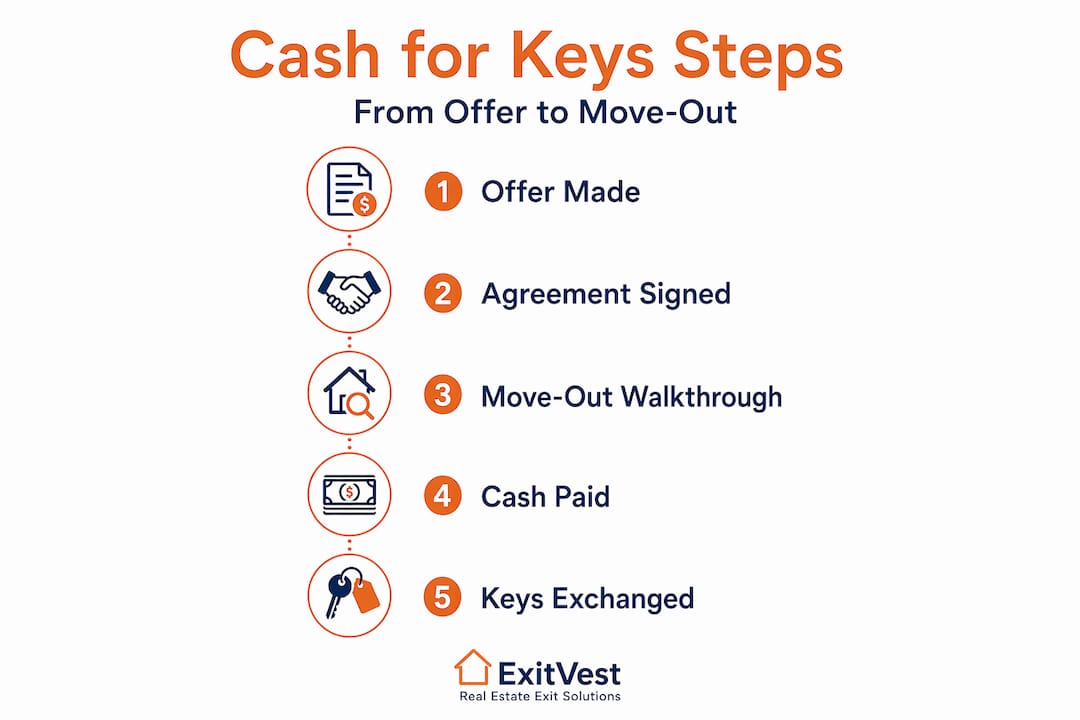
The cash for keys process from offer to move-out
Knowing how cash for keys works at each stage helps you set realistic expectations and avoid missteps. Here's how the process typically unfolds:
- Make the initial offer. Approach the tenant or occupant with a written offer that outlines the payment amount and proposed move-out date. Keep the tone professional and non-confrontational. This is a business transaction, not a confrontation.
- Negotiate terms. The occupant may counter with a higher payment or a later move-out date. Build some flexibility into your opening offer so you have room to meet in the middle without exceeding your budget.
- Sign the agreement. Once both parties agree on terms, sign a written, dated contract. Both sides should get a copy. Do not hand over any money at this stage.
- Move-out and property condition check. The tenant vacates by the agreed date, removes all belongings, and leaves the property in the agreed condition. Schedule a walkthrough for the move-out day.
- Inspection and key handover. Walk the property with the tenant present. Confirm the condition meets the agreement. Take photos of the keys being handed over as proof of delivery.
- Payment delivery. Only after confirming vacant possession do you release payment. Use a certified or cashier's check, or have funds held in escrow until this moment.
The entire process typically takes 30 to 60 days, compared to formal evictions that can drag on for three to nine months in many states. Formal evictions also cost landlords between $3,500 and $10,000 in legal fees, court costs, and lost rent. Cash for keys puts a hard number on what you'll spend and gives you a firm exit date.
Pro Tip: Schedule the final walkthrough for the exact move-out date, not a day later. If the tenant hasn't fully vacated, you still have the payment as leverage to get them to finish moving before the check changes hands.

Financial and practical benefits of cash for keys
This is where the case for cash for keys becomes hardest to argue against, especially for landlords who have been through a full eviction before.
Eviction costs averaging $3,500 to $10,000 don't account for the revenue you lose while a unit sits occupied by a non-paying tenant during a multi-month court process. Add attorney fees, filing fees, and potential property damage from a resentful occupant, and the real cost climbs fast. A cash for keys payment of $2,000 to $5,000 can look like the better deal on a spreadsheet pretty quickly.
The practical benefits go beyond dollars:
- Predictable timeline. You know your move-out date the moment the agreement is signed. No court continuances, no last-minute legal motions, no surprises.
- Reduced property damage risk. Tenants who feel forced out through eviction have little reason to be careful with the property. Tenants who've agreed to cash for keys have a financial incentive to meet the condition standards in the contract.
- Faster path to revenue. Getting possession back weeks or months sooner means you can lease, sell, or renovate that much faster.
- No eviction record for the tenant. From the occupant's perspective, cash for keys avoids a formal eviction on their record, which makes them more willing to cooperate.
A cash for keys program isn't charity and it isn't a defeat. It's a calculated decision to trade a known, manageable cost for an unknown, potentially far larger one.
The benefits of cash for keys apply to foreclosure situations too. Banks and mortgage servicers routinely use this strategy with homeowners who've defaulted, offering payment to get clean, undamaged possession of the property. If you're a homeowner in foreclosure, the same approach can work in your favor as well.
Common pitfalls and how to protect yourself
Understanding where cash for keys arrangements go wrong is just as useful as knowing how they work when everything goes right. Here are the traps that catch property owners most often:
- Paying too early. Releasing the check before the property is vacant and keys are in hand is the single most common mistake. Payment should only happen at vacant possession, with keys in your hand.
- Using vague agreements. If the contract doesn't specify the expected condition of the property in detail, you have no legal basis to dispute damage or a partial move-out.
- Skipping the mutual release. Without a release of claims clause, a tenant could still sue you after accepting payment.
- Ignoring local laws. In Los Angeles, for example, landlords must provide disclosures, allow a 30-day rescission period, and file the agreement with the housing department within 60 days. Failing to follow local rules can void your agreement entirely.
Here's a quick comparison of key agreement safeguards:
| Protection method | What it prevents | Risk if skipped |
|---|---|---|
| Written, signed contract | Disputes over terms | Tenant keeps money, stays put |
| Mutual release of claims | Post-move-out lawsuits | Ongoing litigation exposure |
| Payment held in escrow | Early payment risk | Loss of leverage before move-out |
| Move-out condition clause | Property damage disputes | Costly repairs with no recourse |
| Local law compliance | Agreement invalidation | Contract voided, fines possible |
Escrow arrangements are worth considering for any transaction where the relationship is tense or the dollar amount is significant. A neutral third party holds the funds until both the tenant confirms move-out and you confirm property condition. It removes the trust problem entirely.
Pro Tip: Photograph every room before and after the move-out, and photograph the keys being handed over. This documentation takes five minutes and eliminates the most common sources of post-agreement disputes.
How to negotiate cash for keys offers
The most common question from landlords is: how much should I actually offer? The honest answer is that it depends on what a formal eviction would cost you, not on a fixed formula.
Typical offers range from $2,000 to $20,000, or roughly one to two months' rent. Several factors move that number up or down:
- Local eviction cost and timeline. In states where eviction takes six months and costs $8,000, a $4,000 cash for keys offer is cheap. In states with fast, inexpensive eviction courts, your leverage as a landlord is stronger.
- Property value and location. Higher-value properties in tight rental markets often require larger payments because tenants have more to lose.
- Occupant leverage. A tenant with a valid lease has more negotiating power than a holdover tenant with no legal standing.
- Condition risk. If you have reason to believe the occupant may damage the property during a contested eviction, that risk has real dollar value.
Start your opening offer below your maximum. Tenants under pressure know cash for keys is negotiable and may counter. Build yourself room to meet their counter without exceeding what makes financial sense. If a tenant asks for more than you can justify against eviction costs, run the numbers honestly before walking away.
Also know when to bring in help. If the occupant is represented by legal counsel, or if the situation involves a protected class under fair housing law, get professional legal advice before making any offers. The cash for keys process is straightforward in most cases, but complicated situations benefit from experienced guidance.
My honest take on cash for keys after seeing it work and fail
I've watched landlords spend eight months and $9,000 in legal fees to evict a tenant they could have paid $3,500 to move out in six weeks. The math isn't complicated. But I still see this mistake made regularly, usually because the landlord is too angry at the tenant to think clearly about the transaction.
Cash for keys isn't about being soft. It's about recognizing that your goal is possession of the property, not punishment. Eviction courts are not reliable punishment mechanisms anyway. They're slow, public, and often produce no financial recovery even when you win.
The mistakes I see most often aren't about the money. They're about documentation. Landlords who hand over a check before the walkthrough. Owners who rely on texts and verbal confirmations instead of a signed agreement with a notary. Those situations end badly, and they didn't have to.
One thing I'd add that most articles skip: the timing of when you make the offer matters. Approaching a tenant the day after sending a pay-or-quit notice, when emotions are high, usually produces a bad negotiation. Give it a few days. Let the reality of the situation settle. You'll get a more rational conversation and a faster agreement.
A well-structured cash for keys arrangement, done with proper documentation, a clear move-out date, and payment tied to confirmed possession, resolves most tenant disputes faster and cheaper than any court process. That's not an opinion. That's what the numbers show, and what experience confirms.
— Alek
How Exitvest can help when the property itself is the problem

Sometimes the tenant situation gets resolved but the property still isn't something you want to hold onto. Maybe it needs repairs you can't fund, or the foreclosure process has already started, or you inherited a home you simply don't want to manage. That's exactly what Exitvest is built for. We buy houses, land, and small apartment buildings as-is for cash, with no pressure, no agent commissions, and no long closing timelines. You pick the date that works.
Exitvest works with property owners across New Jersey, Texas, Florida, Tennessee, and nationwide, including people dealing with problem tenants, vacant homes, foreclosure, or properties that just need a clean exit. If you've already handled your cash for keys situation and are ready to move on from the property entirely, or if you want to explore a fast cash offer right now, we're ready to talk. No obligation, no pressure, just clear numbers and a timeline that fits your situation.
FAQ
What is a cash for keys offer exactly?
A cash for keys offer is a payment from a property owner to a tenant or occupant in exchange for voluntarily vacating the property by a specific date and returning all keys in good condition.
Is cash for keys legal?
Yes, cash for keys arrangements are legal in all U.S. states as a voluntary contractual agreement. Some cities like Los Angeles have specific disclosure and filing requirements landlords must follow to keep the agreement valid.
How much is a typical cash for keys payment?
Payments typically range from $2,000 to $20,000, or one to two months' rent, depending on local eviction costs, property value, and the occupant's negotiating position.
How does cash for keys differ from eviction?
Eviction is a court-ordered legal process that can take months and cost landlords $3,500 to $10,000 in fees. Cash for keys is voluntary, faster (typically 30 to 60 days), and avoids the courtroom entirely.
What should a cash for keys agreement include?
A solid agreement should specify the move-out date, payment amount and method, expected property condition, keys to be returned, and a mutual release of claims from both parties.