
Yes, you can sell a house with a leased solar system, and you have four workable paths: transfer the lease to the buyer, buy out or prepay the lease so the system conveys as owned, remove or relocate the panels, or sell as-is for cash to sidestep lease friction entirely. Leases commonly trigger title complications through UCC-1 filings and can hurt a buyer's mortgage approval odds, so start resolving them the day you list. If your timeline is tight or your buyer's financing is shaky, a cash sale is a dependable fallback.
TL;DR:
- Transferring the lease to the buyer is the most common option but can take two to six weeks and requires employer approval and credit checks before listing.
- Buying out the lease or prepaying can make the system appear fully owned, expanding the potential buyer pool, but requires immediate payment negotiations with the provider.
- Removing or relocating the solar system is costly and complex, generally a last resort when the buyer declines the lease and a buyout isn't feasible.
- A cash sale avoids lease and financing issues entirely, making it ideal when timeline or credit constraints prevent successful lease transfer or buyout.
- Early documentation gathering and proactive communication with providers, title companies, and lenders are crucial to prevent delays and unresolved liens from derailing the sale.
Table of Contents
- How to Sell a House With Solar Lease Payments Attached
- What Do Lenders and Title Companies Check on a Solar Lease?
- Seller Checklist: Documents and Timing From Listing to Closing
- When Timing Is Tight, Consider These Alternatives
- When a Cash Sale Solves the Solar Lease Problem
- A Faster Path When the Lease Is Slowing Down Your Sale
- Sources
- FAQ
How to Sell a House With Solar Lease Payments Attached
Every seller with a leased or PPA-financed solar system has three real paths forward, and picking the wrong one costs weeks you might not have.
Transfer the lease to the buyer. This is the most common route, and it works when your buyer is willing and creditworthy. The solar provider's transfer team runs a credit check on the buyer, reviews the existing contract, and reassigns it to the new owner. Most sellers underestimate how much paperwork this involves. Transfers commonly take several weeks, often between two and six, once initiated, but that clock only starts once you contact the provider, which is why waiting until under contract to make the call is a common mistake.
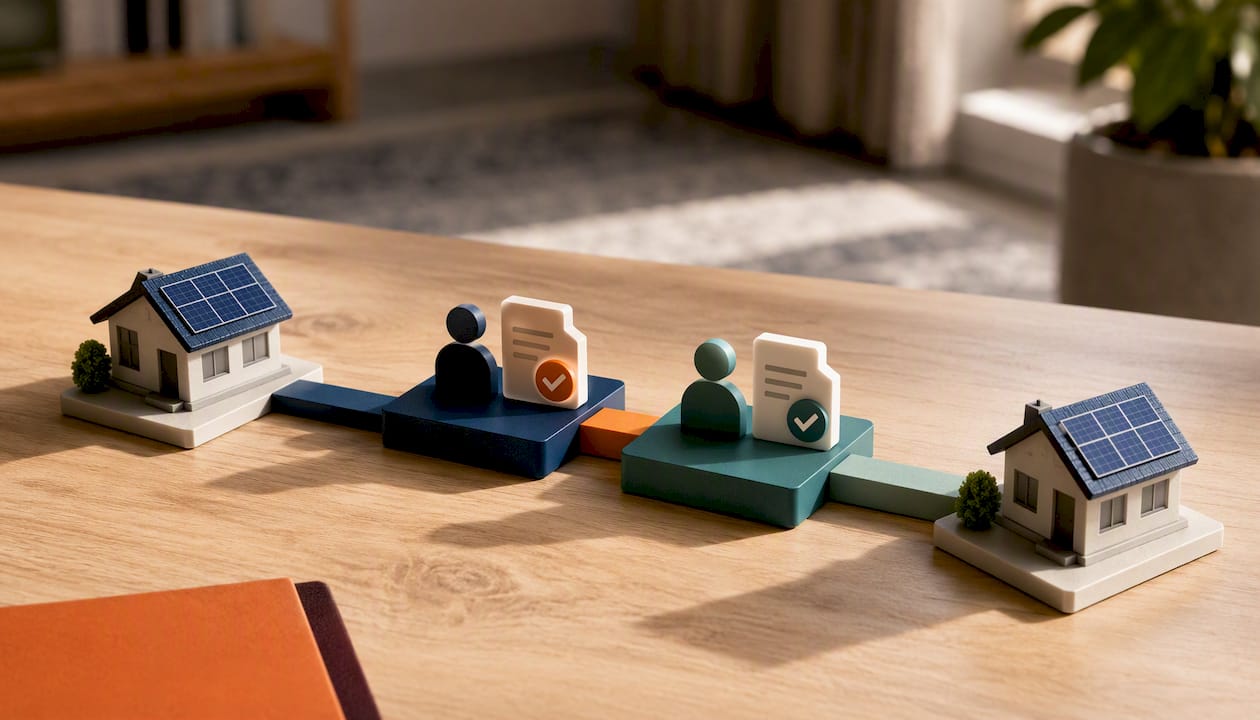
Buy out or prepay the lease. Request a written payoff quote directly from your solar provider. Some contracts distinguish between a full buyout (you own the system outright, free and clear) and a prepay (you cover remaining payments, but title terms may still differ). A buyout lets you market the system as owned equipment rather than a monthly obligation the buyer inherits, which widens your buyer pool considerably.
Remove or relocate the system. This is usually the last resort. Removal and reinstallation fees commonly range from several hundred to a few thousand dollars depending on the provider and system complexity. Reinstalling elsewhere also means new utility interconnection approval, and some providers simply won't permit relocation under the original contract terms.
- Transfer when your buyer qualifies and wants the system.
- Buy out when you have the cash or equity and want a cleaner sale.
- Remove or relocate only when the buyer refuses the lease and a buyout isn't affordable.
- Sell as-is when none of the above fits your timeline.
Pro Tip: Call your solar provider before you list, not after you get an offer. Ask for their transfer packet and current buyout quote in the same call, so you have both numbers ready when a buyer asks.
What Do Lenders and Title Companies Check on a Solar Lease?
Lenders and title companies scrutinize leased solar systems more than most sellers expect, and the two issues that stall closings most often are debt ratios and title clouds.
Under Fannie Mae's underwriting guidance, a buyer's monthly solar lease payment counts as debt in their debt-to-income calculation. A monthly lease payment example can be enough to push a marginal buyer over the limit and shrink the loan amount they qualify for. source Appraisers also treat leased and PPA-financed systems differently from owned ones: a leased system typically adds little or nothing to the appraised value, since the appraiser can't credit equipment the seller doesn't own.
Most solar leases and PPAs include annual escalator clauses, typically ranging from about 1.5% to 3.5% per year, which means the payment a buyer sees today isn't the payment they'll owe in year five. Buyers and their lenders need the full remaining schedule, not just the current monthly figure.
Solar companies frequently file a UCC-1 fixture financing statement against the property when the lease starts. That filing shows up on a title report and can cloud the sale until it's released, subordinated, or paid off. Title companies won't clear closing with an unresolved UCC-1 sitting on record.
Three moves prevent most of this from becoming a crisis:
- Order a UCC search the moment escrow opens, not when the preliminary title report arrives.
- Get a current, written buyout quote from your provider before you negotiate with a buyer.
- Hand the buyer's lender the complete lease payment schedule, including escalators, as early as possible.
Seller Checklist: Documents and Timing From Listing to Closing
A leased solar system adds a parallel workflow to your sale, and missing a step here is what causes deals to die in week three of escrow.
Gather these documents before you list:
- The full lease or PPA agreement, plus any amendments.
- A current buyout quote from your solar provider.
- Twelve to twenty-four months of production data and utility bills.
- System warranties, specs, and the interconnection agreement with your utility.
- Direct contact information for your installer and the provider's transfer department.
Consumer guides call this bundle the solar packet, and handing it to a buyer unprompted, before they ask, is one of the more effective ways to head off objections later.
Notify these people early: your solar provider's transfer team, the title company (specifically request a UCC search), your listing agent, and eventually the buyer's lender. Start the transfer paperwork the day you accept an offer, not the day before closing.
Watch these milestones: listing preparation, offer acceptance (this is your trigger to initiate transfer), the buyer's credit approval window, title clearance on the UCC-1, and any contingency planning if transfer paperwork lags behind the rest of escrow.
If the provider's approval or UCC release is still pending near your closing date, ask your title company about an escrow holdback or a transfer contingency clause. These let closing proceed on schedule while the final solar paperwork catches up. If anything about the lien or UCC filing looks unresolved, involve a real estate attorney before you sign closing documents, similar to how you'd handle selling a house with other liens on title.
Pro Tip: Ask your buyer's lender to run a debt-to-income scenario with the lease payment included before you get deep into escrow. If the buyer is borderline, you'll want to know in week one, not week five.
When Timing Is Tight, Consider These Alternatives
Sometimes the transfer or buyout math doesn't work fast enough, and that's when a different kind of sale makes more sense than forcing a traditional closing.
A cash, as-is sale sidesteps the whole problem. Since there's no mortgage lender involved, there's no DTI calculation to worry about and no appraisal that penalizes a leased system. For sellers facing foreclosure, a job relocation, or a property they simply can't keep carrying, converting to a cash sale trades some sale price for speed and certainty, often closing in a fraction of the time a lease transfer would take. This is also the practical answer if you're wondering how to sell rental property as-is with a lease attached to a tenant-occupied unit.
A seller credit or price reduction can widen your buyer pool without you paying the full buyout. Compare the buyout cost against what a modest price cut would cost you; sometimes covering part of the buyer's closing costs is cheaper than a full payoff and still gets a mortgage buyer comfortable with the deal.
Escrow holdbacks and transfer contingencies let a sale close on schedule while final lease paperwork wraps up in the background, a workaround title companies use routinely when a UCC-1 release is still pending.
- Cash sale: fastest, avoids lender and appraisal issues entirely.
- Seller credit: cheaper than a buyout, keeps traditional buyers in play.
- Holdback or contingency: keeps a mortgage deal on track without delaying closing.
If none of these fit and your timeline is genuinely urgent, a specialized cash buyer is worth a call before you lose another week to a stalled lender file.
When a Cash Sale Solves the Solar Lease Problem
A cash offer becomes the practical choice in a specific set of situations: the property is headed toward foreclosure, the buyer's lender rejected the deal over DTI once the lease payment got added in, or the UCC-1 can't be cleared fast enough to hit a closing date. In those cases, waiting on a traditional buyer's financing usually costs more time than the lease was ever going to save.
Some cash buyers handle these deals by coordinating directly with the title company on UCC-1 resolution and working with sellers on a closing timeline that fits their situation, rather than forcing a fixed 30-day window that leaves no room for provider delays. There's no lender approval to wait on and no appraisal that discounts the property for having a leased rather than owned system.
If you're vetting a cash buyer for this kind of sale, ask directly how they plan to handle the UCC-1 release, whether they'll want a current buyout quote from your provider, and what documentation they need from you upfront. Most legitimate buyers will ask for the same seller document checklist a traditional lender would want to see, just without the DTI math attached to it.
— Alek
A Faster Path When the Lease Is Slowing Down Your Sale
If a leased solar system is turning your sale into a waiting game on lender approvals and UCC releases, Exitvest offers a different route: a cash offer on the house as-is, with no financing contingency to trip over the lease at all. Exitvest buys houses, small apartment buildings, and land directly from owners, including properties tangled up in liens, title issues, or urgent timelines like foreclosure.
There's no agent commission, no waiting on a buyer's DTI math to work out, and no appraisal fight over whether the solar system adds value. If your closing date is at risk because a UCC-1 hasn't cleared or a buyer's lender balked at the lease payment, reach out to Exitvest directly for a cash offer and a closing timeline built around your actual situation, not a standard 30-day mortgage clock.
Sources
Pull these before contacting a buyer or lender: Fannie Mae's underwriting guidance on leased-equipment debt treatment, your provider's transfer and buyout request page, general UCC-1 fixture filing guidance, and Berkeley Lab's resale-value research.
FAQ
What happens if I sell my house with leased solar panels still on the roof?
You'll need to either transfer the lease to your buyer (subject to provider approval and a credit check), buy out the remaining payments, or arrange removal before closing; skipping this step is what causes titles to get held up by unresolved UCC-1 filings.
Should I buy a house that has leased solar panels?
You can, but budget the monthly lease payment into your own debt-to-income calculation and request the full payment schedule, since escalator clauses typically raise payments 1.5% to 3.5% annually.
Is it harder to sell a house with a solar loan versus a lease?
A solar loan is usually simpler because you own the equipment outright and it can be paid off or rolled into the sale like any other lien, while a lease or PPA involves a third-party provider, a UCC-1 filing, and a separate transfer or buyout process.
Are houses with solar panels harder to sell overall?
Homes with owned solar systems tend to sell at a premium, but Berkeley Lab research shows leased or third-party-owned systems don't reliably add appraised value, which is why resolving the lease terms before listing matters more than the panels themselves.
How long does a solar lease transfer take during a home sale?
Provider transfers commonly take two to six weeks once you start the paperwork, so initiate the transfer request the same day you accept an offer rather than waiting for closing week.