

Contract assignment real estate, in the sense that matters if you're staring at a foreclosure notice or a house full of a deceased parent's belongings, means selling as-is directly to an investor who closes on your timeline. It's not the wholesaling maneuver some sites describe. If speed and certainty matter more than squeezing out the last dollar, a reputable cash buyer can be the right call. But don't sign anything today. Verify the buyer's proof of funds first, then have the written offer reviewed before you commit.
TL;DR:
- Broad assignment clauses and vague deduction terms in cash sale contracts can expose sellers to title issues or unexpected costs if not carefully reviewed.
- Cash buyers typically base their offers on repair estimates and resale margins, resulting in lower prices compared to retail listings and a quicker closing process.
- Verifying proof of funds and requesting a title search upfront are crucial steps to avoid delays or dealing with unqualified buyers during a fast sale.
- The type of sale most suitable depends on the seller’s urgency, property condition, and whether maximizing price outweighs the need for speed and certainty.
- State-specific laws and local customs influence assignment restrictions and should be checked to prevent legal complications when selling to an investor.
Table of Contents
- What Does Contract Assignment Mean in a Cash Home Sale?
- How Does the Cash Sale Process Actually Work?
- What Contract Clauses Should You Watch For?
- What Should You Prepare Before Selling Fast?
- Is a Cash Sale Your Best Option?
- What Legal Risks Come With Contract Assignment Language?
- Can You Negotiate the Assignment Fee?
- Assignment vs. Double Closing: What's the Difference?
- Do Assignment Restrictions Vary by State?
- Every Seller's Situation Looks the Same on Paper, Until It Isn't
- Get a Fair Cash Offer Without the Contract Guesswork
- Where to Verify These Facts Yourself
- Sources
- FAQ
What Does Contract Assignment Mean in a Cash Home Sale?
The term gets used loosely, so here's the version that applies to you: a homeowner, landlord, or heir signs a purchase agreement directly with a cash buyer, who then closes on the property, as-is, without a mortgage lender in the mix. No middleman flips your contract to someone else before closing. You deal with one buyer from the first phone call to the final signature.
This distinction matters because some real estate contracts do contain assignment clauses, language that lets the buyer transfer their rights in the deal to a different, undisclosed party. In a straightforward investor sale, that clause shouldn't be doing much work. If it's written broadly and paired with a rock-bottom earnest money deposit, it's worth asking why.
How Does the Cash Sale Process Actually Work?
The mechanics are fairly consistent across reputable buyers, even though every property is different. Here's the typical sequence:
- Inquiry. You describe the property, its condition, and your reason for selling (foreclosure, inherited property, tenant issues, whatever it is).
- Preliminary number. The buyer pulls public records and comparable sales to give you a rough range before ever seeing the house. This number, often shifts once someone actually walks the property.
- Walkthrough. A representative inspects the property in person, noting repairs, code issues, or anything that affects resale value.
- Written offer. You receive a formal purchase agreement stating price, closing date, and any conditions.
- Escrow and earnest money. A neutral third party (a title company, typically) holds a good-faith deposit and manages funds until closing.
- Title work. The title company searches public records for liens, judgments, and unpaid taxes, and generates payoff statements for any mortgage balance.
- Closing. You sign, the buyer wires funds, and ownership transfers.
Investors calculate as-is offers by estimating repair costs, subtracting their holding costs and target resale margin, and working backward from what they expect to sell or rent the property for later. That's why the number often looks lower than a fixed-up retail listing. It's pricing a different product: convenience and speed, not top dollar.
Title problems are usually what slows things down. A cash sale can close in roughly two weeks when title is clean, but a lien, an outdated payoff statement, or a probate complication can stretch that timeline by weeks.
What Contract Clauses Should You Watch For?
Investigative reporting on the cash-buyer industry has documented real patterns worth knowing before you sign anything. Sellers get pressured, contract language gets stretched, and the tactics reporters found tend to cluster around a few specific red flags.
- Broad assignment or "memorandum of sale" clauses. Some contracts let the buyer record a memo against your property's title before closing, which can cloud the title and make it harder for you to sell to anyone else if the deal falls through.
- Tiny or nonrefundable earnest money. One contract reviewed by ProPublica put down just $100 on a $157,000 deal. That's a buyer with almost nothing at stake if they walk away, and it's a signal worth taking seriously.
- One-sided cancellation rights. If only the buyer can back out penalty-free, you're carrying all the risk of a stalled sale.
- Vague deduction language. Watch for contracts that mention deductions "for repairs" or "for liens" without listing amounts or a method for calculating them.
- Pressure to sign the day of the walkthrough. Legitimate buyers give you time to read the agreement.
Pro Tip: Ask specifically whether your earnest money will sit in an escrow account with a licensed title company. If the buyer says they'll hold it themselves, that's your answer about how seriously to take the offer.
Before you sign, request proof of funds, a bank letter or statement showing the buyer can actually close, and consider a quick call to a real estate attorney or your local legal aid office. It's a cheap insurance policy against a bad contract. For a broader read on when a cash buyer makes sense for your situation, see when a cash buyer fits your situation.
What Should You Prepare Before Selling Fast?
Gathering paperwork early is the single biggest thing you control in a fast sale. Title companies and buyers both move faster when you're not scrambling for documents mid-transaction.
- Deed or prior title policy
- Mortgage account number and most recent statement (for the payoff request)
- Property tax bills and any HOA statements or dues
- Government-issued ID for every owner on title
- Letters of administration or probate documents, if you inherited the property
Order or request a title search early. A title report typically runs $50 to $250 and can surface old liens, unpaid contractor bills, or judgment liens you didn't know existed. Better to find those now than during closing week.
To estimate what actually lands in your pocket, subtract your mortgage payoff, any liens, prorated property taxes, transfer taxes, and typical closing costs from the offer price. A full rundown of what documents to have ready lives in ExitVest's seller document checklist.
If money is the real pressure behind the sale, not just timeline, check in with a HUD-approved housing counselor or your state's NCSHA Homeowner Assistance Fund program before you commit to selling. Some homeowners qualify for mortgage assistance that changes the calculation entirely, and that counseling is free.
Is a Cash Sale Your Best Option?
A fast cash sale isn't automatically the right move for every seller. It's a trade: speed and certainty in exchange for a lower gross number, and whether that trade is worth it depends entirely on your timeline and the property's condition.
- Traditional agent listing. Usually nets a higher sale price, but takes longer and comes with a commission, typically 5 to 6% split between agents.
- iBuyers and large cash programs. Fast and convenient, using algorithm-driven valuations, though offers can vary widely depending on your local market and the program's current appetite for inventory.
- Short sale or foreclosure-avoidance routes. Worth exploring with your loan servicer and a HUD counselor if you're behind on payments and want to avoid foreclosure on your record entirely.
- A direct cash buyer. Makes the most sense when you're facing a hard deadline, the property needs work you can't afford or don't want to do, you're navigating probate, or you've got tenants you can't easily remove before selling.
For background on how different cash buyer types actually operate, what a cash home buyer is breaks down the landscape without the sales pitch.
What Legal Risks Come With Contract Assignment Language?
The core risk isn't the concept of assignment itself. Assignment clauses are standard in commercial contract law and show up in plenty of legitimate real estate agreements. The risk comes from how broadly that clause is written and what it lets the other party do without telling you.
A poorly drafted assignment clause can let a buyer transfer their obligations, and sometimes the property's title exposure, to a party you never vetted. If a memorandum of sale gets recorded against your property before closing, you may find it harder to sell to a backup buyer or refinance if the original deal collapses. That's a real liability sitting on your title, not just paperwork friction.
There's also enforcement risk. If your contract is silent on assignment or written ambiguously, you may end up dealing with a party you never agreed to sell to, with terms you thought were fixed. Courts generally enforce contracts as written, so ambiguity favors whoever drafted the language, usually the buyer's side.
The fix is simple, even if it takes an extra day: read the assignment clause specifically, ask who can be substituted in and under what conditions, and strike or narrow the clause if it feels open-ended. A short consultation with a real estate attorney, or a call to your state's legal aid office, catches most of these issues before you're locked in.
Can You Negotiate the Assignment Fee?
If a buyer's offer includes any kind of assignment or transaction fee tacked onto your net proceeds, that number is negotiable more often than sellers assume. Buyers set these fees based on their own margin targets, not a fixed market rate.
Start by asking for an itemized breakdown of every deduction in the offer, not just a lump final number. Vague line items like "processing" or "transaction fee" should come with a dollar figure and a plain explanation. If you're getting competing interest from more than one buyer, even informally, that leverage alone often shrinks the fee or gets it dropped entirely.
Timing also matters. A buyer facing a tight closing deadline, or one who already has resale plans lined up for your property, has more incentive to trim their fee to keep the deal moving. Sellers who ask directly, "Is this fee flexible?" get better outcomes than sellers who assume it's fixed. It rarely is.
Assignment vs. Double Closing: What's the Difference?
These two structures solve the same underlying problem, getting a property from the original seller to a final buyer, but they look very different on paper and carry different risks for you as the seller.
In an assignment, the original buyer never actually takes title. They transfer their contractual rights to a new buyer, who then closes directly with you. Your name on the deed transfers once, to whoever ends up as the final buyer of record.
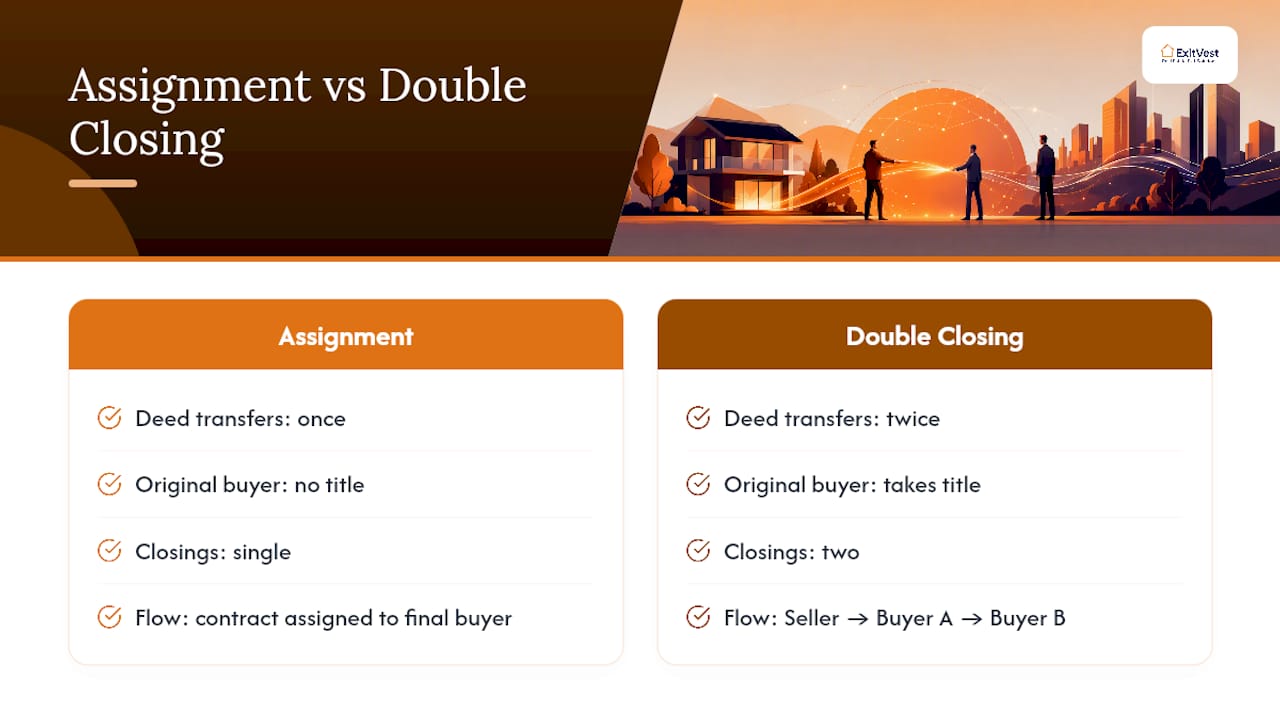
In a double closing, two separate transactions happen, often on the same day or within days of each other. You sell to Buyer A, and Buyer A immediately resells to Buyer B, with two separate closings and two separate title transfers. From your side as the original seller, the practical difference is smaller than it sounds. Either way, your job is to confirm you're closing with a buyer who has verified funds and a clean contract, regardless of what happens to the property afterward.
Do Assignment Restrictions Vary by State?
Yes, and this is where sellers often assume more uniformity than actually exists. Real estate contract law is largely governed at the state level, not federally, so what's standard practice in one state can require extra disclosure, licensing, or paperwork in another.
Some states treat certain assignment and wholesale-adjacent activity as requiring a real estate license depending on how the transaction is marketed and structured, while others have no such requirement. A handful of states have moved toward requiring specific disclosure language in contracts that include assignment provisions, spelling out that the buyer may transfer the agreement. Local title and escrow customs also vary, which affects who typically handles closing and how earnest money gets held.
The practical takeaway: don't assume a contract template that's standard in one state applies cleanly in yours. A quick consultation with a local real estate attorney, particularly if you're in probate or facing foreclosure and already navigating other state-specific rules, is worth the modest cost before you sign anything with assignment language in it.
Every Seller's Situation Looks the Same on Paper, Until It Isn't
Foreclosure, an inherited house nobody in the family wants to manage, a rental with tenants who stopped paying rent months ago. These situations share one thing: the seller needs speed and certainty more than they need to maximize the sale price. That's the calculus behind most fast, as-is cash sales, and it's not a compromise so much as a different set of priorities.
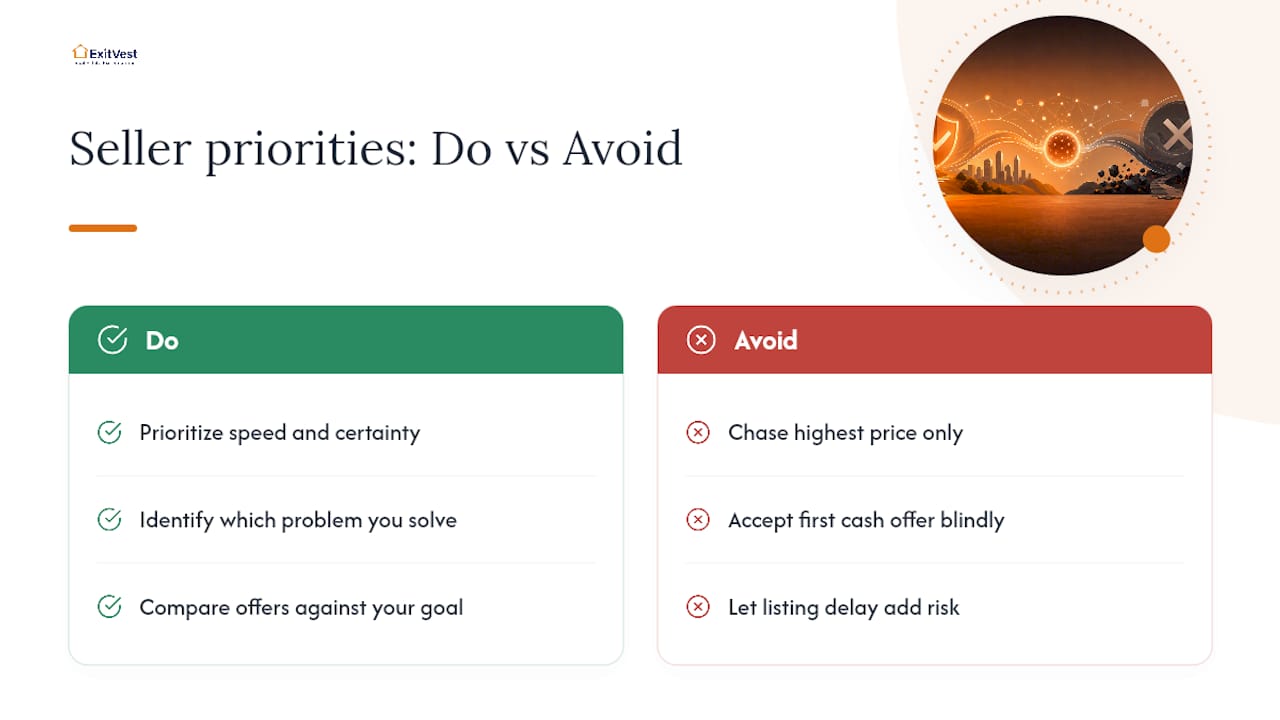
ExitVest works specifically in these categories: foreclosure, inherited property, problem tenants, vacant homes, deferred repairs, and financial pressure, because these are the situations where a traditional listing process adds risk instead of reducing it. A house tied up in probate doesn't benefit from sitting on the market for 90 days. A landlord dealing with a nonpaying tenant doesn't want six more months of vacancy risk while an agent tries to find a retail buyer willing to take on the tenant problem.
None of that means every seller should take the first cash offer that lands in their inbox. It means the calculation is genuinely different once your priority shifts from "highest number" to "solved problem." Know which one you're actually solving for before you start comparing offers.
— Alek
Get a Fair Cash Offer Without the Contract Guesswork
We buy houses, land, and small apartment buildings directly from owners, with no agent commissions or financing contingencies. If you're dealing with foreclosure, an inherited property, a rental with problem tenants, or a house that just needs to sell fast because life got complicated, that's exactly the kind of situation ExitVest handles every day.
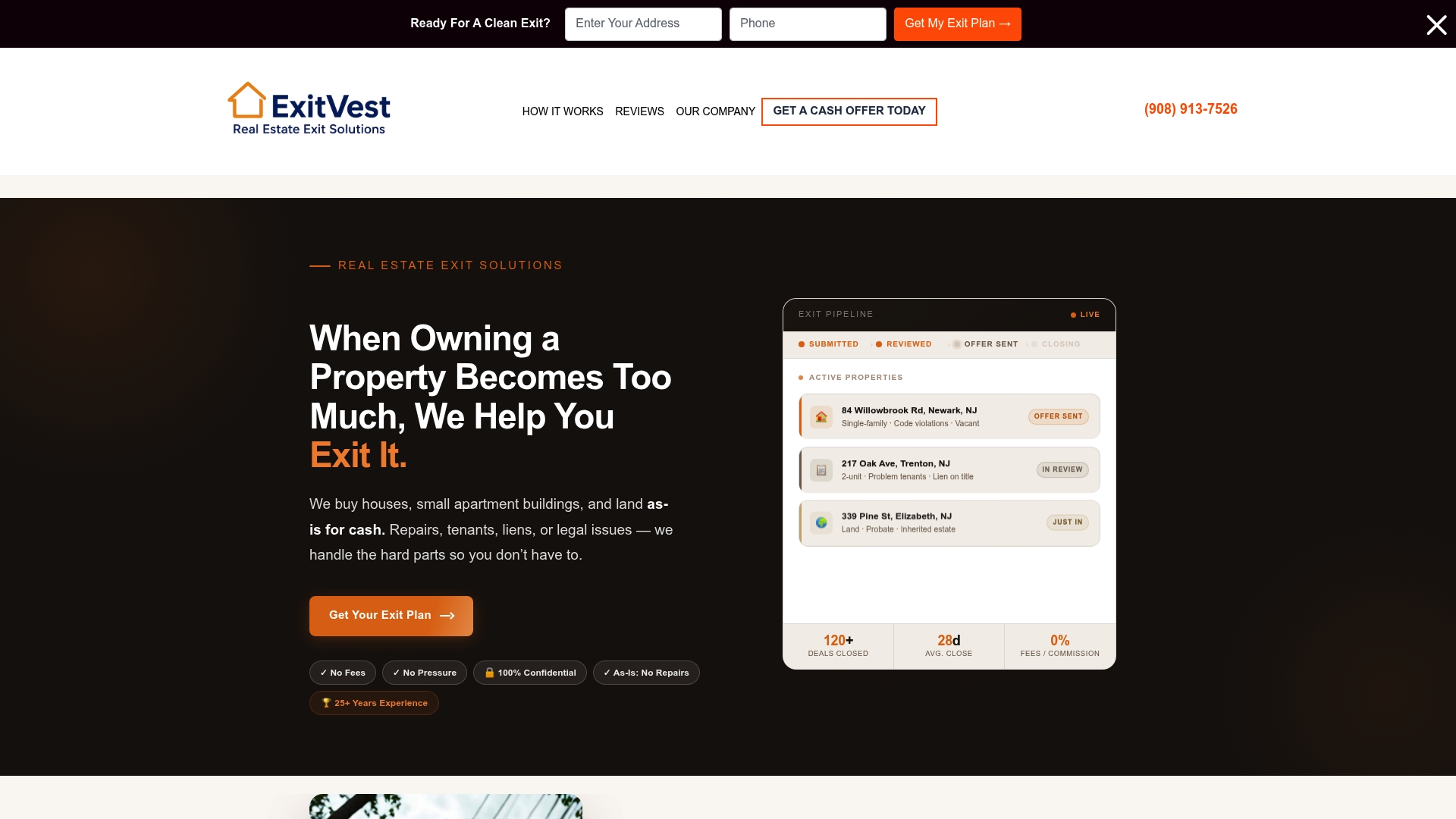
Reach out and describe your property and situation. You'll get a preliminary conversation, then a walkthrough, then a written offer with clear numbers, not vague deduction language you have to decode. We offer flexible closing timelines built around your schedule, whether that means closing quickly or giving you extra time to move out. We buy properties nationwide, focusing on several key states.
If you want to see exactly how the process works before you commit to anything, review ExitVest's how-it-works page and reach out for a no-pressure conversation about your specific property.
Where to Verify These Facts Yourself
For free help with mortgage distress, contact a HUD-approved housing counselor or your state's Homeowner Assistance Fund program. For legal questions about a contract you've been asked to sign, the Legal Services Corporation directory connects you to local, low-cost legal aid. For general homeowner guidance on contractor and repair-related contract risk, see how remodeling contracts work.
This article is general information, not a substitute for advice from a qualified financial advisor. Consult a qualified financial professional about your own circumstances before acting on anything here.
Sources
- Want to Sell Your Home for Cash? Read This First — ProPublica
- How to Sell My House for Cash | Zillow
- Cash Offer Process: 7-Step Walkthrough
FAQ
What Does Contract Assignment Mean When Selling to an Investor?
In this context, it means selling your property directly to a cash buyer who closes on it themselves, as-is, rather than a middleman transferring the deal to someone else before closing.
How Fast Can a Cash Sale Actually Close?
A cash sale can close in as little as two weeks when title is clean, compared to 30 to 60 days for a typical financed purchase.
What's the Biggest Red Flag in a Cash Offer Contract?
A very small, nonrefundable earnest money deposit paired with vague deduction language or broad assignment rights for the buyer is the clearest warning sign to watch for.
Do I Need a Real Estate Attorney to Sell to a Cash Buyer?
It's not required, but a brief consultation, or a call to your local legal aid office, is a smart, low-cost step before signing any contract with assignment language.
Does ExitVest Buy Houses With Problem Tenants or Code Violations?
Yes. ExitVest specifically works with property owners facing situations like problem tenants, code violations, vacant homes, and deferred repairs, buying as-is without requiring fixes first.