

A seller rent-back lets you sell your house and keep living in it for a set stretch afterward, paying the buyer rent until you move out. Most deals run for a short period because loan programs expect owner-occupant buyers to move in within a typical timeframe. Before you sign anything, get the buyer's lender to confirm the arrangement in writing, line up renters insurance, and understand that rent beyond two weeks usually counts as taxable income for the buyer.
TL;DR:
- Lenders usually require rent-backs to last no longer than a few weeks to comply with owner-occupancy rules and avoid higher interest rates or loan reclassification.
- Rent calculations should be clearly documented using either a PITI-derived daily rate or comparable market rent, with the agreed amount in writing before closing.
- Homeowner and renters insurance policies must be active and documented with policy numbers before keys are exchanged to prevent coverage gaps during the stay.
- In case of overstaying, legally mandated eviction procedures must be followed, and lease addenda should include penalties and escrow holdbacks to prevent delays.
- Buyers must obtain written lender acknowledgment confirming the rent-back does not violate occupancy requirements, bypassing potential loan approval issues.
Table of Contents
- What Is a Seller Rent Back and Why Do Sellers Use It?
- How Does the Rent-Back Process Actually Work?
- What Are the Lender Occupancy Rules for Rent-Back Agreements?
- How Is Rent Calculated and What Are the Tax Rules?
- Who Needs What Insurance During a Rent-Back?
- What Happens If a Seller Won't Leave?
- Rent-Back Negotiation Checklist for Sellers
- What Should You Do at Closing to Set Up the Rent-Back?
- ExitVest's Perspective: When a Cash Sale Beats a Rent-Back
- A Simpler Path Than Negotiating a Lease Back
- Where to Verify Rent-Back Rules Before You Sign
- Sources
What Is a Seller Rent Back and Why Do Sellers Use It?
A seller rent-back, sometimes called a sale-leaseback or post-settlement occupancy agreement, flips the usual script on closing day. You sell the house, hand over the deed, and the buyer becomes the legal owner. But instead of moving out that same afternoon, you stay put as a paying tenant for an agreed number of days or weeks.
The mechanics are simple even when the timing pressure isn't. You need a place to land after selling, but your new home isn't ready, a mortgage hasn't cleared underwriting, or a moving company can't get you scheduled for another three weeks. Rather than moving twice, or into a hotel with your furniture in storage, you negotiate to rent the property back from its new owner.
Common scenarios where this comes up include:
- Buying and selling in the same tight window and the new house needs a few extra weeks of repairs or renovation.
- A new construction closing that slips past the original date, leaving no bridge housing lined up.
- Families timing a move around the school calendar instead of the closing calendar.
- A chain of sales where your buyer is waiting on you to close before you can close on your own purchase.
Once the deed transfers, your legal status changes completely. You're no longer the owner with unrestricted rights to the property. You're a tenant, subject to whatever terms sit in the rent-back agreement, and the buyer is your landlord from the moment the ink dries.
How Does the Rent-Back Process Actually Work?
A rent-back only works cleanly when the paperwork nails down dates, money, and access before anyone signs. Vague verbal promises ("just a couple of weeks, no big deal") are exactly how these arrangements turn into disputes.
- Set a firm start and end date. The start is closing day. The end date should be a specific calendar date, not "sometime in June" or "when I'm ready."
- Decide on prepayment. Many sellers pay the full rent-back amount at closing, straight out of sale proceeds, so there's no separate rent collection process during the stay.
- Build in a walkthrough. The buyer typically has the right to a final inspection before or immediately after you vacate, confirming the home matches the condition promised at closing.
- Attach the right form. Most transactions use a standardized addendum, commonly called a Seller's Temporary Residential Lease or a Post-Settlement Occupancy Agreement, attached directly to the purchase contract rather than drafted from scratch.
- Calculate the rent. Two approaches dominate: a daily rate derived from the buyer's new mortgage payment (principal, interest, taxes, and insurance, known as PITI, divided by days in the month), or a flat market-rent figure based on comparable local rentals.
The PITI method tends to favor sellers slightly, since it reflects the buyer's actual carrying cost rather than what a landlord could charge a stranger. Either way, the number belongs in writing, not in a handshake, and the addendum should live inside the closing package your escrow or title company processes, not as a side letter between you and the buyer.
What Are the Lender Occupancy Rules for Rent-Back Agreements?
This is the part sellers skip and regret. Most buyers aren't paying cash. They're financing the home with a mortgage, and that mortgage almost certainly carries an owner-occupancy requirement.
Loans backed by Fannie Mae, Freddie Mac, FHA, and VA generally require the borrower to occupy the property as a primary residence within about 60 days of closing, and some lenders impose stricter overlays on top of that baseline. A rent-back lasting within a few weeks usually fits comfortably inside that window. Longer rent-backs risk violating the buyer's loan terms.
The consequences aren't hypothetical scare tactics. They're written into most mortgage agreements:
- The lender can reclassify the loan as an investment property loan, which usually carries a higher interest rate.
- In a worst case, the note can trigger acceleration language, technically making the full loan balance due.
- The buyer's homeowners insurance, written for an owner-occupant, may not cover a landlord scenario without an endorsement.
- Underwriters occasionally flag a rent-back at the closing table itself, delaying or derailing the sale entirely.
Get the buyer's loan officer to acknowledge the rent-back in writing before signing the occupancy addendum. That single step, more than any clause in the lease itself, determines whether the arrangement survives contact with reality. A verbal "my lender's fine with it" from the buyer's agent is not the same as a letter from underwriting.
How Is Rent Calculated and What Are the Tax Rules?
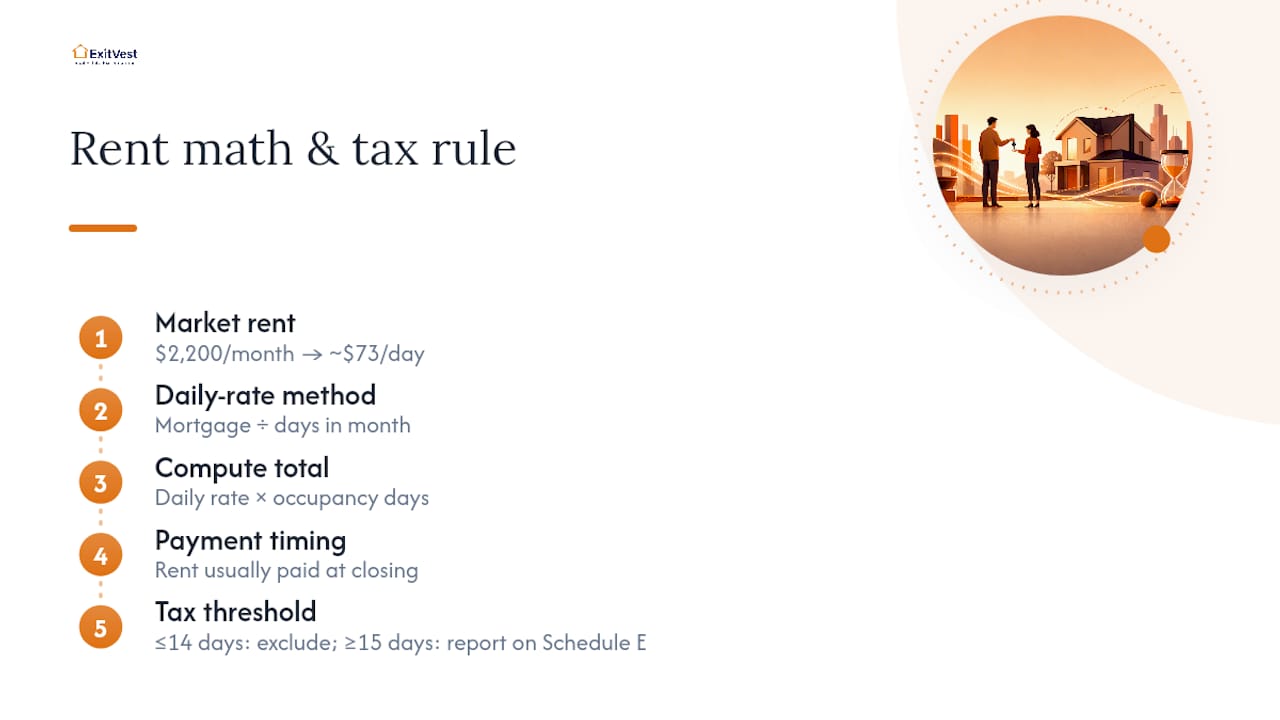
Here's a working example. For example, you can calculate rent by dividing the buyer's monthly mortgage payment by the number of days in the month to get a daily rate, then multiply by the number of occupancy days. A typical rent-back period might be several weeks, with the rent usually paid in full at closing out of your proceeds.
Market-rent pricing works differently. If comparable rentals in your area go for $2,200 a month, the buyer might set the daily rate closer to $73, or push for a flat weekly figure instead. Either method is fine as long as both sides agree on it in writing before closing, not after.
A figure worth building into your math: rental income becomes taxable to the buyer the moment the stay crosses roughly two weeks. Under IRC Section 280A(g), often called the 14-day rule, a buyer who rents out the home for fewer than 15 days in a tax year can exclude that rent from income entirely. Cross that threshold, and the buyer generally must report the rent-back income on Schedule E, along with any related expenses.
Most rent-backs typically exceed the short tax-exempt threshold, which means buyers generally owe tax on the rent received. That's their problem to file, not yours, but it explains why some buyers push for higher rent or shorter stays: they're doing tax math in the background. The IRS guidance on rental income and recordkeeping covers what buyers need to track.
Security deposits deserve the same rigor. Hold the deposit in escrow through the title company rather than handing cash directly to the buyer, and document the home's condition with photos and a signed checklist before you move out. State rules on deposit caps and return timelines vary, so don't assume your neighbor's experience in another state applies to you.
Who Needs What Insurance During a Rent-Back?
Insurance is the piece both sides forget until something breaks. The moment the deed transfers, the buyer's homeowner policy needs to function like a landlord policy, at least temporarily, and your policy needs to function like a renter's.
- The buyer should confirm with their carrier that a short-term rental endorsement or a temporary landlord policy applies during the rent-back window. A standard owner-occupant policy may not cover a tenant-occupied claim.
- You should carry renters insurance for the duration of your stay, covering your personal belongings and liability, since the home's structure is now the buyer's coverage responsibility, not yours.
- Both policies should be active and documented before you hand over keys at closing, not scrambled into place after move-in.
Pro Tip: List both insurance policy numbers directly in the occupancy addendum and require proof of coverage at or before closing. If a claim happens on day 12 of a 30-day rent-back, nobody wants to be digging through email threads trying to prove coverage existed.
Skipping this step is how a burst pipe or a kitchen fire turns into a lawsuit instead of an insurance claim. A five-minute phone call to your insurance agent before closing costs nothing. A coverage gap discovered after a loss costs thousands.
What Happens If a Seller Won't Leave?
Most rent-backs end exactly on schedule. The ones that don't tend to follow a predictable pattern: the seller's new home falls through, the movers cancel, or someone just decides an extra week won't matter. It matters legally.
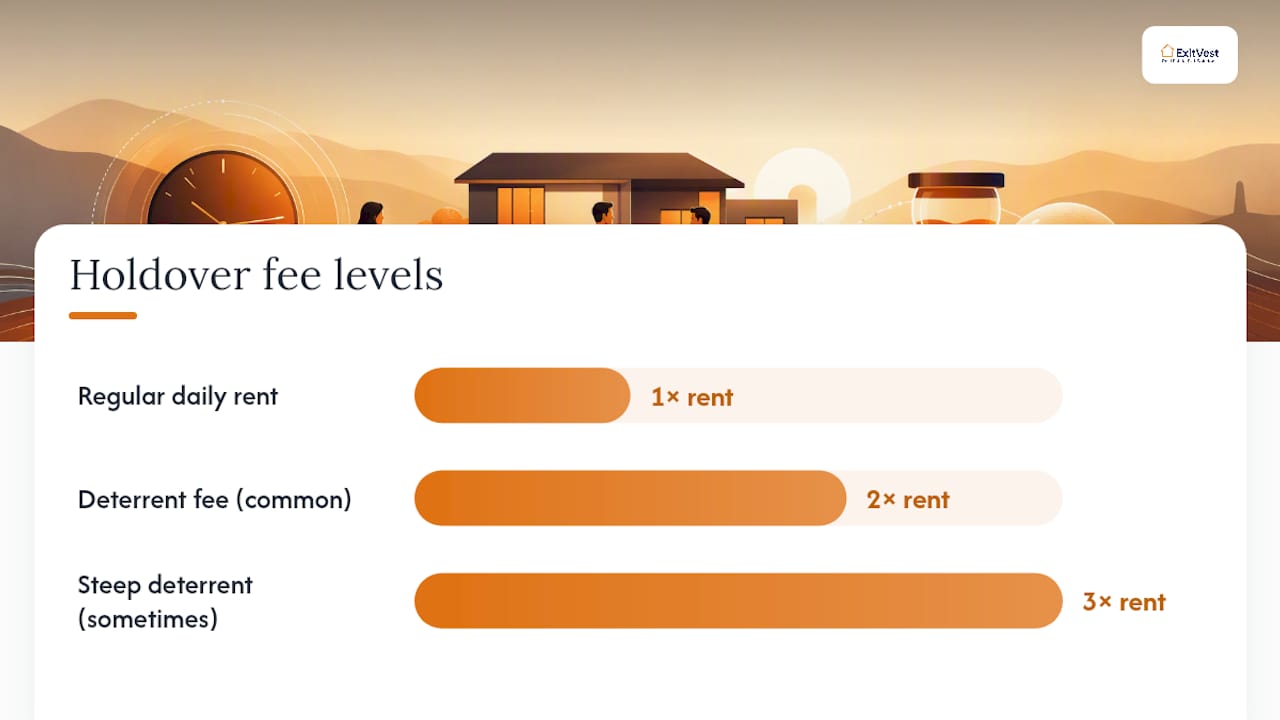
A well-drafted addendum builds in a holdover penalty, usually a daily fee that's noticeably higher than the regular rent rate, sometimes double or triple, specifically to make overstaying expensive rather than convenient. Some agreements also hold back a portion of sale proceeds in escrow, releasing those funds to the seller only after the buyer confirms a clean, on-time move-out at final walkthrough.
If a seller does refuse to leave past the agreed date, the buyer's only lawful path is a formal eviction, sometimes called an unlawful detainer or holdover proceeding, filed through the local court system. Self-help remedies, meaning a buyer changing the locks, shutting off utilities, or removing a seller's belongings without a court order, are illegal in every state, regardless of how airtight the buyer's case is.
Practical safeguards worth building into any agreement:
- A holdover fee steep enough to actually discourage lingering, not a token amount.
- A documented, photographed condition report signed by both parties before the seller moves in as a tenant.
- A named point of escalation, ideally a real estate attorney, if the move-out date passes without resolution.
- An escrow holdback tied to final walkthrough confirmation, giving the seller a financial incentive to leave on time.
Consumer protection groups have flagged a related pattern worth knowing about: sale-leaseback scams targeting financially distressed homeowners with vague verbal promises instead of documented terms. If a buyer resists putting rent-back terms in writing, that resistance is the warning sign, not an oversight to work around.
Rent-Back Negotiation Checklist for Sellers
Bring this list to your agent or attorney before you ask for a rent-back, not after the buyer has already countered with different terms.
- Exact move-out date, stated as a calendar date, not a duration.
- Rent amount and the method used to calculate it (PITI-based daily rate or market rent).
- Security deposit amount and where it's held during the stay.
- Who pays utilities during the occupancy period.
- Who handles maintenance and repairs if something breaks mid-stay.
- Proof of insurance from both parties, with policy numbers listed.
- Access rights, meaning whether the buyer can inspect the property before move-out.
- Holdover fee amount and how it escalates for each additional day.
- Whether extensions are allowed at all, and under what conditions.
- Written lender acknowledgment confirming the rent-back doesn't violate occupancy terms.
| Negotiation lever | What it does for the seller |
|---|---|
| Prepay full rent at closing | Removes ongoing collection friction, simplifies the paperwork |
| Offer a larger security deposit | Signals good faith, can shorten buyer hesitation on terms |
| Accept a steeper holdover fee | Makes the buyer more comfortable granting extra days if needed |
| Request an escrow holdback release tied to walkthrough | Gives both sides a clean, verifiable exit point |
Make sure the signed addendum gets forwarded to escrow before closing day, not handed over as a separate document afterward. If it isn't part of the official closing package, it's not enforceable the same way, and you're relying on goodwill instead of a contract.
What Should You Do at Closing to Set Up the Rent-Back?
Walk into closing with copies of the signed occupancy addendum, a written note from the buyer's lender acknowledging the arrangement, and proof of your own renters insurance policy. Title companies increasingly expect these documents as part of the standard closing call process, and having them ready avoids a scramble at the table.
Confirm who's holding the security deposit, typically the title company or an attorney's escrow account, and get written confirmation of the exact release conditions.
Before you hand over keys, run through this same-day checklist:
- Utilities transferred to your name for the rent-back period, or confirmed still active under the buyer's account with reimbursement terms spelled out.
- Movers or storage scheduled for your actual move-out date, with a buffer day if possible.
- Renters insurance policy active, not just applied for.
- A copy of every signed document saved somewhere other than your phone.
Small gaps here cause most of the friction that shows up three weeks later.
ExitVest's Perspective: When a Cash Sale Beats a Rent-Back
Rent-backs solve a real timing problem, but they're not free of risk, and they're not the only fix. If you're facing foreclosure, dealing with a problem tenant, or juggling repairs you can't afford before listing, a guaranteed cash sale with a flexible move date often removes the pressure that makes a rent-back necessary in the first place.
Exitvest buys houses as-is, sets its own closing timeline around your schedule, and skips the financing contingencies that make lender occupancy rules a factor at all. For sellers who want certainty over negotiation, that's often the simpler path, and it's worth comparing before you draft a rent-back addendum at all.
— Alek
A Simpler Path Than Negotiating a Lease Back
Not every seller wants to negotiate holdover penalties, lender acknowledgments, and insurance endorsements just to buy a few extra weeks in a house they've already sold. Exitvest offers a direct alternative: a cash offer on your property as-is, with a closing date built around your timeline instead of a lender's occupancy clock.
There's no financing contingency to trip over, no buyer's underwriter to satisfy, and no rent formula to argue about, because there's no landlord relationship to set up in the first place. If your situation involves a tight moving window, an inherited property, a tenant issue, or repairs you don't want to tackle before selling, Exitvest's straightforward cash-offer process is built for exactly that. Reach out for a no-pressure offer and see what a guaranteed closing date looks like compared to negotiating a rent-back from scratch.
Where to Verify Rent-Back Rules Before You Sign
Check the IRS rules on rental income and Publication 523 for the 14-day tax threshold, and confirm occupancy terms directly with the buyer's lender rather than relying on secondhand assurances. Guides from Chase and Nolo cover typical clauses in more depth. Security deposit and eviction procedures vary by state, so confirm local rules before finalizing terms.
This article is general information, not a substitute for advice from a qualified lawyer. Consult a qualified legal professional about your own circumstances before acting on anything here.
Sources
- Publication 523 (Selling Your Home) | IRS
- What Is a Lease Back? How It Works for Buyers and Sellers - LegalClarity
- Rent-back agreements: How they work, pros and cons | Rocket Mortgage
- How to Sell Your Home With a Rent-Back Agreement | Chase