

Home selling fees beyond commissions are the additional costs that determine your true net proceeds when you sell a property. Agent commissions get all the attention, but seller closing costs typically add another 1%–3% of the sale price before you factor in staging, repairs, or concessions. On a $400,000 home, that gap between your sale price and your check at closing can easily reach $30,000 or more. This guide breaks down every major fee category so you can plan accurately and avoid costly surprises.
1. What are home selling fees beyond commissions?
Seller closing costs are the industry term for the fees and expenses a seller pays at or before closing, separate from agent commissions. These costs cover title work, government taxes, escrow services, and loan payoff obligations. Understanding the full property selling fees breakdown before you list is the only way to set a realistic price and protect your proceeds.
Closing costs for sellers typically range between 1%–3% of the sale price and include title work, escrow fees, and transfer taxes. That range does not include agent commissions, which historically added another 5%–6%. Knowing both numbers together gives you the real cost of selling.

2. Closing costs sellers pay at the table
The fees below hit your proceeds at closing. Most are non-negotiable because they are set by local law or lender requirements.
| Fee | Typical Cost | Notes |
|---|---|---|
| Owner's title insurance | 0.5%–1% of sale price | Protects the buyer; often a seller obligation |
| Escrow or settlement fee | $500–$2,000 | Varies by state and transaction complexity |
| Transfer taxes | 0.1%–2.2% of sale price | Wide geographic variance; highest in New York and Pennsylvania |
| Recording fees | $50–$250 | Set by the county recorder's office |
| Prorated property taxes | Varies | Covers the seller's ownership period in the tax year |
Transfer taxes deserve special attention because they vary so dramatically. A seller in Delaware pays 4% of the sale price in combined transfer taxes, while a seller in Texas pays none. Know your state's rules before you price your home.
Prorated property taxes are one of the most frequently missed fees, causing costly surprises unless sellers plan for them early. On a $6,000 annual tax bill, closing in June means you owe roughly $3,000 at the table. That is real money that disappears from your proceeds if you did not account for it.
Pro Tip: Request a preliminary closing disclosure from your title company or escrow officer at least two weeks before closing. It lists every fee line by line, giving you time to question or negotiate anything unexpected.
3. How staging, repairs, and seller concessions add to your costs
These costs happen before and during the transaction, not just at closing. They are also the most controllable part of your real estate selling expenses if you plan ahead.
Pre-sale preparation typically costs 1%–4% of the home value, averaging $5,400, with staging costs between $800 and $2,500 that often increase sale price premiums. Nearly 65% of sellers complete at least two improvement projects before listing. That investment usually pays off, but it still comes out of your pocket before you see a dollar.
Staging is not just furniture arrangement. Professional stagers in markets like New Jersey and Florida regularly charge $2,000 or more for a full-home setup. The return is real: staged homes sell faster and often above asking price. The cost is also real, and most sellers underestimate it when budgeting.
Repairs are the other major pre-sale expense. A buyer's inspection almost always surfaces issues, and the negotiation that follows drives seller concessions. Sellers commonly budget approximately 2% of the sale price for concessions like repair credits or buyer closing cost credits to save deals. On a $350,000 home, that is $7,000 you may hand back to the buyer after the inspection report lands.
Common types of seller concessions include:
- Repair credits: Cash toward specific repairs the buyer will handle after closing
- Closing cost credits: Seller pays a portion of the buyer's closing costs
- Home warranty: A one-year policy that covers major systems and appliances
- Price reductions: A formal price drop after inspection or appraisal issues
- Rate buydowns: Seller pays points to lower the buyer's mortgage rate
Pro Tip: Get a pre-listing inspection before you list. Knowing your home's condition upfront lets you price repairs into your asking price instead of conceding them under pressure during negotiations.
If you want to skip repairs entirely, selling without repairs is a real option that more sellers are choosing in 2026 to avoid this cost category altogether.
4. What hidden fees should sellers expect?
Hidden fees in home sales are not truly hidden. They are just buried in documents most sellers never read until closing day. These are the costs that cause the most frustration because they feel avoidable in hindsight.
HOA transfer and document fees
If your property sits in a homeowners association, expect fees at closing that go beyond your regular dues. HOA transfer fees, estoppel certificate fees, and capital contribution fees can total over $1,000, creating unexpected closing costs for sellers. Sellers in HOA communities should request not only transfer fees but all associated document preparation and capital contribution fees to fully anticipate their closing costs. Call your HOA management company the moment you decide to sell.
Mortgage prepayment penalties
Mortgage prepayment penalties can cost 2%–5% of the remaining mortgage balance. They are classified as hidden fees because they are uncommon but financially significant and only detailed in original loan documents. Pull out your original loan agreement and look for a prepayment penalty clause before you list. On a $200,000 remaining balance, a 3% penalty is $6,000 you did not see coming.
Carrying costs for vacant homes
Carrying costs for vacant homes, including utilities, insurance, and landscaping, add ongoing monthly expenses that erode seller proceeds while the home sits on the market. A vacant home in Tennessee or Florida can cost $500–$1,500 per month in carrying costs alone. Every extra month on the market is money leaving your pocket.
Attorney fees
Attorney fees run $500–$1,500 for straightforward home sales and up to $3,000 for complex transactions. Some states, including New Jersey, require a real estate attorney for every residential closing. Even where attorneys are optional, hiring one for an estate sale, a divorce sale, or a property with title complications is money well spent.
Moving expenses
Moving costs are part of your home sale transaction costs even though no one puts them on a closing disclosure. Local moves average $1,000–$2,500. Long-distance moves can exceed $5,000. Budget for this before you calculate your net proceeds.
5. How the 2024 NAR settlement changed seller fees
Commission structures became fully negotiable after the 2024 NAR settlement, which removed buyer agent compensation from MLS listings. This is the biggest structural change to real estate selling expenses in decades. Sellers now decide if they want to offer buyer agent compensation and how much.
With commissions now negotiable, sellers can better control listing costs and steer offers more strategically based on how much they are willing to spend on agent fees. That flexibility creates real options for reducing your total cost of sale.
Strategies sellers are using in 2026 to manage agent fees:
- Flat fee MLS listings: Pay a set fee to list on the MLS without a full-service listing agent
- Tiered commission agreements: Offer a higher commission if the home sells above a target price
- Buyer agent fee caps: Offer a fixed dollar amount toward buyer agent compensation instead of a percentage
- Dual agency arrangements: One agent represents both sides, sometimes at a reduced total commission
- For sale by owner (FSBO): Eliminate listing agent fees entirely, though this requires more seller involvement
To understand how these changes affect your specific situation, selling without agent fees is now a realistic path for sellers who are willing to handle more of the process themselves.
The NAR settlement did not eliminate buyer agent fees. It made them a negotiating point. Sellers who understand this shift can use it to reduce their total home sale transaction costs by thousands of dollars.
Key takeaways
Seller closing costs, staging, concessions, and hidden fees can add 3%–8% to your total cost of selling on top of agent commissions.
| Point | Details |
|---|---|
| Closing costs are 1%–3% | Title, escrow, transfer taxes, and recording fees add up before commissions. |
| Prorated taxes catch sellers off guard | A mid-year closing on a $6,000 tax bill costs roughly $3,000 at the table. |
| Concessions average 2% of sale price | Budget $7,000 on a $350,000 home for repair credits or closing cost credits. |
| HOA and prepayment fees are truly hidden | Request HOA fee schedules and review your loan documents before listing. |
| NAR settlement made commissions negotiable | Sellers now control buyer agent compensation, reducing total selling costs. |
What I've learned about fees sellers never see coming
I've worked with enough sellers to know that the closing disclosure is rarely a surprise to buyers. It almost always surprises sellers. The reason is simple: buyers spend months studying costs before they make an offer. Sellers spend months thinking about their sale price and almost no time thinking about what comes out of it.
The fees that hurt the most are not the big ones. Title insurance is expected. Transfer taxes are expected. The fees that cause real damage are the ones that arrive in the last two weeks before closing. An HOA estoppel fee you did not know existed. A prepayment penalty buried in a 2019 loan agreement. A prorated tax bill that covers eight months of a year you thought you were done with.
My honest advice: treat your net proceeds calculation the same way you treat your asking price. Be specific, be conservative, and update it every time new information arrives. Pull your mortgage statement and find the payoff amount. Call your HOA and ask for every fee they charge at closing. Ask your title company for a seller net sheet before you accept any offer.
The sellers who feel good about their closing are the ones who did this work early. The ones who feel burned are the ones who found out at the table.
— Alek
How Exitvest helps sellers avoid unexpected fees
Selling through a traditional listing means absorbing every fee in this article. Exitvest offers a direct alternative.
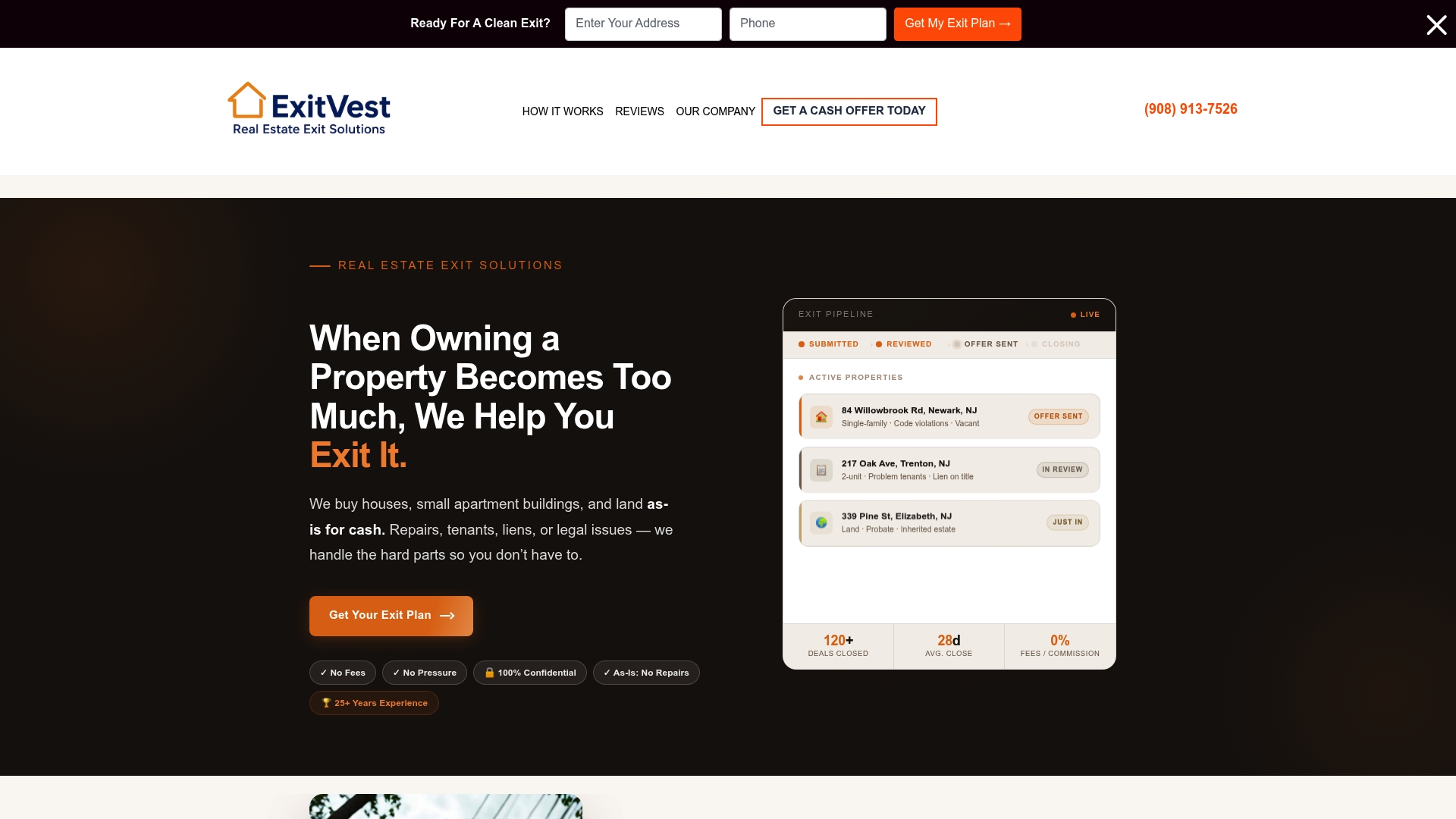
Exitvest buys houses, land, and small apartment buildings as-is for cash, with no repairs required and no agent commissions. Exitvest covers closing costs, which eliminates title fees, escrow charges, and transfer tax surprises from your side of the ledger. Fast closings also cut carrying costs for vacant or problem properties. If you are facing foreclosure, an inherited property, financial pressure, or a home you simply no longer want, see how the process works and get a no-pressure cash offer. Exitvest operates nationwide with strong coverage in New Jersey, Texas, Florida, and Tennessee.
FAQ
What are typical seller closing costs beyond commissions?
Seller closing costs typically range from 1%–3% of the sale price and include title insurance, escrow fees, transfer taxes, and recording fees. These costs vary by state and the specific terms of your sale.
What are seller concessions and how much do they cost?
Seller concessions are credits or payments a seller offers to close a deal after inspection or appraisal issues. Sellers typically budget about 2% of the sale price for concessions such as repair credits or buyer closing cost assistance.
Are HOA fees part of seller closing costs?
Yes. HOA transfer fees, estoppel certificates, and capital contribution fees can total over $1,000 at closing. Request a complete fee schedule from your HOA management company before you list your property.
Can sellers avoid paying buyer agent commissions in 2026?
Yes. The 2024 NAR settlement removed buyer agent compensation from MLS listings, making it fully negotiable. Sellers now choose whether to offer buyer agent fees and at what amount.
What is a mortgage prepayment penalty?
A mortgage prepayment penalty is a fee charged by some lenders when a borrower pays off a loan early, including at the time of a home sale. These penalties can reach 2%–5% of the remaining balance and are only disclosed in the original loan documents.