

A cash offer in real estate is when the buyer pays the full purchase price upfront, with no mortgage lender involved. A financed offer relies on a mortgage loan, meaning the deal depends on underwriting approval, appraisals, and lender timelines before closing. Understanding the cash offer vs financed offer explained distinction is the single most important factor sellers face when evaluating competing bids. 63% of sellers receive at least one all-cash or no-financing-contingency offer in current markets, yet many sellers still default to the highest number on paper without weighing the full picture. The right choice depends on your timeline, risk tolerance, and what you actually walk away with after closing costs.
What are the main advantages and disadvantages of cash offers?
Cash offers remove the two biggest threats to any real estate transaction: lender delays and financing collapse. When a buyer pays cash, there is no underwriting process, no appraisal required by a bank, and no loan officer who can kill the deal at the last minute. Cash offers close in as few as 7 to 14 days, compared to 30 to 90 days for a financed transaction. For sellers facing foreclosure, an estate deadline, or a job relocation, that speed difference is not a minor convenience. It is the difference between solving the problem and missing the window entirely.
The trade-off is price. Cash buyers typically offer 2 to 5% below the asking price, and they know sellers will often accept that discount in exchange for certainty. This means a $400,000 home might net you $380,000 to $392,000 from a cash buyer versus a higher number from a financed buyer. Whether that discount is worth it depends entirely on your situation, not on a universal rule.

There is also a verification problem that catches sellers off guard. "Cash offer" sounds ironclad, but cash on paper can be misleading. A buyer who says they have the funds and a buyer who can actually wire the full amount at closing are not always the same person. Sellers should require recent bank statements or a letter from a financial institution confirming liquid assets before accepting any cash offer.
Pro Tip: Always request documented proof of funds dated within 30 days, not just a letter of intent. A real cash buyer will provide this without hesitation.
Key advantages and disadvantages at a glance:
- Speed: Closes in 7 to 14 days with no lender involvement
- Certainty: No financing contingency means fewer deal-killing conditions
- Simplicity: No appraisal required by a lender, fewer third parties involved
- Price discount: Expect 2 to 5% below market value in most cases
- Verification risk: Sellers must confirm liquid funds independently before accepting
How do financed offers work and what benefits can they provide?
A financed offer works through a structured mortgage process. The buyer applies for a loan, the lender orders an appraisal, an underwriter reviews the buyer's income and credit, and the deal closes only after the lender issues a clear-to-close. This process typically takes 30 to 60 days for a conventional loan, though some lenders push timelines to 90 days on complex files. Understanding mortgage underwriting helps sellers recognize what stages can cause delays and what documentation signals a strong buyer.
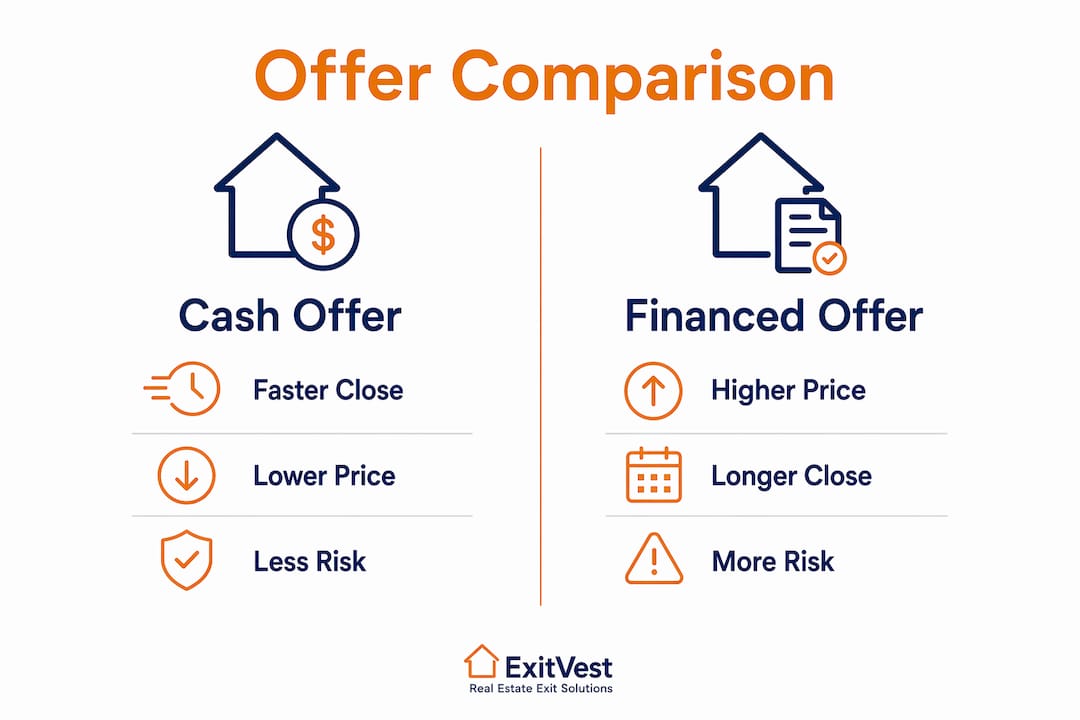
The most important and often overlooked fact about financed offers is that they frequently produce higher net proceeds for sellers. Across a dataset of 85,000+ Pennsylvania transactions, financed buyers paid an average of 100.1% of asking price while cash buyers settled at 98.9%. On a $350,000 home, that gap represents roughly $4,200 in additional proceeds before any concessions. The price premium from financed buyers is real and consistent across many market segments.
The risk of a financed offer is not the financing itself. The risk is a poorly structured offer with weak documentation. Here is what separates a strong financed offer from a risky one:
- Pre-underwriting approval letter: This goes beyond a standard pre-qualification. The lender has already reviewed income, assets, and credit before the offer is made.
- Large earnest money deposit: A deposit of 3 to 5% of the purchase price signals serious intent and financial capacity.
- Contingency waivers: Buyers who waive the financing contingency, backed by a pre-underwriting letter, remove the primary risk sellers fear.
- Transfer tax coverage: Strong offers sometimes include the buyer covering transfer taxes, which directly improves seller net proceeds.
- Appraisal gap coverage: A written commitment to cover any gap between appraised value and purchase price protects the seller if the appraisal comes in low.
Pro Tip: Before comparing offers, calculate your net proceeds for each scenario. Subtract agent commissions, transfer taxes, any concessions, and closing credits. The financed offer at a higher price often wins on paper once you run the actual numbers.
Financing as a tool also preserves the buyer's liquidity and can provide tax advantages, which means motivated, financially stable buyers often choose financing even when they could pay cash. That is a signal of buyer quality, not buyer weakness.
What are the key differences in risk and certainty between cash and financed offers?
Risk is where most sellers make their biggest evaluation mistakes. They treat "cash" as synonymous with "safe" and "financed" as synonymous with "risky," but neither label tells the full story.
Financing problems cause roughly 40% of all failed real estate sales, and about 15% of financed deals collapse before closing. Those are real numbers that justify caution. But they also describe poorly structured financed offers, not all financed offers. A buyer with a pre-underwriting commitment letter from a reputable lender like Wells Fargo or Rocket Mortgage, combined with a 5% earnest money deposit and a contingency waiver, carries far less risk than those averages suggest.
Cash offers carry their own risk profile. The danger is not financing collapse but liquidity fraud. Sellers must verify that the buyer's funds are liquid, accessible, and not tied up in assets that cannot be converted before closing. A buyer who plans to sell stock or liquidate a retirement account to fund the purchase is not truly a cash buyer in the practical sense.
| Risk factor | Cash offer | Financed offer |
|---|---|---|
| Financing collapse | None | 15% failure rate without pre-underwriting |
| Liquidity verification | Required via bank statements | Handled by lender during underwriting |
| Appraisal risk | None (no lender appraisal) | Present unless buyer waives appraisal gap |
| Timeline certainty | High (7 to 14 days) | Moderate to high with pre-underwriting |
| Price certainty | Lower (2 to 5% discount typical) | Higher with competitive financed buyers |
Pro Tip: Read every financing letter carefully. A pre-qualification letter means almost nothing. A pre-underwriting approval letter from the lender means the hard work is already done. Ask your agent to confirm which type you are looking at before making any decision.
How do market factors and buyer strategies shape the decision?
Cash offers appear across all price points, not just luxury or investor segments. This matters because sellers of modest homes sometimes dismiss cash offers as investor lowballs without realizing that cash buyers operate at every tier of the market. In competitive markets like New Jersey, Florida, and Tennessee, where Exitvest operates, cash offers frequently appear on properties priced between $150,000 and $500,000.
Investor cash buyers and owner-occupant financed buyers behave very differently at the negotiating table. Investors prioritize speed and discount. They want to close fast, pay less, and move on. Owner-occupants using financing are emotionally invested in the home and will often stretch their price to win. This behavioral difference is why financed offers from owner-occupants frequently exceed investor cash offers in final sale price.
A newer development worth understanding is cash-backed financing. Programs like Golden Ticket financing and bridge loan structures allow buyers to make cash-style offers without liquidating all their assets upfront. The lender funds the purchase as cash, and the buyer refinances afterward. From the seller's perspective, these offers close with the speed and certainty of cash while the buyer retains their financial flexibility.
Several factors should guide your decision beyond the offer price:
- Your timeline: If you need to close in under 30 days, a cash offer or cash-backed financing is your only realistic path.
- Your property condition: Homes that need significant repairs often fail lender appraisals. Cash buyers skip that hurdle entirely.
- Buyer profile: An owner-occupant with pre-underwriting approval is a safer financed buyer than an investor with a vague proof of funds letter.
- Market competition: In a multiple-offer scenario, a financed offer with contingency waivers and a large deposit can be just as competitive as cash.
Why sellers accept lower cash offers often comes down to certainty and timing rather than a failure to negotiate. When the property has deferred maintenance, title complications, or a seller under financial pressure, the guaranteed close outweighs the price gap.
Key takeaways
The best offer type is not determined by the financing label but by the net proceeds, closing certainty, and timeline alignment with the seller's actual situation.
| Point | Details |
|---|---|
| Cash offers close faster | Expect 7 to 14 days versus 30 to 90 days for financed transactions. |
| Financed buyers often pay more | Data from 85,000+ transactions shows financed buyers average 100.1% of asking price. |
| Verify cash buyer liquidity | Require recent bank statements confirming liquid funds before accepting any cash offer. |
| Strong financed offers reduce risk | Pre-underwriting letters and large earnest money deposits rival cash offer certainty. |
| Net proceeds matter most | Calculate actual take-home after commissions, taxes, and concessions for both offer types. |
What I've learned from watching sellers choose the wrong offer
Most sellers I've seen regret their decision in the same direction: they took the cash offer without doing the math. The number looked lower, but they assumed certainty was worth any price. Sometimes it is. But when a financed buyer comes in $15,000 higher with a pre-underwriting letter and a 4% earnest money deposit, walking away from that for a slightly faster close is a real cost, not a free trade-off.
The other mistake runs the opposite direction. Sellers take the highest financed offer from a buyer with a basic pre-qualification letter and no contingency waivers, then watch the deal collapse six weeks later when the lender denies the loan. That outcome is entirely preventable if you read the documentation carefully and ask the right questions upfront.
What I consistently tell sellers is this: the label on the offer, cash or financed, tells you almost nothing. The documentation behind it tells you everything. A cash offer without verified liquid funds is riskier than a financed offer with a pre-underwriting commitment. A financed offer with no contingency waivers and a 1% deposit is riskier than a cash offer with bank statements in hand.
Experienced agents emphasize net proceeds and contingency terms over financing type, and that approach consistently produces better outcomes for sellers. Align your decision with your actual timeline and financial goals, not with the conventional wisdom that cash always wins.
— Alek
How Exitvest makes cash offers simple for sellers
If you are a homeowner weighing your options and a fast, certain close matters more than squeezing every dollar from a drawn-out process, Exitvest is built for exactly that situation.
Exitvest buys houses, land, and small apartment buildings directly from sellers across New Jersey, Texas, Florida, and Tennessee, with no agent commissions, no repair requirements, and no lender timelines to manage. Whether you are dealing with an inherited property, a vacant home, financial pressure, or a house that simply needs to move, Exitvest provides a straightforward cash offer with a flexible closing date based on your schedule. There is no obligation to accept, and the process is designed to give you a clear answer fast. If you want to understand what a real cash offer looks like for your specific property, see how it works and get started without any pressure.
FAQ
What is the main difference between a cash and financed offer?
A cash offer means the buyer pays the full purchase price upfront with no mortgage, while a financed offer depends on lender approval and underwriting before closing. Cash offers close faster but typically come in 2 to 5% below asking price.
How long does a financed offer take to close?
Financed offers typically close in 30 to 60 days, though complex transactions can extend to 90 days. Cash offers close in as few as 7 to 14 days with no lender involvement.
Are financed offers riskier than cash offers for sellers?
Financing problems cause about 40% of failed sales, but a financed offer backed by a pre-underwriting letter and a large earnest money deposit carries significantly lower risk than a standard pre-qualified offer.
Should I always accept a cash offer over a financed offer?
Not automatically. Financed buyers often pay more, with data showing they average 100.1% of asking price versus 98.9% for cash buyers. Evaluate net proceeds, buyer documentation, and your timeline before deciding.
How do I verify a cash offer is legitimate?
Require recent bank statements, dated within 30 days, showing liquid funds equal to or greater than the purchase price. A genuine cash buyer will provide this documentation without delay.