

Selling a house with liens in NJ is possible, and most homeowners complete the process without paying a single dollar upfront. A lien is a legal claim attached to your property, filed by a creditor to secure a debt you owe. The IRS, New Jersey tax authorities, mortgage lenders, judgment creditors, and child support agencies all have the legal right to file liens. None of those claims automatically block a sale. What they do require is a clear plan: identify every lien, understand the payoff order, and use your sale proceeds to settle debts at closing.
How to sell a house with liens in NJ: what you need to know first
Liens on a house in NJ fall into two categories. Voluntary liens are ones you agreed to, like your mortgage. Involuntary liens are filed against you without your consent, including federal tax liens, state tax liens, judgment liens from lawsuits, and child support liens.
The distinction matters because involuntary liens often carry higher emotional weight but are frequently negotiable. Liens create legal claims on your property, but they do not result in immediate seizure. Lienholders generally prefer a negotiated payoff over a drawn-out collection process. That reality gives you more leverage than most homeowners realize.
Title defects caused by unpaid liens affect nearly 1 in 4 real estate transactions in New Jersey. That statistic explains why title companies require proof of lien satisfaction before issuing title insurance, and why buyers and their lenders will not close without it.
Pro Tip: Order a preliminary title report before you list the property. It costs between $75 and $200 and reveals every lien on record, giving you time to plan instead of react.
Common lien types you may encounter in New Jersey include:
- Federal tax liens filed by the IRS for unpaid income taxes
- State and municipal tax liens for unpaid property or income taxes
- Judgment liens from civil court rulings against you
- Child support liens coordinated through NJ Probation
- HOA liens for unpaid homeowner association fees
- Mechanic's liens filed by contractors for unpaid work
Each type has its own rules, timelines, and negotiation options. Knowing which ones you face is the first step toward selling your property.
How lien priority affects what you actually receive at closing

Lien priority determines who gets paid first from your sale proceeds. New Jersey places property tax liens at the top of the priority order, followed by government claims, then mortgages, IRS liens, judgment liens, and HOA liens at the bottom. That order is fixed by law, not by negotiation.
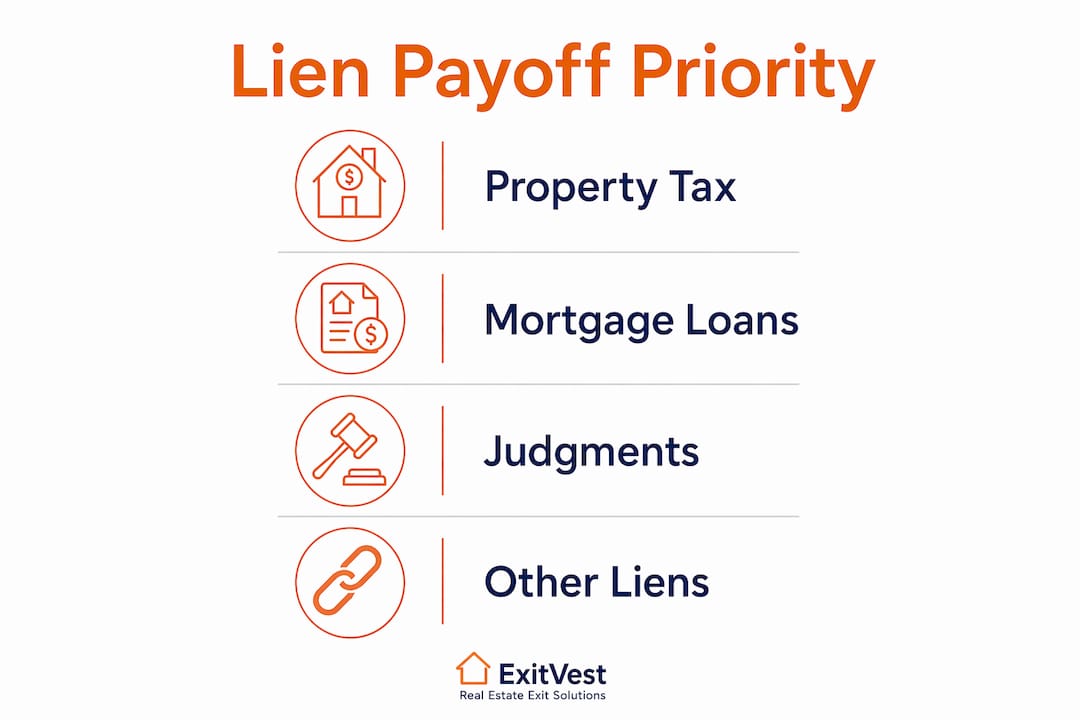
Understanding priority is critical because it directly controls how much money you walk away with. If your property sells for $300,000 and you carry $280,000 in total liens, the payoff sequence determines whether any surplus reaches you at all.
| Lien type | Priority level | Notes |
|---|---|---|
| Property tax lien | Highest | Paid first, no exceptions |
| State government lien | Second | Includes NJ income tax debts |
| First mortgage | Third | Largest balance in most cases |
| Federal IRS lien | Fourth | Discharge or subordination available |
| Judgment lien | Fifth | Often negotiable below face value |
| HOA lien | Lowest | Smallest balance, easiest to resolve |
The title company or escrow agent manages the actual payoff sequence at closing. They collect the full sale price, pay each lienholder in priority order, and release the remaining balance to you. You do not write checks to creditors yourself. The process is structured and handled by professionals.
Pro Tip: Request written payoff statements from every lienholder before you accept an offer. Payoff figures change monthly due to accruing interest and penalties, so get updated numbers within 30 days of your expected closing date.
When total liens exceed the sale price, you face a short sale scenario. That requires your mortgage lender to approve a sale for less than the balance owed. Short sales add time and complexity, but they remain a viable path for homeowners who cannot cover the gap from personal funds.
Strategies for selling a property with liens in New Jersey
You have four main options when selling a home with encumbrances in New Jersey. The right choice depends on your lien total, your timeline, and how much equity you have.
Pay liens from sale proceeds at closing
This is the most common approach. The title company holds the sale funds in escrow and pays each lienholder directly before releasing anything to you. You need no upfront cash, and the process is clean. It works best when your equity exceeds your total lien balance.
Negotiate reduced payoffs before closing
Many creditors accept settlements well below the full amount owed, especially judgment holders and the IRS. Creditors know that collecting through the courts takes years and costs money. A discounted lump sum at closing is often more attractive to them than waiting. This is a realistic option that many sellers overlook entirely.
Use IRS Form 14135 for federal tax lien discharge
If the IRS holds a lien on your property, you can apply for a Certificate of Discharge using IRS Form 14135. This removes the lien from the specific property being sold, even if the underlying tax debt remains. The IRS typically reviews these applications in 30–45 days, though the full process can add 45 or more days to your timeline. Plan for this early if a federal tax lien is in play.
Sell to a cash buyer experienced with lien properties
Properties sold to cash buyers with lien complications close 40–60% faster than traditional sales, often within 7–14 days after liens are resolved. Cash buyers work with specialized title companies, understand lien negotiations, and do not require mortgage financing that could fall apart over title issues. For homeowners in financial distress, this speed difference is significant. Exitvest buys properties in New Jersey regardless of lien status, handling the complexity so you do not have to.
Common mistakes to avoid during this process:
- Accepting an offer without knowing your full lien total first
- Failing to get updated payoff statements close to the closing date
- Assuming all liens must be paid in full without attempting negotiation
- Skipping legal counsel when multiple or disputed liens are involved
- Waiting too long to apply for IRS discharge if a federal tax lien exists
Step-by-step guide to preparing your lien-encumbered property for sale
A structured approach prevents the surprises that derail most lien-affected sales. Follow these steps before you list or accept any offer.
- Order a preliminary title report. A title report costs $75–$200 and reveals all liens and encumbrances on record. Do this before you set a listing price or talk to buyers.
- Contact every lienholder for a payoff statement. Call or write each creditor and request a written payoff figure valid for 30 days. Include accrued interest and any fees.
- Calculate your net position. Add up all lien payoffs plus estimated closing costs. Subtract that total from your expected sale price. The result tells you whether you will net money or face a shortfall.
- Consult a real estate attorney. New Jersey law requires an attorney review period in most residential transactions. An attorney protects your interests and can negotiate directly with lienholders on your behalf.
- Prepare for negotiation if liens exceed equity. If your lien total is close to or above your sale price, contact creditors early to discuss reduced settlements. Do not wait until you are under contract.
- Disclose liens to buyers. New Jersey law requires honest disclosure of known encumbrances. Buyers who discover hidden liens late in the process will walk away, and you may face legal liability.
Pro Tip: For child support liens in New Jersey, title agents coordinate directly with NJ Probation for payoff. You typically do not need upfront cash. Confirm this process with your title company early so it does not delay closing.
Common challenges when selling a house with title issues in NJ
Even well-prepared sellers encounter obstacles. Knowing what to expect reduces the chance of a deal falling apart.
- Delayed payoff validation. Lienholders sometimes take weeks to respond to payoff requests. Start the process early and follow up in writing.
- Unexpected liens discovered late. Old judgment liens or mechanic's liens from prior owners can surface during the title search. A preliminary report ordered early gives you time to address them before a buyer is involved.
- Buyers withdrawing over title concerns. Some buyers panic when they see liens on a title report. Working with a title company that communicates clearly with all parties keeps deals together.
- Conflicting priority claims. When two creditors dispute their position in the payoff order, closing can stall. A real estate attorney resolves these disputes faster than you can on your own.
- Personal funds needed to close. If liens exceed sale proceeds, you may need to bring cash to the closing table or negotiate a short sale. Know this number before you go under contract.
- IRS discharge timing. Federal tax lien discharge applications add 45 or more days to the process. If you have an IRS lien, file Form 14135 as soon as you have a signed purchase agreement.
For homeowners also dealing with foreclosure risk, selling a home in foreclosure in New Jersey follows a similar framework but with tighter deadlines. Speed matters more in those situations, which is another reason cash buyers are often the most practical path.
Key Takeaways
Selling a house with liens in NJ requires identifying every lien early, understanding the payoff priority order, and using sale proceeds or negotiated settlements to clear all claims at closing.
| Point | Details |
|---|---|
| Liens do not block a sale | Most liens are paid at closing from sale proceeds, requiring no upfront cash from the seller. |
| Priority order is fixed by law | Property tax liens are paid first; judgment and HOA liens are paid last, often leaving little surplus. |
| Negotiation is a real option | Judgment holders and the IRS regularly accept reduced settlements to avoid long collection processes. |
| Early title report prevents surprises | A $75–$200 preliminary title report reveals all liens before buyers are involved, protecting the deal. |
| Cash buyers close faster | Cash buyers with lien experience close 40–60% faster than traditional sales, often within 7–14 days. |
What I have learned from watching sellers navigate liens in New Jersey
Most homeowners I have seen in this situation make the same mistake: they assume the lien total is the final word. They see a $50,000 judgment lien and believe they owe $50,000. That is rarely true. Judgment creditors know the court system is slow and expensive. A seller offering $30,000 at closing, right now, is often more attractive to them than waiting years for a full recovery.
The second thing I have noticed is that sellers wait too long to get legal help. A real estate attorney in New Jersey costs money, but the cost of a deal collapsing because of an unresolved lien dispute is far higher. Get an attorney involved before you accept an offer, not after problems surface.
Cash buyers get a bad reputation in some circles, but for lien-encumbered properties, they are genuinely the most practical option in many cases. They do not need mortgage approval, they work with title companies that specialize in complex closings, and they move fast. If you are in financial distress and need this resolved in weeks rather than months, that speed has real value. I have seen sellers lose their window to avoid foreclosure because they held out for a traditional buyer who eventually walked away over title concerns.
The emotional weight of liens is real. These situations often come with shame, stress, and fear. But liens are a legal and financial problem, not a moral one. They have solutions. The sellers who come out ahead are the ones who face the numbers honestly, get the right professionals involved early, and stay focused on the outcome they want.
If you are also dealing with an inherited property that carries liens, the guide to selling inherited houses in NJ covers the additional probate and title considerations that apply in those cases.
— Alek
Exitvest buys NJ properties with liens, as-is and for cash
Liens, title complications, and financial pressure do not have to mean a long, uncertain sale process. Exitvest makes cash offers on New Jersey properties regardless of lien status, and works directly with title professionals to handle the payoff coordination.
You do not need to repair the property, pay off liens before closing, or wait months for a traditional buyer to qualify for financing. Exitvest provides a fair cash offer, a flexible closing timeline, and a clear process from start to finish. If you want to know what your property is worth and what a cash sale could look like for your situation, get a no-obligation cash offer from Exitvest today. There is no pressure and no commitment required. You can also see how the process works before you decide anything.
FAQ
Can you sell a house with liens in New Jersey?
Yes. Liens do not prevent a sale. Most liens are paid directly from sale proceeds at closing, with the title company coordinating payoffs in the legally required priority order.
Do I need to pay off liens before listing my home?
No. Most sellers pay liens at closing using sale proceeds. Paying them off beforehand is an option but is not required to list or sell the property.
What happens if my liens are more than my home is worth?
If total liens exceed the sale price, you may need lender approval for a short sale or bring personal funds to closing. Negotiating reduced payoffs with creditors is often the most practical solution.
How long does it take to sell a house with a federal tax lien in NJ?
If you pay the IRS lien from closing proceeds, no pre-approval is needed. If you apply for a Certificate of Discharge using IRS Form 14135, the review process typically takes 30–45 days and can add 45 or more days to your overall timeline.
What is the fastest way to sell a lien-encumbered property in NJ?
Selling to a cash buyer is the fastest option. Cash buyers experienced with lien properties close 40–60% faster than traditional sales, often within 7–14 days after liens are resolved.