

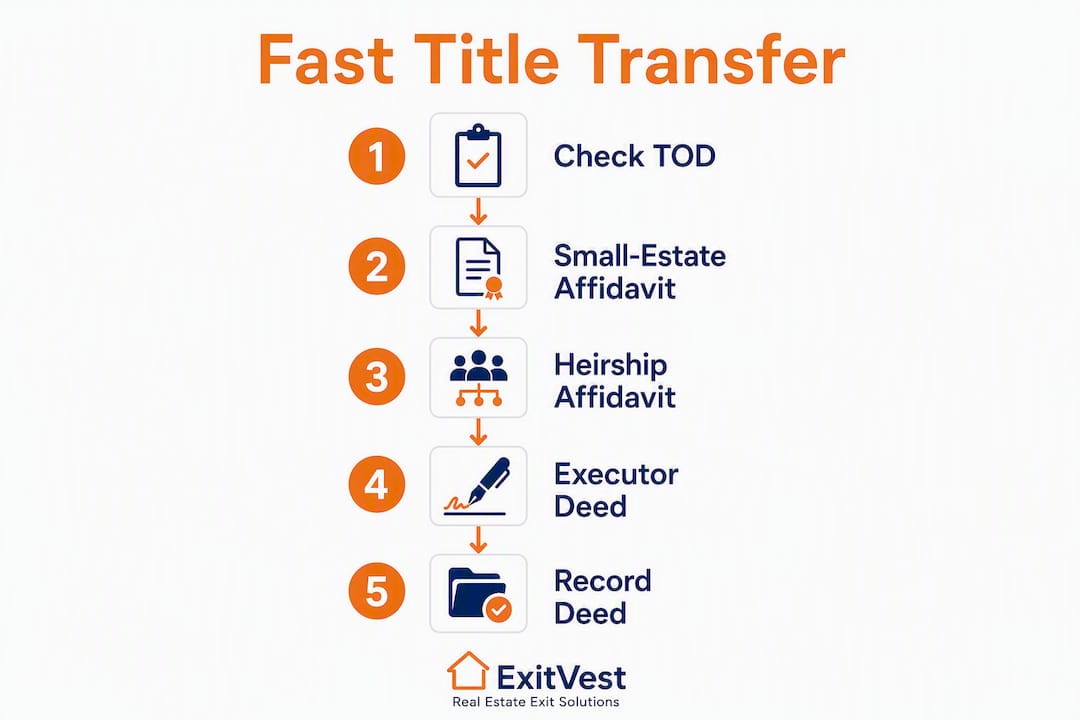
If speed is your priority, the fastest legal route depends entirely on how the property is titled. A recorded transfer-on-death (TOD) deed is the quickest path: the beneficiary records acceptance with the county recorder and title clears without probate. No TOD deed? A small-estate affidavit works in many states when the estate falls under the dollar threshold. Everything else — contested heirs, liens, no will — typically means probate, which can stretch months or longer. If you need cash now, selling directly to a cash buyer like Exitvest is often faster than waiting out any court process.
Quick decision rules:
- TOD deed already recorded: Record beneficiary acceptance at the county recorder. Title clears in days. You can sell immediately.
- Estate qualifies for small-estate affidavit: File the affidavit, record it with the county, and transfer title without a judge. Weeks, not months.
- Valid will, no TOD deed: Executor files for probate and issues an executor deed. Expect 6–12 months minimum in most states.
- No will (intestate): Intestate probate is slower. An affidavit of heirship (state-dependent) can sometimes substitute for real property.
- Liens, disputes, or foreclosure risk: A cash sale to a buyer who handles title issues is often the fastest exit that preserves value.
This week's action: Call the county recorder to confirm whether a TOD deed is on file. Gather the death certificate, the existing deed, and any will. Request a cash offer in parallel — you can always decline it.
Table of Contents
- What are the fastest legal routes to transfer inherited property title?
- How to transfer inherited property title fast: your action checklist
- What delays the title transfer and how do you get past them?
- Key Takeaways
- Why recordation and a cash sale should come first when speed matters
- Exitvest buys inherited properties as-is, fast, and without the usual friction
- Useful sources and where to find state-specific forms
What are the fastest legal routes to transfer inherited property title?
The method that moves fastest depends on three things: whether a TOD deed was recorded before death, whether a valid will exists, and whether the estate clears your state's small-estate threshold.

Transfer-on-death deeds are the gold standard for speed. The owner names a beneficiary on a recorded deed before death. When the owner dies, the beneficiary records an acceptance document and a certified death certificate at the county recorder. TOD deeds avoid probate entirely — title transfers in days, not months. Not every state recognizes them, so check your state's rules first.
Small-estate affidavits are the next fastest option when the estate qualifies. States set dollar thresholds and asset-type limits; if the estate clears those bars, heirs can file a short affidavit with the county instead of opening probate. Texas, for example, limits the small-estate affidavit for real property to a surviving spouse or minor children — adult children must use an affidavit of heirship instead.
Affidavits of heirship apply when there is no will and the estate is primarily real property. In Texas, once recorded in the county deed records, an affidavit of heirship becomes evidence of title after five years on file. It does not instantly transfer title the way a TOD deed does, but it creates a chain of title that lets heirs sell.
Executor or administrator deeds come into play when probate is unavoidable. A valid will speeds this up considerably — a valid will usually lets an executor transfer property under supervised probate, while intestate probate adds time because the court must first determine heirs.
| Method | Typical Timeline | Rough Cost | Best When |
|---|---|---|---|
| TOD deed acceptance | Days | Recording fee only | TOD deed was recorded before death |
| Small-estate affidavit | Several weeks | Filing fees, attorney optional | Estate under state dollar threshold |
| Affidavit of heirship | Several weeks to record; longer for full legal effect | Low | No will; real property; state allows it |
| Executor/administrator deed | 6–12 months minimum (with will); over a year (intestate) | Probate court fees, attorney | Valid will or intestate; no shortcut available |
| Cash sale (as-is) | A few weeks | No commissions; discount on price | Speed is non-negotiable; liens or disputes exist |
Recording the deed at the county recorder is not optional regardless of method. A deed transfers title on delivery and acceptance, but recording creates the public notice that protects the new owner against later purchasers who have no knowledge of the transfer.
How to transfer inherited property title fast: your action checklist
Move through these steps in order. Skipping any one of them is the most common reason title transfers stall.
- Obtain certified copies of the death certificate. Order at least four. County recorders, title companies, and lenders all require originals or certified copies — not photocopies.
- Locate the original deed and any recorded TOD deed. Search the county recorder's online index by the decedent's name. A recorded TOD deed changes everything about your timeline.
- Pull a title search or ownership-and-encumbrance report. This surfaces liens, unpaid taxes, and any competing claims before you spend money on transfer documents. A title company or real estate attorney can run one quickly.
- Identify the correct transfer method using the table above. If a TOD deed exists, go straight to step 5. If not, confirm whether the estate qualifies for a small-estate affidavit in your state.
- Prepare the transfer document. For a TOD acceptance, you need the beneficiary's acceptance affidavit plus the death certificate. For a small-estate affidavit, use your state's official form. For an executor deed, the probate court issues letters testamentary first.
- Have the document notarized and witnessed per your state's requirements.
- Record the document at the county recorder immediately. Same-day electronic recording is available in many counties through e-recording providers or legal document assistants — this compresses recording time from weeks to hours where the service is offered.
- Notify the mortgage servicer if a loan exists. Lenders can accelerate a mortgage after the owner's death, which creates foreclosure risk. Getting ahead of this call matters.
Documents typically required by method:
- TOD acceptance: Certified death certificate, beneficiary ID, acceptance affidavit
- Small-estate affidavit: Certified death certificate, affidavit (state form), property legal description, heir IDs
- Executor deed: Letters testamentary, certified death certificate, probate court order, existing deed, IDs
- Affidavit of heirship: Disinterested witness statements, legal description, certified death certificate
| Scenario | Fastest Realistic Timeline |
|---|---|
| TOD deed recorded | Same day to a few days (e-recording) |
| Small-estate affidavit | Several weeks depending on county |
| Affidavit of heirship | Several weeks to record; longer for full title effect |
| Full probate (with will) | Several months to about a year |
| Full probate (intestate) | Over a year |
| Cash sale to direct buyer | Several weeks from offer to close |
Pro Tip: Order certified death certificates directly from the state vital records office online — most states process expedited orders in 3–5 business days, which is faster than going through a funeral home. Ask for six copies; running out mid-process costs weeks.
What delays the title transfer and how do you get past them?
Most title transfers stall for one of five reasons. Knowing which one you're facing tells you exactly how to respond.
No will (intestate). Without a will, the court must determine heirs before any transfer can happen. An affidavit of heirship sidesteps this for real property in states that allow it, but contested heirs can block even that route. If two siblings disagree on who gets what, probate is unavoidable unless everyone signs a written agreement.
Recorded liens or unpaid property taxes. A lien does not stop a transfer, but it travels with the property. Any buyer — including a cash buyer — will want it resolved or priced into the offer. Call the lienholder directly for a payoff quote; most provide one within a week. Unpaid property taxes are usually the easiest to resolve since the county will give you a payoff figure the same day.
Missing or unknown original deed. The county recorder's index is your first stop. If the deed was never recorded, a clouded title blocks any marketable sale until a court quiets title or a new deed is established through probate.
Mortgage acceleration. Lenders may demand full repayment after the owner's death, triggering foreclosure risk. This is the scenario where a fast cash sale most clearly beats waiting out probate — a buyer closes before the lender acts.
Occupants or squatters. A cash buyer who purchases as-is typically handles occupant situations post-close. Trying to remove occupants before a sale adds weeks and legal fees.
When liens, disputes, and a missing will all land at once, the math often favors a cash sale. Probate attorney fees, carrying costs, property taxes, and repair expenses during a 12–18 month probate can easily exceed the discount a cash buyer requires. Selling as-is for cash is not giving up value — it is often the option that preserves the most of it.
Pro Tip: If a co-heir is uncooperative, document every communication in writing. A quitclaim deed between heirs who agree can consolidate ownership quickly — but it carries no title warranty, so follow it with a title search before any sale.
Key Takeaways
The single fastest legal route to clear an inherited title is a recorded TOD deed followed by beneficiary acceptance; when that is not available, a cash sale to a direct buyer like Exitvest is typically faster than completing full probate.
| Point | Details |
|---|---|
| Check for a TOD deed first | A recorded TOD deed clears title in days — it is the fastest legal path available. |
| Small-estate affidavit when eligible | If the estate meets your state's threshold, this skips probate and takes weeks, not months. |
| Record immediately after transfer | An unrecorded deed leaves the new owner exposed to later purchasers who lack notice. |
| Mortgage acceleration is urgent | Notify the lender early; foreclosure risk makes speed non-negotiable when a loan exists. |
| Exitvest cash sale as the fastest exit | When liens, disputes, or probate would drag on, Exitvest buys as-is and can close in 2–4 weeks. |
Why recordation and a cash sale should come first when speed matters
The conventional advice is to complete probate properly before selling. That is sound legal guidance — but it ignores the real cost of time. Carrying a vacant inherited property for 12–18 months means property taxes, insurance, potential code violations, and deferred maintenance that compounds. The legal process is not free either: probate attorney fees in contested estates can run into thousands of dollars before a deed ever transfers.
What most guides understate is the recording step itself. A deed that is delivered but never recorded leaves the new owner legally exposed. A subsequent buyer with no notice of the prior transfer can, in many states, take priority. Recording is not a formality — it is the act that makes the transfer real in the eyes of every future buyer, lender, and court.
On the cash-sale tradeoff: yes, a direct buyer offers less than retail. But when you factor in avoided probate costs, no agent commissions, no repair expenses, and a close in weeks rather than a year, the net difference often narrows considerably. For heirs who live out of state, have no interest in managing the property, or are facing a mortgage acceleration notice, the math frequently tips toward the cash sale.
The practical move is to pursue both tracks in parallel: start the legal transfer process and request a cash offer at the same time. You keep all options open and lose nothing by knowing what a buyer will pay.
Exitvest buys inherited properties as-is, fast, and without the usual friction
Inherited a property with liens, deferred repairs, or a probate clock ticking? Exitvest purchases houses, land, and small apartment buildings directly for cash, in as-is condition, with no agent commissions and no pressure to fix anything first.

The process is straightforward: share basic property details, receive a cash offer, sign the purchase agreement, and let Exitvest coordinate title and escrow. Most closings happen in 2–4 weeks when speed is the priority. Exitvest operates nationwide, with particular depth in New Jersey, Texas, Florida, and Tennessee — states where inherited-property rules and timelines vary most.
This is not the path for every heir. If the estate is clean, the title is clear, and you have time to list on the open market, a traditional sale will likely net more. But if you are dealing with a distressed or inherited property where probate, liens, or occupant issues make a standard listing impractical, Exitvest is built for exactly that situation. Request your cash offer at exitvest.com/how-it-works and know your number before committing to anything.
Useful sources and where to find state-specific forms
The rules for small-estate affidavits, affidavit of heirship eligibility, and TOD deed recognition differ by state. These resources help you find the right forms and confirm local recording requirements:
- Texas Law Help — Transferring Property Without Probate: Covers small-estate affidavits, affidavits of heirship, and TOD deeds with Texas-specific rules and form guidance.
- Illinois Legal Aid Online — Settling an Estate: Explains small-estate procedures and TOD instruments with state-specific thresholds and deadlines.
- LegalShield — How Long to Transfer Property After Death: Covers will vs. intestacy timelines, mortgage acceleration risk, and clouded-title consequences.
- TruPoint Legal — Deed Transfer and E-Recording: Explains same-day electronic recording options and flat-fee deed preparation services for non-escrow transfers.
- Your county recorder's website: Search "[county name] recorder deed recording" to find local fees, e-recording availability, and same-day filing options.
| Resource | What It Covers |
|---|---|
| Texas Law Help | TX small-estate affidavit, affidavit of heirship, TOD deed rules |
| Illinois Legal Aid | IL small-estate thresholds, TOD instruments, estate FAQ |
| LegalShield blog | Probate timelines, will vs. intestacy, mortgage risk |
| TruPoint Legal | E-recording, deed prep services, same-day filing |
| County recorder site | Local fees, e-recording availability, required forms |
For deeper reading on the inherited-title process, Exitvest's blog covers inherited property title basics, selling without probate delay, and state-specific legal requirements for 2026.
This article is general information, not legal advice. Confirm current rules with your state's court system, county recorder, or a licensed real estate attorney before acting on your specific situation.