

When someone dies and leaves real estate behind, the property title doesn't simply float into an heir's hands. An inherited property title is the legal record proving that ownership of real estate has passed from a deceased person to a named heir or beneficiary, and getting that record updated requires deliberate legal steps. The process varies by state, by how the property was originally titled, and by whether the deceased left a will. Three main transfer methods exist: probate court administration, trust distribution, and automatic survivorship rights (such as joint tenancy or a transfer on death deed). A title search conducted by a title company or real estate attorney is the starting point for any of these paths, because it reveals existing liens, competing claims, and gaps in the ownership chain before they become your problem.
- Probate: Court-supervised process that validates a will and authorizes the executor to transfer title.
- Living trust: Property held in trust passes directly to beneficiaries without court involvement.
- Joint tenancy / tenancy by the entirety: The surviving co-owner receives full ownership automatically upon death.
- Transfer on death (TOD) deed: Available in many states; property bypasses probate and transfers directly to the named beneficiary.
How to transfer an inherited property title in the US
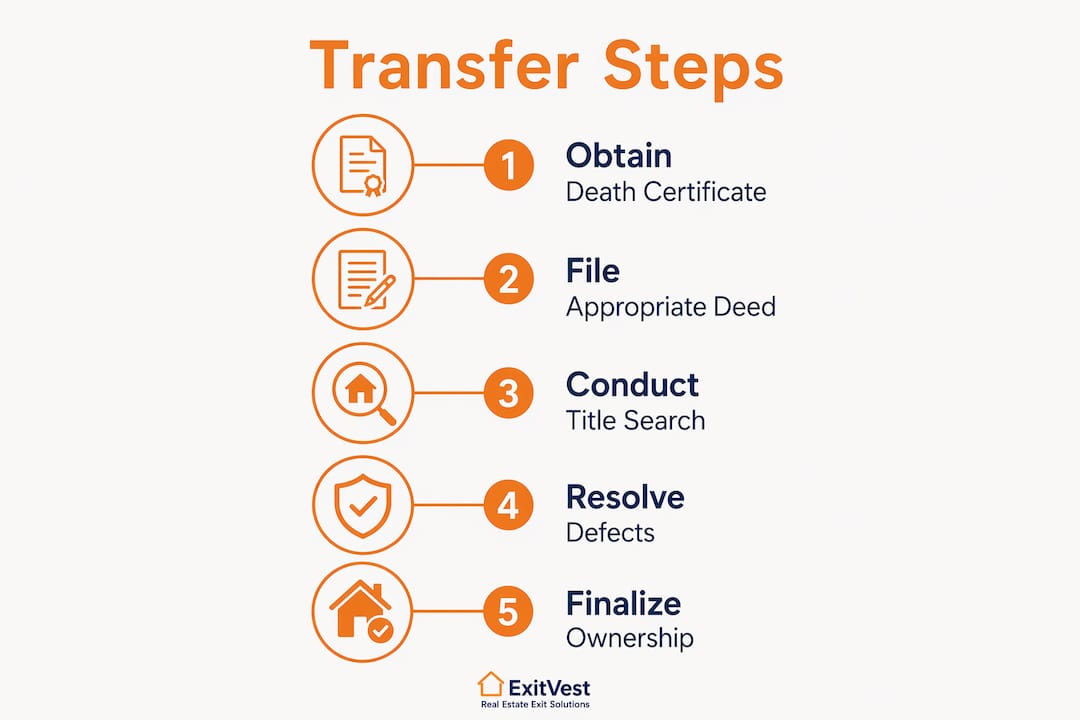
Transferring an inherited property title is a legal process that requires recording deeds or probate documents in the county land records office where the property sits. The exact steps depend on how the deceased held title and what estate planning tools were in place.
-
Determine how the property was titled. Pull the most recent recorded deed from the county recorder's office. It will show whether the deceased owned the property alone, as a joint tenant, or through a trust. That single document dictates which transfer path applies.
-
Locate the will and open probate if required. If the property was solely owned and not held in a trust, the estate typically goes through probate. File the will with the probate court or clerk of court in the county where the deceased lived. The court will appoint an executor (or personal representative) and issue Letters Testamentary, the document that gives the executor legal authority to act on behalf of the estate.
-
Obtain the right deed or transfer document. For probate estates, the executor prepares an executor's deed (sometimes called a personal representative's deed) conveying title from the estate to the heir. If the property passed through a trust, the trustee signs a trustee's deed. For a TOD deed, the beneficiary records a certified copy of the death certificate alongside the existing deed.
-
File the deed with county land records. The signed and notarized deed, along with any required probate court orders or certified copies, must be recorded at the county recorder or register of deeds office. Recording fees vary by county and state.
-
Handle multi-state property separately. If the deceased owned real estate in more than one state, each state's probate court may need to open an ancillary probate proceeding. This adds time and cost, so flag it early.
-
Update title insurance and property records. After recording, notify the county tax assessor of the ownership change so future tax bills reach the right person. If the property carries a mortgage, contact the lender as well.
Pro Tip: Get a certified copy of the death certificate as soon as possible after the owner's death. Most county offices, lenders, and title companies require it, and ordering multiple copies upfront saves weeks of back-and-forth.
What title defects in inherited property can cost you
Title defects are more common in inherited property than in conventional sales, and they can block a future sale, prevent refinancing, or trigger ownership disputes. The most frequent problems include:
- Missing or unknown heirs: If the deceased had children or relatives who were not named in the will, they may have a legal claim to the property.
- Unclear chain of title: Decades of informal transfers, unrecorded deeds, or estates that were never formally probated leave gaps that cloud ownership.
- Unresolved liens: Unpaid contractor bills, medical debt judgments, or IRS tax liens attach to the property and follow it to the new owner.
- Unpaid property taxes: Delinquent taxes can result in a tax lien or, in extreme cases, a tax sale that wipes out the heir's interest.
- Probate errors: A will that was improperly executed, a missed creditor claim, or an estate closed without addressing all assets can invalidate the transfer.
Quitclaim deeds are often used in family transfers because they are simple and cheap. The catch is that a quitclaim deed conveys only whatever interest the grantor actually holds, with zero warranty. If the grantor's title was defective, the defect transfers too.
When a title is genuinely clouded, two remedies are most common. An affidavit of heirship is a sworn statement signed by people who knew the deceased, establishing the family relationship and the heir's right to the property. It is recorded in the county land records and can resolve gaps where no formal probate occurred. For more complex disputes, a quiet title action filed in court forces a judicial ruling on who holds valid title, clearing competing claims of record.
Pro Tip: Order a title search before you spend money on repairs, insurance, or carrying costs. Finding a lien or a missing heir early costs far less than discovering it the week before closing.
If you are dealing with title issues on an inherited property, knowing your options early makes the difference between a clean resolution and a prolonged legal fight.
Why title insurance matters more for inherited property
Title insurance protects against undisclosed defects, liens, and competing claims that can surface after you take ownership. For inherited property, that protection is especially valuable because the chain of title often stretches back decades and may include informal transfers, unrecorded deeds, or estates that were never fully administered.

Before issuing a policy, a title insurance company conducts its own title search, reviewing public records going back as far as necessary to trace ownership. That search frequently turns up problems the heir did not know existed.
Key benefits of title insurance for heirs:
- Protection from prior liens: Covers financial losses if a creditor's lien surfaces after closing.
- Defense against ownership claims: The insurer pays legal costs if a previously unknown heir challenges your title.
- Smoother future sales: Buyers and their lenders almost always require a clean title insurance commitment before closing; having a policy in place speeds that process.
- Coverage for probate errors: Mistakes in the probate process, such as a creditor who was not properly notified, can generate claims years later. An owner's policy covers those.
Two policy types exist. An owner's policy protects the heir and stays in force as long as the heir or their heirs own the property. A lender's policy protects the mortgage lender if the heir refinances or takes out a loan against the property. Both are typically purchased at closing, and the one-time premium is modest relative to the protection provided.
Managing money and making decisions after you inherit property
Heirs generally do not owe federal income tax on inherited property itself, but financial responsibilities begin the moment ownership transfers, sometimes before the estate is even settled. Property taxes, homeowner's insurance, utilities, and maintenance costs continue regardless of where the probate process stands. If you are also the executor, those expenses may need to come from estate funds before the estate closes and the deed is re-titled in your name.
From a tax standpoint, inherited real estate generally receives a step-up in basis to its fair market value at the date of the owner's death. That means if you sell shortly after inheriting, capital gains taxes are often minimal. Getting a qualified appraisal soon after the death date locks in that basis and protects you if the IRS ever questions the numbers.
The keep-versus-sell decision comes down to a few concrete factors:
- Carrying costs: Mortgage payments, taxes, insurance, and maintenance add up fast, especially during a probate process that can run six months to over a year.
- Property condition: A house that needs a new roof and HVAC system before it can be rented or sold changes the math significantly.
- Market conditions: A rising market may reward patience; a declining one may not.
- Co-heirs: When siblings or other relatives inherit jointly, disagreements over what to do with the property are common. If no consensus is reached, a court can order a partition sale, often at below-market value.
- Emotional attachment: Sentiment is real, but it should be weighed against the financial reality of holding a property you do not plan to use.
Pro Tip: If you are inheriting with siblings, put the decision-making process in writing early. A simple written agreement on timelines and responsibilities prevents the kind of disputes that end up in partition court.
For heirs weighing their options, fastest ways to sell an inherited house covers the practical trade-offs between a traditional listing, an auction, and a direct cash sale.
If holding costs are mounting and a quick resolution makes more sense than a drawn-out listing process, Exitvest buys inherited properties as-is, nationwide, with flexible closing timelines. No repairs, no agent commissions, and no pressure. See how it works for heirs dealing with exactly this situation.

Common questions about inherited property titles
How do I change the title on an inherited property? File the appropriate deed (executor's deed, trustee's deed, or a recorded death certificate for TOD properties) with the county recorder's office where the property is located. The exact document depends on how the deceased held title.
Do I owe taxes when I inherit property? Heirs generally owe no federal income tax on the inheritance itself. The property receives a step-up in basis to its fair market value at the date of death, which reduces capital gains exposure if you sell soon after inheriting. Some states impose a separate inheritance tax, so check your state's rules.
How long does probate take? Timelines vary widely by state and estate complexity. Simple estates in cooperative states can close in a few months; contested estates or those with real estate in multiple states can take a year or more.
What is the difference between joint tenancy and tenancy in common in inheritance? Joint tenancy includes a right of survivorship, meaning the surviving co-owner automatically inherits the deceased's share without probate. Tenancy in common carries no survivorship right; each owner's share passes through their estate according to their will or state intestacy laws.
What happens if the title is disputed or unclear? A quiet title action filed in the appropriate state court forces a judicial determination of ownership, clearing competing claims from the public record. An affidavit of heirship is a faster, lower-cost alternative when the dispute involves only an unrecorded family transfer rather than an active competing claim.
Expert insights that most heirs miss
The biggest misconception about inheriting property is that title transfers automatically at the moment of death. Legally, an heir's interest does vest immediately upon the owner's death, but that vesting is invisible to the public record until the proper documents are filed. A buyer, a lender, or a title company will not recognize your ownership until the county land records reflect it.
Legal interest vests immediately upon death, but formal proof of ownership can take weeks or months to appear in the public record. That gap is where problems breed. An heir who pays property taxes and maintains a home for years without updating the title can find themselves unable to sell because no lender will issue a mortgage on a property with a stale title.
A subtler issue arises when the executor and the sole heir are the same person. Even then, the estate requires a formal deed transfer from the estate to the individual before the property can be sold or mortgaged. The estate is a separate legal entity, and the executor's authority to act for the estate does not automatically make the heir the titled owner of record.
Expert recommendations for heirs navigating inherited property:
- Hire a real estate attorney early. State laws on probate, TOD deeds, and intestate succession differ enough that general advice can mislead.
- Order a title search before making any financial commitments. Repairs, renovations, and carrying costs are wasted if a title defect surfaces later.
- Get a dated appraisal. It establishes the step-up in basis and protects against IRS scrutiny if you sell later.
- Consider title insurance even if you plan to sell quickly. Buyers' lenders will require it, and having a clean title commitment ready accelerates closing.
- Address co-heir disagreements in writing. A simple agreement on timelines and responsibilities prevents partition actions.
For heirs who need to understand the full legal requirements for selling an inherited property, including probate clearance and deed recording, getting that clarity upfront prevents costly delays.
Key Takeaways
Clearing the title on inherited property is the single most important step an heir can take before making any financial decision about the property.
| Point | Details |
|---|---|
| Title does not transfer automatically | Legal interest vests at death, but county land records must be updated through formal deed filing before ownership is recognized publicly. |
| Probate type determines the path | Whether the estate goes through probate, a trust, or a TOD deed determines which documents you need and how long the process takes. |
| Title defects are common and fixable | Liens, missing heirs, and clouded chains of title can be resolved through affidavits of heirship or quiet title actions before they block a sale. |
| Title insurance protects against hidden claims | An owner's policy covers financial losses from defects, prior liens, and ownership challenges that surface after you take title. |
| Step-up in basis reduces capital gains | Inherited property is valued at fair market value at the date of death; a qualified appraisal within 30–60 days locks in that basis. |