

You can close a home sale in days, not months, by selling as-is to a vetted cash investor. Cash eliminates lender approval timelines, appraisals, and most contingencies, which is why investor transactions close far faster than financed sales. A realistic window for a clean cash deal is typically about two weeks, though it can be as fast as a few days or take up to three weeks depending on three conditions:
- Verified cash proof: The buyer holds liquid funds confirmed in writing, not a promise to fund.
- Clear title or a fast cure path: No unresolved liens, probate holds, or ownership disputes.
- Seller paperwork ready: Payoff statement, government ID, deed copy, and keys in hand before closing day.
Selling as-is to a cash investor usually means accepting a price below full market value. For sellers facing foreclosure, mounting carrying costs, or an inherited property they cannot maintain, that discount often costs less than months of mortgage payments, taxes, and repairs while a listing sits.
Speed and certainty are the trade. Understand that going in, and the process becomes straightforward.
Table of Contents
- What speeds up or slows down a cash-as-is sale?
- How to vet a cash buyer fast
- Costs and tradeoffs: what you may give up for speed
- What to prepare now to shave days off closing
- Common delays and how Exitvest handles them
- Key Takeaways
- Why the investor route is the right call when speed is the priority
- Exitvest gets you to closing without the wait
- Sources and further reading
What speeds up or slows down a cash-as-is sale?
Cash sales typically close in about two weeks, compared with 30–60 days for financed purchases. But "about two weeks" assumes everything is clean. Here is what actually moves the needle.
Title issues are the single biggest delay. A recorded lien, an old mortgage that was never released, or a missing heir on the deed can add days to weeks depending on the county recorder's workload and whether the problem requires a court order. Simple lien payoffs at closing are fast. Probate, quiet-title actions, or disputed ownership are not.
Buyer funding model matters more than their pitch. A buyer who wires from a funded escrow account closes faster than one who needs internal committee approval or a private lender draw. Ask upfront whether funds are already liquid or still being assembled.
| Factor | Fast scenario | Slow scenario |
|---|---|---|
| Buyer funding | Liquid cash in escrow | Pending lender draw or partner approval |
| Title status | Clear or minor payoff at closing | Lien dispute, probate, or missing heir |
| Escrow/title company | Local firm with same-day recording | Overloaded or out-of-state processor |
| Seller readiness | Payoff statement and ID ready | Waiting on lender payoff or estate documents |
| Occupancy | Vacant at closing | Tenant requiring formal eviction |
| Permits | All work permitted | Unpermitted addition flagged by title search |
Sellers with inherited properties or open permits should expect the longer end of that range. In states like Texas and Florida, local recording offices and title companies familiar with cash-investor closings can shave days off the back end of the process.
Key stat: Cash sales typically close in about two weeks, roughly half the time of a standard financed closing.
How to vet a cash buyer fast
Selling to an investor removes staging, open houses, and most buyer contingencies, but it also removes the lender's built-in vetting of the buyer. That job falls to you.
Ask for these three things before you sign anything:
- Written proof of funds (bank letter or escrow confirmation, dated within 30 days)
- The name and direct contact of their title/escrow company
- A clear, specific closing date in the purchase agreement
If the buyer uses an LLC or corporate entity, ask for the EIN and confirm the entity is in good standing. This takes two minutes on your state's Secretary of State website.
Pro Tip: When reviewing a proof-of-funds letter, look for the institution's letterhead, the account holder's name matching the buyer's entity, and a balance sufficient to cover the purchase price. A screenshot of a brokerage account is not a proof-of-funds letter.
A buyer who hesitates to name their title company or delays sending proof of funds is not ready to close. Legitimate, funded buyers expect these requests and answer them immediately.
Red flags to watch: vague answers about funding sources, pressure to sign before you've verified funds, no escrow contact provided, and buyer-only email communication with no third-party title involvement. Check Google reviews and ask for references from sellers they've closed with in the past 90 days.
Costs and tradeoffs: what you may give up for speed
Cash investor offers typically come in below full market value. The discount reflects the buyer's risk, repair costs, and the speed premium you're receiving. Understanding the full picture helps you decide whether the tradeoff makes sense.
| Cost item | Traditional listing | Cash investor sale |
|---|---|---|
| Agent commissions | 5–6% of sale price | None |
| Staging and repairs | — | None (sold as-is) |
| Carrying costs (mortgage, taxes, insurance) | 1–3% per month of delay | Eliminated at closing |
| Investor price discount | None | Typically 10–25% below market |
| Title and closing fees | Shared or seller-paid | Often negotiated; sometimes buyer-paid |
Key stat: Investor programs advertise closings in 7–30 days with no repairs or showings required, but most clean cash sales are completed in about two weeks, compared with the national average of 30–60+ days for financed sales.
A seller facing foreclosure in 45 days on a $250,000 home might net $195,000 from a cash investor after a 15% discount and minimal closing costs. The alternative, a listing that takes 60 days to close, could mean a foreclosure on record, legal fees, and credit damage that costs far more over time. The math shifts when you factor in what a delayed sale actually costs. Review the cash home sale benefits before deciding which route fits your situation.
What to prepare now to shave days off closing
Pull these together before you even accept an offer. Having them ready cuts 2–5 days from the average timeline.
- Government-issued photo ID (driver's license or passport)
- Mortgage payoff statement requested directly from your lender, valid for 30 days
- Copy of the deed (available from your county recorder's office if you don't have one)
- Recent property tax and utility bills (last 2–3 months)
- HOA contact and current ledger if the property is in an association
- All keys, garage codes, and gate access information
- Tenant contact details and lease copies if the property is occupied
- Photos of major systems (roof, HVAC, electrical panel) to answer buyer questions without scheduling additional walkthroughs
For inherited properties, gather the death certificate, letters testamentary, and any probate court filings before you contact buyers. Missing estate documents are among the most common reasons a fast-sale timeline stretches to weeks. A guide on selling an inherited house quickly covers the specific documents heirs need to move fast.
Minor fixes worth doing: secure any loose handrails, clear debris from entry points, and replace burned-out bulbs. None of these require a contractor, and all of them remove easy objections during a walkthrough.

Common delays and how Exitvest handles them
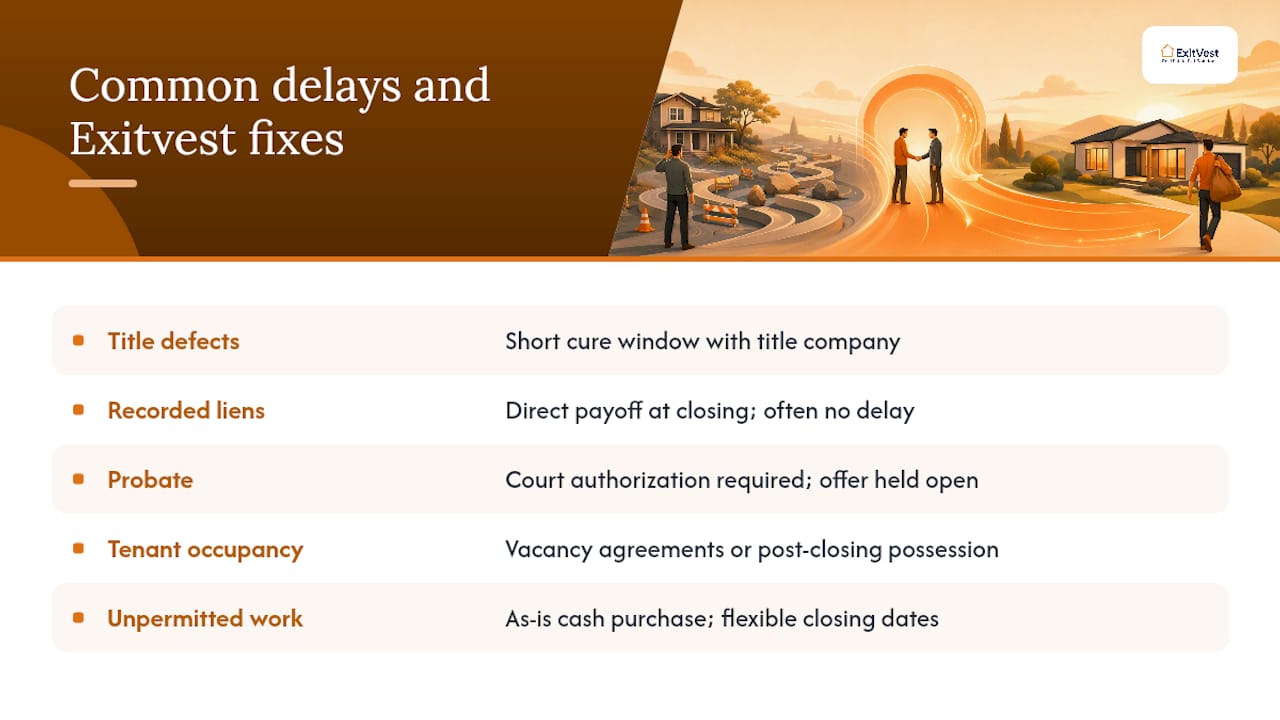
Most delays fall into five categories: title defects, recorded liens, probate requirements, tenant occupancy, and unpermitted work. Exitvest works with experienced local title partners to identify and triage these issues early, often within the first 48 hours after an offer is accepted.
Title defects and liens are resolved through escrow holdback arrangements or direct payoff at closing. For straightforward liens, this adds no meaningful time. For more complex defects, Exitvest coordinates a short cure window with the title company rather than canceling the transaction.
Probate situations require court authorization before a sale can close. Exitvest sets realistic timelines upfront for these cases and holds the offer open while the estate process moves forward, rather than pressuring sellers into signing before they have legal authority to sell.
Tenant occupancy is handled through coordinated vacancy agreements or post-closing possession arrangements, depending on the lease terms and state law.
Exitvest's as-is cash purchase process is built around flexible closing dates precisely because real-world properties rarely arrive with perfectly clean titles and vacant units. The goal is to close as fast as the property allows, not as fast as a marketing headline suggests.
Sellers in New Jersey, Texas, Florida, and Tennessee benefit from Exitvest's established relationships with local title companies that understand investor closing workflows and can prioritize recording when timelines are tight.
Key Takeaways
Selling as-is to a vetted cash investor with verified funds and a clear title is the fastest reliable way to close a home sale in days, not months.
| Point | Details |
|---|---|
| Verify funds first | Request a dated bank letter or escrow confirmation before signing any purchase agreement. |
| Title is the real timeline | Clear title closes in days; liens, probate, and defects add weeks without a mitigation plan. |
| Expect a price discount | Cash investor offers typically run 10–25% below market, but eliminate commissions, repairs, and carrying costs. |
| Prepare documents in advance | Payoff statement, deed copy, ID, and HOA ledger ready before offer acceptance cuts 2–5 days from closing. |
| Exitvest as your buyer | Exitvest buys as-is nationwide, handles title complications through local partners, and offers flexible closing dates. |
Why the investor route is the right call when speed is the priority
Speed versus price is a real tradeoff, and pretending otherwise does sellers a disservice. The investor route accepts a lower sticker number in exchange for certainty and a compressed timeline. For most sellers reading this, that is not a consolation prize. It is the correct financial decision.
Carrying costs are invisible until you add them up. Mortgage payments, property taxes, insurance, and utilities on a vacant or distressed property can run thousands of dollars per month. A 15% investor discount on a $200,000 home is $30,000. Three months of carrying costs plus agent commissions on a traditional sale can easily reach $20,000 or more, and that assumes the listing actually closes. Many don't.
The ethical side of this matters too. Sellers should always use a licensed title company, get proof of funds in writing, and never wire money to a buyer. Those protections exist regardless of how fast you want to close, and any legitimate cash buyer will support them without hesitation.
Exitvest gets you to closing without the wait
If you need to sell a house, land, or small apartment building fast, Exitvest buys properties as-is for cash with no agent commissions, no repair requirements, and no hidden fees. You pick the closing date that works for your situation, typically around two weeks for most cash transactions, but sometimes as fast as 7 days or as long as 30.
Here is what happens after you reach out:
- Submit your property details to get a cash offer today.
- Exitvest reviews the property and sends a written cash offer, typically within 24–48 hours.
- You verify proof of funds and confirm the title partner.
- Choose your closing date and sign the purchase agreement.
- Close with a licensed title company and receive your funds by wire.
No pressure, no obligation, and no surprises at the closing table. See how the process works and find out what your property is worth in cash.
Sources and further reading
The claims in this article are backed by the following sources. Review them directly to verify timelines, vetting guidance, and seller protections.
- Pros and Cons of Selling Your House to Investors | Zillow
- How to Sell My House for Cash | Zillow
- Should I Sell to a Home Investor or List With an Agent? | HomeLight
- Cash for houses in – how to sell your house for fast cash – ExitVest
- Sell Property As-Is for Cash | No Pressure | ExitVest
- Get A Cash Offer Today | ExitVest
- What Is a Cash Home Buyer? A Seller's Guide
General information only. This article is not legal, tax, or financial advice. Confirm current rules and your specific situation with a licensed real estate attorney or qualified professional before signing any purchase agreement.