

An executor can sell estate property, but only after legal authority formally vests. That authority arrives when the probate court issues Letters Testamentary (if there is a will) or Letters of Administration (if there is not). Being named in a will is not enough. Until you hold those certified letters in hand, you cannot sign a listing agreement, accept an offer, or close escrow without risking personal liability for a breach of fiduciary duty.
A few things control what you can do and when:
- Letters Testamentary or Letters of Administration are the court-issued documents that give you legal authority to act on the estate's behalf. No letters, no authority; be sure to complete the Sale Instruction Form | Parramatta Conveyancing to accurately document your authority and intentions.
- Will language matters. A power-of-sale clause in the will can simplify the process, but it does not replace the need for probate appointment in most states.
- Probate vs. non-probate ownership. Property held in a living trust, with a joint tenant, or with a transfer-on-death deed may pass outside probate entirely, bypassing the executor's role in the sale.
- State rules vary significantly. Some states permit independent administration, where you can sell without court confirmation. Others require a formal confirmation hearing, especially for supervised estates or sales to interested parties.
- Selling too early carries real consequences. A premature sale can be voided, and you may be held personally liable for any resulting losses to the estate.
Pro Tip: Request at least three certified copies of your Letters Testamentary or Letters of Administration from the probate court. Title companies, lenders, and real estate agents will each want an original-certified copy, and ordering them all at once is faster and cheaper than going back for more.
If the estate needs a fast, certain sale, Exitvest purchases properties as-is for cash nationwide, including properties in probate, with no commissions or listing delays.
Table of Contents
- What being an executor actually means for property sales
- How to confirm your legal authority before you list
- Pre-listing tasks that protect you and the estate
- Choosing between a traditional listing and a cash sale
- Handling offers, overbids, and court confirmation
- What happens at closing and how proceeds get distributed
- Tax considerations you cannot afford to skip
- Common mistakes executors make and how to avoid them
- Key Takeaways
- What practitioners get wrong about executor sales
- Executors who need a fast, certain sale: how Exitvest can help
- Useful sources for executors
What being an executor actually means for property sales
The American Bar Association describes an executor (also called a personal representative) as the individual who settles the estate according to the terms of the will, or under state intestacy laws when there is no will. A person serving without a will is typically called an administrator, not an executor, though the duties are nearly identical. A successor trustee is different again: that person manages trust assets, which pass outside probate and outside the executor's authority.
Fiduciary duty is not a formality. As executor, you are legally obligated to act in the best interests of the estate and its beneficiaries — not your own convenience, not the preferences of the loudest heir. Every decision you make about the property, from pricing to timing to choosing a buyer, must be defensible as a reasonable action taken for the estate's benefit. Selling below fair market value without documented justification, or favoring a buyer with whom you have a personal relationship, can expose you to personal liability even if everyone seemed fine with it at the time.
The core fiduciary duties that govern every property sale are:
- Loyalty: Act for the estate's benefit, not your own.
- Prudence: Make decisions a reasonable person in your position would make, including getting an appraisal.
- Impartiality: Balance the interests of all beneficiaries, not just the most vocal ones.
- Transparency: Keep beneficiaries informed and document every material decision.
The will's instructions take priority. If the will directs that a specific property be sold and the proceeds split equally, you must follow that instruction. If it directs that a property be distributed in-kind to a named beneficiary, selling it instead requires either beneficiary consent or a court order.
How to confirm your legal authority before you list
Before you contact a real estate agent or accept any offer, work through this checklist. Skipping steps here is where most executor liability problems start.
- File the will with the probate court. This is the first formal step. Most states require filing within 30–90 days of death, though the IRS notes that probate typically opens within that same window.
- Get formally appointed. Being named in the will is not authority. The court must confirm your appointment at a hearing or through a written order.
- Obtain certified Letters Testamentary or Letters of Administration. These are the documents that actually authorize you to sign deeds, open estate bank accounts, and execute contracts. Do not sign any sale document before you have them.
- Review the will for a power-of-sale clause. This clause grants you explicit authority to sell real property without returning to court for each transaction. Its presence can speed up the process considerably.
- Check your state's administration rules. Many states have adopted independent administration statutes that allow sales without prior court approval. Under supervised administration, or when selling to a related party, you will likely need a court confirmation hearing.
- Confirm how title is held. Pull the deed. If the property was held in a revocable living trust, it passes to the successor trustee, not through probate. If it was held jointly with right of survivorship, it passes to the surviving owner automatically.
- Consult a probate attorney. State rules differ enough that a one-hour consultation with a local probate attorney before you list can prevent months of delay later.
Timing is worth understanding clearly. Probate appointment can take anywhere from a few weeks to several months depending on the state, the court's docket, and whether anyone contests the will. Independent administration, once granted, lets you move quickly. Supervised administration adds a court confirmation step after you accept an offer, which typically adds four to eight weeks to the closing timeline.
Pre-listing tasks that protect you and the estate
Once you have your letters, the work before listing is where you protect yourself from beneficiary disputes and closing surprises.

Secure the property first. Change the locks, collect all known keys, and notify the homeowner's insurance carrier of the ownership change. Many standard policies lapse or exclude coverage when a property becomes vacant, so ask specifically about a vacancy endorsement. Use estate funds, not your personal money, for all expenses, and keep every receipt.
Order an appraisal or broker price opinion (BPO). A formal appraisal from a licensed appraiser gives you the strongest documentation of fair market value. A BPO from an experienced agent costs less and can be sufficient for lower-value properties, but for anything significant, the appraisal is worth the cost. Documented valuation is your primary defense if a beneficiary later claims you sold too cheap.
Run a title search early. Do not wait until you are under contract. A title search will surface outstanding mortgages, tax liens, judgment liens, mechanic's liens, and any clouds on ownership. Clearing these takes time, and discovering them at closing is how deals fall apart. Engaging a title company early in the process, rather than at the last minute, is one of the most practical things you can do.
Address tenants and maintenance. If the property has tenants, review their leases before listing. Selling a tenant-occupied property adds complexity, and some buyers will not touch it. Maintain utilities and basic upkeep throughout the listing period using estate funds.
Pro Tip: Photograph the property's condition thoroughly before any cleaning or repairs, and again before closing. Timestamped photos create a clear record that protects you if a buyer later claims the property was misrepresented or if a beneficiary disputes how the estate was managed.
Choosing between a traditional listing and a cash sale
The right sale method depends on the estate's specific needs, not a universal rule. Here is how the main options compare:
| Factor | Traditional agent listing | Cash buyer (as-is) |
|---|---|---|
| Timeline to close | 60–120+ days typical | Often 2–4 weeks |
| Price potential | Closest to full market value | Below market, but certain |
| Carrying costs | Higher (months of taxes, insurance, utilities) | Minimal |
| Repairs required | Often expected by buyers | None |
| Commissions/fees | Typically 5–6% of sale price | None |
| Certainty of close | Financing contingencies create risk | High certainty |
| Court confirmation delay | Applies equally | Applies equally |
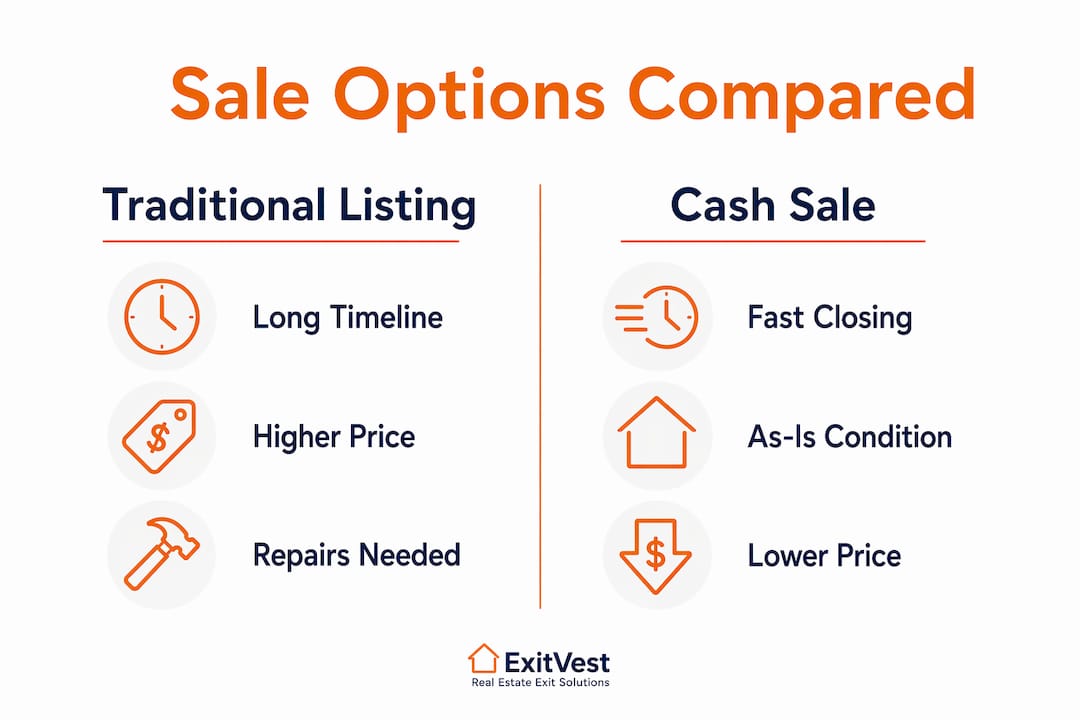
A traditional listing makes the most sense when the estate has time, the property is in good condition, and maximizing sale price is the primary goal. A cash sale becomes the defensible choice when the estate carries debt that needs to be paid quickly, when carrying costs are eroding the estate's value, when the property has deferred maintenance or code issues, or when tenant problems make a traditional showing difficult.
The key is documentation. Estate practitioners note that a cash sale can be entirely appropriate as an estate-purpose decision, but you must be able to show why speed or certainty served the estate better than waiting for a higher offer. Write a brief memo to the file explaining your reasoning, attach the appraisal or BPO, and keep it with your estate records.
When interviewing agents or cash buyers, ask specifically about their experience with probate transactions. A probate-experienced agent understands the documentation requirements, the timing constraints around court letters, and how to handle disclosure obligations in an estate context. The same applies to cash buyers for estate homes: ask whether they have closed probate purchases before and how they handle title curative issues.
Handling offers, overbids, and court confirmation
Evaluating an offer as an executor is not the same as evaluating one as a private seller. Your benchmark is fair market value, supported by your appraisal or BPO. An offer that comes in significantly below that figure needs either a documented reason to accept (estate debts, carrying costs, property condition) or a counteroffer.
When court confirmation is required, the process works differently than a standard sale. After you accept an offer, you petition the probate court to confirm the sale. At the confirmation hearing, other parties can submit competing bids, called overbids, which must typically exceed the accepted offer by a statutory minimum. The original buyer can be outbid and lose the sale entirely. This is a meaningful risk for buyers, which is why some will not pursue probate properties in supervised-administration states. If your state or your estate's administration type requires confirmation, disclose this to any buyer upfront.
State rules determine when confirmation is required. Under independent administration, most states allow you to sell without court approval as long as you notify beneficiaries and no one objects within the required window. Supervised administration, or a sale to an interested party (a beneficiary, a family member, or yourself), almost always requires a confirmation hearing regardless of state. If you are unsure which applies to you, that is a question for your probate attorney, not something to guess at.
Keep a paper trail through every stage of negotiation. Save all written offers, counteroffers, and communications. If a beneficiary objects to the sale price or the chosen buyer, your documentation is what demonstrates you acted prudently and in the estate's interest.
What happens at closing and how proceeds get distributed
Closing an estate property sale involves more paperwork than a standard residential transaction. The title company will require specific documents before it can issue title insurance and record the deed.
| Document | Purpose |
|---|---|
| Certified Letters Testamentary / Administration | Confirms executor's authority to sign |
| Court confirmation order (if required) | Authorizes the specific sale |
| Executor's deed | Transfers title in representative capacity |
| Payoff statements for all liens | Clears mortgages, tax liens, judgments |
| Death certificate | Establishes chain of title |
| Affidavit of heirship or survivorship (if needed) | Resolves ownership questions |
| Closing disclosure / settlement statement | Documents all proceeds and disbursements |
The role of the title company in an estate sale goes well beyond the standard transaction. Title companies verify your authority, run the title search, identify any curative work needed, and coordinate payoffs. Probate title problems are common, and a probate-savvy title company can often resolve them before closing through corrective affidavits, court orders, or lien releases. Engaging them early, not the week before closing, is what keeps deals on track.
After closing, the proceeds flow in a specific order. Pay estate debts and administration expenses first: outstanding mortgages, property taxes, liens, attorney fees, and executor compensation if the will or state law provides for it. Then pay any estate taxes owed. What remains is distributed to beneficiaries according to the will, or under state intestacy rules if there is no will.
Keep a detailed ledger of every dollar in and out, with supporting documentation. Most states require a formal accounting to be filed with the probate court before the estate can be closed, and beneficiaries are entitled to review it.
Tax considerations you cannot afford to skip
The most important tax concept for executors selling estate property is the stepped-up basis. When someone dies, the tax basis of their assets is generally reset to the fair market value on the date of death. If the estate sells the property shortly after death at or near that value, the capital gain is minimal or zero. If the estate holds the property for months and it appreciates, the estate (or the beneficiaries who receive it) may owe capital gains tax on the increase above the stepped-up basis.
Pro Tip: Get a formal date-of-death valuation from a licensed appraiser as soon as possible after appointment. This figure establishes the stepped-up basis and is required for both estate tax returns and any future capital gains calculations. Waiting months to order the appraisal makes the retrospective valuation harder to defend.
For federal estate tax, the IRS sets an exemption threshold that applies to the total taxable estate, not just the real property. Estates below that threshold owe no federal estate tax. Estates above it require a federal estate tax return. Many states also impose their own estate or inheritance taxes with lower thresholds, so check your state's rules specifically.
As executor, you are responsible for filing Form 1041 (U.S. Income Tax Return for Estates and Trusts) for any tax year in which the estate earns income, including rental income from the property before it sells or interest on estate bank accounts. If the estate owes federal estate tax, a separate Form 706 is required. For anything beyond a straightforward sale, a CPA with estate experience is worth the cost.
Common mistakes executors make and how to avoid them
Most executor liability problems trace back to a short list of preventable errors.
- Listing before you have Letters. Signing a listing agreement before the court issues your letters can invalidate the agreement and expose you to liability. Wait for the physical, certified document.
- Skipping the appraisal. Accepting an offer without documented fair market value gives beneficiaries grounds to claim you sold too cheap. An appraisal or BPO is cheap insurance.
- Poor beneficiary communication. Beneficiaries who feel left out become beneficiaries who file objections. Send written updates at each major milestone: appointment, listing, accepted offer, closing.
- Self-dealing without disclosure or court approval. Selling to yourself, a family member, or a business you control without court approval is a serious breach of fiduciary duty, even if the price is fair.
- Ignoring title defects. Liens, clouds, and ownership gaps do not resolve themselves. A title search early in the process gives you time to fix problems before they kill a deal.
- Mixing estate and personal funds. Open a dedicated estate bank account and run all estate transactions through it. Commingling funds is both a fiduciary violation and an accounting nightmare.
- Missing tax deadlines. The estate's income tax obligations do not pause because you are busy managing a sale. Know the filing deadlines for Form 1041 and any applicable estate tax returns.
When to stop and call a probate attorney: beneficiary disputes, complex or contested liens, any sale to a related party, potential conflicts of interest, or any situation where you are unsure whether court approval is required. The cost of a consultation is trivial compared to the cost of a lawsuit.
Key Takeaways
An executor's authority to sell estate property is real but conditional: Letters Testamentary or Letters of Administration from the probate court are the non-negotiable starting point, and every decision after that must be documented as serving the estate's best interest.
| Point | Details |
|---|---|
| Letters come first | You cannot sign sale documents until the probate court issues certified Letters Testamentary or Letters of Administration. |
| Document fair market value | An appraisal or broker price opinion is your primary defense against beneficiary claims that you sold below value. |
| State rules determine court approval | Independent administration often allows sales without court confirmation; supervised administration usually requires a hearing and may involve overbids. |
| Title search early, not at closing | Running a title search before listing gives you time to clear liens and ownership clouds before they derail a deal. |
| Exitvest for fast, certain sales | When the estate needs to pay debts or cut carrying costs quickly, Exitvest purchases properties as-is for cash with no commissions or listing delays. |
What practitioners get wrong about executor sales
Most guides on this topic treat the executor's job as a checklist problem: get the letters, get an appraisal, list the property, close. That framing misses the real challenge, which is judgment under pressure.
Executors are often managing grief, family conflict, and unfamiliar legal processes simultaneously. The temptation is to move fast to get it over with, or to defer every decision to avoid conflict. Both instincts create liability. Moving fast without documentation leaves you exposed. Deferring decisions without authority or process leaves the estate in limbo, accumulating carrying costs and beneficiary frustration.
The practitioners who handle estate sales well share one habit: they treat every decision as something they will have to explain in writing to a judge or a skeptical beneficiary. That standard forces clarity. It pushes you to get the appraisal, send the beneficiary notice, document why you chose a particular buyer, and keep the estate account separate. None of those steps are complicated. They just require discipline at a time when discipline is hard.
There is also a persistent myth that a cash sale is somehow a lesser outcome that requires extra justification. It does not. When the estate carries debt, when the property needs significant repairs, or when a traditional listing would take months the estate cannot afford, a well-documented cash sale at a fair discount is often the most prudent decision an executor can make. The duty is to the estate's interest, not to achieving the highest theoretical price regardless of cost or risk.
Executors who need a fast, certain sale: how Exitvest can help
If you are administering an estate with a property that needs to sell quickly, Exitvest offers a direct path. We purchase houses, land, and small apartment buildings as-is for cash, with no commissions, no repair requirements, and flexible closing timelines that work around probate schedules. That matters when the estate has debts to pay, when carrying costs are eating into what beneficiaries will receive, or when a vacant or tenant-occupied property is creating ongoing liability.

Executors dealing with inherited property situations like foreclosure risk, code violations, problem tenants, or simply a property that needs more work than the estate can fund are exactly the sellers we work with. We operate nationwide, with particular depth in New Jersey, Texas, Florida, and Tennessee. Our process is straightforward: you share basic property details, we make a cash offer, and if it works for the estate, we close on a timeline that fits your probate schedule. We handle title issues in many cases and work directly with probate-experienced title companies.
To request a cash offer or learn more about how the process works, visit Exitvest.com. There is no obligation, and the offer gives you a concrete data point to document in your estate records regardless of whether you accept it.
This article is general information, not legal, tax, or financial advice. Probate rules vary by state. Confirm current requirements with a licensed probate attorney and a CPA for your specific situation.
Useful sources for executors
Finding reliable, state-specific guidance is one of the most practical things you can do early in the administration process.
- Your state's probate court website. Most state court systems publish local rules, required forms, and filing instructions. Search "[your state] probate court forms" to find the official clerk's page for your jurisdiction.
- The IRS estate administrator page. The IRS publishes a plain-language overview of estate administrator responsibilities, including tax filing obligations and what Letters Testamentary authorize.
- The American Bar Association's executor guidelines. The ABA's guidelines for individual executors and trustees cover fiduciary duties, asset management, and closing procedures in accessible language.
- A licensed probate attorney in your state. State rules on independent vs. supervised administration, court confirmation, and beneficiary notice requirements vary enough that local counsel is not optional for complex estates.
- A probate-savvy title company. Engage one before you list, not at closing. They will run the title search, identify curative work, and coordinate the closing package.
- A CPA with estate experience. Particularly important for estates with significant real property, rental income before sale, or potential estate tax exposure.
- Exitvest blog resources. For state-specific guidance, the New Jersey executor legal guide and the inherited property legal requirements guide cover probate timelines, required documentation, and sale options in detail.