

An executor selling a house in NJ is defined as the court-authorized personal representative of an estate who holds the legal power to transfer real property on behalf of deceased beneficiaries. This role carries fiduciary weight: you must act in the estate's best financial interest, not your own. The process requires Letters Testamentary from the Surrogate's Court before you can list or sell anything. Probate and title clearance typically take 6–18 months, and transaction costs run close to 8–10% of the sale price. Knowing what comes first saves you from costly delays and personal liability.
What legal authority does an executor need to sell a house in NJ?
Your authority to sell inherited real estate begins with one document: Letters Testamentary. The Surrogate's Court in the county where the deceased lived issues this document after the will clears probate. Without it, no title company will close a sale, and no buyer's attorney will sign off on the transfer.

The will itself may grant you broad powers to sell real property without returning to court for each transaction. If the will is silent on that point, or if there is no will, the court appoints an administrator instead of an executor. An administrator typically has narrower powers and may need court approval for each sale. That distinction matters because it affects your timeline by weeks or months.
New Jersey may also require you to post a surety bond before you can act, unless the will explicitly waives it. The bond protects beneficiaries against mismanagement. Many wills include a bond waiver, so check the document carefully before filing.
Key documents you need before listing the property:
- Letters Testamentary (or Letters of Administration if no will exists)
- Short Certificate issued by the Surrogate's Court, required by title companies and banks
- A copy of the will showing your authority to sell real property
- Bond documentation or written waiver from the will
- Beneficiary notification records showing you met the 60-day notice requirement for all interested parties
Pro Tip: Request at least six certified copies of the Short Certificate from the Surrogate's Court. Title companies, banks, and government agencies each require their own original copy, and ordering more later adds weeks to your timeline.
How does probate affect selling inherited property in New Jersey?
New Jersey separates probate from estate administration. Probate validates the will; estate administration covers the actual management and distribution of assets. Disputes that start in Surrogate's Court can escalate to Superior Court, which adds significant time and legal cost to the process.
After probate opens, you must file an inventory of all estate assets, including the real property, within a set period. That inventory requires a formal appraisal of the house at fair market value as of the date of death. The appraisal is not optional. It establishes the tax basis for the property and protects you if beneficiaries later challenge the sale price.
Creditors have a window to file claims against the estate before you can distribute proceeds. Paying valid creditor claims takes priority over beneficiary distributions. Selling the house before that window closes is possible, but you cannot release sale proceeds to heirs until creditor claims are resolved.
New Jersey also requires inheritance tax waivers before title transfers to certain beneficiaries. The Division of Taxation issues these waivers after reviewing the estate's tax situation. Missing this step will block your closing.
| Probate phase | Key action | Typical timing |
|---|---|---|
| Will validation | File with Surrogate's Court | Week 1–4 |
| Inventory and appraisal | Assess all estate assets | Month 1–3 |
| Creditor claims period | Notify and pay valid claims | Month 3–9 |
| Inheritance tax waiver | Apply to NJ Division of Taxation | Month 3–12 |
| Property sale and closing | List, contract, close | Month 6–18 |
Pro Tip: File for the inheritance tax waiver as early as the Division of Taxation allows. Delays in receiving the waiver are one of the most common reasons closings get pushed back at the last minute.
What are the financial considerations when selling an estate house in NJ?
Transaction costs for selling inherited property in NJ run approximately 8–10% of the sale price. That figure includes real estate commissions, the New Jersey Realty Transfer Fee, attorney fees, and title costs. On a $400,000 property, that is $32,000–$40,000 leaving the estate before a single dollar reaches a beneficiary.
The stepped-up basis rule is the most important tax concept you need to understand. The stepped-up basis resets the property's tax basis to fair market value at the date of death. If the deceased bought the house for $150,000 and it is worth $400,000 at death, the estate's basis is $400,000, not $150,000. Selling quickly after inheritance often means little or no capital gains tax owed.
New Jersey's Realty Transfer Fee is paid by the seller, which means the estate pays it. The fee is calculated on a sliding scale based on sale price. For estate sales, an exemption may apply in certain circumstances, so confirm this with your estate attorney before closing.
New Jersey inheritance tax applies based on the relationship between the deceased and the beneficiary:
- Class A beneficiaries (spouses, children, grandchildren, parents) pay no inheritance tax
- Class C beneficiaries (siblings, sons-in-law, daughters-in-law) pay rates starting at 11%
- Class D beneficiaries (all others) pay rates up to 16%
These inheritance tax classes directly affect how much the estate nets after the sale. Knowing who the beneficiaries are before you close helps you plan distributions accurately and avoid surprises.
Pro Tip: Work with a CPA who specializes in estate taxation, not just a general tax preparer. The stepped-up basis calculation and NJ inheritance tax waiver process have specific filing requirements that general practitioners often miss.
What steps should executors follow to sell inherited real estate efficiently?
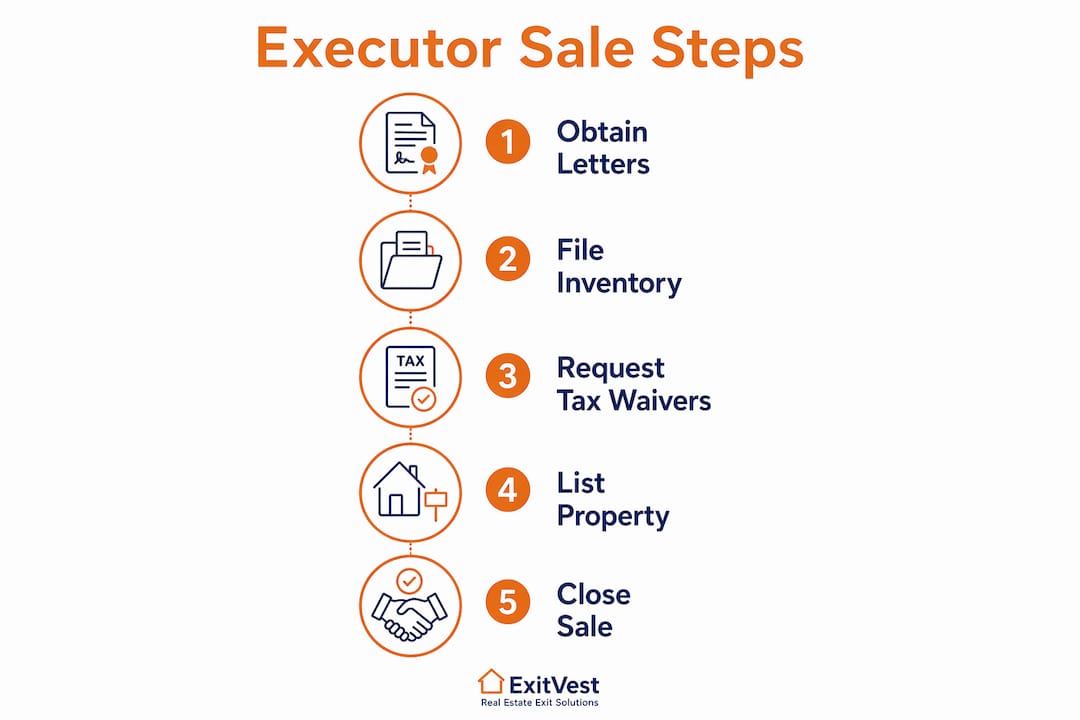
A clear sequence keeps the sale on track and protects you from personal liability. Follow these steps in order:
- Obtain Letters Testamentary from the Surrogate's Court and collect certified Short Certificates.
- Notify beneficiaries within 60 days of appointment, as required by NJ law.
- File the estate inventory and commission a formal property appraisal.
- Resolve creditor claims before releasing any sale proceeds.
- Apply for inheritance tax waivers from the NJ Division of Taxation.
- List the property with a real estate agent experienced in estate sales, or pursue a direct cash sale.
- Review all offers against the appraised value to satisfy your fiduciary duty.
- Sign the purchase contract and allow for the mandatory three-business-day attorney review period required under NJ law.
- Close the sale and deposit proceeds into the estate account.
- Distribute proceeds to beneficiaries after all debts, taxes, and fees are paid.
New Jersey's three-business-day attorney review period is unique to the state. Either party's attorney can cancel or modify the contract during this window. Build that time into your closing schedule from the start.
If you are an out-of-state executor, you can still manage the sale remotely, but you will need a local estate attorney and a power of attorney arrangement for any in-person signing requirements. Remote notarization is available in New Jersey, which reduces the need for travel.
Beneficiary disputes over sale timing or price are common. Document every decision you make and the reasoning behind it. You do not need unanimous heir consent to sell if the will authorizes the sale. Your obligation is to the estate, not to any individual beneficiary's preference.
Pro Tip: Send written updates to all beneficiaries at each major milestone: appraisal completion, listing, accepted offer, and closing date. This paper trail is your best defense if anyone later challenges your decisions.
What challenges do executors face when selling estate property in NJ?
Executor liability is the most underestimated risk in the entire process. If you sell the property below fair market value, fail to pay creditors before distributing proceeds, or miss a required filing deadline, a court can hold you personally responsible for the resulting losses. That is not a theoretical risk. Courts do surcharge executors who cut corners.
Heir disputes are the most common cause of delays. One beneficiary may want to keep the house; another may need cash immediately. Your legal authority is clear: executors can sell despite beneficiary objections if the will authorizes it. The practical challenge is managing relationships while exercising that authority. Written communication and a neutral estate attorney help significantly.
Tax complexity catches many executors off guard. The combination of federal capital gains rules, the stepped-up basis calculation, the NJ Realty Transfer Fee, and the inheritance tax waiver process creates a multi-agency compliance burden. Missing any one of these steps can delay closing or create tax penalties for the estate.
Executors who maintain detailed financial records and communicate transparently with beneficiaries at every stage are far less likely to face court surcharges, removal proceedings, or personal liability claims. Documentation is not just good practice. It is your legal shield.
Coordination between your estate attorney, real estate agent, title company, and CPA requires active management. These professionals do not automatically communicate with each other. You are the hub. Set up a shared timeline with all parties at the start and hold brief check-ins at each milestone to keep the sale moving.
What I've learned from watching executors get this wrong
Most executors I've seen struggle with this process share one trait: they underestimate how much the legal process controls the timeline. They assume selling an inherited house works like selling any other house. It does not. The probate calendar, the creditor window, and the inheritance tax waiver process all run on their own schedules, and none of them care about your preferred closing date.
The executors who get through this cleanly do two things differently. First, they hire an estate attorney before they do anything else, not after they have already made decisions that need to be undone. Second, they over-communicate with beneficiaries. Sending one email update per month feels like too much until the moment a beneficiary files a complaint with the court because they felt left out. That complaint costs far more in time and legal fees than a dozen emails ever would.
The other thing worth saying plainly: the fastest way to sell inherited property is not always the traditional listing route. A cash sale to a direct buyer eliminates the buyer financing contingency, shortens the closing timeline, and removes the uncertainty of a deal falling through at the last minute. For estates with creditor pressure or beneficiaries who need distributions quickly, that speed has real financial value. It is not the right choice for every estate, but it deserves a place in your evaluation.
The NJ attorney review period catches out-of-state executors every time. They sign a contract, assume the deal is done, and then learn that either attorney has three business days to walk away. Build that window into your mental model from day one.
— Alek
How Exitvest helps NJ executors sell inherited estates quickly
Selling an inherited property through the traditional listing process takes time that many estates cannot afford. Holding costs, property taxes, and maintenance expenses accumulate every month the house sits unsold.

Exitvest buys inherited properties in New Jersey as-is, for cash, with no repairs required and no agent commissions. The process is built around executor timelines: you choose the closing date, and Exitvest works around probate milestones rather than against them. For executors managing creditor pressure or beneficiary disagreements, a fast cash offer removes the uncertainty of a traditional sale falling through. If you want to understand exactly how the process works, Exitvest's step-by-step process lays it out clearly with no pressure and no obligation.
Key takeaways
Selling an inherited house in NJ as executor requires court authorization, strict fiduciary documentation, and careful coordination of probate, tax, and sale timelines to protect both the estate and yourself.
| Point | Details |
|---|---|
| Court authority comes first | Obtain Letters Testamentary from Surrogate's Court before listing or negotiating any sale. |
| Probate takes 6–18 months | Plan your sale timeline around creditor windows and inheritance tax waivers, not just market conditions. |
| Transaction costs reach 8–10% | Budget for commissions, the NJ Realty Transfer Fee, attorney fees, and title costs before projecting net proceeds. |
| Stepped-up basis reduces taxes | Selling soon after inheritance minimizes capital gains because the tax basis resets to date-of-death value. |
| Documentation protects you | Record every decision and beneficiary communication to defend against liability claims or court challenges. |
FAQ
What does an executor need to sell a house in NJ?
An executor needs Letters Testamentary from the Surrogate's Court and a Short Certificate before listing or selling any estate property. The will must also authorize the sale, or the executor must obtain separate court approval.
How long does it take to sell an inherited house in NJ?
The full process, from probate filing to closing, typically takes 6–18 months depending on creditor claims, inheritance tax waivers, and any heir disputes. A cash sale can shorten the closing phase significantly once probate clears.
Does an executor need all heirs to agree to sell the property?
No. An executor does not need unanimous heir consent to sell if the will grants that authority. The executor's fiduciary duty runs to the estate as a whole, not to any individual beneficiary's preference.
What is the NJ attorney review period and why does it matter?
New Jersey law requires a three-business-day attorney review period after a residential purchase contract is signed. Either party's attorney can cancel or modify the contract during this window, so executors must factor it into their closing schedule.
Do beneficiaries pay inheritance tax in New Jersey?
Class A beneficiaries, including spouses, children, and parents, pay no NJ inheritance tax. Class C and Class D beneficiaries pay rates ranging from 11% to 16%, and the estate cannot transfer title until the Division of Taxation issues the required tax waivers.