

If you need cash fast or plan to move, selling almost always beats a reverse mortgage. If you're 62 or older, want to stay in your home, and just need to supplement income without a monthly payment, a reverse mortgage usually makes more sense. The decision hinges on how fast you need money, how much you can afford to lose to fees, and whether you're staying put or leaving.
- Timeline to cash: A cash sale to a buyer like Exitvest can close in days to a few weeks; a traditional listing takes months; a Home Equity Conversion Mortgage (HECM) requires counseling and underwriting before funds arrive.
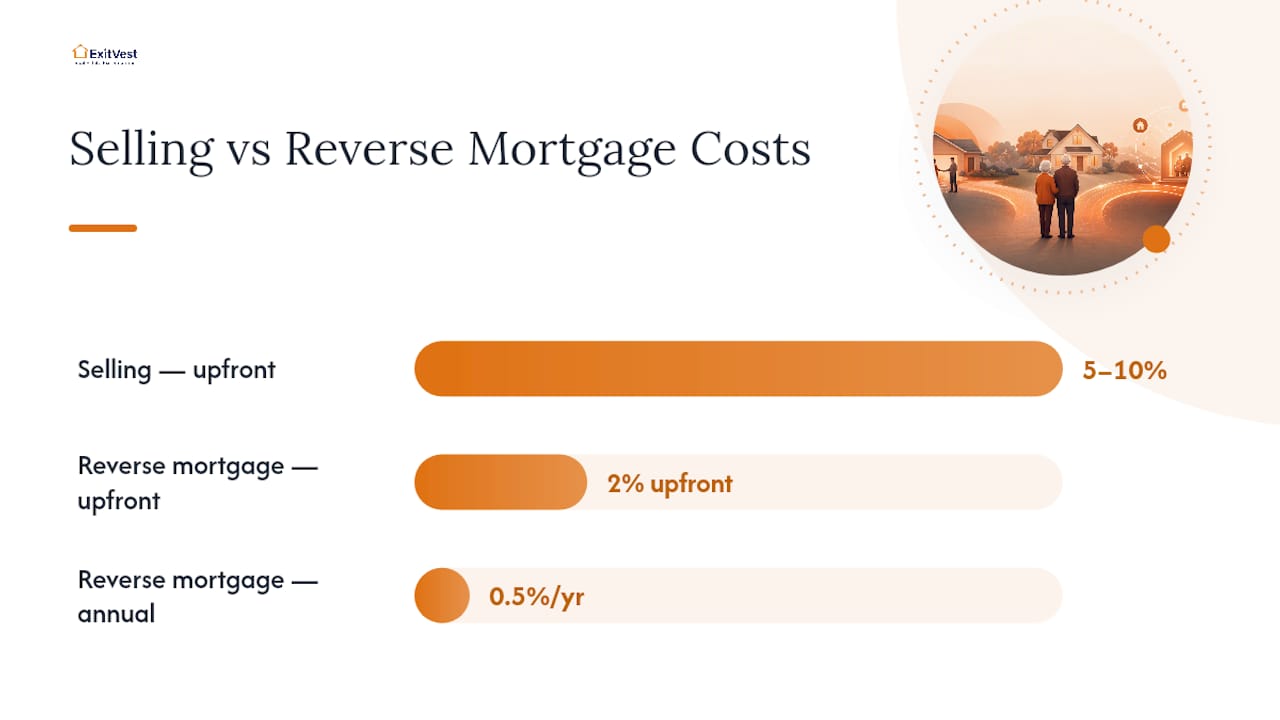
- Costs: Selling typically costs 5% to 10% of the sale price in commissions and closing fees. A reverse mortgage adds an upfront FHA insurance premium plus origination and closing costs.
- Estate impact: Selling hands you the net proceeds now. A reverse mortgage grows in balance over time and shrinks what's left for heirs.
According to the Social Security Administration, many retirees rely on benefits that cover only a portion of monthly expenses, which is exactly why home equity becomes such a pivotal decision for people 62 and older. HUD requires HUD-certified counseling before most HECM closings, and the Consumer Financial Protection Bureau publishes the clearest breakdown of what each option actually costs.
Key Takeaways
Selling delivers full net proceeds fast and with no ongoing obligations, while a reverse mortgage trades slower access to partial equity for the ability to stay home without a monthly payment.
| Point | Details |
|---|---|
| Speed favors selling | A cash sale can close in days to weeks; a HECM requires counseling and underwriting first. |
| Costs differ in structure | Selling runs 5% to 10% upfront; reverse mortgages add 2% upfront insurance plus 0.5% annually. |
| Lifestyle drives the choice | Moving or downsizing favors selling; staying put favors a reverse mortgage. |
| Heirs feel the difference | Selling preserves full equity for heirs; reverse mortgage balances compound and reduce it over time. |
| Next step is verification | Get HUD-certified counseling for a HECM or compare cash offers, like one from Exitvest, before deciding. |
Table of Contents
- Reverse Mortgage vs Selling: A Side-by-Side Comparison
- How Selling and a Reverse Mortgage Actually Work
- What Each Option Actually Costs You
- Which Homeowner Fits Which Option
- How to Decide: A Practical Checklist
- Why We Think Selling Often Makes More Sense
- Get a Cash Offer Instead of Listing or Borrowing
- Sources
Reverse Mortgage vs Selling: A Side-by-Side Comparison
The two paths diverge on almost every axis that matters to a homeowner weighing options. Selling converts your equity into cash today, in full, and closes the door on ongoing homeownership costs. A reverse mortgage keeps you in the house and turns part of your equity into a credit line or monthly check, but the loan balance keeps growing until you leave or pass away.
| Dimension | Selling | Reverse Mortgage (HECM) |
|---|---|---|
| Best for | Moving, downsizing, needing full liquidity | Staying put, 62+, needs supplemental income |
| How you receive cash | One lump sum at closing | Lump sum, line of credit, or monthly payments |
| Typical costs & fees | 5% to 10% of sale price (commission plus closing costs) | 2% upfront FHA mortgage insurance, origination and closing fees, 0.5% annual mortgage insurance |
| Eligibility & requirements | None beyond owning and clearing any liens | Age 62+, primary residence, HUD counseling required |
| Timeline to get funds | Days (cash buyer) to months (open market) | Weeks to a few months after counseling and underwriting |
| Impact on heirs/estate | Immediate net proceeds distributed as you choose | Loan balance compounds; reduces inheritance over time |
| Ongoing obligations & risks | None once sold | Must maintain taxes, insurance, upkeep or risk default |
| Tax consequences | Possible capital gains above exclusion thresholds | Loan proceeds are not taxable income |
HECM loans are non-recourse by federal design. If the loan balance ever exceeds what the home is worth, neither you nor your heirs owe the difference, and heirs can typically settle the debt for as little as 95% of the home's appraised value.
The single biggest financial difference boils down to timing and control:
- Selling gives you every dollar of equity, minus fees, on closing day.
- A reverse mortgage gives you access to only part of your equity, and interest quietly eats into the rest every month you keep the loan.
- Heirs inherit whatever equity remains after a reverse mortgage is repaid, which shrinks the longer the loan runs.
How Selling and a Reverse Mortgage Actually Work
Selling a house is a process most homeowners have some familiarity with, but the mechanics change depending on the route you pick. A HECM works nothing like a traditional loan closing, and skipping a step can delay your funds by weeks.
Selling a home, step by step:
- Choose your route: list with an agent, sell for sale by owner, or sell directly to a cash buyer.
- Get a payoff figure from your lender or reverse mortgage servicer if you have an existing loan (this alone can take 5 to 10 business days).
- Set a timeline: a cash buyer can close in one to three weeks; a listed home typically takes 30 to 90 days from offer to close.
- Account for transaction costs, generally 5% to 10% of the sale price between commission and closing fees.
- Sign, close, and receive your net proceeds.
How a HECM reverse mortgage works:
- You must be 62 or older and use the home as your primary residence.
- HUD-certified counseling is required before most applications move forward.
- Funds arrive as a lump sum, a line of credit, monthly payments, or a mix.
- You keep paying property taxes, insurance, HOA dues, and maintenance, and failing to do so can trigger default.
- The loan comes due when you sell, permanently move out, or pass away.
A homeowner who needs $40,000 for medical bills next month gets there faster selling to a cash buyer than starting a HECM application. A homeowner who wants $1,000 extra a month for the next fifteen years, and has no plans to move, is often better served by the reverse mortgage's monthly payment option.
What Each Option Actually Costs You
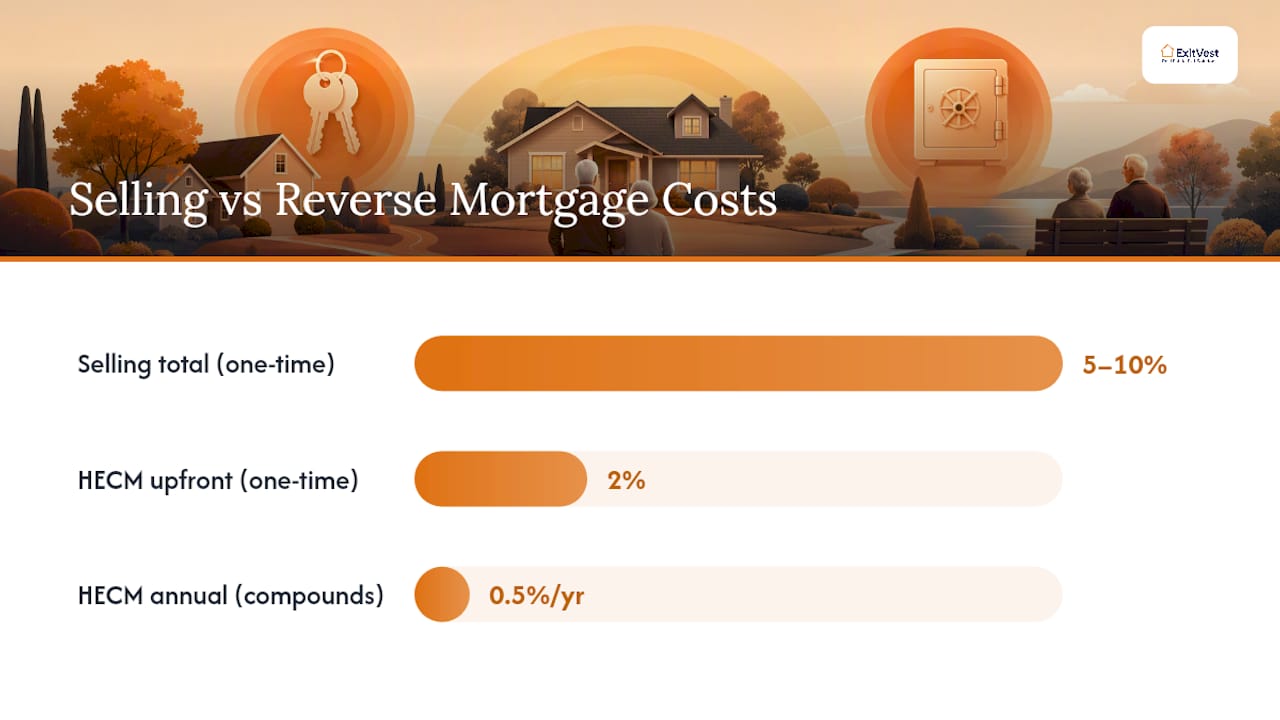
Run the numbers on a $500,000 home and the gap becomes concrete. Selling through a traditional listing typically costs $25,000 to $50,000 in commission (5% to 6%) and closing costs, landing total transaction costs in the 5% to 10% range. A HECM on the same home charges an upfront FHA mortgage insurance premium of about $10,000 (2% of value), plus origination and third-party closing fees, plus an annual mortgage insurance premium of 0.5% on the outstanding balance that compounds for as long as the loan is open.
| Cost category | Selling ($500,000 home) | Reverse mortgage ($500,000 home) |
|---|---|---|
| Upfront fee | 5% to 6% agent commission | 2% upfront FHA mortgage insurance premium |
| Additional closing costs | Included in 5% to 10% total | Origination, appraisal, and title fees |
| Ongoing cost | None after closing | 0.5% annual mortgage insurance, plus accruing interest |
| Net effect | One-time deduction from proceeds | Growing balance that reduces future equity |
Selling triggers a possible capital gains tax if your profit exceeds the IRS exclusion thresholds, though most homeowners stay under that limit. Reverse mortgage proceeds are not counted as taxable income since they're loan disbursements, not earnings, but drawing down large amounts can still affect eligibility for means-tested programs like Medicaid, which is worth reviewing with an advisor before you sign anything.
Financial advisors and reporters covering reverse mortgages consistently flag the same tradeoff: the loan balance compounds through interest and mortgage insurance every year it's open, which steadily shrinks what heirs eventually inherit. Selling hands you full control of net proceeds the moment debts are paid off.
The non-recourse structure of HECM loans offers real protection here. Even if the balance eventually exceeds the home's value, the debt never exceeds the home's worth at settlement, and heirs won't owe money out of pocket.
Which Homeowner Fits Which Option
The homeowner who wants to move. If you're downsizing, relocating near family, or heading to a retirement community, selling wins outright. You get full equity today, no ongoing mortgage insurance, and a clean break. Downsizing in retirement often comes with lower utility bills and less upkeep, compounding the financial upside of selling.
The homeowner who wants to stay and needs monthly income. If you're 62 or older, comfortable in your home, and Social Security alone doesn't stretch far enough, a reverse mortgage's monthly payment option can bridge the gap without adding a new bill to pay.
The homeowner with low equity or maintenance worries. If you're already stretched thin on property taxes, insurance, or HOA dues, a reverse mortgage adds risk rather than relief, since missing those payments can trigger default. Selling clears the burden entirely.
When a cash sale is the strongest fit. If your home needs repairs you can't afford, you inherited a property you don't want to manage, or you simply need certainty over speed, selling to a cash buyer avoids agent commissions, as-is condition concerns, and open-ended closing timelines.
- Red flag for a reverse mortgage: you're planning to move within the next few years, or you're already behind on taxes or insurance.
- Red flag for selling: your local market is soft and you'd rather age in place than accept a lowball offer.
Pro Tip: Before assuming your home needs repairs to sell, get a cash offer first. Many as-is buyers price around the home's current condition rather than requiring you to fix anything up front.
How to Decide: A Practical Checklist
Turning this comparison into an actual decision means running a few numbers and asking pointed questions before you sign anything.
- Calculate your likely net proceeds from selling and compare that figure against your projected reverse mortgage payout.
- If considering a HECM, confirm eligibility (age 62+, primary residence) and schedule HUD-certified counseling early since most closings require it.
- Request a written payoff estimate from your current mortgage servicer if you have an existing loan.
- Collect two to three cash-sale offers or a net-proceeds estimate from a real estate professional to compare against a HECM payout.
- Talk with your heirs and a financial advisor, especially if estate planning is a priority.
Before signing with any lender or buyer, ask direct questions: What fees come out of my proceeds? How fast can you close? Is there an appraisal contingency that could delay or change the offer? Also weigh other home-equity tools like a cash-out refinance, a HELOC, or a home equity loan, which may fit better if you don't meet HECM age requirements or plan to move within a few years.
Watch for warning signs that mean you should pause: aggressive advertising promising "free money," any request for upfront fees before counseling, or high-pressure sales tactics pushing you toward a decision on the spot. Legitimate lenders and buyers give you time to think.
Why We Think Selling Often Makes More Sense
Speed and certainty matter more to most sellers than people expect going in. When a homeowner is facing a deadline, an inherited property they don't want, or repairs they can't afford, a reverse mortgage's slower underwriting process and ongoing obligations often add stress rather than remove it. That's the case where Exitvest positions a cash sale as the more practical route: no repairs, no showings, no commission eating into proceeds.
That said, reverse mortgages exist for good reason. A homeowner who wants to stay in a paid-off house and just needs supplemental income shouldn't be talked out of a tool built for exactly that situation. Complex estates, co-owned properties, or anyone unsure which way to go should talk to a HUD-certified counselor and a financial advisor before committing to either path.
Get a Cash Offer Instead of Listing or Borrowing
If selling is the direction you're leaning, Exitvest cuts out the two biggest costs of a traditional sale: agent commissions and repair bills. You send basic property details, get a no-obligation cash offer, and pick a closing date that works for you, whether that's ten days out or ten weeks out.
The process is simple by design. You submit your address and a few property details, Exitvest reviews the property and sends a cash offer, and if you accept, you choose the closing timeline. There's no cleaning, no staging, no repairs, and no agent commission coming out of your proceeds. Exitvest buys houses, land, and small apartment buildings as-is nationwide, with particular focus in New Jersey, Texas, Florida, and Tennessee, including homes with liens, code violations, or difficult tenants.
Compare this offer against a traditional listing and, if you're eligible, a reverse mortgage estimate before deciding. Selling has its own tax and moving considerations worth reviewing with an advisor. When you're ready to see what your home is worth in cash, request a free offer from Exitvest, and get a number in hand before you commit to either path.
Sources
- How much does a reverse mortgage loan cost? — Consumer Financial Protection Bureau (CFPB)
- HECM upkeep responsibilities — HelpWithMyBank (consumer guidance)
This article is general information, not a substitute for advice from a qualified financial advisor. Consult a qualified financial professional about your own circumstances before acting on anything here.