

You can skip the listing-agent commission entirely by choosing one of six proven routes: sell your home yourself (FSBO), post on the MLS through a flat-fee service, hire a discount or rebate broker, use a transaction/limited-service broker, sell directly to a cash buyer or iBuyer, or go to auction. Listing commissions typically total about 5% of the sale price, split between the listing and buyer's agents. On a home, the listing-agent side alone runs a substantial amount in fees. That's the number most sellers are trying to recover.
Here's the one-line verdict for each alternative:
- FSBO: Best if you want maximum control and are willing to invest real time in pricing, marketing, and paperwork.
- Flat-fee MLS: Best if you want MLS exposure without paying a full listing commission and can handle buyer interactions yourself.
- Discount/rebate broker: Best if you want some agent support at a reduced fee in a price-stable market.
- Transaction/limited-service broker: Best if you already have a buyer and just need help with contracts and closing.
- Cash buyer/iBuyer: Best if speed, certainty, or selling as-is matters more than squeezing out the last dollar.
- Auction: Best for distressed, unique, or hard-to-price properties where a competitive bidding environment could work in your favor.
Every option in this guide gets evaluated across the same dimensions: net proceeds, speed to close, seller effort required, out-of-pocket costs, repairs needed, legal complexity, and best use case.
Table of Contents
- How to sell your house yourself: the FSBO path explained
- What flat-fee MLS services actually give you
- Discount and rebate brokerages: lower commissions, limited frills
- Transaction brokers and attorney-assisted closings: when you already have a buyer
- iBuyers and cash home buyers: what you trade for speed
- Auctions and investor sales: the right choice for the right property
- How to pick the right alternative for your situation
- When a cash offer is the right move: Exitvest's take and a seller checklist
- Key Takeaways
- The case for cash: what most sellers get wrong about their options
- Exitvest makes cash offers on homes you don't want to list
- Useful sources and where to read more
How to sell your house yourself: the FSBO path explained
For sale by owner, or FSBO, removes the listing-agent fee entirely. What it doesn't remove is the work that agent would have done. Pricing, marketing, scheduling showings, vetting buyers, negotiating offers, and navigating closing paperwork all land on you. That's a significant undertaking, and sellers who underestimate it tend to either misprice their home or accept the first offer out of exhaustion.

Prepare and price before you list
Start with a comparative market analysis using recent sales in your ZIP code, not just active listings. Zillow's Zestimate is a starting point, not a pricing tool. Pull actual closed sales from the county recorder's office or a free agent CMA if a local agent will provide one. Overpricing is the single most common FSBO mistake, and it costs more in carrying costs and price reductions than the commission you saved.
Staging doesn't require a professional. Declutter, depersonalize, and get professional photography. Listings with professional photos sell faster and attract more serious buyers, regardless of whether an agent is involved.
Getting your listing in front of buyers
Without MLS access, your exposure is limited to Zillow, Craigslist, Facebook Marketplace, and yard signs. FSBO homes typically receive less exposure because sellers can't access the MLS directly, which shrinks the buyer pool and can lead to lower offers. Pairing your FSBO with a flat-fee MLS service (covered in the next section) solves most of that problem.
Open houses and private showings require you to be available, flexible, and comfortable showing the home to strangers. Build a showing schedule, use a lockbox if needed, and always verify buyer identity before letting anyone in.
Offers, negotiations, and closing
When offers come in, you'll need to evaluate them on price, contingencies, financing type, and closing timeline. A cash offer with no inspection contingency is not automatically better than a financed offer at a higher price. Run the math on both.
Closing paperwork varies by state. Some states require a real estate attorney at closing; others don't. Either way, hiring a real estate attorney to review contracts is strongly recommended for FSBO sellers. Attorney fees typically run $500–$1,500 depending on location and complexity. Add in title insurance, transfer taxes, and any buyer-agent commission you've agreed to pay, and your true out-of-pocket costs are higher than zero even on a pure FSBO deal.
Pro Tip: Get a pre-listing inspection before you go to market. It costs $300–$500 and lets you price accurately, disclose known issues upfront, and avoid last-minute renegotiations after a buyer's inspector finds something. Sellers who skip this step often lose more in post-inspection price cuts than the inspection would have cost.
State disclosure requirements differ significantly. Texas sellers, for example, must complete a Seller's Disclosure Notice under TREC rules. California requires a Transfer Disclosure Statement. Always confirm your state's specific disclosure obligations before listing.
What flat-fee MLS services actually give you
A flat-fee MLS service lists your property on the local Multiple Listing Service for a one-time fee, without requiring you to sign a full listing agreement with an agent. Once on the MLS, your listing automatically syndicates to Zillow, Realtor.com, Redfin, and hundreds of other portals. That's the same buyer reach a traditional listing agent provides, at a fraction of the cost.

Flat-fee MLS is the practical compromise for sellers who want MLS exposure but can manage buyer interactions themselves. It preserves most of the buyer pool while keeping listing costs low.
What's typically included vs. what you're still handling
| Service tier | Typical one-time fee | What's usually included | What you handle |
|---|---|---|---|
| Basic MLS-only | $300–$500 | MLS posting, basic syndication | Everything else |
| Standard package | $300–$500 | MLS + photos, listing description, showing scheduler | Negotiations, contracts, closing |
| Enhanced package | $500–$1,500 | Above + contract review, agent support options | Final negotiations, closing coordination |
Fees vary by provider and market. The numbers above reflect commonly advertised ranges, not a guarantee for any specific service.
What flat-fee MLS does not do: it doesn't send an agent to your showings, negotiate on your behalf, or handle your closing paperwork. You're still running those pieces. If you're comfortable with buyer conversations and have time to manage the process, that's a reasonable tradeoff. If you're not, the enhanced tiers with add-on agent support start to look more like a discount broker than a pure flat-fee product.
When flat-fee MLS makes the most sense:
- Your market is competitive and homes are selling quickly with multiple offers.
- You're confident in your pricing and don't need agent guidance on positioning.
- You can respond to buyer inquiries and showing requests promptly.
- You want MLS exposure but are willing to pay a buyer's agent commission (typically 2.5–3%) to attract financed buyers.
Discount and rebate brokerages: lower commissions, limited frills
Discount brokerages charge a reduced listing fee, typically 1–1.5% instead of the traditional 2.5–3%, or offer a flat fee that comes in below full-service rates. Some rebate brokers return a portion of the buyer's agent commission to the buyer at closing, which can make your home more attractive to buyers working with those agents.
The tradeoff is straightforward: you pay less, and you get less. Discount brokers usually provide MLS listing, basic marketing, and some level of agent contact, but the depth of service varies widely. In a hot market where homes sell themselves, that's often fine. In a slower market where negotiation and marketing creativity matter, the gap between a discount broker and a full-service agent can show up in your final sale price.
Before signing with any discount or rebate broker, ask:
- What's included in the fee, and what costs extra?
- Who handles showings, and how quickly do they respond to buyer inquiries?
- Does an agent negotiate on my behalf, or do I handle that?
- How is my listing marketed beyond the MLS?
- What happens if the deal falls through? Are there cancellation fees?
- How many listings does this agent or team currently carry?
Pro Tip: Ask for a sample listing agreement before you commit. Some discount brokers lock you into 6-month contracts with early termination fees. A reputable discount broker should offer a clear, short-form agreement with no hidden exit penalties.
Discount brokers work best for sellers in price-stable, high-demand markets where the home will attract buyers without aggressive marketing. If your property has deferred maintenance, a complicated title, or sits in a slower market, the savings on commission can evaporate in a lower final sale price.
Transaction brokers and attorney-assisted closings: when you already have a buyer
A transaction broker, sometimes called a limited-service broker, doesn't represent either party exclusively. Instead, they facilitate the paperwork, coordinate the closing, and keep the deal moving without acting as a full advocate for the seller or buyer. This is different from a listing agent, who has a fiduciary duty to you.
Industry guides identify attorney-facilitated private sales as one of the three main practical routes for selling without a listing agent, alongside FSBO and cash buyers. In states where real estate attorneys routinely handle closings (New York, Massachusetts, Georgia, and others), an attorney can draft the purchase agreement, manage escrow, and handle the title transfer without any broker involvement.
Who benefits from this route:
- Sellers who've already found a buyer privately, through a neighbor, family member, or workplace connection.
- Sellers who need contract and legal help but have no interest in paying for marketing they don't need.
- Sellers in attorney-closing states where this is already standard practice.
Typical costs and what to expect:
- Transaction broker fee: roughly 0.5–1% of sale price, or a flat fee in the $500–$2,000 range depending on the market.
- Real estate attorney fee: $500–$2,000 for contract drafting and closing coordination.
- Some states require attorney involvement at closing regardless of whether a broker is used. Check your state's requirements before assuming you can skip both.
The legal liability difference matters here. A listing agent carries errors-and-omissions insurance and a fiduciary duty. A transaction broker does not advocate for you. If something goes wrong in the contract, you're more exposed. That's why pairing a transaction broker with an independent real estate attorney is the safer play, even if it adds a few hundred dollars to your costs.
iBuyers and cash home buyers: what you trade for speed
iBuyers and direct home-buying companies offer something traditional sales can't: a firm offer within 24 hours and a closing timeline measured in days, not months. Direct home-buying companies can provide a cash offer within 24 hours and close in as few as 7–10 days. The cost of that speed is a purchase price that typically comes in below what you'd net on the open market.
That's not a flaw in the model. It's the model. These buyers take on the risk of repairs, carrying costs, and resale uncertainty. Their margin has to come from somewhere, and it comes from the gap between what they pay you and what the property is worth after they've fixed it up and sold it.
Who's actually making these offers
The "cash buyer" category covers a wide range:
- Large iBuyer platforms that use automated valuation models to make standardized offers on move-in-ready homes in specific markets.
- Local house flippers who buy distressed properties, renovate, and resell.
- Buy-and-hold investors looking for rental income, often interested in properties with tenants already in place.
- Home-buying companies like Exitvest that purchase houses, land, and small apartment buildings as-is, including properties with code violations, liens, or probate complications.
The pricing tradeoff on a $400,000 home: a full-agent sale might net you $376,000 after a 6% commission. A cash buyer might offer $340,000–$360,000, with no commission, no repairs, and no 60-day wait. Whether that gap is worth it depends entirely on your situation.
Red flags and verification steps before accepting any cash offer:
- No written, itemized offer. Walk away from any buyer who won't put the offer in writing with a clear price and fee breakdown.
- Vague or missing inspection contingency terms. Know exactly what triggers a price reduction.
- Unusually large non-refundable earnest money deposit demanded from you (not from them).
- No verifiable proof of funds or financing.
- Pressure to sign quickly without time to review.
- No clear title and closing process explained upfront.
Experts advise sellers to demand itemized written offers, confirm title and closing processes, and consider representation to review terms. That advice applies whether you're dealing with a large iBuyer or a local investor.
Auctions and investor sales: the right choice for the right property
Real estate auctions come in a few forms. An absolute auction sells to the highest bidder regardless of price. A reserve auction sets a minimum price the seller must accept. Online auction platforms have expanded access to both formats, letting sellers reach national buyer pools without a traditional listing.
Online and live auctions offer quick sales, but final prices depend on bidding and reserve settings. Investors at auctions often expect a discount for the uncertainty and as-is condition, so the final price can land well below what a retail buyer would pay on the open market.
Pros and cons of auctions and investor sales:
- Fast close: Auctions typically close within 30–45 days of the sale date.
- Competitive bidding: In the right market, multiple bidders can push the price up, sometimes past expectations.
- Unpredictable outcome: Without a reserve, you could sell for less than you planned.
- Fees: Some auction formats charge the seller a listing or marketing fee; others charge a buyer's premium that can affect who bids.
- Investor offers: Local investors move fast and buy as-is, but their offers reflect a wholesale price, not retail.
When auctions or investor sales make sense:
- Distressed properties with significant deferred maintenance that retail buyers won't touch.
- Inherited homes where heirs need a fast, clean sale without coordinating repairs or staging.
- Properties with title complications, code violations, or problem tenants that make traditional listing difficult.
- Sellers facing foreclosure who need to close before a specific date.
Before going to auction, set a realistic reserve price based on a current appraisal or broker opinion of value. Have your title work ready. Be transparent about the property's condition — surprises discovered after the auction can kill the deal or trigger legal disputes.
How to pick the right alternative for your situation
The right choice comes down to ranking three things: how much you need from the sale, how fast you need to close, and how much time and effort you can put in. Get those priorities in order before you evaluate any option.
Step 1: Rate your priorities. Assign each of these a rank from 1 (most important) to 3 (least): maximum net proceeds, fastest possible close, minimum seller effort.
Step 2: Map to alternatives. Net proceeds first? FSBO or flat-fee MLS. Speed first? Cash buyer or iBuyer. Minimum effort? Cash buyer, transaction broker, or auction.
Step 3: Run a quick net-proceeds check. On a $400,000 home:
- Full agent listing: $400,000 minus 6% commission ($24,000) = $376,000 net (before closing costs).
- Flat-fee MLS + buyer's agent commission: $400,000 minus flat-fee ($400) minus buyer's agent (3%, or $12,000) = $387,600 net (before closing costs).
- Cash buyer: $360,000 offer, no commission, no repairs = $360,000 net (before closing costs, but no repair costs either).
The cash buyer nets $27,600 less than the flat-fee MLS route on paper. If your home needs $20,000 in repairs to list competitively, that gap shrinks to $7,600. If you're facing foreclosure in 30 days, the gap is irrelevant.
Comparing your alternatives at a glance
| Alternative | Net proceeds | Speed to close | Seller effort | Out-of-pocket costs | Repairs required | Legal complexity | Best use case |
|---|---|---|---|---|---|---|---|
| FSBO | Highest potential | 60–90 days | High | Low–moderate | Yes | High | Experienced sellers, strong markets |
| Flat-fee MLS | High | 30–45 days | Moderate–high | Low | Usually yes | Moderate | Sellers wanting MLS exposure, low cost |
| Discount broker | Moderate–high | 30–45 days | Low–moderate | Moderate | Usually yes | Moderate | Price-stable markets, limited marketing needs |
| Transaction broker | Moderate–high | 30–60 days | Low | Low | Usually yes | Low–moderate | Seller already has a buyer |
| Cash buyer/iBuyer | Moderate | 7–30 days | Very low | None | No | Low | Speed, as-is, distressed, inherited |
| Auction | Variable | 30–45 days | Low–moderate | Low–moderate | No | Moderate | Distressed, unique, or hard-to-price properties |
Red-flag checklist for any no-agent sale:
- Contract terms that let the buyer reduce the price after inspection without a clear process.
- Fees that aren't disclosed upfront in writing.
- Buyer who won't provide proof of funds before you take the home off the market.
- Vague closing timelines with no penalty for delays.
- Any pressure to waive your right to review the contract with an attorney.
When a cash offer is the right move: Exitvest's take and a seller checklist
Cash offers aren't for every seller. They're for sellers where speed, certainty, or the ability to sell as-is outweighs the goal of maximizing the sale price. That's a real category, and it's larger than most people assume.
Real estate experts recommend sellers decide whether they value speed and certainty over maximizing sale price. The situations where cash wins aren't edge cases. They're common.
Concrete use cases where a cash sale is often the highest-value choice:
- Imminent foreclosure: A cash close in 7–14 days can stop the process and protect your credit.
- Inherited property: Heirs often live out of state, can't manage repairs, and need a clean settlement fast. Selling an inherited house quickly is often simpler with a direct buyer.
- Problem tenants: A property with non-paying or difficult tenants is nearly impossible to list on the retail market. Cash buyers buy with tenants in place.
- Vacant homes: Every month a vacant home sits costs money in taxes, insurance, utilities, and maintenance. Speed has real dollar value.
- Costly repairs: If your home needs a new roof, foundation work, or major systems replacement, a cash buyer absorbs those costs in their offer price rather than requiring you to fund them upfront.
- Financial pressure: Job loss, divorce, medical bills, or relocation on a tight timeline all create situations where certainty beats price.
Exitvest purchases houses, land, and small apartment buildings as-is with flexible closing timelines, serving sellers nationwide with a strong focus on New Jersey, Texas, Florida, and Tennessee.
Seller checklist before accepting a cash offer
- Gather your deed, most recent mortgage statement, and any HOA documents.
- Pull a preliminary title report or confirm with a title company that there are no outstanding liens.
- Get the offer in writing with a clear purchase price, fee breakdown, and closing timeline.
- Ask the buyer for proof of funds, not just a verbal assurance.
- Confirm who pays closing costs and whether any fees are deducted from the offer price at closing.
- Review the contract with a real estate attorney before signing, even on a simple cash deal.
- Understand your state's disclosure requirements and complete them accurately.
Pro Tip: A reputable cash buyer will never pressure you to skip the title process or waive your right to review the contract. If a buyer pushes you to close without a title company or attorney involved, that's a serious red flag regardless of how attractive the offer looks.
Key Takeaways
Selling without a listing agent is practical for most U.S. homeowners, but the right alternative depends entirely on whether you're optimizing for net proceeds, speed, or seller effort.
| Point | Details |
|---|---|
| Commission savings are real | A typical listing-agent fee is around 3% of the home's sale price (listing side only); however, total listing commissions commonly come to 5–6% of the sale price, split between listing and buyer's agents. |
| Flat-fee MLS is the best middle ground | It gives you full MLS exposure for a low one-time fee while letting you keep control of showings and negotiations. |
| Cash buyers win on speed and certainty | Offers in 24 hours and closings in 7–30 days make cash buyers the right call for distressed, inherited, or time-constrained sellers. |
| FSBO demands real effort | Pricing accuracy, marketing reach, and legal paperwork are the three areas where inexperienced FSBO sellers most often lose money. |
| Exitvest buys as-is, fast | Exitvest purchases houses, land, and small apartment buildings with no repairs required, no commissions, and flexible closing timelines. |
The case for cash: what most sellers get wrong about their options
Most sellers approach this decision as a pure price comparison. They look at the cash offer, compare it to the Zestimate, and conclude they're leaving money on the table. That framing misses half the equation.
The real comparison isn't cash offer vs. list price. It's cash offer vs. net proceeds after repairs, carrying costs, agent fees, and the risk of a deal falling through. A home that needs $25,000 in work before it can list competitively, sits on the market for 60 days, and then loses a buyer to a failed inspection has a very different net outcome than the list price suggests.
The sellers who benefit most from a direct cash sale aren't the ones who couldn't get a better price elsewhere. They're the ones who correctly identified that time, certainty, and avoiding repair costs are worth more to them than the theoretical upside of a retail listing. That's a legitimate financial decision, not a desperate one.
What I'd push back on is the assumption that FSBO is always the "smart" choice for sellers who want to save money. FSBO success correlates strongly with pricing accuracy, seller availability, and local market demand. In a hot market with a well-priced home and a seller who can dedicate real time to the process, FSBO works. In most other situations, the savings on commission get eaten by a longer time on market, a lower final price, or both.
The alternatives to listing with a traditional agent are genuinely good options. The key is matching the right one to your actual situation, not the situation you wish you were in.
Exitvest makes cash offers on homes you don't want to list
If you've read through the alternatives and what you really need is a fast, certain sale with no repairs, no commissions, and no 90-day listing process, Exitvest is built for exactly that situation.
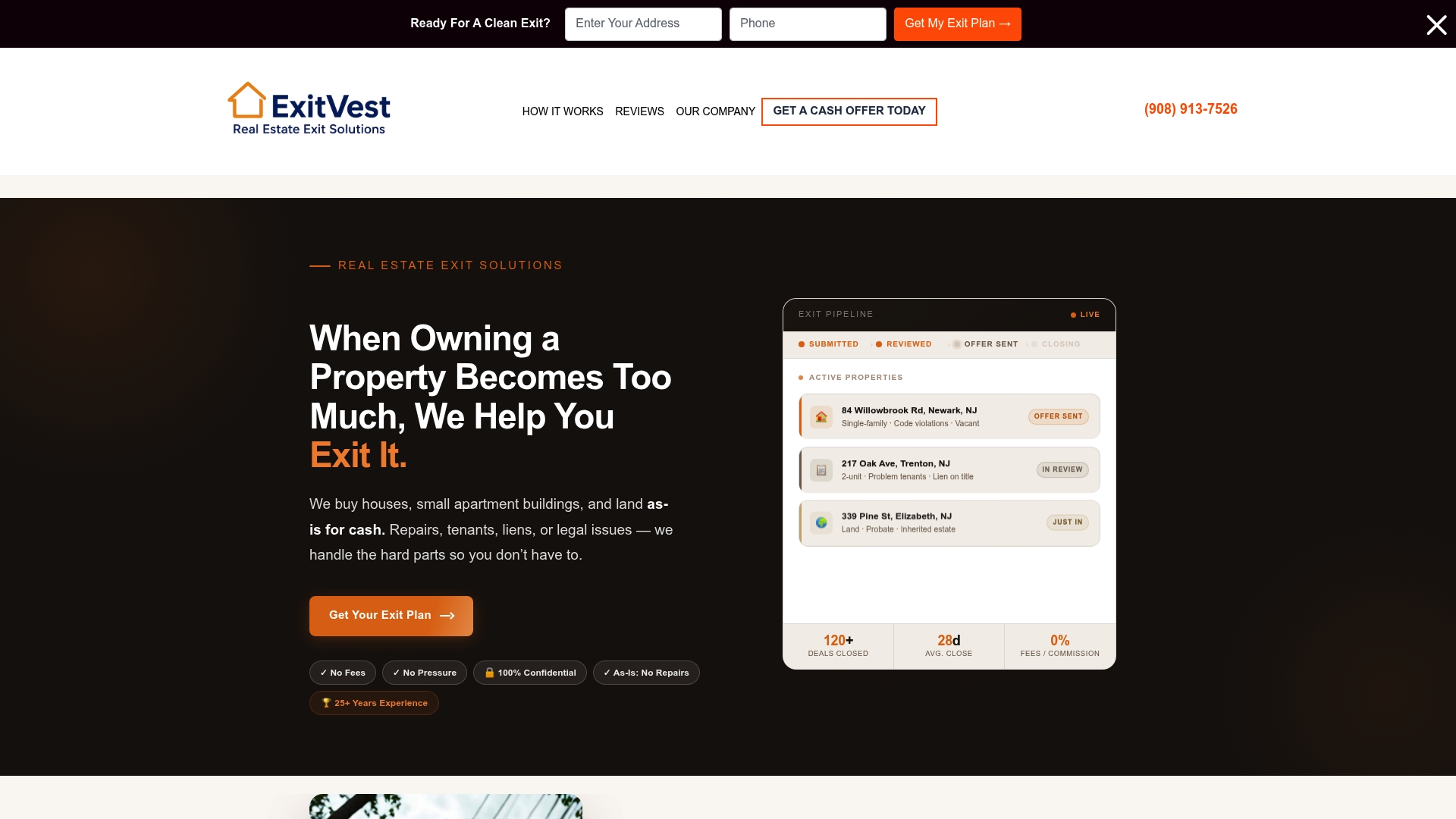
Exitvest buys houses, land, and small apartment buildings directly from owners, as-is, with written cash offers and flexible closing timelines. No listing agent, no open houses, no repair negotiations. Sellers facing foreclosure, inherited properties, problem tenants, vacant homes, or properties with code violations and liens are the situations Exitvest handles every day. The focus markets are New Jersey, Texas, Florida, and Tennessee, with purchases nationwide.
What you get with Exitvest:
- A written cash offer, typically within 24–72 hours of contact.
- Flexible closing dates, with the ability to close in as few as 7–30 days based on your timeline.
- No listing-agent commission, no repair requirements, no staging.
- A transparent process with itemized offer details and a clear title and closing procedure.
To get started, gather your property address, a rough sense of the home's condition, and any relevant details about your situation (foreclosure timeline, tenant status, title issues). Then visit Exitvest's situations page to describe your property and get a no-pressure cash offer. The process is straightforward, and there's no obligation to accept.
Useful sources and where to read more
External resources used in this article:
- Bankrate: How to Sell a House Without a Realtor — Step-by-step FSBO guidance, commission math, and attorney recommendations.
- CFPB: Owning a Home — Federal consumer guidance on the home sale and mortgage process.
Exitvest resources for next steps:
- Sell Property As-Is for Cash — Describe your situation and get a cash offer.
- How the Exitvest process works — Timeline, steps, and what to expect.
- Selling a home without repairs — What as-is sales look like in practice.
- Cash for homes guide — How cash sales work and what sellers can expect.
- Selling without paying agent fees — Strategies for keeping more of your proceeds.
This article provides general information about home-selling options in the United States and is not legal, financial, or real estate advice. Commission rates, fees, disclosure requirements, and legal rules vary by state and individual circumstance. Confirm current requirements with a licensed real estate attorney or your state's real estate commission before proceeding.