

Realtor fees are negotiated commissions, typically paid by the seller at closing, calculated as a percentage of the final sale price. The short version for sellers who want to skip them: you have real options, and each one trades something different.
Your quick-decision summary:
- Run a net-proceeds check first. A lower cash offer with zero commission often beats a higher listed price after fees, repairs, and carrying costs.
- Compare speed vs. price. FSBO and flat-fee MLS listings can preserve more equity but take longer. A direct cash buyer closes in days.
- For a no-commission, as-is sale, Exitvest buys houses, land, and small apartment buildings nationwide with no agent fees and flexible closing dates.
Table of Contents
- How are realtor commissions actually calculated?
- What do realtor fees actually pay for?
- What are your real alternatives to paying full commission?
- How Exitvest works as a direct cash buyer
- Does skipping commission actually improve your net proceeds?
- Legal and timing checkpoints sellers must know
- Should you keep an agent, renegotiate, or sell without one?
- Your next steps to sell without paying realtor fees
- Key Takeaways
- The part most sellers figure out too late
- Sell your property fast with no agent fees
- Sources and further reading
How are realtor commissions actually calculated?
Real estate commissions typically run several percentage points of the final sale price, split between the listing agent and the buyer's agent, which can amount to a significant sum at closing. For vacant land, the number can be far higher: land commissions sometimes reach 10%–20% because of longer marketing timelines and harder financing.
That headline percentage doesn't go straight to the agent. The commission flows to the brokerage first, which deducts overhead, then splits the remainder with the agent. Common splits are 50/50, 60/40, or 70/30 in the agent's favor, depending on their contract. So when an agent quotes you 3%, their actual take-home may be closer to 1.5%.
The 2024 NAR settlement changed who formally pays the buyer's agent. Written buyer-broker agreements are now required, and buyers are officially responsible for their agent's compensation unless negotiated otherwise. Sellers can still voluntarily offer buyer-agent compensation to attract more offers, but it's no longer automatic or listed on the MLS.
By the numbers: A 5.5% commission on a $350,000 sale equals $19,250 at closing, before closing costs, repair credits, or concessions.
- Commission is calculated on the final sale price, not the list price.
- The fee is a negotiated contract term, not a fixed legal requirement.
- Buyer-agent compensation rules changed in August 2024 under the NAR settlement.
- Land and specialty properties often have higher commission rates than residential homes.
What do realtor fees actually pay for?
A full-service commission typically covers: comparative market analysis (CMA), professional photography, MLS listing and staging advice, open houses, showing coordination, offer negotiation, and transaction management through closing. For a seller in a hot market with a move-in-ready home, those services can drive a higher sale price that offsets the fee.

For a seller who needs speed, has deferred maintenance, or owns a distressed or vacant property, many of those services are either irrelevant or won't move the needle. Staging a house with foundation issues doesn't change the buyer pool.
Pro Tip: Before signing any listing agreement, request a full itemized fee schedule. Brokerages sometimes add administrative or transaction fees on top of the percentage commission. These can add hundreds to thousands of dollars and won't appear in the headline rate.
Services that matter most for a traditional listed sale:
- MLS access and syndication to Zillow, Realtor.com, and similar platforms
- Professional photography and virtual tours
- Offer negotiation and contract management
- Title coordination and closing logistics
Services you can skip or handle yourself in a cash sale:
- Staging and open houses
- Extended marketing campaigns
- Buyer financing contingency management
What are your real alternatives to paying full commission?
| Option | Typical seller cost | What's included | Time to close | Repairs required | Seller net (example on $350K) | Effort | Certainty |
|---|---|---|---|---|---|---|---|
| Full-service agent | 5%–6% commission | Full marketing, negotiation, closing | 45–90 days | Usually yes | — | Low | Moderate (financing risk) |
| Flat-fee MLS | — | MLS listing only | 45–90 days | Usually yes | Higher, but seller handles rest | High | Moderate |
| Discount broker | 1%–2% listing side | Reduced service package | 45–90 days | Often yes | — | Medium | Moderate |
| FSBO | 0% listing side (may still owe buyer agent) | Nothing included | — | Usually yes | Highest potential, lowest floor | Very high | Low |
| Direct cash buyer | no agent commission | Offer, closing coordination | 7–21 days | No (as-is) | — | Very low | High |
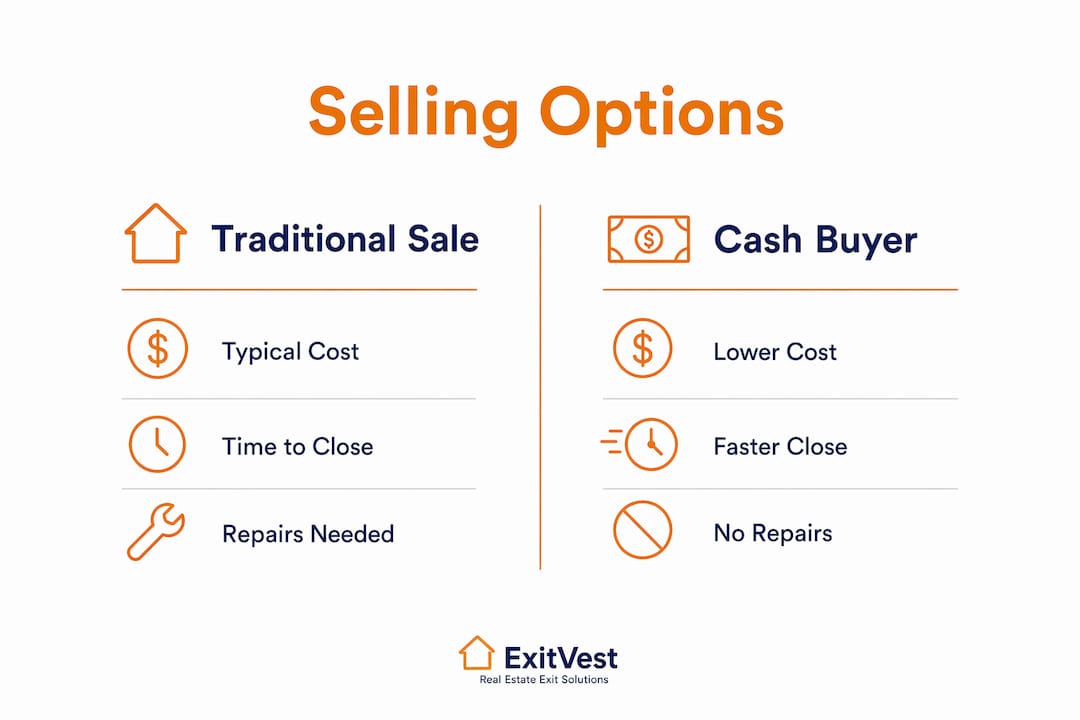
Flat-fee MLS listings charge a one-time fee for MLS exposure and leave everything else to you. That's a real option if you're comfortable handling showings, negotiations, and paperwork. FSBO eliminates the listing agent entirely but still leaves you potentially owing a buyer's agent fee if the buyer has representation.
Where sellers underestimate costs:
- FSBO homes often sit longer, increasing carrying costs (mortgage, taxes, insurance).
- Discount brokers may not negotiate as aggressively, leaving money on the table.
- iBuyer offers frequently include service fees that approach traditional commission levels.
- Cash buyer offers are lower than market value, but the math often closes the gap once you subtract commissions, repairs, and time.
How Exitvest works as a direct cash buyer
Exitvest buys houses, land, and small apartment buildings directly from owners, in as-is condition, for cash. No agent, no commission, no repair requirements. Closing timelines are flexible and can be as short as a week or stretched to fit your situation.
The best-fit cases for a direct cash sale with Exitvest:
- Properties with deferred maintenance, code violations, or structural issues
- Inherited homes in probate or with title complications
- Rentals with problem tenants or unpaid rent
- Vacant properties accumulating carrying costs
- Sellers facing foreclosure, financial pressure, or a hard deadline
Exitvest's process: Request a cash offer with basic property details and photos. Exitvest assesses the property as-is and presents a no-obligation offer. You choose the closing date. No commissions, no agent fees, no repair negotiations.
Exitvest operates nationwide, with concentrated buying activity in New Jersey, Texas, Florida, and Tennessee. For sellers who need to sell without paying agent fees, the direct cash route removes the largest variable in the equation.
Does skipping commission actually improve your net proceeds?
The formula is straightforward: Sale price − commissions − closing costs − repairs/concessions = net proceeds.
Closing costs typically add another 2%–7% on top of commission, making the total cost of a traditional sale substantial.
| Scenario | Sale price | Commission | Closing costs | Repairs/concessions | Net proceeds |
|---|---|---|---|---|---|
| Listed with 5.5% agent | $350,000 | $19,250 | — | — | — |
The gap here is about $9,000, not $42,000. That's the number sellers rarely see until they run it.
To run your own version:
- Get a realistic market value estimate (Zillow, a local CMA, or a cash offer).
- Subtract the full commission (5%–6% or your negotiated rate).
- Subtract estimated closing costs (budget 2%–3% for seller-side costs without commission).
- Subtract likely repair credits or concessions buyers will request after inspection.
- Compare that number to a cash offer minus only closing costs.
Test two variables: how much more a listed sale might realistically fetch in your market, and how long you can carry the property while it sits.
Legal and timing checkpoints sellers must know
Pro Tip: Even in a direct cash sale, you need a title search and a licensed closing agent or real estate attorney. Skipping this step to save money is where sellers create real problems.
Key items before any closing:
- Order a title search to surface liens, judgments, or ownership disputes.
- Confirm all property taxes are current or account for them in the settlement.
- Complete required state disclosure forms, even in as-is sales.
- Use a licensed escrow or title company to handle fund disbursement.
The 2024 NAR settlement also means that if a buyer brings a represented agent to your FSBO sale, that buyer is now formally responsible for their agent's fee under a written agreement. You're not automatically on the hook, but buyers may still negotiate for you to cover it as a concession.
Timeline comparison: a traditional listed sale typically takes 45–90 days from listing to close. A direct cash sale with a buyer like Exitvest can close in 7–21 days. For sellers in foreclosure or with a hard deadline, that difference is the whole decision.
For contract review and settlement statements, use a real estate attorney or licensed title agent, not just the buyer's paperwork.
Should you keep an agent, renegotiate, or sell without one?
Work through these questions before deciding:
- Do you have a hard deadline (foreclosure notice, relocation, probate court date)? If yes, skip to cash buyer options.
- Is your property move-in ready with no deferred maintenance? If yes, a full-service agent may recover more than their fee.
- Can you handle showings, negotiations, and paperwork yourself? If yes, flat-fee MLS or FSBO is worth modeling.
- Does your property have title complications, liens, or contested ownership? If yes, FSBO is high-risk without legal support.
- Is your primary goal speed and certainty over maximum price? If yes, a direct cash buyer is the cleaner path.
If you're negotiating with an agent, ask for these in writing:
- Full itemized list of services included at the quoted rate
- Cap on total compensation including administrative fees
- What happens to the commission if the deal falls through
Red flags that argue against FSBO:
- Active liens or unresolved title issues
- Contested probate or multiple heirs
- Significant structural repairs needed
- Out-of-state ownership with no local support
Your next steps to sell without paying realtor fees
- Pull your title information. Order a preliminary title report or contact a title company to surface any liens or encumbrances.
- Get a market value baseline. Request a cash offer from Exitvest or pull recent comparable sales from a public source.
- Run the net-proceeds comparison. Use the formula above with realistic repair and concession estimates.
- Set your repair threshold. Decide upfront what you're willing to fix and what you'll price into the offer instead.
- Choose a closing agent. A licensed title company or real estate attorney handles escrow and the settlement statement.
- Prepare your paperwork. Gather the deed, mortgage payoff statement, HOA documents if applicable, and any known disclosure items.
What to have ready when contacting a direct cash buyer:
- Property address and basic specs (beds, baths, square footage, lot size)
- Current condition and known issues (roof age, HVAC, foundation, tenants)
- Recent photos, including any problem areas
- Your target timeline and any deadlines
For land sellers, review the specific considerations for selling vacant land before requesting offers, since commission structures and buyer pools differ significantly from residential sales.
Key Takeaways
Traditional realtor commissions cost sellers a significant percentage of the sale price, but running a net-proceeds comparison often shows the gap between a cash offer and a listed sale is smaller than the headline numbers suggest.
| Point | Details |
|---|---|
| Commission cost | Total commissions typically run 5%–6% of the final sale price, often the largest single closing expense. |
| Net-proceeds math | Subtract commissions, closing costs, and repair credits from the listed price before comparing it to a cash offer. |
| NAR settlement impact | Since August 2024, buyer-broker agreements are required in writing, and buyer-agent fees are formally negotiable. |
| When cash beats listing | Distressed property, hard deadlines, or heavy repairs usually favor a direct cash sale on net proceeds and speed. |
| Exitvest option | Exitvest buys houses, land, and small apartment buildings as-is, nationwide, with no commissions and flexible closing dates. |
The part most sellers figure out too late
The commission conversation almost always starts in the wrong place. Sellers fixate on the percentage and miss the full picture: repair credits, carrying costs, concessions, and the real probability that a financed offer falls through. A 5.5% commission on a deal that closes is one thing. A 5.5% commission on a deal that dies at inspection, then relists, then closes three months later at a lower price, is something else entirely.
The 2024 NAR settlement gets framed as a win for sellers, and in some ways it is. But the practical effect for most sellers isn't a dramatic fee reduction. It's more transparency and slightly more room to negotiate. Agents who were already flexible still are. Agents who weren't, still aren't.
What actually moves the needle for sellers who need speed: skipping the listing process entirely. Not because agents are bad at their jobs, but because the traditional process is built around buyers with financing, inspections, and contingencies. A seller with a vacant property, a probate deadline, or a tenant who won't leave doesn't need a 90-day marketing campaign. They need a closing date.
The net-proceeds math in this article isn't designed to make cash offers look better than they are. It's designed to make the comparison honest. Run the numbers for your property, your timeline, and your repair situation. The answer will be obvious.
Sell your property fast with no agent fees
If you've run the numbers and a direct cash sale makes sense, Exitvest makes the process straightforward. No listings, no showings, no repair negotiations, and no commission at closing.
Exitvest buys houses, land, and small apartment buildings across the country, with strong local presence in New Jersey, Texas, Florida, and Tennessee. Properties with liens, tenants, code violations, or deferred maintenance are all eligible. You pick the closing date. The offer is based on the property as-is, so there's no inspection-driven renegotiation after the fact.
To get started, visit Exitvest's property situations page and submit basic details about your property. Have your address, a rough description of the condition, and your target timeline ready. Exitvest will come back with a no-obligation cash offer, and you decide from there.
Sources and further reading
- LegalClarity: How Does Realtor Commission Work — Commission mechanics, brokerage splits, and administrative fees
- Realtor.com: Real Estate Agent Fees in 2025 — Current fee data, NAR settlement impact, and closing cost ranges
- Realtor.com: Real Estate Commission Guide — Land and specialty property commission rates
- Investopedia: Understanding Real Estate Commissions — FSBO, flat-fee MLS, and discount broker trade-offs
- Sold.com: Who Pays Realtor Fees — Buyer vs. seller fee responsibility and post-settlement disclosure rules
- Rocket Mortgage: What Are Realtor Fees — Fee structures, listing agreements, and negotiation guidance
- Exitvest: Sell Without Paying Agent Fees — Step-by-step guide for sellers avoiding commissions
- Exitvest: Cash Home Sale Benefits — What sellers gain and give up in a direct cash transaction