

If you're behind on your mortgage and the clock is running, bankruptcy usually gives you more legal protection than letting foreclosure proceed — but only when you have multiple debts to clear or genuinely need to keep the home. The single mechanism that changes everything is the automatic stay under 11 U.S.C. § 362, which halts a foreclosure sale the moment you file.
Three factors determine which path fits your situation:
- Scope of your debts. If your only problem is the mortgage, foreclosure or a short sale may be simpler. If you're drowning in credit cards, medical bills, and a car loan on top of the mortgage, bankruptcy addresses all of it at once.
- Whether you want to keep the home. Chapter 13 can stop a sale and let you repay arrears over 3–5 years. Foreclosure ends your ownership. Chapter 7 only buys time.
- Deficiency judgment and tax risk. Many states allow lenders to sue for the gap between what the home sells for and what you owe. Bankruptcy can eliminate that balance. Foreclosure alone often leaves it wide open.
Named entities that anchor this analysis: the automatic stay under 11 U.S.C. § 362, Fannie Mae and HUD/FHA waiting-period guidelines, and Exitvest's cash-sale option for homeowners who need speed over legal process.
Key Takeaways
Bankruptcy addresses your full debt picture and can stop foreclosure immediately; foreclosure resolves only the mortgage and often leaves deficiency liability, a longer mortgage waiting period, and no relief for other debts.
| Point | Details |
|---|---|
| Automatic stay stops foreclosure | Filing bankruptcy under 11 U.S.C. § 362 halts a pending sale instantly, but only if filed before the sale completes. |
| Chapter 13 can save the home | A 3–5 year repayment plan cures arrears and keeps the stay active, provided you make ongoing mortgage and plan payments. |
| Foreclosure waiting period is longest | Fannie Mae requires several years after a completed foreclosure vs 4 years after Chapter 7 or 2 years after Chapter 13 discharge. |
| Deficiency risk survives foreclosure | In many states, lenders can sue for the shortfall after a foreclosure sale; bankruptcy typically discharges that balance. |
| Exitvest for speed | If you need to exit before the auction date, Exitvest buys homes for cash as-is, with closings in as little as 7–14 days. |
Table of Contents
- What foreclosure actually does to you
- How bankruptcy works and what it can do for homeowners
- How filing bankruptcy interacts with a pending foreclosure
- Credit score impact and mortgage waiting periods after each path
- Deficiency judgments, nondischargeable debts, and tax consequences
- Chapter 7 vs Chapter 13 vs foreclosure: a side-by-side comparison
- Alternatives to bankruptcy and foreclosure you should know
- How Exitvest's cash sale works as a practical alternative
- How to decide: a practical checklist
- Typical timelines and costs for each path
- What I'd tell a homeowner facing this choice right now
- Facing foreclosure? Exitvest can close before the auction date
- Sources
What foreclosure actually does to you
Foreclosure is a lender-initiated legal process. When you stop making mortgage payments, your lender eventually moves to repossess and sell the property to recover the loan balance. It does not touch your other debts. It resolves one lien on one property, and that narrow scope is both its limitation and, in certain situations, its appeal.
The typical sequence runs: missed payments → written notice of default → a waiting period set by state law → public notice of sale → auction. How long that takes varies dramatically. Judicial foreclosure states (like New York and New Jersey) require the lender to sue in court, which can stretch the process to a year or longer. Nonjudicial states (like Texas and California) use a deed-of-trust process that can move in as few as 90–120 days after the first missed payment. State-specific timelines matter enormously when you're deciding whether you have time to act.
The immediate consequences of foreclosure include:
- Loss of the home. Once the sale completes, ownership transfers. You typically have a short redemption window in some states, but most homeowners cannot exercise it.
- Public record entry. The foreclosure appears on your credit report and in public court or county records.
- Credit damage. A foreclosure typically drops a credit score significantly, and it stays on your credit report for seven years.
- Possible deficiency judgment. If the home sells for less than you owe, the lender may sue for the difference in states that permit it.
- Potential tax consequences. The IRS may treat forgiven mortgage debt as taxable income unless an exclusion applies.
Foreclosure resolves only the mortgage lien and can leave borrowers exposed to deficiency judgments, while bankruptcy addresses multiple debts and can eliminate deficiency balances entirely.
Pro Tip: To find your scheduled sale date, check your county recorder's website or the court docket in judicial states. Once you know the date, you have a hard deadline — filing bankruptcy before that date triggers the automatic stay and stops the sale.
How bankruptcy works and what it can do for homeowners
Bankruptcy is a federal court process governed by Title 11 of the U.S. Code. Filing immediately triggers the automatic stay under 11 U.S.C. § 362, which pauses virtually all collection actions, including a pending foreclosure sale. For homeowners in crisis, that stay is the most powerful short-term tool available.
Chapter 7 is a liquidation bankruptcy. A trustee reviews your assets, discharges most unsecured debts (credit cards, medical bills, personal loans), and the case closes in roughly 3–6 months. The catch for homeowners: Chapter 7 does not let you cure mortgage arrears. The stay pauses the foreclosure temporarily, but once the case closes, the lender can resume. Chapter 7 is most useful when you want to walk away from the home cleanly and eliminate other debts at the same time.
Chapter 13 is the tool that can actually save the home. It allows individuals with regular income to propose a 3–5 year repayment plan that cures mortgage arrears while the automatic stay keeps the lender at bay. You keep the house as long as you make ongoing mortgage payments and stay current on the plan. Miss either, and the lender can ask the court to lift the stay and resume foreclosure.
The means test determines which chapter you qualify for. Chapter 7 requires your income to fall below your state's median (or pass a disposable-income calculation). Chapter 13 requires regular income and total debt below statutory limits. Most working homeowners with steady income qualify for Chapter 13.
Key distinctions at a glance:
- Chapter 7: Discharges unsecured debts; no cure for arrears; case closes in 3–6 months; home is typically surrendered or reaffirmed.
- Chapter 13: Cures arrears over 3–5 years; keeps the home if plan is followed; discharges remaining unsecured debts at plan completion.
- Exemptions: State law determines how much home equity you can protect. Check your state's exemption rules before assuming your equity is safe.
Pro Tip: Before filing Chapter 13, build a realistic monthly budget that covers both your ongoing mortgage payment and your trustee plan payment. Attorneys routinely see plans fail because filers underestimated living expenses by $200–$400 a month.
How filing bankruptcy interacts with a pending foreclosure
The automatic stay under 11 U.S.C. § 362 takes effect the instant your bankruptcy petition is filed. A foreclosure sale scheduled for tomorrow morning stops. The lender's attorneys must stand down. All collection calls, garnishments, and lawsuits pause simultaneously. Practitioners note this moves creditors to deal with the court, creating a predictable timeline and reducing direct collection pressure on the homeowner.
Timing is everything, though. Filing before the sale stops it. Filing after the sale is completed is almost always too late — the property has already transferred to a new owner, and the bankruptcy court will not unwind a completed sale in most circumstances.
The automatic stay is powerful but conditional. Courts will lift it if you fail to keep current mortgage payments during a Chapter 13 plan, or if the lender demonstrates cause. Filing multiple bankruptcies in a short window reduces stay protection significantly — after a prior case was dismissed within the last year, the stay may last only 30 days or not apply at all under 11 U.S.C. § 362(c)(3)–(4).
Critical decision moments in the foreclosure timeline:
- First missed payment: Lender begins internal default tracking; no legal action yet.
- Notice of default filed: Public record begins; clock starts on state-mandated waiting period.
- Sale date set and published: You now have a hard deadline. Filing bankruptcy before this date stops the sale.
- Sale completed: Ownership transfers. Bankruptcy can no longer recover the property in most cases.
- Post-sale deficiency notice: Lender may sue for the remaining balance. Bankruptcy filed now can still discharge that deficiency.
Chapter 13 can pause foreclosure and give you time to catch up over 3–5 years, but the automatic stay is conditional: if you fail the plan or miss ongoing mortgage payments, the lender can seek to lift the stay and resume foreclosure immediately.
Credit score impact and mortgage waiting periods after each path
The common assumption is that bankruptcy destroys your credit worse than foreclosure. The reality is more nuanced. Bankruptcy usually causes a larger immediate drop in credit score than foreclosure but can enable faster recovery because it eliminates multiple delinquent accounts at once. Foreclosure, by contrast, may leave ongoing deficiency liability that continues dragging your score long after the sale.
By the time most homeowners file bankruptcy or reach foreclosure, their credit is already damaged from months of missed payments. The starting point matters more than the event itself.
Waiting periods to get a new mortgage vary by loan type:
| Event | Fannie Mae Conventional | FHA |
|---|---|---|
| Chapter 7 discharge | 4 years (2 with extenuating circumstances) | 2 years (1 year with extenuating circumstances) |
| Chapter 13 discharge | 2 years from discharge | 1 year of on-time plan payments + court approval |
| Chapter 13 dismissal | 4 years | 2 years |
| Foreclosure completed | several years (3 with extenuating circumstances) | 3 years |
| Short sale / deed-in-lieu | 4 years (2 with extenuating circumstances) | 3 years |
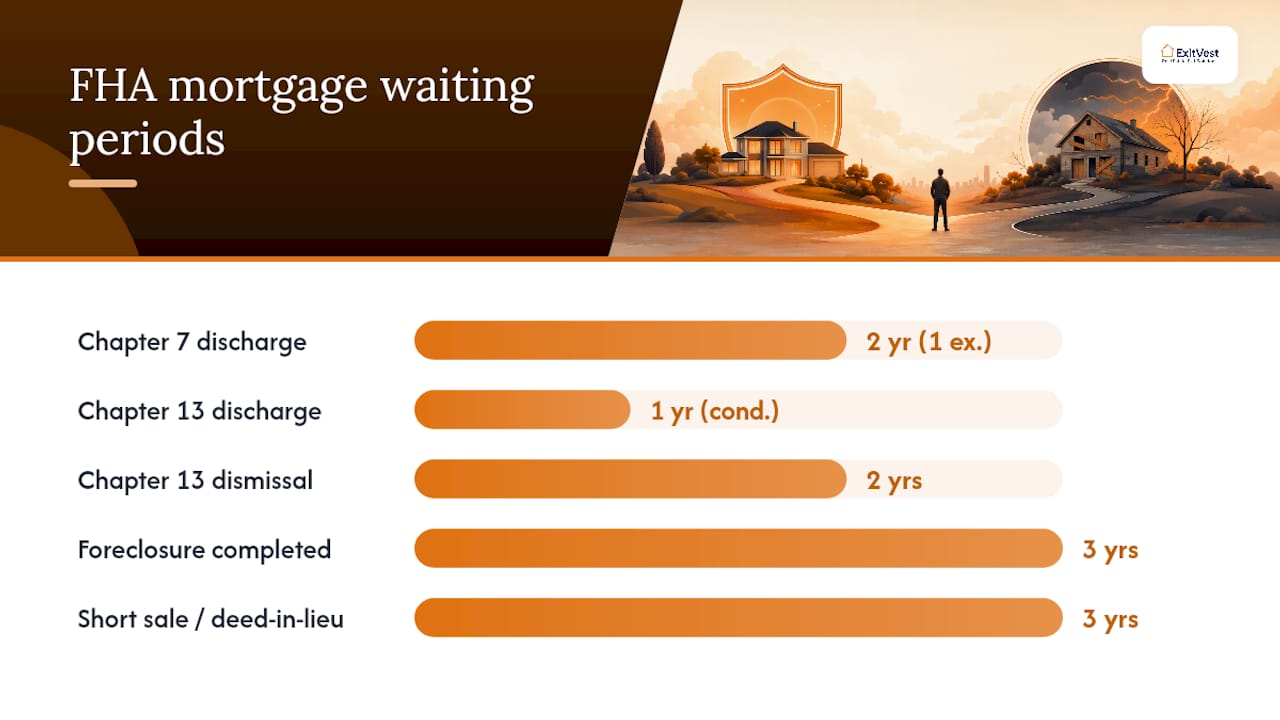
Extenuating circumstances (a job loss, serious illness, or death of a co-borrower) can shorten these windows, but lenders require documentation: termination letters, medical records, and a written explanation. The clock starts from the discharge date for bankruptcy and from the sale completion date for foreclosure.
A few practical points:
- Rebuilding credit after bankruptcy is faster when you add a secured credit card and keep utilization below 30% immediately after discharge.
- Foreclosure's seven-year conventional waiting period is the longest of any derogatory event under Fannie Mae guidelines.
- Practitioners note the misconception that bankruptcy is always worse for credit — an unmanaged foreclosure plus lingering unsecured debts often produces a slower recovery than a clean bankruptcy discharge.
Deficiency judgments, nondischargeable debts, and tax consequences
When a foreclosure sale produces less than the outstanding loan balance, the lender may pursue a deficiency judgment for the shortfall. Whether that's possible depends entirely on state law. Some states (California, for example) limit deficiency actions on purchase-money mortgages. Others allow them freely. Check your state's rules before assuming the lender's claim ends at the sale.
Bankruptcy can eliminate a deficiency balance. Bankruptcy can be a strategic way to eliminate unsecured debt and deficiency balances so a homeowner can walk away cleanly, whereas foreclosure alone often leaves someone liable for remaining balances and collection actions. A Chapter 7 discharge typically wipes the deficiency. A Chapter 13 plan can include it in the repayment structure.
Not everything disappears in bankruptcy, though. Certain obligations cannot be discharged, including:
- Most student loans (absent a showing of undue hardship under the Brunner test)
- Child support and alimony
- Most federal, state, and local tax debts less than three years old
- Debts from fraud or willful misconduct
- Criminal fines and restitution
Tax consequences of forgiven debt add another layer. When a lender forgives a deficiency balance, the IRS generally treats the forgiven amount as ordinary income under the cancellation-of-debt rules. The key exception: debt discharged in a bankruptcy case is excluded from gross income under IRC § 108(a)(1)(A). That exclusion does not apply to a simple foreclosure where the lender voluntarily forgives the balance outside of bankruptcy, so a homeowner who lets foreclosure proceed and then receives a 1099-C could face an unexpected tax bill.
Pro Tip: If your lender sends a 1099-C after foreclosure, consult a tax professional immediately. The insolvency exclusion under IRC § 108(a)(1)(B) may apply even outside bankruptcy if your liabilities exceeded your assets at the time of forgiveness.
Chapter 7 vs Chapter 13 vs foreclosure: a side-by-side comparison
Bankruptcy offers broader debt relief and immediate legal protections, while foreclosure only addresses the mortgage. Here's how the three paths compare across the dimensions that matter most:
| Dimension | Chapter 7 | Chapter 13 | Foreclosure |
|---|---|---|---|
| Scope of debt relief | Discharges most unsecured debts | Restructures and discharges remaining unsecured debts after plan | Resolves mortgage lien only |
| Stops foreclosure? | Temporarily (stay lifts at case close) | Yes, while plan is active and compliant | N/A — this is the foreclosure |
| Can you keep the home? | Rarely (no cure mechanism) | Yes, if plan and mortgage payments are current | No |
| Credit report duration | a decade (Ch. 7) | several years (Ch. 13) | several years |
| Mortgage waiting period | 4 years (Fannie Mae conventional) | 2 years from discharge (Fannie Mae) | several years (Fannie Mae conventional) |
| Deficiency liability | Discharged | Included in plan or discharged | Possible, depending on state law |
| Typical duration | 3–6 months | 3–5 years | 3 months to 2+ years (state-dependent) |
| Typical attorney fees | lawyer fees that typically range in the thousands | lawyer fees that typically range in the thousands | Varies (defense counsel legal defense fees that can range in the thousands) |
Three scenarios that map to a clear recommendation:
-
Sole mortgage debt, state prohibits deficiency, no desire to keep the home. Foreclosure or a short sale is the simplest path. No bankruptcy needed; the lender's claim ends at the sale.
-
Multiple unsecured debts plus mortgage arrears, steady income, want to keep the home. Chapter 13 is the right tool. It stops the foreclosure, cures the arrears over time, and discharges credit card and medical debt at plan completion.
-
No income to sustain a Chapter 13 plan, multiple unsecured debts, willing to surrender the home. Chapter 7 wipes the unsecured debts and the deficiency balance, then the homeowner exits cleanly. The foreclosure proceeds, but the financial slate is cleared.
Alternatives to bankruptcy and foreclosure you should know
Before committing to either path, several alternatives can resolve a mortgage crisis with less legal complexity. Loss-mitigation and loan modification programs can lower payments or restructure loans and should be explored before choosing foreclosure or filing bankruptcy when you qualify.
Loan modification asks the lender to permanently change the loan terms: lower interest rate, extended term, or reduced principal. Lenders often prefer this to foreclosure because it avoids the cost and uncertainty of a sale. The process requires documentation of hardship, income verification, and patience — modifications can take 60–90 days to process. Start by contacting your lender's loss-mitigation department directly, or work through a HUD-approved housing counselor who can negotiate on your behalf at no cost.
Short sale means selling the home for less than the mortgage balance with lender approval. The lender agrees to accept the proceeds as full or partial satisfaction of the debt. It avoids the public stigma of foreclosure, typically results in a shorter mortgage waiting period than a completed foreclosure, and gives you more control over the timeline. The downside: lender approval can take months, and some lenders still pursue a deficiency after a short sale unless you negotiate a full release.
Deed-in-lieu of foreclosure transfers the property title directly to the lender in exchange for release from the mortgage obligation. Faster than a formal foreclosure, it avoids the public auction process. Lenders generally require the home to be listed for sale first and will not accept a deed-in-lieu if there are junior liens on the property.
Selling for cash to a direct buyer like Exitvest is the fastest option when time has run out. No lender negotiations, no court process, no repairs. You get a cash offer, choose a closing date, and walk away. The trade-off is a sale price below retail market value, but for homeowners facing an imminent auction date, the certainty and speed often outweigh the price difference. You can sell your house even during foreclosure — the key is acting before the sale date.
A practical decision flow:
- Determine your sale date. If it's within 30 days, your options narrow immediately.
- Contact a HUD-approved housing counselor (free service, find one at hud.gov).
- Call your lender's loss-mitigation line and ask about modification or forbearance.
- Consult a bankruptcy attorney if you have multiple debts or want to keep the home.
- If speed is the priority and you're ready to move, request a cash offer from a direct buyer.
Pro Tip: HUD-approved counselors are free and can often negotiate directly with your lender's loss-mitigation team. Many homeowners skip this step and go straight to an attorney, spending money they didn't need to.
How Exitvest's cash sale works as a practical alternative
For homeowners who have decided they cannot or do not want to keep the property, a cash sale to Exitvest offers a clean exit without the delays of bankruptcy court or the uncertainty of a foreclosure auction.
Here's what the process actually involves:
- Contact and initial review. You share basic property details. No obligation, no pressure.
- Cash offer. Exitvest provides a written offer based on the property's condition and market. No repairs required, no cleaning, no staging.
- Due diligence. A brief review of title and property condition. Typically takes a few days, not weeks.
- Closing. You choose the date. Closings can happen in as little as 7–14 days, which matters enormously when a foreclosure sale is scheduled.
Pros of a cash sale:
- Speed and certainty: no lender approval, no court calendar, no buyer financing contingencies.
- No repair costs or agent commissions.
- Flexible closing date lets you coordinate a move without pressure.
- Stops the foreclosure clock by completing the sale before the auction date.
Cons to weigh honestly:
- The offer will be below retail market value. That's the trade-off for speed and certainty.
- You won't eliminate other unsecured debts the way bankruptcy would.
- If you have significant equity, a traditional listing might net more even after agent fees.
The right question to ask is not "which option gives me the highest price?" but "which option leaves me in the best financial position after all costs, debts, and waiting periods are factored in?" For many homeowners facing imminent foreclosure with little equity and multiple debts, a fast cash sale plus a Chapter 7 filing to clear remaining balances is a cleaner outcome than either path alone.
Pro Tip: Before accepting any cash offer, ask your attorney to calculate your net proceeds after paying off the mortgage, any liens, and closing costs. Then compare that number to what you'd walk away with after foreclosure, including any deficiency exposure.
How to decide: a practical checklist
Pull these facts together before you talk to anyone:
- Your foreclosure sale date. Everything else depends on how much time you have.
- Total mortgage arrears. How far behind are you, and what would it cost to cure?
- Total unsecured debt. Credit cards, medical bills, personal loans — add it all up.
- Current monthly income. Determines Chapter 13 feasibility and means test for Chapter 7.
- Your state's deficiency judgment rules. Does your state allow lenders to sue after foreclosure?
- Home equity (or lack of it). If you owe more than the home is worth, keeping it may not make financial sense.
Questions to bring to a bankruptcy attorney or housing counselor:
- Do I qualify for Chapter 7 or Chapter 13 given my income and debt levels?
- Can a Chapter 13 plan realistically fit my monthly budget?
- What is my state's deficiency judgment law, and am I at risk?
- Will my lender consider a loan modification or short sale?
- What are the tax consequences of each path in my specific situation?
Red flags that demand immediate action:
- A foreclosure auction date within 30 days
- A wage garnishment order already filed
- A deficiency judgment from a prior foreclosure still outstanding
- Multiple creditors threatening lawsuits simultaneously
Recommended order of outreach:
- HUD-approved housing counselor (free, start at hud.gov)
- Bankruptcy attorney (free consultations are standard)
- Lender's loss-mitigation department
- Exitvest if speed and relocation are the priority
Typical timelines and costs for each path
Time and money are the two variables most homeowners underestimate. Here's a realistic picture:
A few cost realities worth noting:
- Chapter 13 trustee fees are paid from your plan payments, not out of pocket upfront, but they add up over a 5-year plan.
- Bankruptcy requires two mandatory courses: a credit counseling course before filing and a debtor education course before discharge. Both carry small fees, typically $25–$50 each.
- Foreclosure defense attorneys can slow a judicial foreclosure significantly, which buys time but adds cost.
- A cash sale to a direct buyer like Exitvest carries no attorney fees, no court costs, and no agent commissions — the trade-off is the below-market offer price.
Fees vary by jurisdiction and case complexity. Always get a written fee agreement from any attorney before signing.
What I'd tell a homeowner facing this choice right now
The bankruptcy-vs-foreclosure question looks like a legal problem, but it's really a financial triage problem. The law gives you tools; the question is which tool fits the actual damage.
When I look at the cases where bankruptcy clearly wins, they share one trait: the mortgage isn't the only problem. A homeowner with $40,000 in credit card debt, a car loan in default, and three months of mortgage arrears is not facing a mortgage problem. They're facing a total financial collapse, and foreclosure alone won't fix it. Chapter 13 stops the bleeding on all fronts simultaneously.
Where I see homeowners make the wrong call is when they file bankruptcy primarily to delay the inevitable. If you can't sustain a Chapter 13 plan payment on top of your current mortgage, the stay will be lifted, the foreclosure will resume, and you'll have spent money on attorney fees and court costs with nothing to show for it. A clean exit — short sale, deed-in-lieu, or a cash sale — is often the more honest answer.
The other underappreciated factor is the deficiency judgment risk. Many homeowners assume the foreclosure ends their liability. In states that permit deficiency actions, it doesn't. A lender can wait years, then garnish wages or bank accounts. Bankruptcy eliminates that exposure. That alone sometimes justifies filing even when the home is already lost.
Consult a bankruptcy attorney and a HUD-approved counselor before deciding. And if you're considering a cash sale, ask for a net-proceeds calculation so you're comparing real numbers, not assumptions.
Facing foreclosure? Exitvest can close before the auction date
When the foreclosure clock is running and you've decided a fast exit is the right move, Exitvest buys properties for cash, as-is, with no repairs, no agent commissions, and no lender approval required. That matters when you have days or weeks, not months.
Exitvest works with homeowners across the country, with a strong focus on New Jersey, Texas, Florida, and Tennessee. The process is straightforward: you share your property details, receive a written cash offer, and choose your closing date. Closings can happen in as little as 7–14 days, which is often the difference between completing a sale and losing the property at auction.
This is not a substitute for legal advice. If you have significant unsecured debt or a deficiency judgment risk, talk to a bankruptcy attorney first. But if speed and certainty are what you need, request a cash offer from Exitvest and compare the net proceeds against your other options before the sale date arrives.
Sources
The following authoritative sources were used in this article. Consulting a HUD-approved housing counselor or a licensed bankruptcy attorney for your specific situation is strongly recommended before taking any action.
- Chapter 13 - Bankruptcy Basics - United States Courts
- Is Foreclosure Worse Than Bankruptcy? Credit and Costs - LegalClarity
- Considering Foreclosure and Bankruptcy – Financial Education
This article provides general information only and is not legal, financial, or tax advice. Consult a licensed bankruptcy attorney and a qualified tax professional for guidance specific to your situation.