

Yes, you can sell an outdated home quickly, and the most predictable fast route is a direct cash sale to an as-is buyer. The typical U.S. home was built over 40 years ago, so sellers dealing with dated kitchens, aging systems, or deferred maintenance are far from alone. Selling as-is to a cash buyer like Exitvest removes the repair treadmill entirely.
The short version:
- Fastest timeline: Cash as-is sale closes in as few as 7–21 days
- Price tradeoff: Cash offers typically come in below full retail value, accounting for repair costs and investor risk
- Immediate next step: Request a no-obligation cash offer, gather your title documents, and pick your closing date
Table of Contents
- What are your realistic options for selling an outdated house?
- How does selling as-is to a cash buyer actually work?
- What timeline and price tradeoff should you expect?
- How do you prepare an outdated home for a better offer without major repairs?
- How Exitvest buys outdated homes and what you can expect
- What questions should you ask every cash buyer before signing?
- Legal and financial checks you cannot skip
- Key Takeaways
- The part most sellers get wrong about selling an outdated property
- Ready to get a cash offer from Exitvest on your terms?
What are your realistic options for selling an outdated house?
Every seller's situation is different, but the routes below cover the full range. Selling as-is is a real, viable option, though it usually yields a lower sale price than a fully repaired listing.
| Route | Speed to close | Certainty | Net proceeds | Repairs required | Seller fees | Closing control |
|---|---|---|---|---|---|---|
| Cash as-is sale | 7–21 days | Very high | Below market | None | Minimal | High (you pick the date) |
| Agent listing as-is | 30–120+ days | Moderate | Closer to market | None to minor | 5–6% commission | Low |
| Repair-and-list | 3–6+ months | Moderate–high | Highest potential | Significant | 5–6% commission | Low |
| Auction | 30–60 days | Moderate | Unpredictable | None | Auction fees | Low |
| Hold/rent | Ongoing | N/A | Rental income | Varies | Management costs | High |
When each route makes sense:
- Cash sale: You need to close fast, can't fund repairs, or the property has liens, probate complications, or problem tenants
- Agent as-is listing: You have time and want to test the retail market without investing in repairs; works best in high-demand areas
- Repair-and-list: You have budget, time, and the property's core systems are sound; about 42% of buyers want move-in-ready homes, so a repaired listing attracts the widest pool
- Auction: Works when you want a hard deadline and can accept price uncertainty
- Hold/rent: Only practical if you don't need the equity now and the property is rentable
How does selling as-is to a cash buyer actually work?
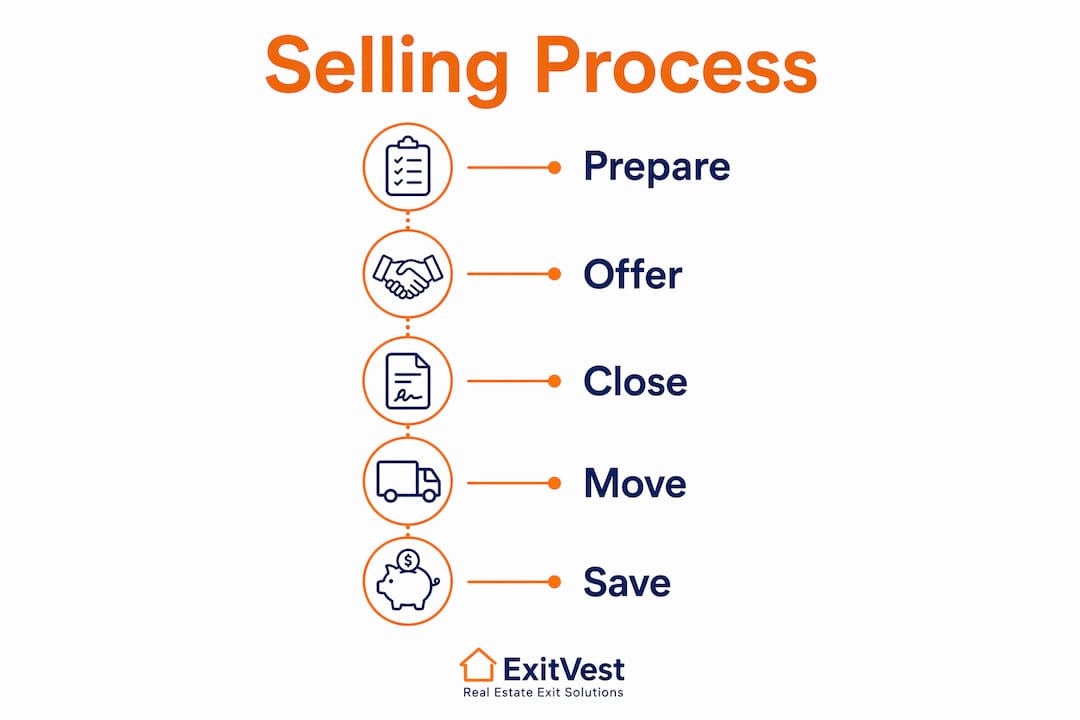
The process is more straightforward than most sellers expect. Here's the typical flow:
- Request an offer — you submit basic property info (address, condition, any known issues)
- Property review — the buyer does a drive-by, virtual walk-through, or brief on-site visit
- Valuation — the buyer estimates the after-repair value (ARV) of your home, then subtracts estimated repair costs and their required profit margin; a common investor rule of thumb targets a total investment at roughly 70% of ARV or less
- Firm cash offer — a serious buyer presents a written offer; the key word is firm, meaning no financing contingency and no inspection-driven renegotiation
- Title check and closing — a title company or closing attorney verifies ownership, clears any liens, and handles the paperwork
The distinction between a firm, no-contingency offer and a standard as-is listing matters more than most sellers realize. An as-is listing does not prevent a buyer from requesting an inspection and then pushing for a price reduction afterward. Only a direct cash buyer offering a genuinely no-contingency purchase removes that re-trade risk.
Pro Tip: Before requesting offers, pull together your title documents, a recent tax bill, and a short written summary of known defects. Buyers who have this information upfront move faster and are less likely to revise their offer downward later.
What timeline and price tradeoff should you expect?
Cash sales can close very quickly, sometimes within a week; a more typical window is about two to three weeks when title work is involved. Agent listings for as-is properties often sit 30–120 days or longer, depending on the market. A repair-and-list strategy adds months of contractor work before the clock even starts.
| Route | Typical close time | Typical net vs. market value |
|---|---|---|
| Cash as-is sale | 7–21 days | Below market (repair costs + investor margin deducted) |
| Agent as-is listing | 30–120+ days | Closer to market, minus 5–6% commission |
| Repair-and-list | 3–6+ months | Closest to full market value, minus repair spend |
| Auction | 30–60 days | Unpredictable; can go low |
The honest tradeoff: speed and convenience come at a price. A cash offer will be lower than what a fully renovated home would fetch on the open market. For many sellers facing foreclosure, inherited properties, or properties with serious deferred maintenance, that tradeoff is worth it. For others with time and budget, a repair-and-list strategy may net more.
Costs you avoid with a cash sale: agent commissions (typically 5–6%), staging, most repair bills, and often the seller's share of closing costs. Costs you still face: title fees, any unpaid liens or back taxes, and applicable capital gains tax.
Pro Tip: Get at least two or three cash offers before accepting. The spread between buyers can be meaningful, and comparing net proceeds after any fees gives you a cleaner picture than comparing headline offer prices.
How do you prepare an outdated home for a better offer without major repairs?
You don't need a renovation to improve your position. A few hours of effort can meaningfully increase what a buyer offers and how quickly they move.
- Declutter every room — empty spaces photograph better and feel larger during walk-throughs
- Deep clean, including appliances and bathrooms — buyers notice grime; it signals neglect even when the bones are fine
- Replace burned-out bulbs and fix broken fixtures — small cosmetic updates like lighting and hardware have an outsized effect on perceived value
- Patch visible safety hazards — a loose handrail or cracked step gives buyers a reason to discount; a tube of caulk and an hour of work can remove that leverage
- Take honest, well-lit photos — accurate photos that show the property fairly attract the right buyers and reduce surprises; exterior presentation matters more than most sellers expect
- Gather your documents — title deed, recent utility bills, any repair receipts, HOA rules, and property tax records all speed the offer process and reduce friction at closing
Highlight what the property genuinely has going for it: lot size, location, school district, or architectural character. Buyers who want a fixer-upper are looking for potential, not perfection.

How Exitvest buys outdated homes and what you can expect
Exitvest buys houses, land, and small apartment buildings directly from owners, as-is, for cash. The process is designed to be fast and low-friction regardless of the property's condition.
How it works:
- Request an offer — fill out a short form or call; provide the address and a brief description of the property's condition
- Property review — Exitvest reviews the property, often with a quick visit or virtual walk-through
- Firm cash offer — you receive a written offer with no financing contingency
- Title and closing coordination — Exitvest works with a title company or closing attorney to verify ownership and clear any issues
- Flexible closing date — you choose when to close, whether that's 10 days or 60 days out
Exitvest covers properties in all 50 states, with particular depth in New Jersey, Texas, Florida, and Tennessee. There are no agent commissions, no repair requirements, and the paperwork is straightforward. For liens, probate situations, or tax questions, Exitvest recommends working with a title company, real estate attorney, or CPA to confirm your numbers before closing.
To move quickly, gather your title documents, a recent tax bill, and a list of any known liens or code violations before you reach out. If the property is inherited and still in probate, note that — Exitvest handles those situations regularly, and knowing upfront avoids delays. For rental properties with tenants, the same applies: selling a rental as-is is a path Exitvest navigates often.
What questions should you ask every cash buyer before signing?
Not every "cash buyer" operates the same way. Ask these before you commit:
- Can you provide proof of funds? A legitimate buyer will show a bank statement or letter from their funding source without hesitation
- Is your offer contingency-free? Confirm in writing that no financing or inspection contingency is attached
- Who handles the title and closing? The answer should be a licensed title company or real estate attorney, not the buyer themselves
- How are liens handled? Clarify in writing whether the buyer or seller is responsible for clearing outstanding liens
- What fees, if any, will I pay? Reputable cash buyers charge no upfront fees; any fee before closing is a red flag
- What is your actual close timeline? Get a specific date range, not a vague "as soon as possible"
Red flags to avoid: any buyer who asks for an upfront fee, pressures you to sign without reviewing paperwork, gives vague answers about title, or refuses to use a licensed title company or escrow service. Verify proof of funds directly — a screenshot of a balance is not the same as a verifiable bank letter.
Legal and financial checks you cannot skip
Selling as-is does not remove your legal obligations. Under state law, you must disclose known material defects even when selling without repairs. Withholding known problems can lead to post-closing litigation.
- Liens: Unpaid property taxes, mechanics liens, and recorded judgments attach to the title. A title search will surface them; clarify in writing whether the buyer or seller resolves each one before closing
- Probate: If the property is inherited and the estate is still open, you may need court approval to sell. Consult a real estate attorney early; Exitvest's team can point you to the right resources, and this guide to selling an inherited house covers the timeline in detail
- Capital gains: A deeply discounted sale can still trigger capital gains tax, particularly on inherited property where the step-up in basis may or may not apply. Consult a CPA before closing to understand your actual net
This article is general information, not legal or tax advice. Confirm your specific situation with a licensed attorney, title company, or CPA.
Key Takeaways
Selling an outdated home as-is for cash is the fastest, most certain route for sellers who prioritize speed over maximum sale price, but preparation and due diligence still determine how much you walk away with.
| Point | Details |
|---|---|
| Cash sale is fastest | A direct cash as-is sale closes in 7–21 days, far faster than any agent-listed or auction route. |
| Expect a price tradeoff | Cash offers are below retail market value; the gap reflects repair costs and investor margin, not a scam. |
| Prepare before requesting offers | Gather title documents, tax bills, and a defect summary to speed valuation and reduce re-trades. |
| Two red flags to avoid | Upfront fees from a buyer and offers with hidden contingencies are the clearest signs of a bad deal. |
| Exitvest option | Exitvest buys outdated homes as-is nationwide, with no commissions, flexible closing dates, and a straightforward process. |
The part most sellers get wrong about selling an outdated property
The fear of selling a dated or distressed home is almost always worse than the reality. Sellers spend months paralyzed by the idea that their property is unsellable, or they pour money into renovations that don't return what they cost, trying to appeal to a buyer who was never going to show up anyway.
The market for outdated homes is real and active. Investors, renovators, and buyers who specifically want a project are out there, and they are not looking for perfection. What they are looking for is honesty, clear title, and a fair price that reflects the property's actual condition. The sellers who do best in a cash sale are the ones who come in organized: they know what they owe, they have their documents ready, and they've thought through their timeline. That preparation is worth more than any cosmetic fix.
The one thing worth repeating: a cash offer is not a charity. It is a business transaction where the buyer is pricing in risk and repair costs. Understanding that math, and getting multiple offers to test it, is how you protect yourself.
Ready to get a cash offer from Exitvest on your terms?
If you've read this far, you already know more than most sellers do when they start. Exitvest's process is built for exactly this situation: a property that needs work, a seller who wants clarity, and a closing timeline that fits your life, not a lender's schedule.
No agent fees. No repair requirements. No pressure to sign before you're ready. Exitvest buys houses, land, and small apartment buildings as-is, nationwide, with particular focus on New Jersey, Texas, Florida, and Tennessee. You provide the basic property details; Exitvest handles the rest, from the offer through closing coordination with a licensed title company.
To move fastest, have your title documents, a recent tax bill, and a short list of known issues ready when you reach out. For liens or probate questions, a title company or real estate attorney should be your first call before closing. When you're ready, request your cash offer and choose a closing date that works for you.