

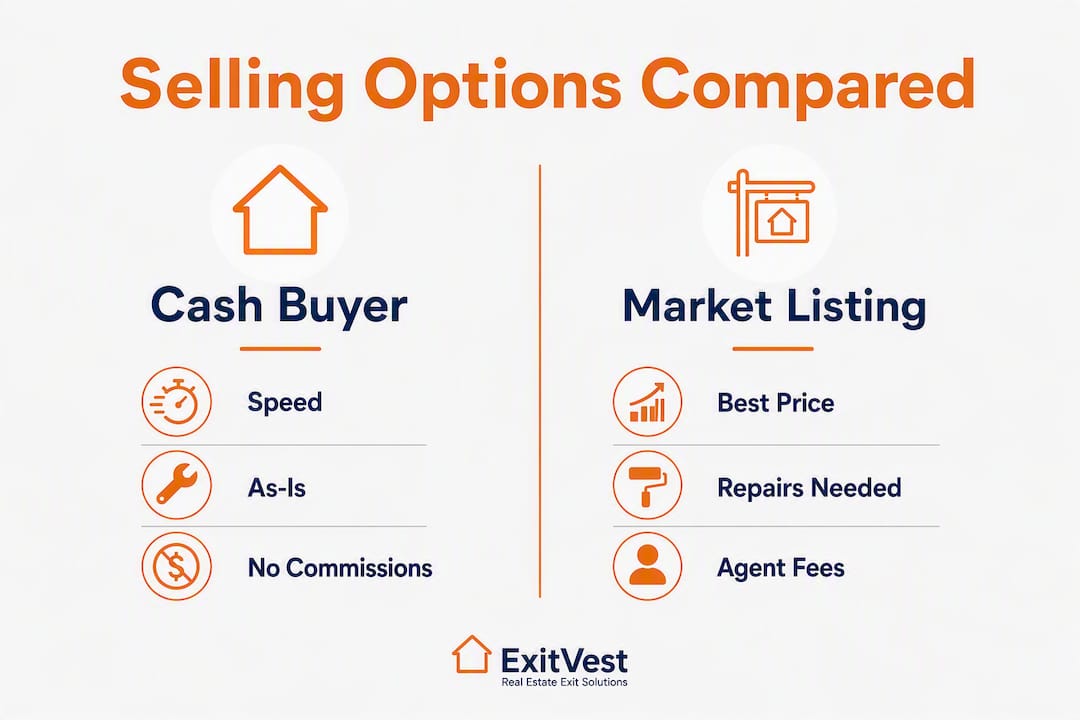
If speed is your priority, sell as-is to a cash buyer. If maximum sale price matters more and you can wait, list with a probate-savvy real estate agent. For a middle path, low effort with a reasonable price, broker-matching services or a fix-and-resell investor may fit. When heirs prefer keeping the property in the family, a private sale with proper documentation is the cleanest route. The trade-off is always the same: higher price means more time, more work, and more carrying costs eating into what you actually pocket.
The step-up in basis resets your inherited property's tax basis to fair market value at the date of death, which often eliminates capital gains tax if the estate sells soon after inheritance. That changes the math considerably for many heirs.
| Selling Approach | Best For | Typical Timeline | Net Proceeds |
|---|---|---|---|
| Cash buyer (as-is) | Speed, certainty, low effort | 7 days | Lower gross, often competitive net |
| Agent market listing | Maximum sale price | 9–18 months total | Highest gross, reduced by fees |
| Fix-and-resell investor | Major repairs, no cash for rehab | Weeks to months | Below market, no repair cost |
| Broker-match / iBuyer | Easy comparison, online process | Varies | Moderate, watch service fees |
| Private / family sale | Keeping property in family | Flexible | Varies, requires appraisal |
Quick next steps:
- Confirm who holds legal authority to sell (executor, trustee, or unanimous heir agreement) before anything else.
- Get at least one cash offer as a baseline, even if you plan to list with an agent.
- Interview one probate-experienced agent and compare net proceeds after commissions, repairs, and carrying costs.
- Set a firm internal decision deadline tied to your monthly carrying costs.
Table of Contents
- What are the top probate property selling solutions side by side?
- Do you have legal authority to sell the inherited property?
- Should you list the inherited home with a probate-savvy agent?
- Why selling as-is to a cash buyer is often the strongest move
- What about a fix-and-resell investor?
- Are broker-matching services and iBuyers worth using?
- When does a private or family sale make sense?
- Can you combine approaches?
- What do the numbers actually look like? Costs, timelines, and the cost of waiting
- How do you choose? A decision checklist and red flags to watch
- Quick decision guide: which approach fits your situation?
- Key Takeaways
- The mistake most heirs make, and how to avoid it
- Exitvest: a direct path to a fast, certain probate sale
- Authoritative sources and where to read more
What are the top probate property selling solutions side by side?
The table below maps each option across the dimensions that actually move the needle for heirs and executors. Generic advice says "it depends." This shows you what it depends on.
| Dimension | Cash buyer (as-is) | Agent market listing | Fix-and-resell investor | Broker-match / iBuyer | Private / family sale |
|---|---|---|---|---|---|
| Expected net proceeds | Moderate (lower gross, fewer deductions) | Highest gross, minus 5–6% commission + repairs + carrying costs | Below market; investor absorbs rehab cost | Moderate; watch service/convenience fees | Varies; must document fair market value |
| Timeline to close | 7 days | 9–18 months total (probate + sale) | Weeks to months post-purchase | Days to weeks for offer; closing varies | Flexible; can be fast or slow |
| Out-of-pocket costs | Minimal to none | Commissions, staging, repairs, closing costs | None for repairs; lower sale price | Platform fees or agent commissions | Appraisal, legal docs, recording fees |
| Seller work required | Very low | High: repairs, staging, showings, disclosures | Low after sale | Low to moderate | Moderate: legal docs, negotiations |
| Certainty of close | Very high | Moderate; buyer fall-through risk is real | High once purchased | Moderate; platform terms vary | High if heirs agree |
| Legal/probate complexity | Low to moderate; cash buyers can work with attorneys | Moderate to high; agent must understand confirmation | Low to moderate | Low to moderate | Moderate; requires written agreements |
| Emotional/admin burden | Low | High | Low | Low to moderate | Can be high; family dynamics |
| Tax implications | Step-up in basis applies; consult CPA | Step-up in basis applies; longer timeline may affect estate taxes | Step-up applies; lower sale price reduces exposure | Step-up applies | Step-up applies; gift tax risk if below market |
One-line verdict per option:
- Cash buyer: — Pick this when you need liquidity fast, the property needs work, or carrying costs are mounting.
Do you have legal authority to sell the inherited property?
Before you contact a single buyer or agent, confirm who actually has the right to sign a purchase contract. Getting this wrong can void a sale, expose the personal representative to personal liability, or trigger court sanctions.
The authority comes from one of three sources. An executor named in the will receives Letters Testamentary from the probate court. An administrator, appointed when there is no will, receives Letters of Administration. A trustee named in a living trust can sell trust property without court involvement at all. When no formal representative exists and all heirs agree, a unanimous written consent among heirs may allow a private sale, though state law varies significantly on this point.
Document checklist to confirm before you proceed:
- Certified copy of the death certificate
- Original will (if one exists) and court-filed copy
- Letters Testamentary or Letters of Administration issued by the probate court
- Trust agreement (if the property is held in a trust)
- Recorded deed showing how title was held (sole ownership, joint tenancy, tenants in common)
- Mortgage payoff statement and any lien documentation
- Property tax status and any outstanding assessments
State procedures split into two broad camps. Independent administration states (Texas, for example) give the executor broad authority to sell without court confirmation at each step. Court-confirmation states (California is the clearest example) require the court to approve the sale price, and California's Probate Code allows overbids at the confirmation hearing where a new buyer must exceed the contract price by at least $5,000 plus 10%. That process can add months and real uncertainty to a sale you thought was done.
Pro Tip: In your first 15 minutes with a probate attorney, ask two questions: "Do I have authority to sell without court confirmation?" and "Is notice to creditors or beneficiaries required before I can close?" The answers determine your timeline and which buyers will actually follow through.
For a detailed breakdown of executor duties and the documents required, the role of estate executor in a sale covers fiduciary responsibilities and Letters Testamentary in plain terms.
Should you list the inherited home with a probate-savvy agent?
Yes, if the property is in decent condition, heirs can absorb several months of carrying costs, and the goal is the highest possible gross sale price. An experienced probate agent is not the same as a standard listing agent. The probate-specific skills matter: understanding court confirmation procedures, working with probate referees on appraisals, and navigating title documentation that a standard agent may flag as a problem and walk away from.

Typical costs to factor in include commission of a few percent of sale price split between listing and buyer's agent, seller-paid closing costs including title, escrow, and transfer taxes, staging and prep expenses which vary but can be several thousand dollars, repairs which may be substantial depending on the property's condition, and ongoing carrying costs such as property taxes, insurance, utilities, and mortgage payments while the property is listed.
The seller work is real. Heirs should expect to coordinate repairs and contractors, attend or arrange access for multiple showings, review and respond to offers, and manage disclosure requirements that vary by state. If the estate is in court-confirmation territory, the agent also needs to know how to present the sale to the court and handle overbid scenarios.
Red flags to watch for when interviewing agents: no experience with probate confirmation hearings, vague answers about appraisal requirements, or pressure to list at an aggressive price without accounting for the property's condition. Probate-experienced agents who understand the confirmation process and title documentation requirements reduce procedural delays significantly. Price erosion from extended carrying costs is the most common way heirs lose money on a market listing, not the commission itself.
Why selling as-is to a cash buyer is often the strongest move
Cash-as-is buyers are the practical top pick when heirs need liquidity, want minimal involvement, or are watching carrying costs compound month over month. The trade is straightforward: you accept a price below what a fully prepped market listing might fetch, and in return you get speed, certainty, and near-zero seller effort.
Vetting checklist before accepting any cash offer:
- Proof of funds (bank statement or letter from lender, dated within 30 days)
- Track record of recent closings, ideally in probate or estate sales
- Clear purchase contract with no hidden fees or post-inspection price reductions
- Flexible closing timeline options (some estates need 30 days, others need 90)
- Confirmation that the buyer handles title work and lien resolution
- Transparent earnest money terms and what happens if the buyer walks
- Experience with court-confirmation scenarios if your state requires them
Sample net-proceeds comparison (illustrative, $300,000 estimated market value):
| Item | Market listing | Cash as-is offer |
|---|---|---|
| Sale price | $300,000 | $300,000 |
| Agent commission (a few percent) | ($18,000) | — |
| Repairs / staging | ($15,000) | — |
| Closing costs (2%) | ($6,000) | — (buyer pays) |
| Carrying costs (6 months) | ($9,000) | ($1,500) |
| Estimated net proceeds | $252,000 | $298,500 |
The gap between a market listing and a cash offer narrows significantly once you account for real costs, especially when the market listing closes within several months and buyer fall-through is avoided. Extend the timeline or add a major repair, and the cash offer wins outright.
Cash offers can arrive within a few days of a property inquiry, and closings can happen within about a week to over a month, depending on title work and probate authority status. When court confirmation is required, a reputable cash buyer will work alongside the estate's attorney to submit the required documentation and attend the hearing.
Exitvest buys houses, land, and small apartment buildings as-is, directly from heirs and executors, with no commissions and flexible closing timelines. The process: request an offer, review the terms with your attorney, and close on a schedule that fits the estate. Exitvest handles repairs, title issues, and lien coordination so the estate does not have to. For a practical breakdown of what to expect, fast inherited property sale mechanics walks through each step.
Pro Tip: Get a cash offer before you commit to a listing. It costs nothing and gives you a concrete floor for net proceeds. If the agent's projected net after all costs beats the cash offer by a meaningful margin, list. If it does not, you already have your answer.
What about a fix-and-resell investor?
Fix-and-resell investors buy the property at a discount, handle the renovation, and resell at a profit. For the estate, the benefit is simple: no repair budget required, no contractor management, and a relatively fast close. The cost is a lower sale price than a fully renovated market listing would command.
This route fits best when:
- The property needs moderate to major repairs the estate cannot fund
- Heirs do not want to manage contractors or coordinate work from a distance
- The property would otherwise sit vacant and accumulate carrying costs while waiting for a retail buyer
- Time pressure exists but the estate can accept a price below market
The typical process: the investor makes an offer, the estate accepts, the investor closes quickly, then the investor handles all rehab and resells independently. The estate's involvement ends at closing.
Common drawbacks worth knowing upfront. The net price is lower than a market listing, sometimes significantly. If the sale requires court confirmation, the overbid process can attract competing buyers who may outbid the investor at the hearing, creating uncertainty after you thought a deal was done. Vet the investor's rehab experience before signing; an investor who underestimates repair costs may try to renegotiate after the inspection period.
Are broker-matching services and iBuyers worth using?
They can be, with caveats. Broker-matching services connect heirs to agents or buyers quickly, and iBuyer platforms generate fast algorithmic offers. Both are useful for getting a baseline number without much effort. The results, though, vary widely by platform and local market.
Key things to vet before committing:
- Understand the full fee structure. Some platforms charge service fees or convenience charges on top of standard commissions that reduce net proceeds more than a traditional agent would.
- Confirm whether multiple competing offers are genuinely independent or whether the platform is steering you toward a preferred buyer.
- Ask specifically how the platform handles probate title issues and court-confirmation requirements. Many iBuyer platforms are not set up for probate complexity and will simply decline the property.
- Check time-to-close guarantees in writing, not just in marketing copy.
Flat-fee MLS and broker-matching services can list faster and reduce out-of-pocket agent fees, but market exposure and probate experience vary by vendor. For a straightforward, well-maintained inherited property in a strong market, a broker-match service can work well. For a distressed property with title complications or a court-confirmation requirement, the platform may not be equipped to follow through.
The best use of an iBuyer offer: treat it as one data point in a comparison, not a final decision. Collect it alongside a cash buyer offer and an agent's projected net, then decide.
When does a private or family sale make sense?
A private or family sale makes sense when heirs prefer to keep the property within the family or want to avoid the costs and exposure of a public sale. It requires more careful documentation than any other option, because the legal and tax risks of getting it wrong fall entirely on the heirs.
Practical steps and legal checklist:
- Get a formal appraisal from a licensed appraiser to document fair market value at the time of sale
- Draft a written purchase and sale agreement with clear payment terms, contingencies, and closing date
- Disclose all known material defects in writing, even in a family transaction
- Record the deed correctly with the county recorder's office after closing
- Confirm that all heirs with an ownership interest have consented in writing to the sale terms
On the tax side, the step-up in basis applies regardless of who buys the property. Document the fair market value carefully. If the sale price is significantly below market, the IRS may treat the difference as a gift, which can trigger gift tax reporting requirements. Consult a CPA before finalizing any below-market sale to a family member.
The emotional risks are real. Intra-family disputes over price, payment terms, or perceived favoritism among heirs are common. A written agreement signed by all parties before the sale closes is the single most effective way to prevent litigation later. If heirs cannot agree on terms, a private sale is not the right route.
Can you combine approaches?
Yes, and combining approaches is often the smartest risk management strategy available to an estate. The core logic: run parallel tracks so you preserve options and set a firm deadline that forces a decision.
Practical hybrids that work:
- List with an agent while simultaneously soliciting cash offers. Set a deadline (say, 30 days) and accept whichever produces the better net. If the agent produces a strong offer, take it. If not, the cash offer is already in hand.
- Accept a cash offer with a short inspection period and a marketing fallback. Some cash buyers will allow a brief window during which the estate can continue marketing, with the cash offer as a floor.
- Sell to a family member conditioned on a formal appraisal and written consent from all heirs. This protects against later disputes and documents fair market value for tax purposes.
- Pursue targeted light repairs (paint, cleaning, landscaping) to attract a retail buyer while keeping a cash offer on the table as a fallback if the listing stalls.
Fallback checklist to keep the process from drifting:
- Set firm decision deadlines for each track (cash offer: 7–14 days; agent listing: 30–60 days)
- Document every offer in writing, including verbal discussions reduced to email
- Keep the probate attorney looped on all offers to prevent procedural errors, especially in court-confirmation states
- Recalculate carrying costs monthly and adjust your decision threshold accordingly
What do the numbers actually look like? Costs, timelines, and the cost of waiting
Waiting usually costs more than heirs expect. Ongoing taxes, utilities, insurance, and maintenance can erode estate value faster than a marginally higher market sale price earned over a long timeline. The math is worth doing explicitly.
Sample net-proceeds scenarios ($300,000 estimated market value property):
| Scenario | Gross sale price | Commissions & fees | Repairs & staging | Carrying costs | Estimated net |
|---|---|---|---|---|---|
| Market listing (6 months) | $300,000 | $18,000 | $15,000 | $9,000 | $258,000 |
| Market listing (12 months) | $305,000 | $18,300 | $15,000 | $18,000 | $253,700 |
| Cash as-is (30 days) | $300,000 | — | — | $1,500 | $298,500 |
| Fix-and-resell investor | $270,000 | — | — | $1,500 | $268,500 |
These figures use conservative assumptions: 6% commission, $15,000 in repairs and staging, and $1,500/month in carrying costs (taxes, insurance, utilities). Your actual numbers will vary, but the structure of the math holds.
Notice what happens between the 6-month and 12-month market listing scenarios. An extra six months of carrying costs and a modest price increase of $5,000 produces a lower net. That is the cost of waiting made concrete.
A typical inherited-property sale takes 9 to 18 months when probate processes and court steps are included. That timeline is the single biggest variable in the net-proceeds calculation.
Pro Tip: To estimate your break-even waiting time, divide the difference between the cash offer and the projected market net proceeds by your monthly carrying costs. If the gap is $15,000 and carrying costs are $1,500/month, you break even at 10 months. If the market listing takes longer than that to close, the cash offer was the better financial choice.
For more detail on fastest ways to sell an inherited house and how timelines compare across approaches, that guide covers the speed-focused options in depth.
How do you choose? A decision checklist and red flags to watch
Follow this sequence before committing to any approach:
- Confirm legal authority. Do not market the property until you have Letters Testamentary, Letters of Administration, or trustee authority confirmed in writing.
- Decide your primary priority. Speed and certainty, or maximum price? This single decision narrows the field immediately.
- Collect 2–3 offers. Always include at least one cash-as-is offer as a baseline. Add an agent's projected net and, if relevant, an iBuyer or broker-match offer.
- Vet each buyer or agent. Use the questions below.
- Set a firm decision deadline. Tie it to your carrying cost estimate. Drift is expensive.
Questions to ask cash buyers:
- Can you provide proof of funds dated within the last 30 days?
- How many probate or estate sales have you closed in the last 12 months?
- Who handles title work and lien resolution, and at whose cost?
- Have you closed sales requiring court confirmation? How did you handle the overbid process?
- What happens to your offer if the probate timeline extends?
Questions to ask agents:
- Have you handled court-confirmed probate sales in this state?
- What is your realistic net-proceeds estimate after commissions, repairs, and carrying costs at 6 months? At 12 months?
- How do you handle probate referee appraisals and title documentation?
Red flags that warrant walking away or escalating to your attorney:
- No proof of funds, or proof of funds that is vague or undated
- Vague closing timelines with no contractual commitment
- Hidden fees or post-inspection price reductions not disclosed upfront
- Unwillingness to work with the probate attorney or attend a court confirmation hearing
- Pressure to skip required disclosures or sign before you have reviewed documents with counsel
- Requests to transfer title before closing
For recommended timetables: give cash offers 7–14 days for a decision once you have the offer in hand. For agent interviews and listing decisions, 30–60 days is reasonable, but only if your carrying costs support that window.
Quick decision guide: which approach fits your situation?
| Your priority or constraint | Best approach | One-sentence rationale |
|---|---|---|
| Need cash quickly | Cash buyer (as-is) | Closes in 7 days with near-zero seller effort and high certainty. |
| Want maximum sale price | Agent market listing | Highest gross price, provided the property is in good condition and heirs can absorb carrying costs. |
| Property needs major repairs, no budget | Fix-and-resell investor | Investor absorbs rehab cost; estate closes fast without funding repairs. |
| Want easy process, online convenience | Broker-match / iBuyer | Fast baseline offer with minimal effort; vet fees and probate capability before committing. |
| Heirs want to keep it in the family | Private / family sale | Avoids public sale costs; requires appraisal, written agreements, and all-heir consent. |
| Court confirmation required in your state | Cash buyer experienced with confirmations | Buyers familiar with overbid hearings reduce deal-failure risk significantly. |
| Mixed priorities: some price, some speed | Hybrid: list + cash offer fallback | Run both tracks with a firm deadline; take whichever produces the better net. |
Key Takeaways
Selling a probate property comes down to one decision made early: confirm your legal authority first, then choose between speed and price, because trying to optimize both usually costs you both.
| Point | Details |
|---|---|
| Confirm authority before anything | Verify Letters Testamentary, Letters of Administration, or trustee authority before contacting any buyer or agent. |
| Cash offers close quickly, typically within a few days to several weeks. | For heirs facing carrying costs or needing liquidity, a cash-as-is sale often produces competitive net proceeds after fees and repairs are deducted from a market listing. |
| Probate timelines commonly span several months to over a year. | The full inherited-property sale process commonly takes 9 to 18 months; carrying costs during that window directly reduce net proceeds. |
| Always quantify the cost of waiting | Divide the net-proceeds gap between cash and market sale by monthly carrying costs to find your break-even waiting period. |
| Exitvest for fast, as-is sales | Exitvest buys inherited properties as-is nationwide, with no commissions, flexible closing timelines, and handling of title and lien issues. |
The mistake most heirs make, and how to avoid it
Most heirs wait too long. Not because they are indecisive, but because the decision feels permanent and the options feel complicated. So they delay. They hold an estate meeting, then schedule another one. They get one agent's opinion and wait for a second. Meanwhile, the property taxes, insurance, and utilities keep running, and the carrying costs quietly consume the premium they were hoping to earn from a longer listing.
The single most useful thing an heir or executor can do is set a decision deadline before collecting any offers. Not after. Before. Decide in advance: "If we do not have a signed contract by [date], we accept the best cash offer on the table." That deadline changes the entire dynamic. It forces the comparison to happen on a real timeline, not an indefinite one. It also gives every buyer and agent a concrete signal that the estate is serious.
The other mistake is treating the step-up in basis as a reason to rush or delay. It is neither. The step-up simply means that for most estates selling within a reasonable period after inheritance, capital gains tax is not the deciding factor. The deciding factor is almost always carrying costs versus net proceeds, and the only way to see that clearly is to run the numbers with real offers in hand.
Consult a probate attorney and CPA for any court-confirmation or complex tax scenario. General guidance is a starting point, not a substitute for advice specific to your estate.
Exitvest: a direct path to a fast, certain probate sale
If speed and certainty are your priorities after reading through these options, Exitvest offers a direct route. Exitvest buys houses, land, and small apartment buildings as-is, directly from heirs and executors, with no agent commissions, no repair requirements, and closing timelines you choose.

Properties that fit Exitvest's process include inherited homes in any condition, vacant properties, homes with tenants, properties with code violations or liens, and estates in active probate. The process is straightforward: request an offer, review the terms with your probate attorney, and close on a schedule that works for the estate. Exitvest handles title work, lien coordination, and the paperwork, so the estate does not have to manage those details.
To get a fast quote, have these ready: a copy of the deed or property address, basic condition notes, mortgage payoff information if applicable, and your probate authority documents. Exitvest operates nationwide, with particular depth in New Jersey, Texas, Florida, and Tennessee.
One transparency note: for complex court-confirmation scenarios or estates with significant tax exposure, consult your probate attorney and CPA before closing any sale, including a cash sale.
See how Exitvest's process works or review eligible property situations to request a no-pressure cash offer.
Authoritative sources and where to read more
- IRS Publication 551: Basis of Assets — The primary IRS reference for step-up in basis rules; consult this for the tax mechanics of inherited property.
- LegalClarity: What Happens If You Inherit a House and Sell It? — Plain-language explanation of the probate process, executor authority, and legal steps required before a sale.
- Inherited Property Match: Probate Real Estate Guide for Heirs and Executors — Detailed walkthrough of agent selection, appraisal requirements, and court-confirmation procedures.
- HomeLight: I Inherited a House and Want to Sell It — Practical 10-step guide covering selling options, cash buyers, and net-proceeds considerations.
- Redfin: Selling an Inherited House — Covers carrying costs, emotional considerations, and the financial case for faster sales.
- Houzeo: Selling an Inherited Property — Covers timelines, flat-fee listing options, and state-by-state probate variation.
- Made For Law: Selling Real Estate During Probate — Authoritative guide on court-confirmation procedures, overbid rules, and step-up in basis mechanics.
- Exitvest: Inherited Property Sale Legal Requirements — Document checklist and state-variation notes for heirs navigating legal authority requirements.