

You can sell a house with unpermitted work. The catch is that how you handle it determines whether you close cleanly or face a lawsuit six months later. Most U.S. sellers have three practical paths: obtain retroactive permits before listing, disclose the work and sell as-is with a price adjustment or buyer credit, or remove and rebuild the unpermitted work to permitted condition. Which one fits your situation depends on your timeline, budget, and how significant the work actually is.
Here is the immediate triage checklist to run before you do anything else:
- Assess scope. Walk the property and note every improvement that looks like it might have required a permit: finished rooms, added bathrooms, structural changes, electrical panels, decks.
- Pull permit records. Contact your local building department or search its online portal for a permit history on your address.
- Get a contractor estimate. A licensed contractor can tell you within a few days whether the work is up to current code and what retroactive permitting or removal would cost.
- Consult a real estate attorney if the scope is large, if the work involves structural or safety issues, or if you have any doubt about your disclosure obligations.
- Consider a cash as-is offer if your timeline is short or the repair costs are prohibitive. Exitvest purchases properties in as-is condition nationwide, including homes with code violations and unpermitted work, with no agent commissions and flexible closing dates.
The sections below walk through each path in detail, including legal exposure, financing consequences, negotiation language, and realistic cost and timeline ranges.
Key Takeaways
Selling a house with unpermitted work is legal in most U.S. states, but disclosure is mandatory, and the resolution path you choose determines your legal exposure, your buyer pool, and your net proceeds.
| Point | Details |
|---|---|
| Disclosure is non-negotiable | You must disclose known unpermitted work in virtually every U.S. state; nondisclosure can trigger rescission or damages. |
| Three resolution paths exist | Retroactive permitting, sell as-is with disclosure and credit, or remove/rebuild; choose based on timeline, cost, and work severity. |
| Financing and appraisal are real obstacles | FHA and VA loans often cannot fund until issues are resolved; appraisers may exclude unpermitted square footage from value. |
| Document everything before listing | Photos, contractor estimates, permit history, and receipts reduce negotiation friction and post-sale legal exposure. |
| Exitvest buys as-is for cash | For sellers who cannot wait for permits or repairs, Exitvest offers cash purchases with flexible closing and no agent fees. |
Table of Contents
- What counts as unpermitted work, and which projects typically require a permit?
- How to find out whether your home has unpermitted work
- What are your disclosure obligations, and what happens if you skip them?
- How does unpermitted work affect financing, appraisal, insurance, and title?
- What are the three resolution paths, and which one fits your situation?
- How to negotiate and document a sale when unpermitted work exists
- Who should you call, and what should you ask them?
- When is a fast, as-is cash sale the right call?
- What do costs and timelines actually look like?
- What sellers under a tight timeline should actually do
- Exitvest can close your as-is sale without the permit headache
- Sources
What counts as unpermitted work, and which projects typically require a permit?
Unpermitted work is any construction, renovation, or installation that required a local building permit under your municipality's code but was completed without one. The permit requirement exists so a licensed inspector can verify that the work meets safety standards for structure, fire, electrical, and plumbing before it is covered up by drywall or flooring.
The projects that almost always trigger a permit requirement include:
- Finished basements and attic conversions turned into living space
- Added bedrooms or bathrooms, including half-baths
- Garage conversions to living space or ADUs (accessory dwelling units)
- Structural changes: removing load-bearing walls, adding or enlarging windows, room additions
- Electrical upgrades: panel replacements, new circuits, rewiring
- Plumbing work: new supply or drain lines, water heater replacements in many jurisdictions
- Decks, pergolas, and covered patios above a certain square footage
- Major HVAC changes: new ductwork systems, added mini-splits in some jurisdictions, central air installations
Minor maintenance, by contrast, usually does not require a permit: painting, flooring replacement, cabinet swaps, faucet replacements, and most cosmetic work. The line is drawn at anything that touches structure, egress, fire separation, electrical systems, or plumbing supply and drain.
Pro Tip: Check your local code's four trigger categories before assuming a project was minor: structural, egress (how people escape in a fire), electrical, and plumbing. If the work touched any of those four systems, assume a permit was required and verify before listing.
According to practical guidance for homeowners selling with unpermitted work, documenting all known unpermitted projects and consulting professionals early is the most reliable way to reduce liability before a sale. The reason is straightforward: unpermitted work follows the property, not the person. If a prior owner built an unpermitted addition in 2008 and you sell in 2026 without disclosing it, the buyer's claim lands on you.
How to find out whether your home has unpermitted work
Start at your local building department. Most municipalities maintain a permit history for every address, and many now publish it through an online portal. Here is the step-by-step process:
- Search your municipality's online permit portal. Search "[your city] building permit history" or "[your county] permit search." Many jurisdictions let you pull records by address in minutes.
- Call or visit the building department directly. Ask for the permit history on your address, any open permits, any recorded code violations, and whether a certificate of occupancy was issued for the current structure. Bring the property address and, if you have them, the parcel number and legal description.
- Review closing documents from your own purchase. Prior disclosure forms, title commitments, and inspection reports sometimes flag unpermitted work or open permits that were known at the time.
- Order a targeted home inspection. Hire a licensed home inspector and ask them to focus specifically on areas you suspect were renovated without permits: the basement, any added rooms, the electrical panel, and the deck. A good inspector will note work that looks newer than the permit record suggests.
- Request a paid permit report. Services like Shovels aggregate permit data from municipal databases and can surface permit gaps faster than manual searches in some markets.
- Interpret what you find. An open permit means work was started but never inspected to completion. A red tag or stop-work order means the municipality flagged a violation. No permit on record for a finished basement built in 2015 is a clear signal.
Pro Tip: When you visit the building department in person, bring sketches or photos of the suspected work, any contractor receipts you have, and the approximate year the work was done. Inspectors can often tell you on the spot whether that type of project required a permit in that year and what retroactive options exist.
Local building departments are the definitive source for permit history and after-the-fact permit guidance. Contacting them early, before a buyer's inspector does, puts you in control of the conversation.
What are your disclosure obligations, and what happens if you skip them?
Most U.S. jurisdictions require sellers to disclose known material defects, and unpermitted work qualifies as a material defect in virtually every state. Nondisclosure is not a gray area: it can trigger rescission of the sale, compensatory damages, and in egregious cases, fraud claims.
The legal standard most courts apply is "actual or constructive knowledge." If you knew the basement was finished without a permit, you had actual knowledge. If a reasonable investigation would have revealed it, courts may find constructive knowledge even if you claim ignorance. Either way, the buyer's attorney does not need to prove you lied — only that you knew or should have known.
California Civil Code §1102 is the most cited example of mandatory seller disclosure law: it requires sellers to complete a Transfer Disclosure Statement covering known material facts, including renovations and permit status. California is not unique. Most states have equivalent statutes; the specific form and penalty structure vary, but the underlying duty is consistent across the country.
Sample disclosure language sellers can adapt:
"Seller discloses that the [describe improvement, e.g., finished basement / rear deck / added bathroom] located at [address] was constructed without a building permit to Seller's knowledge. Seller makes no representation as to whether the improvement meets current building code requirements. Buyer is advised to conduct independent inspections and consult with the local building department prior to closing."
Typical buyer remedies for nondisclosure include: demanding the seller pay to bring the work into compliance, negotiating a price reduction post-discovery, or pursuing rescission and damages in court. Timelines for claims vary by state, but most statutes of limitations for real estate fraud run three to six years from discovery, not from closing.
Pro Tip: Before you finalize your seller disclosures, have a local real estate attorney review them. A one-hour consultation ($150–$400 in most markets) is far cheaper than defending a rescission claim.
How does unpermitted work affect financing, appraisal, insurance, and title?
The financing impact is often the deal-killer sellers do not anticipate. Here is what happens across each dimension:
- Lender underwriting delays. Conventional lenders may flag unpermitted square footage during underwriting and require the seller to resolve it before funding. FHA and VA loans are stricter: HUD's single-family handbook describes inspection and habitability requirements that can block FHA financing entirely until safety and structural issues are corrected. A buyer using an FHA loan to purchase a home with an unpermitted structural addition may find their lender will not fund until the addition is either permitted or removed.
- Appraisal adjustments. Appraisers frequently exclude unpermitted square footage from the comparable measurement, which can lower the appraised value below the contract price and trigger a renegotiation or a financing gap.
- Insurance coverage gaps. A homeowner's insurance policy covers the structure as it was permitted and built. If a fire starts in an unpermitted addition, the insurer may deny the claim or reduce the payout on the grounds that the addition was not part of the insured structure. This risk transfers to the buyer at closing, but it can also become a seller liability if the buyer pursues a claim based on nondisclosure.
- Title exceptions and lien risk. Title insurance typically does not cover losses related to undisclosed unpermitted work discovered after closing. A municipality can also place a lien on the property for unresolved code violations, which must be cleared before title can transfer cleanly.
Practical mitigation steps:
- Obtain retroactive inspection records or a contractor's compliance report before listing.
- Provide a seller credit sized to the estimated cost of permitting or corrective work.
- Use an escrow holdback for repairs rather than a price reduction when the lender requires documented resolution.
- For buyers using FHA or VA financing, consider whether the property is better marketed to cash buyers or conventional-loan buyers to avoid the stricter inspection triggers.
What are the three resolution paths, and which one fits your situation?
The decision rule is simple: if the unpermitted work involves a structural or safety defect, repair or permit it. If it is minor cosmetic work, permit it or sell as-is with disclosure. If your timeline is urgent or the repair cost exceeds the value gain, sell as-is to a cash buyer.
Path A: Retroactive (after-the-fact) permitting
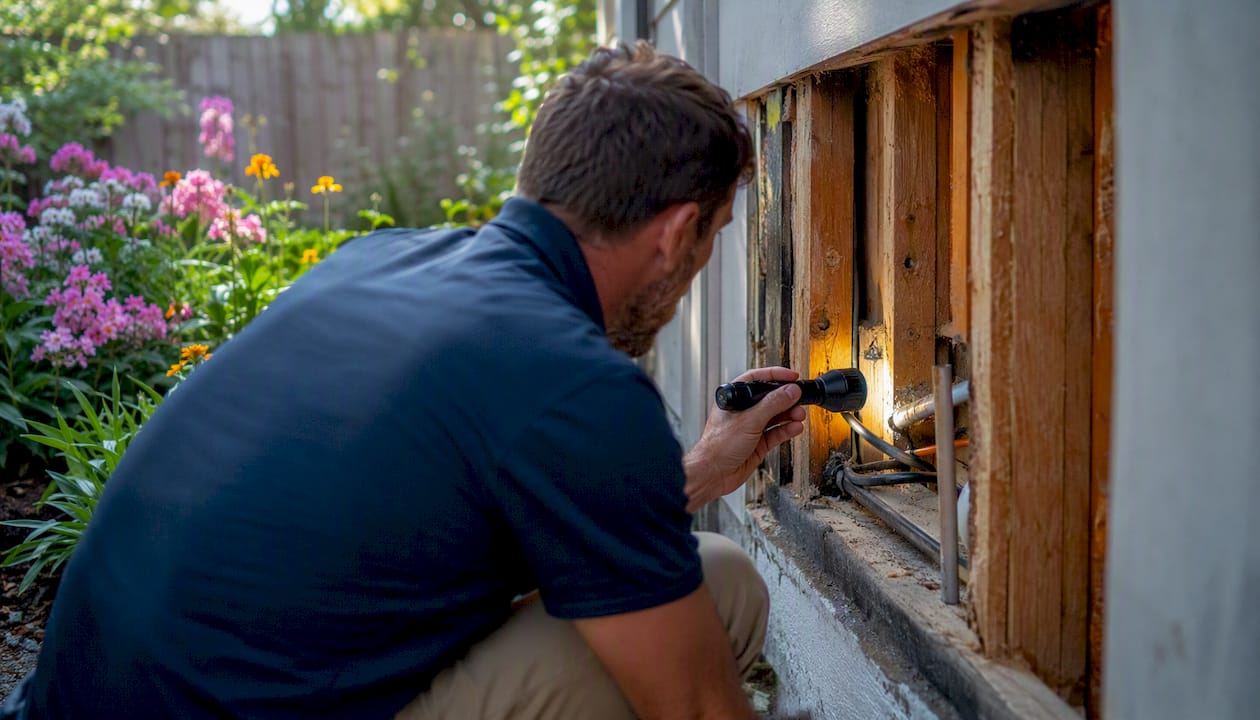
Retroactive permitting is possible in most jurisdictions, but the process is not a rubber stamp. You submit as-built plans, pay permit fees, and schedule inspections. If the inspector finds the work does not meet current code, you may need to open walls, replace materials, or rebuild sections entirely. Retroactive permitting often requires opening finishes to verify compliance and sometimes rebuilding to meet current code.
Pros: Maximizes sale price, removes lender and appraisal friction, eliminates ongoing liability. Cons: Costly and time-consuming; may reveal additional problems; some municipalities deny retroactive permits for work that cannot be brought to current code.
Process checklist:
- Hire a licensed contractor or architect to prepare as-built drawings.
- Submit plans and permit application to the building department.
- Schedule rough inspections (may require opening walls).
- Complete any required corrective work.
- Obtain final inspection sign-off and updated certificate of occupancy.
Path B: Sell as-is with disclosure and price adjustment or buyer credit
This is the most common path for sellers with minor to moderate unpermitted work. You disclose the issue fully, price the property to reflect the work's unverified status, and either reduce the price or offer a credit at closing sized to the estimated cost of permitting or removal.

Many sellers successfully sell as-is by disclosing unpermitted work and offering a credit or targeting cash investors. Proactive documentation, including contractor estimates and photos, speeds negotiations and reduces post-sale disputes. Industry guidance commonly estimates that properties with unpermitted work sell for roughly 10%–20% less than they would if the same improvement were fully permitted, though the actual discount varies by market and the severity of the issue.
Pros: Faster than permitting, avoids repair costs, keeps the sale moving. Cons: Price reduction or credit required, may limit buyer pool (FHA/VA buyers often excluded), some residual liability if disclosure is incomplete.
Path C: Remove or rebuild to permitted condition
Removal makes sense when the unpermitted work is so far out of code that retroactive permitting would cost more than the value it adds, or when a lender specifically requires removal. It is also the right call for safety hazards: an unpermitted electrical panel that poses a fire risk should be corrected, not disclosed and sold around.
Pros: Eliminates the issue entirely, opens the full buyer pool. Cons: Expensive and disruptive, may reduce the home's livable square footage or features.
| Resolution path | Typical cost range | Timeline | Lender impact | Marketability |
|---|---|---|---|---|
| Retroactive permit | $200–$50,000+ depending on scope | 4 weeks to 6+ months | Resolves most lender issues | Full buyer pool |
| Sell as-is with credit | Cost of credit only | Days to weeks | Limits FHA/VA buyers | Reduced pool |
| Remove/rebuild | $2,000+ | 1–4 months | Resolves lender issues | Full buyer pool |
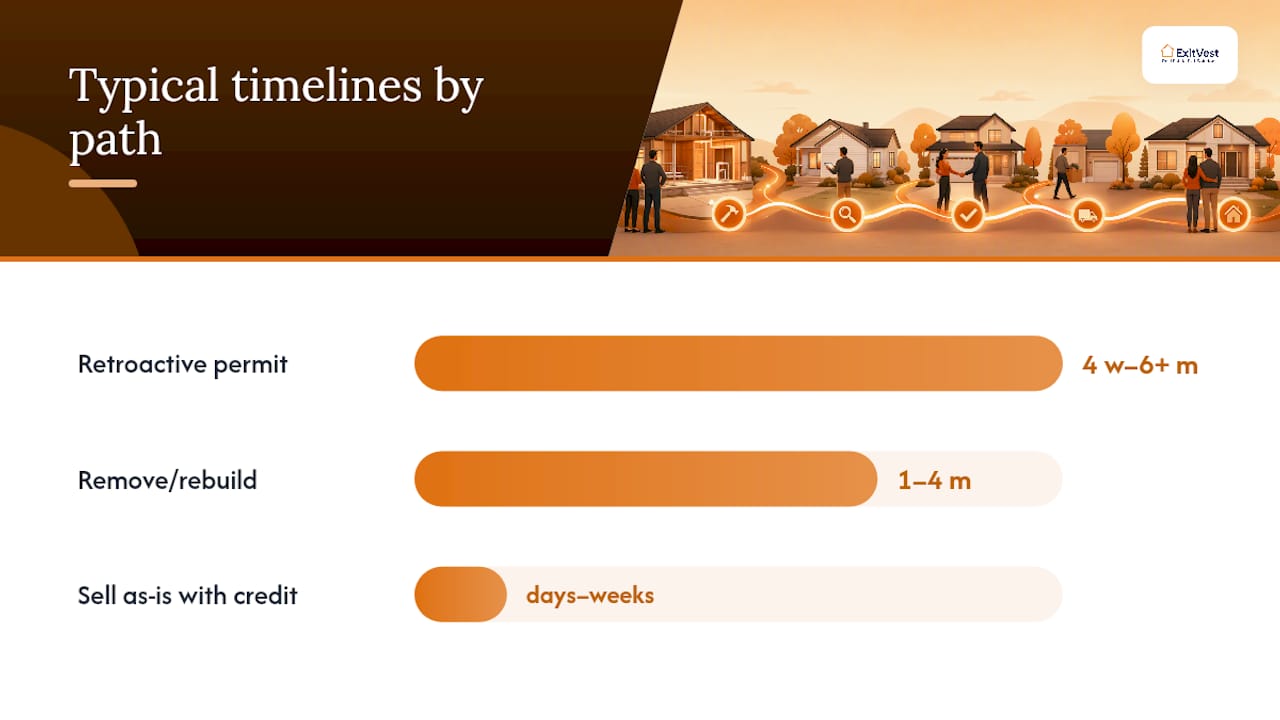
When corrective work would cost more than the improvement is worth, removal or an as-is sale is almost always the smarter financial move.*
How to negotiate and document a sale when unpermitted work exists
Disclose, document, and use contingency language or credits. Hiding the problem is not a strategy; it is a liability that follows you for years after closing.
Sample contract clauses sellers can adapt:
- As-is clause: "Property is sold in its present condition. Seller makes no warranty as to the condition or permit status of any improvements. Buyer acknowledges receipt of Seller's disclosure regarding [specific unpermitted work] and accepts the property with full knowledge of its condition."
- Seller credit schedule: "Seller agrees to provide Buyer a credit of $[amount] at closing, representing Buyer's estimated cost to obtain retroactive permits and complete any required corrective work for the [specific improvement]."
- Escrowed repair provision: "The parties agree to escrow $[amount] from Seller's proceeds to fund permit applications and corrective work to be completed within [X] days of closing. Unused funds shall be released to Seller."
- Buyer acknowledgment: "Buyer acknowledges that the [improvement] located at [address] was constructed without a building permit and that Buyer has had the opportunity to inspect the improvement and consult with the local building department prior to executing this agreement."
Negotiation checklist:
- Calculate the credit using: contractor estimate + permit fees + a 15%–20% buffer for unknowns.
- Offer a credit rather than a price reduction when the lender's appraisal already accounts for the unpermitted work, since a credit does not change the contract price.
- If the buyer's lender requires resolution before funding, an escrowed repair provision is often the fastest path to closing.
- Get two contractor bids before finalizing any credit amount. One bid is a guess; two give you a defensible number.
- Red flags that should prompt legal counsel: the buyer's attorney sends a demand letter, the unpermitted work involves structural damage or safety hazards, or the buyer threatens rescission.
Documentation best practices: Compile photos of the work as it currently exists, any contractor receipts or invoices from when it was built, contractor statements about current condition, prior inspection reports, and any correspondence with the building department. Attach these to your seller disclosures or escrow instructions. Documenting everything pre-listing materially reduces negotiation friction and legal exposure.
If you are listing on the MLS and need to circulate disclosures and state-approved contracts efficiently, SendMLS provides a platform for distributing offers and disclosure packages to buyers' agents using state-approved contract forms.
Pro Tip: Date-stamp every document and photo. If a dispute arises post-closing, a timestamped photo of the unpermitted basement taken before listing is far more useful than a contractor statement written after the fact.
Who should you call, and what should you ask them?
The right professional depends on the problem. Call an attorney for legal risk and disclosure questions. Call a licensed contractor for feasibility and cost estimates. Call a permit expediter when retroactive permitting is likely and you want someone to manage the municipal process. Call a title company when liens or permit-related title issues may exist.
| Professional | What they do | Typical fee/turnaround | Key questions to ask |
|---|---|---|---|
| Real estate attorney | Reviews disclosure obligations, drafts contract language, advises on liability | $150–$500/hr; 1–5 days | "What are my disclosure duties in this state?" "What is my exposure if I sell as-is?" |
| Licensed contractor | Inspects work, estimates retroactive permit cost and corrective work | $200–$600 inspection; bids in 3–7 days | "Is this work up to current code?" "What would it cost to bring it into compliance?" |
| Permit expediter | Manages permit applications, coordinates with building department | $500+ depending on complexity | "Have you pulled retroactive permits in this municipality before?" "What is the realistic timeline?" |
| Title company | Searches for liens, open permits, and title exceptions; issues title insurance | $500–$2,000 at closing | "Are there any open permits or code violations on record?" "Will you insure over this issue?" |
| Licensed home inspector | Identifies unpermitted work and code concerns; documents condition | $300–$600; report in 24–48 hrs | "Does this work look like it was permitted?" "Are there safety concerns I need to address?" |
Documents to gather for each professional:
- Photos of all suspected unpermitted work
- Any contractor receipts or invoices from the original construction
- Prior inspection reports and seller disclosures from your own purchase
- Permit history printout from the building department
- Current property survey or plot plan if available
Pro Tip: To vet a contractor or permit expediter quickly, ask for their license number and verify it with your state licensing board, then ask specifically whether they have pulled retroactive permits in your municipality in the past 12 months. Local experience with your specific building department cuts weeks off the timeline.
When is a fast, as-is cash sale the right call?
Selling as-is for cash makes the most sense when your timeline or financial situation makes permitting or repairs impractical. Specific scenarios where this path is clearly the right one:
- The unpermitted work is extensive and corrective costs would exceed the value gain.
- You are facing foreclosure and cannot wait 3–6 months for a retroactive permit process.
- The property is inherited and you have no knowledge of what was built or when.
- Problem tenants or a vacant property are generating carrying costs that make a long sale timeline expensive.
- You simply cannot fund repairs out of pocket and do not want to negotiate credits with a financed buyer.
Exitvest purchases houses, land, and small apartment buildings in as-is condition, including properties with unpermitted work, code violations, and open permits. The model is straightforward: you receive a cash offer, choose a closing date that works for your situation, and pay no agent commissions. Exitvest operates nationwide, with particular depth in New Jersey, Texas, Florida, and Tennessee.
Tradeoffs to understand clearly: A cash as-is offer will typically be lower than a fully permitted, market-listed sale price. The discount reflects the buyer's cost and risk of resolving the permit issues after purchase. What you gain is certainty, speed, and the elimination of repair costs, agent fees, and the risk of a financed deal falling apart at underwriting.
Selling as-is does not eliminate your disclosure duties. You are still legally required to disclose known unpermitted work to any buyer, including a cash investor. Exitvest purchases with appropriate documentation and reviews title and disclosure materials as part of its standard process.
For sellers in New Jersey specifically, the guide to selling a house with open permits in NJ covers state-specific process steps that apply whether you are listing or selling directly for cash.
Pro Tip: Before accepting any cash offer, get at least one contractor bid for the corrective work. That number tells you whether the discount in the cash offer is reasonable or excessive, and it gives you a basis for negotiation even with an as-is buyer.
What do costs and timelines actually look like?
The ranges below reflect common scenarios across U.S. markets. Municipal review times are the biggest variable: a building department with a two-week review cycle produces very different outcomes than one with a 12-week backlog.
Initial assessment (permit history search, contractor inspection, attorney consult): 1–3 weeks, $500–$1,500 total.
Permit review period (after application submission): 4–12 weeks in most jurisdictions, longer in high-volume markets.
Corrective work timelines and costs:
- Minor permit and inspection only (work already meets code): $200–$2,000 in fees, 2–8 weeks total.
- Moderate corrective work (some wall opening, material replacement): $2,000–$20,000, 1–3 months.
- Major structural rebuild or full removal: $20,000–$50,000+, 3–6+ months.
As-is price adjustment: No out-of-pocket repair cost, but expect a market discount. Industry guidance places typical adjustments in the 10%–20% range of what the improvement would add if permitted, though the actual number depends on your market and the severity of the issue.
For sellers who want to understand the full cost picture of selling without repairs, the guide to selling a home without repairs covers expense and timeline estimates in detail.
Pro Tip: Get two contractor bids and a permit fee estimate from your building department before committing to any path. The permit department will often tell you the fee schedule over the phone in 10 minutes, and two bids give you a realistic cost range rather than a single number that may be optimistic or inflated.
What sellers under a tight timeline should actually do
If you are reading this because you need to sell quickly and you just discovered unpermitted work, here is the honest framework: triage first, then get professional input, then pick the path that balances speed, cost, and liability.
Most sellers in a hurry make one of two mistakes. They either panic and try to hide the issue, which creates legal exposure that outlasts the sale by years. Or they assume they need to fix everything before listing, which burns months and money they do not have. Neither extreme is right.
When speed is the priority, the practical answer is transparent as-is disclosure with thorough documentation, or a direct cash sale to a buyer like Exitvest who handles the complexity after purchase. When maximizing value matters more than speed, retroactive permitting or removal is worth the investment, particularly for structural or electrical work where the permit adds real appraised value.
The one thing that is never optional, regardless of which path you choose, is disclosure. Sellers who skip it do not avoid the problem; they just move it to a courtroom.
Exitvest can close your as-is sale without the permit headache
If retroactive permitting is not realistic for your timeline or budget, Exitvest offers a direct path: a cash offer on your property in its current condition, with no repairs required, no agent commissions, and a closing date you choose.

Here is what the process looks like. You share basic information about the property, including photos and whatever you know about its permit status. Exitvest provides a cash offer, typically within days. If you accept, Exitvest handles title review and due diligence, and you sign standard seller documents. Sellers keep their disclosure obligations throughout: Exitvest purchases with full documentation of known issues.
The tradeoff is real: a cash as-is offer will be below a fully permitted, agent-listed sale price. What you get in return is a closed deal, no repair bills, and no risk of a financed buyer's lender pulling out at the last minute. For sellers facing foreclosure, probate, code violations, or properties they simply cannot afford to repair, that certainty has concrete value.
Get a no-pressure cash offer from Exitvest and find out what your property is worth in its current condition.
Sources
- Hud
- Sell a House With Unpermitted Work: A Practical Guide for Homeowners
- Selling a Home with Unpermitted Work
- Shovels | What Is Unpermitted Work? Risks, Disclosure, and What to Do About It
This article is general information, not a substitute for advice from a qualified lawyer. Consult a qualified legal professional about your own circumstances before acting on anything here.