
Selling a house with open permits in New Jersey means navigating municipal occupancy certification rules, mandatory disclosure laws, and potential closing delays before you can hand over the keys. An open permit is any building permit that was pulled for construction or renovation work but never received a final municipal inspection. More than 80% of New Jersey municipalities require occupancy certification before a home sale can close. That number alone tells you this is not a minor paperwork issue. Under the NJ Seller's Property Condition Disclosure Statement, sellers must disclose known unpermitted work to every buyer. Skipping that step creates legal exposure that can follow you long after closing.
What permits and certificates are required to sell a house in NJ?
New Jersey does not have a single statewide resale certificate. Each municipality sets its own rules, which is why checking local requirements early is the single most important step you can take.
Certificate of Occupancy vs. Certificate of Continued Occupancy
A Certificate of Occupancy (CO) is issued when a structure is newly built or significantly altered and meets all current building codes. A Certificate of Continued Occupancy (CCO) is the more common resale document. It confirms the home is safe and habitable in its current condition, without requiring full compliance with every modern code update. Most NJ towns require one or the other before a sale can close.
Open permits block the issuance of both. Municipalities require completed final inspections for certificate issuance, regardless of construction quality. That means a deck built perfectly to code but never inspected can still stop your closing cold.
Beyond the CO or CCO, most closings in New Jersey also require:
- Smoke detector certificate: Confirms working smoke detectors are installed per current NJ fire code
- Carbon monoxide detector certificate: Required in homes with attached garages, fireplaces, or fuel-burning appliances
- Fire safety inspection: Some municipalities require a separate fire marshal walkthrough
- Well and septic certifications: Required in rural areas where public utilities are not connected
- Swimming pool compliance: Certain towns inspect fencing and safety equipment before issuing resale clearance
Most NJ towns require smoke detector and carbon monoxide certificates as a separate step from the CO or CCO. Missing either one can delay your closing just as effectively as an open permit.
How do you find out if your NJ property has open permits?
The fastest way to identify open permits is to contact your municipal construction or building department directly and request a full permit history for your property address. Most NJ towns maintain these records going back decades, and many now offer online lookup tools.
Here is a practical process to follow:
- Call or visit your municipal construction office. Ask for a complete permit history by address. Specify that you want both open and closed permits.
- Review each permit entry. Look for any permit that shows a status of "open," "pending," or "expired" without a corresponding final inspection date.
- Cross-reference with your renovation history. If a previous owner added a bathroom, finished the basement, or converted the garage, check whether those projects appear in the permit records.
- Hire a real estate attorney early. An NJ real estate attorney can pull title searches that sometimes surface permit-related liens or municipal notices you would not find in the construction office records alone.
- Order a pre-listing home inspection. A licensed home inspector will flag work that looks unpermitted based on construction quality, materials, or code inconsistencies.
Open permits often stem from work done years ago but never finalized with the municipality. Sellers frequently inherit these problems from previous owners without knowing it.
Common unpermitted work types in New Jersey include finished basements, added bathrooms, decks, garage conversions, HVAC replacements, and electrical panel upgrades. These are exactly the projects buyers and their lenders scrutinize most closely.
Pro Tip: Pull your permit history at least 90 days before you plan to list. That window gives you enough time to pursue retroactive permits or adjust your pricing strategy without scrambling.
What options do sellers have when dealing with open permits?
Sellers in New Jersey have three main paths when facing open permits. Each carries different costs, timelines, and trade-offs.

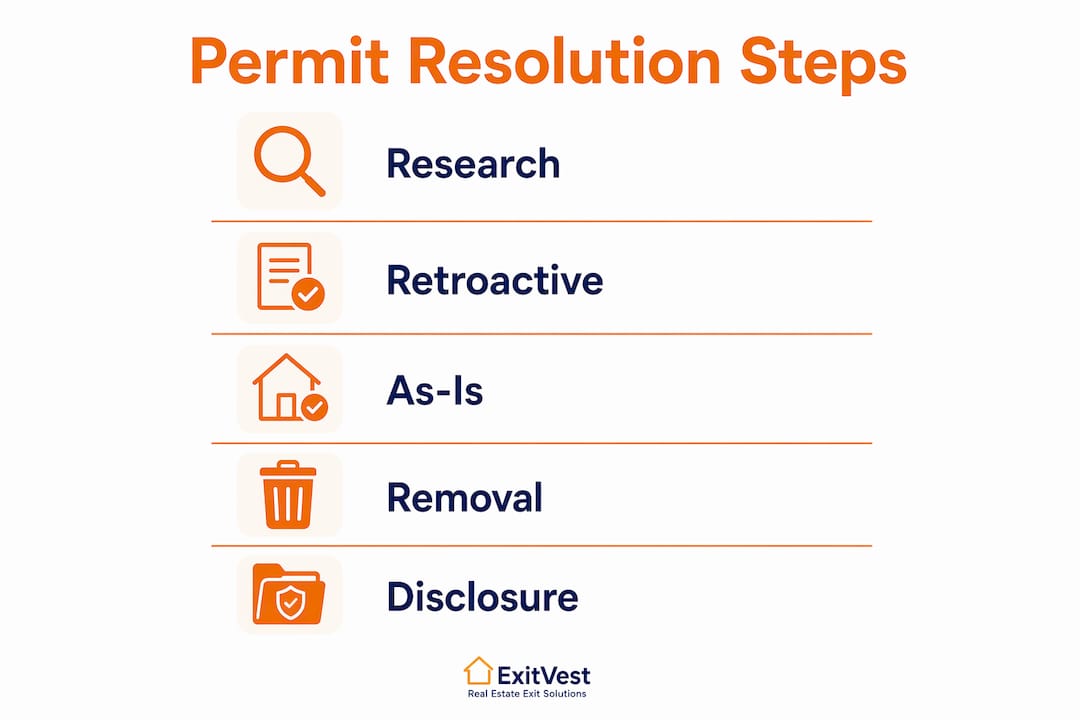
Retroactive permitting
Retroactive permitting means going back to the municipality, reopening the permit, and scheduling a final inspection. If the work passes inspection, the permit closes and you can proceed with your CO or CCO application. If the work does not meet current code, you will need to hire a licensed contractor to make corrections before reinspection.
Obtaining retroactive permits involves inspections, possible corrections, and fees, taking weeks to months depending on scope. A simple deck permit might close in three weeks. A finished basement with electrical and plumbing work could take three months or longer.
Selling as-is with full disclosure
You can sell the property without resolving the open permits, but you must disclose all known unpermitted work on the NJ Seller's Property Condition Disclosure Statement. Selling as-is with full disclosure is legal but usually requires price reductions and may limit buyer financing options. Most conventional lenders will not approve mortgages on homes with unresolved permit issues, which shrinks your buyer pool to cash buyers and investors.
Removal or reconstruction
In rare cases, the unpermitted work cannot be brought up to code without tearing it out and rebuilding. This is most common with structural additions or work that violates setback requirements. The cost and disruption of this path make it the last resort, but it is sometimes the only way to obtain a clean CO.
| Resolution path | Timeline | Cost range | Buyer pool impact |
|---|---|---|---|
| Retroactive permitting | 3 weeks to 6 months | Low to high | Minimal if resolved before listing |
| Sell as-is with disclosure | Immediate | None upfront | Reduced to cash buyers and investors |
| Removal or reconstruction | 1 to 6 months | High | Minimal if resolved before listing |
Pro Tip: If you are facing a tight timeline, get a written estimate from a licensed contractor before deciding between retroactive permitting and selling as-is. The cost difference often makes the decision obvious.
How do you close out open permits and get ready to sell?
Resolving open permits follows a predictable sequence. Moving through each step in order prevents backtracking.
- Confirm your municipality's resale requirements. Call the construction office and ask exactly which certificates are required for your property type and location. Get the answer in writing if possible.
- Contact the permit office about each open permit. Ask whether the permit can be reopened for a final inspection or whether a new permit is required. Some municipalities allow reinspection under the original permit number; others require a fresh application.
- Hire a licensed NJ contractor if corrections are needed. The contractor must be licensed in New Jersey and should pull any additional permits required for corrective work.
- Schedule final inspections. Municipal inspectors are often booked weeks out. Schedule as early as possible to avoid delays.
- Apply for your CO or CCO. Once all permits are closed and inspections are passed, submit your application for the resale certificate. Processing times vary by municipality.
- Obtain smoke, carbon monoxide, and fire safety certificates. Schedule these inspections separately from the CO process. They are often handled by the fire department rather than the construction office.
Required paperwork for closing typically includes:
- Signed NJ Seller's Property Condition Disclosure Statement
- CO or CCO from the municipality
- Smoke detector and carbon monoxide certificate
- Any contractor warranties or receipts for corrective work
- Copies of closed permit records
Sellers handling inherited properties in NJ often face stacked permit issues from multiple owners. Starting the permit research process before the estate is settled saves significant time.
What are the biggest pitfalls when selling with open permits?
Open permits create predictable problems. Knowing them in advance lets you sidestep the worst outcomes.
- Last-minute discoveries: Buyers' home inspectors and real estate attorneys routinely pull permit histories. An open permit found during the inspection period gives the buyer grounds to renegotiate or walk away entirely.
- Lender refusals: Conventional mortgage lenders, including those underwriting FHA and VA loans, will not fund purchases on homes with unresolved permit issues. This forces sellers into a smaller pool of cash buyers, which typically means lower offers.
- Lost negotiating leverage: Unpermitted work is often called a "silent deal-killer" because it surfaces during inspections and shifts all negotiating power to the buyer. Sellers who discover open permits after going under contract are in the weakest possible position.
- Closing delays in Bergen County and beyond: Open permits block resale inspections and often stall closings at the last minute, sometimes causing buyers to lose their rate locks or back out entirely.
Early permit history research allows sellers to manage repairs or obtain retroactive permits well ahead of listing, preventing the closing delays that cost sellers both time and money.
Sellers dealing with additional complications, like properties with liens in NJ, face compounded obstacles when open permits are also in play. Resolving permits first often clears the path for lien negotiations.
Key Takeaways
Selling a house with open permits in New Jersey requires early permit research, proper disclosure, and a clear resolution path chosen before listing.
| Point | Details |
|---|---|
| Check municipal requirements first | Over 80% of NJ towns require a CO or CCO before closing, and rules vary by municipality. |
| Disclose all unpermitted work | NJ law requires sellers to disclose known unpermitted work on the Seller's Property Condition Disclosure Statement. |
| Pull permit history early | Research your permit records at least 90 days before listing to leave time for retroactive permitting. |
| Retroactive permits take time | Closing out open permits can take 3 weeks to 6 months depending on the scope of work and corrections needed. |
| As-is sales limit your buyer pool | Selling without resolving permits restricts buyers to cash purchasers and typically results in lower offers. |
What I have seen sellers get wrong about open permits
Most sellers I have worked with assume open permits are a buyer's problem to sort out after closing. That assumption is wrong, and it costs them money. Buyers and their lenders treat open permits as the seller's unfinished business, and they price their offers accordingly.
The sellers who come out ahead are the ones who pull their permit history before they call a listing agent. They know what they are dealing with. They can decide whether retroactive permitting makes financial sense or whether selling as-is to a cash buyer is the faster, cleaner move. That decision made early, with full information, is almost always better than the same decision made under pressure during a contract negotiation.
I have also seen sellers underestimate how long municipal processes take in New Jersey. Bergen County, Essex County, and Hudson County towns in particular can have inspection backlogs that stretch six to eight weeks. If you are counting on a spring closing and you start the permit process in march, you may be cutting it very close. Start earlier than you think you need to.
The disclosure piece is non-negotiable. Sellers who try to hide unpermitted work face real legal risk after closing. Buyers who discover undisclosed defects can pursue damages, and courts in New Jersey have not been sympathetic to sellers who stayed quiet. Honest disclosure, paired with a realistic price, is always the right call.
— Alek
Selling a property with open permits? Exitvest can help
Open permits do not have to stop your sale. Exitvest works with New Jersey homeowners who need to sell quickly, including those dealing with unresolved permits, code violations, and properties that cannot qualify for conventional financing.

Exitvest buys properties as-is for cash with no requirement to resolve permits before closing. There are no lender approvals, no municipal certificate contingencies, and no waiting on inspection backlogs. You get a straightforward offer based on your property's current condition, and you choose the closing date. If you want to understand how the process works before committing to anything, Exitvest walks you through every step with no pressure. For sellers who need to move fast, this is the most direct path available.
FAQ
What is an open permit in New Jersey real estate?
An open permit is a building permit that was issued for construction or renovation work but never received a final municipal inspection. The permit remains "open" in the municipality's records until a licensed inspector signs off on the completed work.
Can you sell a house with open permits in NJ?
Yes, you can sell a house with open permits in New Jersey, but you must disclose all known unpermitted work on the NJ Seller's Property Condition Disclosure Statement. Unresolved permits typically limit your buyer pool to cash purchasers, since most mortgage lenders will not fund the purchase.
Do open permits affect a home inspection in NJ?
Open permits surface during the buyer's due diligence process, including title searches and permit history reviews. A home inspector may also flag work that appears unpermitted based on code inconsistencies, which gives buyers grounds to renegotiate price or cancel the contract.
How long does it take to close out an open permit in NJ?
Closing out an open permit in New Jersey takes anywhere from three weeks to six months, depending on the scope of the original work, whether corrections are needed, and how quickly the municipal inspection office can schedule a final inspection.
Does buying a home with open permits create risk for the buyer?
Yes. Buyers who purchase a home with open permits inherit the responsibility to resolve them. If the unpermitted work does not meet current code, the buyer may face costly corrections, fines, or difficulty reselling the property in the future.