

Yes, you can sell heir property, but only once you hold clear legal authority to do it. The fastest lawful routes are a probate or trust transfer that clears title, a private buyout between co-heirs, or a sell-as-is deal with a cash buyer. Start today by locating the will or trust, pulling the deed from the county recorder, securing a certified death certificate, and ordering an appraisal.
TL;DR:
- Most heir property cannot be sold legally without clear authority from probate, trust, or joint ownership documentation.
- The typical timeline for a sale varies from weeks to years, depending on whether it's a trust transfer, probate, or contested estate.
- Selling costs and potential tax exposure are usually lower than expected because of the stepped-up basis, often resulting in minimal capital gains taxes.
- Disputes among heirs, unrecorded transfers, unpaid taxes, or lapsed insurance can significantly delay or block the sale if not addressed promptly.
- Fast cash sales as-is cover circumstances where probate or title issues cause delays, allowing heirs to preserve value and avoid lengthy legal proceedings.
Table of Contents
- Who Has the Legal Authority to Sell Heir Property
- How Taxes Usually Work When You Sell Inherited Property
- What Legal and Market Risks Could Block Your Sale
- Step-by-Step: From Documents to Closing
- How to Resolve Disputes Among Co-Owners
- What Most Heirs Get Wrong About Selling Fast
- How Exitvest Helps Heirs Sell Without the Wait
- Where to Verify the Legal and Tax Details
- Sources
- FAQ
Who Has the Legal Authority to Sell Heir Property
Most heir property problems trace back to one thing: nobody legally "owns" the house the way a bank or title company needs to see it. When a homeowner dies without a will, or with a will that never went through probate, the property often passes to multiple relatives as tenants in common. Each heir owns a fractional interest, and none of them individually can sign a valid deed for the whole property. This is exactly the pattern the Lincoln Institute of Land Policy describes as heirs' property: real estate passed down informally across generations, with ownership splitting further every time another heir dies without updating the title.
Who can actually sign for a sale depends on how the property passed:
- An executor or administrator appointed by probate court, holding official Letters Testamentary or Letters of Administration.
- A successor trustee, if the home was held in a revocable living trust.
- All co-owners of record acting together, if title already passed by deed (common with a transfer-on-death deed, sometimes called a TODD, or a Lady Bird deed in states that allow it).
- A court-appointed representative, when heirs disagree and a judge has to settle who controls the sale.
Probate isn't always required. If the deceased set up a trust or recorded a transfer-on-death deed before passing, the property can often move to heirs and then to a buyer within weeks, skipping court entirely. Without that planning, expect a formal probate process.
Practically, start with a title search at the county recorder's office to see whose names are actually on the deed. If the paperwork is messy, missing heirs, unrecorded transfers, decades-old typos, you may need a quiet-title action before any buyer's title company will insure the sale. Contested estates or unclear heirship almost always call for a probate attorney rather than a DIY approach.
How Taxes Usually Work When You Sell Inherited Property
The tax question that stops most heirs cold is capital gains, and the answer is usually better than they expect. Inherited property typically gets a "stepped-up basis," meaning the home's cost basis resets to its fair market value on the date the original owner died, not what that owner originally paid decades earlier. If you sell close to that value, you may owe little or nothing in capital gains tax, according to IRS guidance on inheritances.
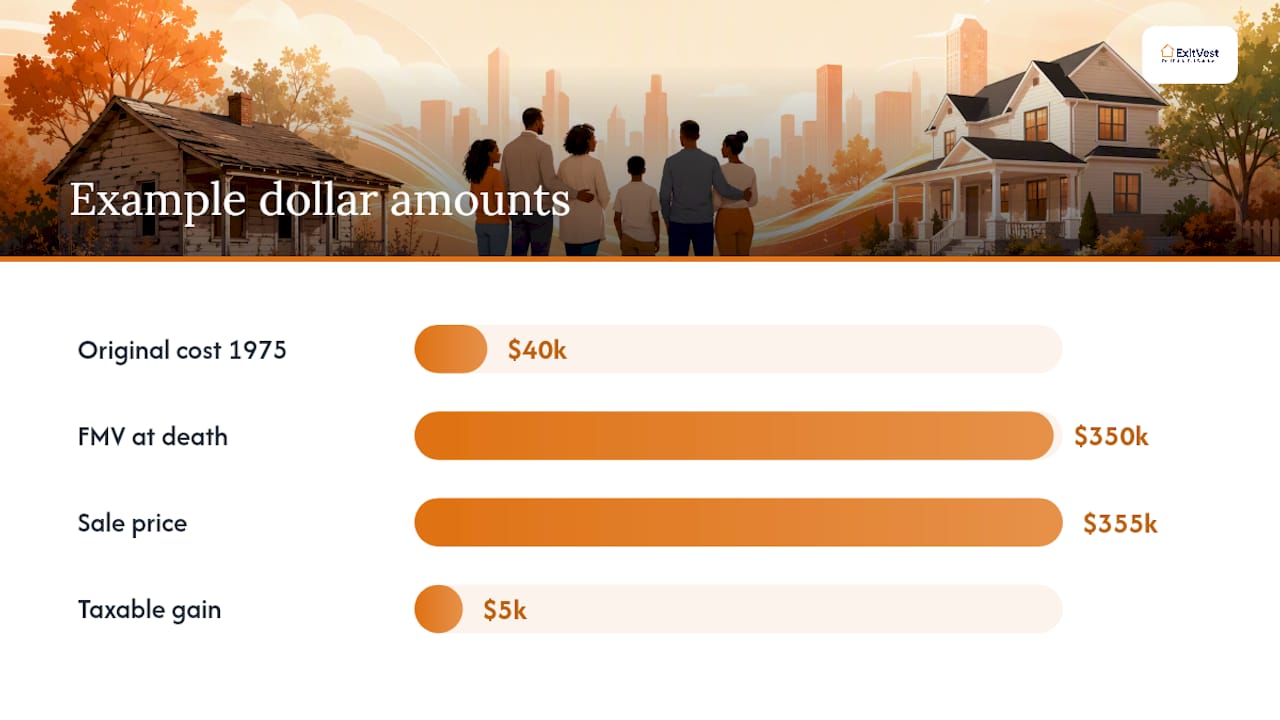
Stepped-up basis in practice: A house Grandma bought for $40,000 in 1975 might be worth $350,000 the day she dies. If her heirs sell it for $355,000 a year later, they generally owe capital gains tax on roughly $5,000, not $315,000.
That said, the sale is still a reportable event. Here's how the paperwork usually flows:
- The closing agent issues Form 1099-S to the IRS and to you.
- You report the sale on Form 8949, often marking the property as inherited (which triggers long-term capital gains treatment regardless of how long you personally held it), then carry the total to Schedule D.
- Skipping this step because you "didn't owe anything" can still trigger an IRS notice, since the agency already has the 1099-S on file.
A few situations do generate real tax exposure: significant appreciation between the date of death and the closing date, depreciation recapture if the property was rented out, or estate tax issues on very large estates. Order a date-of-death appraisal immediately, keep every receipt for repairs or improvements, and loop in a CPA if the estate is complicated.
What Legal and Market Risks Could Block Your Sale
Heir property carries risks that a normal home sale doesn't, and most of them show up right when you're trying to close. The biggest one is partition. When co-owners can't agree on whether to sell, any one of them can petition a court to force a sale or physically divide the land. Courts often order these properties auctioned, and auction sales routinely fetch below market value, a pattern well documented in guidance from Kent County, Delaware on resolving heirs' property disputes.
Other risks compound quickly once a property sits in limbo:
- Clouded title from unrecorded transfers or heirs who were never formally added to the deed, which scares off both buyers' lenders and title insurers.
- Back property taxes piling up while the estate sorts itself out, sometimes for years.
- Lapsed homeowners insurance, leaving the property uninsured against fire or storm damage during probate.
- Deferred repairs that get worse and more expensive with every vacant month.
Academic research on heirs property has linked these exact conditions, unclear title plus unpaid taxes, to elevated tax foreclosure rates in U.S. cities, which is the outcome every heir should be trying hardest to avoid.
Pro Tip: If clearing title would take months and the property is bleeding money on taxes and insurance every week, a fast cash sale to a buyer who purchases as-is often preserves more family equity than waiting out a slow, contested title-clearing process.
Step-by-Step: From Documents to Closing
Selling heir property is a sequence, not a single event. Skip a step and you'll likely get bounced back to it later by a title company or closing attorney.
- Gather your documents. Death certificate, the recorded deed, any mortgage statements, and the will or trust if one exists.
- Confirm your legal authority. This means finishing probate and getting Letters Testamentary, or confirming trustee powers, or recording a transfer deed if the property already passed to heirs directly.
- Get two appraisals if needed. A date-of-death appraisal establishes your tax basis; a current market appraisal sets a realistic asking price. LegalClarity's overview of inherited property sales treats this early appraisal step as one of the most important moves an heir can make.
- Pick your selling route. A traditional agent listing maximizes price but takes months and requires repairs. A probate sale works when court confirmation is required. A sell-as-is cash sale skips repairs and marketing time entirely. A private buyout lets one heir keep the property while paying out the others.
- Clear remaining title issues and close. Resolve any missing-heir problems, get court confirmation if your state requires it for probate sales, then coordinate signatures, especially tricky when heirs live in different states, and close.
Timelines vary enormously depending on which path you're on:
| Path | Typical Timeline | What Drives the Cost |
|---|---|---|
| Trust or transfer-on-death deed already in place | Weeks to a couple of months | Minimal legal fees, mainly appraisal and closing costs |
| Standard probate sale | varies depending on the selling route | Court fees, probate attorney, executor compensation |
| Contested estate or partition action | Many months to several years | Litigation costs, court-ordered appraisals, potential auction discount |
Pro Tip: If you're managing this from out of state, ask whether your state allows remote online notarization or a mail-away closing package. It can save you a plane ticket and weeks of delay.
If your paperwork is messy, a guide to transferring inherited property title can help you sort out what needs to happen before a buyer's attorney will sign off.
How to Resolve Disputes Among Co-Owners
Disagreement among heirs is the single biggest reason heir property sales stall, and partition is almost never the best first move. It's slow, it's public, and it often ends in a below-market auction. Every option short of that tends to preserve more value for the family.
- Private buyout. One heir buys out the others, typically based on a professional appraisal, either with a lump-sum payment or a documented promissory note if cash is tight.
- Mediation. A neutral third party helps siblings or extended family hash out a written agreement, particularly useful when emotions around the family home run high.
- Cooperative sale. All heirs designate one point person, sometimes through a limited power of attorney, and list with a single agent rather than negotiating separately with buyers.
- Court partition. A last resort when heirs simply cannot agree, and increasingly regulated by state law.
More than half of U.S. states have now adopted the Uniform Partition of Heirs Property Act, which changed the math on partition considerably. Under UPHPA, co-owners get a right of first refusal before the property goes to auction, courts must consider whether physical division is possible before ordering a sale, and any forced sale has to happen through a real appraisal-based, open-market process rather than a courthouse-steps auction. It doesn't eliminate the downsides of partition, but it does give the heirs who want to keep the property real leverage to buy out the ones who don't. For a broader look at how these paths compare, see this rundown of probate property selling solutions.
What Most Heirs Get Wrong About Selling Fast
The biggest mistake I see is heirs treating physical possession as legal permission. Having the keys to Mom's house means nothing to a title company if probate never closed. Get the legal authority and a date-of-death appraisal sorted before you do anything else, both are cheap insurance against a deal falling apart at closing.
Speed over price makes sense more often than people assume: when heirs can't agree, when repairs would eat into any profit anyway, or when property taxes and insurance are draining the estate every month you wait.
— Alek
How Exitvest Helps Heirs Sell Without the Wait
If probate is dragging, the siblings can't agree on a price, or the house needs $40,000 in repairs nobody wants to front, a traditional listing isn't always the answer. We buy houses, land, and small apartment buildings directly from heirs in as-is condition, no repairs, no staging, no waiting for a buyer's financing to fall through. We make a cash offer, work around your probate timeline, and let you set the closing date instead of scrambling to meet someone else's.

This works especially well when multiple heirs need a clean, fast split of proceeds instead of a months-long negotiation over who fixes the roof. There's no agent commission and no open houses. If you're weighing your options, get a no-obligation cash offer through a cash buyer's how-it-works page to see what a straightforward sale actually looks like for your situation, whether the property is in New Jersey, Texas, Florida, Tennessee, or elsewhere nationwide.
Where to Verify the Legal and Tax Details
For direct confirmation beyond this guide, check the IRS on inherited property reporting, your state's UPHPA text through the Uniform Law Commission, and Farmers if the property includes farmland or rural acreage.
This article is general information, not a substitute for advice from a qualified lawyer. Consult a qualified legal professional about your own circumstances before acting on anything here.
Sources
- Understanding Heirs Property — Lincoln Institute of Land Policy
- Gifts and inheritances — IRS
- What is Heirs' Property and how to resolve it — Kent County, DE
- Uniform Partition of Heirs Property Act — Uniform Law Commission
FAQ
Can You Buy Heir Property?
Yes. Buyers, including cash buyers like Exitvest, can purchase heir property once the sellers establish legal authority to convey clear title, through probate, a trust, or all co-owners signing together.
Do I Have to Pay Capital Gains If I Inherit a House Worth $300,000?
Usually little to none, because inherited property typically receives a stepped-up basis equal to its fair market value on the date of death. You'd generally only owe tax on appreciation that happens after that date, up to your sale price.
Who Owns the Most Heirs Property in America?
Heirs' property is most concentrated among Black landowning families in the rural South, a pattern extensively documented by the Lincoln Institute of Land Policy, largely tied to historical barriers to accessing wills, probate courts, and legal services.
How Do I Avoid Capital Gains Tax on Selling Inherited Property?
Get a date-of-death appraisal quickly and sell close to that value, since your taxable gain is the difference between the sale price and the stepped-up basis, not the original purchase price decades earlier. Keeping receipts for any capital improvements also raises your basis and lowers your taxable gain further.