

Choose an auction when you have several weeks to spare and a property with broad market appeal. Choose a direct cash sale when you need speed, certainty, or you're dealing with a distressed house that scares off traditional bidders.
That's the whole decision in one sentence, but the details matter because the wrong choice can cost you thousands in holding costs, failed sales, or a price that doesn't cover what you owe. Auctions work through price discovery, where competitive bidding can push a desirable property above its expected value. Direct cash sales, including offers from a buyer like Exitvest, work through process certainty. You know the number and the closing date before you sign anything.
Here's the quick breakdown:
- Auction usually wins when: you have 6 to 10 weeks available, the property is in decent condition, and you want a transparent, publicly verifiable sale price, useful for executors reporting to beneficiaries.
- Cash sale usually wins when: you're facing foreclosure, the house needs major repairs, you have a difficult tenant situation, or the title has liens or probate complications that would spook auction bidders.
- Hybrid option to know about: some auction houses accept a pre-auction cash offer that meets the reserve, letting you exit early under auction contract terms, a middle path worth asking about if you're leaning toward auction but time is tight.
Key Takeaways
The fastest, most certain route to selling a distressed or time-sensitive property is a direct cash sale, while auctions remain the stronger choice for move-in ready homes with time to spare.
| Point | Details |
|---|---|
| Speed gap is significant | Cash sales close in 7 to 28 days versus 6 to 10 weeks for a typical auction. |
| Auctions carry real failure risk | Roughly one in three lots can fail to meet reserve, and fees may still apply. |
| Distressed properties favor cash buyers | Repair, tenant, and title risks that deter auction bidders are priced into cash offers upfront. |
| Costs cut both ways | Auction fees run 3 to 5% all-in; cash sales carry no commission but a lower headline price. |
| Exitvest fits distressed, time-sensitive sales | Exitvest buys as-is, with flexible closings suited to foreclosure, probate, and tenant situations. |
Table of Contents
- Estate Sale vs Auction: A Side-by-Side Comparison
- How Do Property Auctions Actually Work?
- How Does a Direct Cash Sale Work?
- Which Sale Method Fits Your Situation?
- How to Prepare a Property for Either Sale Route
- What Will This Actually Cost You?
- Real Scenarios: Which Route Actually Fits?
- What Should You Do Right Now?
- How Exitvest Makes a Fast, Certain Sale Simple
- Sources
Estate Sale vs Auction: A Side-by-Side Comparison
The two routes differ on almost every dimension that matters to a stressed seller, not just price. A property that's a strong fit for one is often a poor fit for the other.
| Factor | Auction | Direct Cash Sale |
|---|---|---|
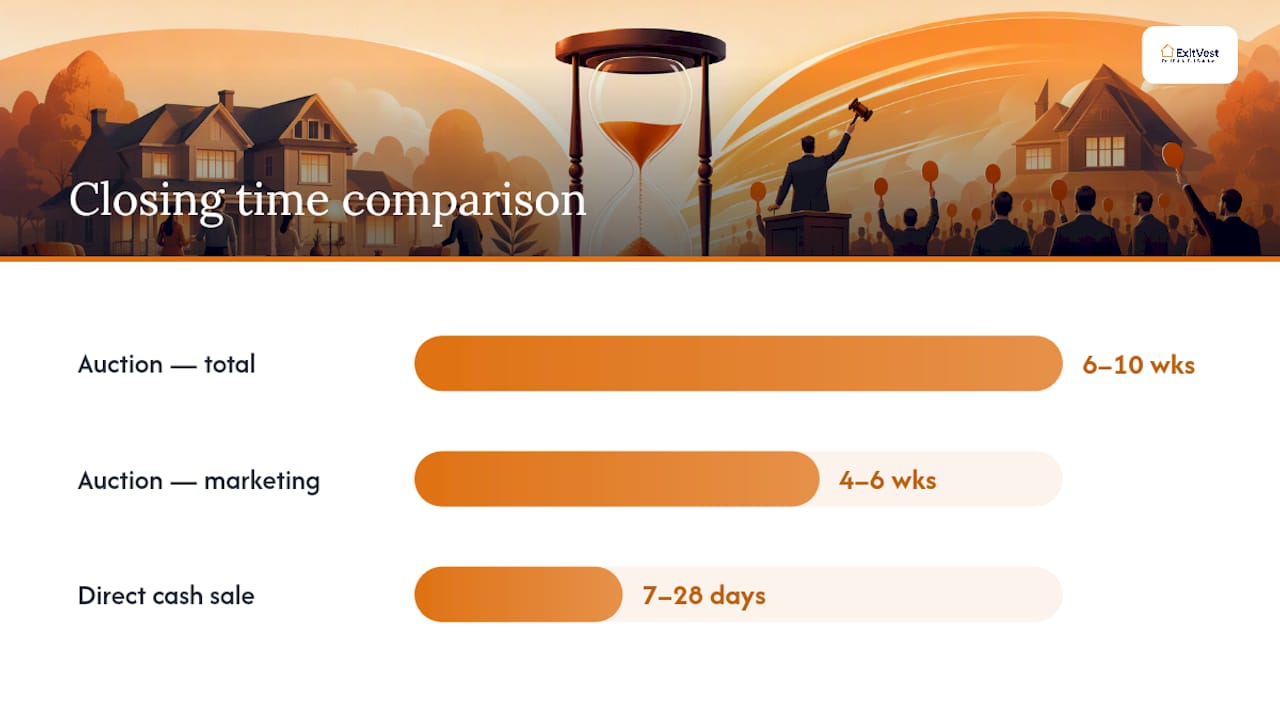
| Speed to closing | 6 to 10 weeks (4 to 6 weeks marketing plus 28 day completion) | 7 to 28 days |
| Certainty of sale | Firm on the day, but the lot can fail if reserve isn't met | Firm offer once accepted, before marketing begins |
| Price outcome | Can exceed market value for desirable homes; can also disappoint | Below top market value, but consistent net proceeds |
| Seller fees | Roughly 3 to 5% all-in, including entry, legal pack, and commission | No commission or agent fees |
| Preparation needed | Legal pack, marketing photos, viewings coordinated | Minimal; most cash buyers purchase as-is |
| Best-suited condition | Move-in ready to moderately dated homes with broad appeal | Damaged, outdated, tenant-occupied, or legally complicated properties |
| Probate/legal friendliness | Strong, creates a public audit trail for beneficiaries | Strong, but no public price benchmark for reporting |
A few things jump out once you line these up side by side:
- Auction seller costs run about 3 to 5% all-in once you count commission, entry fees, and the legal pack, on top of whatever you spend keeping the property presentable during the marketing window.
- Cash sales remove agent commissions entirely, which changes the math more than people expect once you factor in weeks of extra mortgage or insurance payments avoided.
- The buyer pool at auction skews toward investors and developers, and that pool narrows fast once a property has structural issues or a messy title.
- Auctions give you a public price, which matters if you're an executor who needs to show heirs a defensible, transparent number.
- Direct cash offers remove financing risk since there's no buyer mortgage approval that can collapse the deal at the last minute.
How Do Property Auctions Actually Work?
An auction acts fundamentally as a price-discovery tool. Competitive bidding can pull a broadly appealing property above what a private buyer would offer, but that same mechanism means you're trading certainty for upside potential, and it doesn't always pay off.
The process runs in stages. First comes valuation and reserve setting, where you and the auctioneer agree on the minimum acceptable price. Then a solicitor prepares the legal pack covering title, searches, and any special conditions. Marketing runs for roughly four to six weeks, during which the property is listed and viewings happen. On auction day, the highest bid above reserve wins, the winning bidder puts down a deposit immediately, and contracts exchange on the spot, legally binding.
Completion timing depends on the auction format. A traditional unconditional auction typically completes in 28 days. The Modern Method of Auction extends that window to about 56 days, giving buyers more room to arrange mortgage financing, which broadens the buyer pool but slows your payout.
The risks are real. Roughly one in three lots can fail to sell in some markets when bidding doesn't reach reserve, and you may still owe entry and legal pack fees even if nothing sells. Buyer pools also thin out for properties with major repairs needed, since most auction bidders are investors calculating renovation costs on the fly.
Pro Tip: If you're nervous about a failed auction, ask the auctioneer whether they'll accept a pre-auction cash offer at or above your reserve. It lets you exchange under auction terms without gambling on bid day, a hybrid workflow more auction houses now support.
How Does a Direct Cash Sale Work?
A cash sale trades headline price for speed and certainty, and it's built for situations where waiting isn't an option. Cash buyers price in the repair and title risks that scare off auction bidders, which is exactly why distressed properties tend to move faster through this channel than through public bidding.
The process is deliberately short. You submit basic property details, receive an offer, usually within a day or two, and if you accept, the buyer runs title and legal checks while you gather paperwork. Deposit and escrow terms get set, and closing happens anywhere from 7 to 28 days later, compared to the six to ten week runway an auction typically needs.
What you give up is a lower headline number than a strong auction result might produce. What you gain is no agent commission, no auction entry or legal pack fees, and a net proceeds figure you can actually plan around instead of hoping for.
Consider a landlord with a tenant who stopped paying rent eight months ago, damage in two rooms, and a mortgage payment due regardless of occupancy status. Listing publicly would mean disclosing the tenant situation, scheduling viewings around an uncooperative occupant, and likely watching buyers walk after inspection. A direct cash offer skipped all of that: the sale closed in under three weeks, and the seller stopped bleeding money on a property that was actively losing value each month it sat unresolved.
Pro Tip: Get the cash offer in writing before you cancel any auction listing or notify tenants of a move. A firm written offer protects you if plans change.
Which Sale Method Fits Your Situation?
Run through these ten questions honestly, and the right path usually becomes obvious.
- Do you have more than six weeks before you need proceeds in hand?
- Is the property in move-in or near move-in condition?
- Is there a hard deadline, foreclosure date, probate distribution, or lender pressure?
- Are there current tenants, and are they cooperative with showings?
- Would repair costs exceed 10% of the property's value?
- Can you afford another one to two months of taxes, insurance, and utilities?
- Are you comfortable with price uncertainty in exchange for potential upside?
- Do beneficiaries or co-owners need a transparent, publicly verifiable sale price?
- Is your paperwork, title, deed, tax records, ready to go now?
- Are there liens, code violations, or title defects that need resolving?
If you are willing to accept some timeline and price uncertainty and seek a transparent sale price, an auction may be appropriate. If you need speed, certainty, and face property complications, a direct cash sale may be safer.
Three red flags should override everything else and push you straight to a cash buyer:
- An active foreclosure auction date is already scheduled by the lender.
- The property has structural hazards, mold, fire damage, or a compromised roof.
- Title defects, unresolved liens, or unclear probate status would delay or derail a public sale.
How to Prepare a Property for Either Sale Route
Regardless of which path you choose, a few hours of prep work protects your net proceeds and prevents delays down the line.
Gather your paperwork first: the deed or title, recent mortgage statements, property tax records, utility bills, and, if the property is tenant-occupied, current lease agreements. Executors should have the Grant of Probate or documentation showing the estate is "subject to probate" in progress. Missing paperwork is the single most common cause of closing delays on either route.
On the physical side, clear obvious hazards, broken steps, exposed wiring, standing water, since these create liability during viewings and can tank an auction valuation. If you're listing publicly or at auction, professional photos help. If you're selling to a cash buyer, skip the improvements entirely; most cash buyers purchase as-is and won't credit you for cosmetic work.
Pro Tip: If you're an executor still waiting on probate approval, you can market the property "subject to probate" to start generating buyer interest while the paperwork finalizes, shaving weeks off your total timeline instead of waiting for the grant before you list.
What Will This Actually Cost You?
| Cost Item | Auction | Direct Cash Sale |
|---|---|---|
| Marketing / entry fees | Yes, typically part of the 3 to 5% all-in cost | None |
| Auctioneer commission | Yes, included in that same range | None |
| Legal pack preparation | Seller-paid, required before listing | Standard closing paperwork only |
| Buyer's solicitor costs | Buyer-paid | Buyer-paid |
| Typical completion window | 6 to 10 weeks total | 7 to 28 days |
A few notes worth budgeting around:
- The 3 to 5% all-in figure for auctions comes out of your proceeds regardless of whether the sale closes at a strong price, so factor that against a cash offer's zero-commission structure.
- Holding costs, mortgage interest, taxes, insurance, utilities, add up fast over a two to three month auction runway; a faster cash closing often preserves more net value even at a lower sale price.
- Failed auction lots can still generate legal pack and entry costs with nothing to show for it, a risk that simply doesn't exist with an accepted cash offer.
Real Scenarios: Which Route Actually Fits?
The executor selling an inherited house. Three siblings inherited their mother's suburban home, still in reasonable shape, and needed a transparent number to divide fairly. Auction made sense: probate sales frequently favor auction because the public sale price gives every heir a defensible, undisputed figure.
The homeowner facing a foreclosure auction. A homeowner had 45 days before the lender's scheduled foreclosure sale. Waiting on a traditional auction wasn't realistic, there wasn't time for a six to ten week runway. A direct cash sale closed in under three weeks, paid off the balance, and avoided the credit damage a completed foreclosure would have caused.
The landlord with a problem tenant and back rent. Months of unpaid rent, a damaged unit, and no appetite for eviction proceedings pointed straight to a cash buyer, since distressed rental situations rarely attract serious auction bidders willing to inherit tenant disputes.
The house with major structural damage. Foundation cracks and a failing roof meant most conventional and even investor auction bidders would lowball or walk after inspection. A cash buyer who specializes in as-is purchases priced in the repair cost upfront and closed without requiring the seller to fix anything.
What Should You Do Right Now?
The rule of thumb holds: auction if you have time and a desirable property, cash sale if you need speed, certainty, or you're dealing with damage, tenants, or legal complications.
Four things to do today:
- Pull together your title, mortgage statement, and tax records, whichever route you choose, you'll need them.
- If you're leaning auction, request a valuation from a licensed auctioneer to see what your reserve might realistically be.
- If speed matters more, request a no-obligation cash offer so you have a real number to compare against auction estimates.
- If you're an executor, confirm your probate status and whether you can legally list "subject to probate" now.
Pro Tip: Request both a cash offer and an auction estimate before committing to either path. Having two real numbers side by side beats guessing which route pays more.
Why We Generally Recommend Direct Cash Offers for Heirs and Distressed Sellers
Working through cases involving inherited property and foreclosure timelines exposes a pattern fast: the properties that suffer most under auction pressure are the ones already under the most stress, damaged homes, tenant disputes, tight probate deadlines. Auctions reward patience and curb appeal. Heirs juggling grief, paperwork, and a mortgage payment on a house nobody's living in usually have neither.
Practitioners who work probate sales regularly caution that auctions don't guarantee a higher price and can attract bargain hunters looking for a deal, not a bidding war. For a complicated property, a cash buyer often nets more once you subtract commission, holding costs, and the real chance of a failed lot. That's not a knock on auctions, they're the right tool for the right property. It's a recognition that most sellers reading this are dealing with the wrong property for that tool: something damaged, encumbered, or tied to a deadline they didn't choose. In those cases, speed and certainty aren't a consolation prize. They're the better financial outcome.
How Exitvest Makes a Fast, Certain Sale Simple
If your property doesn't fit neatly into an auction, damaged, tenant-occupied, tied up in probate, or facing a foreclosure deadline, Exitvest offers a direct path that skips the marketing window, the legal pack fees, and the risk of a failed bid entirely.
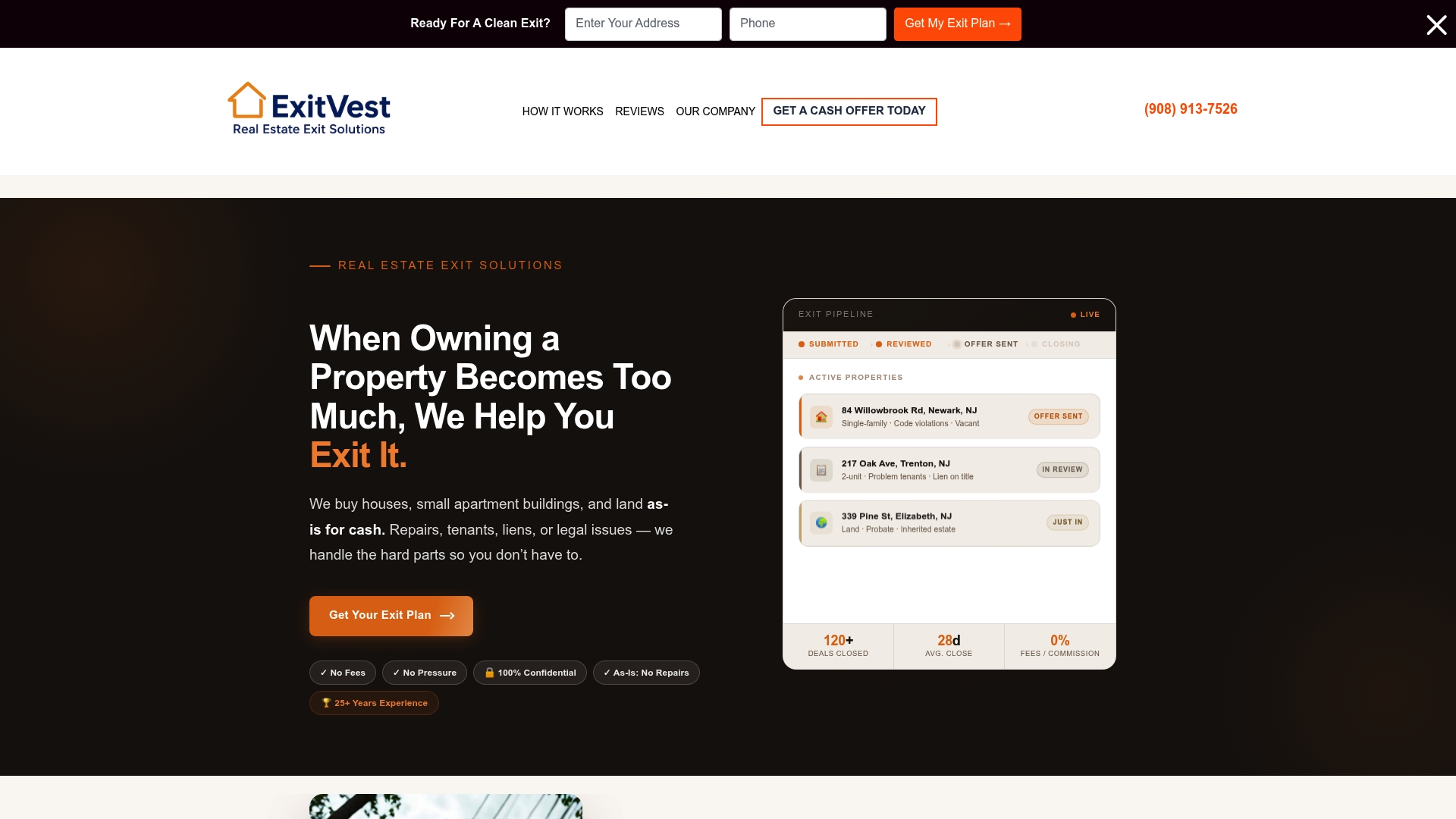
Exitvest buys houses, land, and small apartment buildings as-is, for cash, with flexible closing timelines built around your situation rather than an auction calendar. We work with sellers dealing with foreclosure, inherited property, problem tenants, vacant homes, and repairs they don't want to fund, with a strong focus on New Jersey, Texas, Florida, and Tennessee. There's a real trade-off here worth saying plainly: our cash offers typically come in below what a strong auction day might produce for a move-in ready home, because you're paying for speed and certainty instead of gambling on bid day.
If that trade-off makes sense for your situation, start with a no-pressure cash offer or see how the process works from first contact to closing.
Sources
- Real estate auctions vs traditional listings — which is right for you
- Cash Buyer vs Auction UK 2026 | Which Pays More?
- Cash sale vs estate agent vs auction
- Selling an inherited property at auction
This article is general information, not a substitute for advice from a qualified financial advisor. Consult a qualified financial professional about your own circumstances before acting on anything here.