

Cash for keys means paying a tenant a lump sum to vacate a property voluntarily, without going through eviction court. It's a written, negotiated deal where money changes hands in exchange for a signed move-out date and clean keys handover. Landlords use it when they need possession fast, want to skip months of court costs, or are dealing with a tenant situation that eviction won't resolve any faster.
TL;DR:
- The typical cash-for-keys offer ranges from a few hundred to several thousand dollars, aligned with eviction costs or tenant needs, to ensure rapid and cost-effective turnover.
- A clear, written agreement signed by all adult occupants before handover is essential to avoid disputes and ensure the deal is legally enforceable.
- Payment should always be made after keys are handed over and the property inspection confirms the unit’s condition, to prevent the tenant from withholding keys or further claims.
- Local eviction laws and rent protection ordinances can restrict CFK terms or make the process more costly, so checking rules beforehand is crucial.
- Using a standardized template and thorough documentation reduces legal risks, avoids coercion claims, and streamlines the process into a predictable, audit-ready procedure.
Table of Contents
- What Should You Do Before Starting the Cash for Keys Process?
- What Is Cash for Keys and Why Do Landlords Use It?
- How Does the Cash for Keys Process Work Step by Step?
- How Much Should You Offer in a Cash for Keys Deal?
- What Legal Protections Should Be in a Cash for Keys Agreement?
- What Happens on Handover Day and What Records Should You Keep?
- What Mistakes Should You Avoid With Cash for Keys?
- Why a Repeatable Cash for Keys Template Beats Improvising Every Time
- When Selling the Property Beats Negotiating a Cash for Keys Deal
- Where to Check the Rules Before You Finalize an Offer
- Sources
- FAQ
What Should You Do Before Starting the Cash for Keys Process?
Before you make an offer, get five things locked down. Rushing this stage is where most cash-for-keys deals fall apart.
- Confirm occupancy and lease status. Pull the lease, check who's actually named on it, and find out if anyone else is living there unofficially. An agreement signed only by the leaseholder means nothing if a roommate or adult child refuses to leave.
- Check your state and local eviction rules first. Some cities require relocation assistance or notice periods regardless of whether you go the cash-for-keys route, and skipping this step can undo the whole deal later.
- Set your payment target and payment method. Decide the top dollar figure you're willing to pay and whether you'll use a certified check, cashier's check, or ACH transfer. Cash in an envelope invites disputes over whether payment happened at all.
- Draft a one-page agreement in advance. Have it ready before you start talking, not after the tenant says yes. A blank template you fill in on the spot looks improvised and can spook a nervous tenant.
- Schedule the inspection and handover logistics. Pick a target date, plan for a witness if possible, and decide who does the final walkthrough.
Pro Tip: Keep a folder, physical or digital, with the lease, your notes on the unit's condition, and a blank copy of your agreement template ready to go. When a nonpaying tenant situation turns urgent, you don't want to be drafting documents at 11 p.m.
What Is Cash for Keys and Why Do Landlords Use It?
Cash for keys is a voluntary buyout: the landlord pays the occupant to leave by an agreed date, and both sides sign paperwork confirming the terms. It typically shows up in three situations: a tenant who's stopped paying rent and both sides want to avoid a drawn-out court fight, a bank or investor who acquired a foreclosed property with an occupant still inside (an REO cash-for-keys scenario), or a landlord who simply needs a fast, predictable turnover for renovation or resale.
The appeal is straightforward. Eviction lawsuits typically run from a few weeks to several months depending on the court's docket, and landlords often spend well into four figures on legal fees, court costs, and lost rent before regaining possession, according to guidance from EZ Landlord Forms. A cash-for-keys payment, even a generous one, often costs less and moves faster than the full eviction process.
| Factor | Cash for Keys | Formal Eviction |
|---|---|---|
| Typical timeline | Days to a few weeks | Several weeks to months |
| Cost structure | One negotiated payment | Court fees, attorney fees, lost rent |
| Outcome certainty | Depends on tenant cooperation | Court-ordered, but appealable |
| Record impact on tenant | None, if structured as a release | Eviction judgment on record |
| Landlord control over timing | High | Low, set by court calendar |
CFK isn't always the right call, though. If a tenant is being pressured into signing under threat, implicit or explicit, that agreement can be challenged and may expose you to liability. And in cities with relocation-assistance ordinances or rent-control protections, you may owe a statutory minimum regardless of whether you use CFK or eviction, which limits how much savings the tactic actually offers. Know your local rules before you assume CFK is the cheaper path.
How Does the Cash for Keys Process Work Step by Step?
The cash-for-keys process runs in five stages, and skipping or rushing any one of them is usually where deals unravel.
-
Assess the situation. Review the lease, confirm who lives in the unit, check for any pending litigation, and estimate how long formal eviction would take in your court. This assessment tells you how much leverage you actually have. A tenant three months behind on rent with no legal defense has less negotiating power than one with a habitability complaint pending.
-
Open the conversation. Approach the tenant directly, in writing or in person, using neutral, non-threatening language. You're not trying to scare anyone out. You're offering a business solution.
Sample opening language: "I'd like to talk with you about a mutual move-out arrangement. Instead of going through a formal eviction, I'm proposing to pay you $[amount] to vacate the unit by [date], in good condition, with all keys returned. I think this works better for both of us than the alternative. Can we set a time to discuss?"
If the tenant hesitates or asks for more money, don't get defensive. A calm response works better: "I understand you need time to plan the move. Let's talk about what date and amount would actually work for you, and I'll tell you what I can do."
-
Agree on terms and put them in writing. Once you've settled on a number and a date, draft or finalize the one-page agreement. Get it signed by every adult occupant, not just the lease's primary tenant, and get signatures before move-out whenever possible rather than relying on a verbal promise.
-
Schedule the inspection and handover logistics. Set a specific date and time for the final walkthrough. Line up a witness if you can, a property manager, a neighbor, or a contractor already scheduled to be there. Bring a camera or phone ready to photograph every room, and have a written keys list (front door, mailbox, garage, storage unit) so nothing gets forgotten.
-
Handle handover day. Walk the property together, note any damage beyond normal wear, have the tenant sign an acknowledgment of the unit's condition, collect all keys and access devices, and hand over payment only after keys are in your possession.
That order matters more than any other detail in this process: keys and signed acknowledgment first, payment second. Reversing it is the single most common way a cash-for-keys deal turns into a loss.
A few negotiation habits separate landlords who close these deals quickly from those who drag them out for weeks:
- Lead with your actual number, not a lowball opener. Tenants who sense games tend to counter harder and slower.
- Give the tenant a real reason the deadline matters (a lender closing, a new tenant's move-in date) rather than just stating a date.
- Offer to help with logistics, like extra time to gather belongings or a letter confirming timely move-out for their next landlord, when it costs you nothing but builds goodwill.
- Never promise anything you didn't put in writing. Verbal side deals are where cash-for-keys negotiations go to die.
How Much Should You Offer in a Cash for Keys Deal?
There's no fixed national number, and that's by design. Offer amounts vary based on your court's eviction timeline, the tenant's leverage, and how badly you need the unit back. Typical guidance points to a range from a few hundred dollars up to a few thousand, often landing around one to two months' rent, according to Nolo's cash-for-keys overview.
Two practical ways to land on a number:
- Eviction-cost-avoidance method. Estimate what eviction would actually cost you in filing fees, attorney time, and lost rent during the court process, then offer somewhat less than that total. If eviction would run you $3,000 and eight weeks, an offer of $1,500 to $2,000 that gets the unit back in two weeks is a clear win.
- Tenant-need estimate. Consider what the tenant actually needs to move: a security deposit on a new place, moving truck rental, a few weeks of overlap rent. Offering enough to cover that removes their biggest reason to delay.
Quick math example: A landlord facing a $2,800 eviction cost and a ten-week timeline offers $1,200 for a move-out within 14 days. Even if the tenant counters up to $1,800, the landlord still comes out ahead on both cost and speed.
Three rough scenarios:
- Low-end offer ($300 to $600): A short-term tenant with no real legal defense, low leverage, in a fast-eviction jurisdiction.
- Mid-range offer ($800 to $1,800): A tenant a few months behind on rent, cooperative, in a moderate-timeline court.
- High-end offer ($2,000 to $4,000+): A tenant with a legal defense, a slow local court, or a market with relocation-assistance requirements pushing the floor up regardless of what you'd prefer to pay.
What Legal Protections Should Be in a Cash for Keys Agreement?
The entire deal lives or dies on whether the tenant signed voluntarily. Coercion, threats, utility shutoffs, lockouts, or any pressure tactic doesn't just risk the deal falling apart. It can expose you to legal liability that costs far more than the CFK payment itself.
A solid written agreement should include:
- Full names of the landlord and every occupant, not just the primary leaseholder.
- Property address and unit number.
- Exact vacate date and time.
- Condition standard the unit must be left in (broom-clean, no damage beyond normal wear).
- Payment amount and exact timing (paid at handover, not before).
- Security deposit handling, whether it's returned separately, applied to the CFK amount, or forfeited under specific terms.
- A release of claims, where the tenant agrees not to pursue further action related to the tenancy in exchange for payment.
- A neutral reference clause, if you're willing to confirm timely move-out to a future landlord.
- Remedies for breach, spelling out what happens if the tenant doesn't vacate on schedule.
Federal fair housing law sits underneath every one of these agreements. The Fair Housing Act, as summarized by HUD, prohibits offering different CFK terms based on race, familial status, disability, or other protected classes, and the U.S. Department of Justice's Civil Rights Division has been explicit that even a facially neutral policy can violate the law if it produces a discriminatory effect. Offer the same structure and same good-faith range to every tenant in a similar situation, and document why any offer varies.
State and local rules complicate this further. In California, courts and local ordinances can set a minimum viable settlement tied to relocation assistance or rent-control protections, and structuring the release incorrectly can create problems with how the case is dismissed on the court record, according to a California unlawful detainer analysis from Zak Fisher Law. Some markets set relocation floors that reach five-figure sums, well above what a landlord might assume from national averages. Check your city and state rules, or talk to a local attorney, before finalizing any number.
Pro Tip: Structure the release so it clearly ties the payment to voluntary vacancy, not to settling a rent debt. A poorly worded release can accidentally create a money judgment or leave a mark on the tenant's rental history that neither of you intended.
What Happens on Handover Day and What Records Should You Keep?
Handover day is where the paperwork becomes real. Get the sequence right and you'll have a clean file if anything gets disputed later.
- Do the walkthrough first. Photograph every room, time-stamped, before the tenant hands over keys. Note anything beyond normal wear and compare against your move-in documentation if you have it.
- Pay only after keys are handed over and the agreement is signed. A certified check, cashier's check, or ACH transfer with a confirmation screenshot gives you a paper trail; cash does not.
- Get a signed receipt or acknowledgment confirming the payment amount and the date, separate from the main agreement if you want extra documentation.
- Collect every key and access device, garage remotes, mailbox keys, storage unit keys, and confirm nothing is missing before the tenant leaves.
- Rekey the property immediately. Don't wait until the next day. A tenant who kept a spare copy is a risk you eliminate the moment locks change.
Keep a closing folder with the signed agreement, all handover photos, the payment record, the tenant's forwarding address, and witness names if anyone else was present. This full cash-for-keys landlord playbook approach turns a handshake deal into an audit-ready file you can point to if a dispute surfaces months later.
What Mistakes Should You Avoid With Cash for Keys?
A handful of mistakes account for most cash-for-keys deals that go wrong.
- Paying before the keys are in your hand. This is the single biggest risk in the entire process. A tenant who's already been paid has no financial incentive left to actually leave.
- Using pressure tactics. Shutting off utilities, changing locks while someone's still living there, or threatening a tenant isn't just unethical. It's illegal in most jurisdictions and can turn a simple buyout into a lawsuit against you.
- Missing an occupant. If someone living in the unit isn't named on your agreement, they can refuse to leave even after you've paid the signing tenant. Confirm everyone in the household before you finalize anything.
- Negotiating past the point of savings. If a tenant keeps countering higher and higher, run the math against your eviction-cost estimate. At some point, the "faster" option costs more than the process you were trying to avoid.
Why a Repeatable Cash for Keys Template Beats Improvising Every Time
Most of the landlords who get burned on cash-for-keys deals aren't dealing with bad tenants. They're dealing with a process they've never written down. A one-page agreement template and a photo checklist you use the same way every time removes the guesswork that turns a routine move-out into a legal headache.

The tone of the negotiation matters almost as much as the paperwork. A calm, documented approach, where every promise lives in writing and every payment happens after keys change hands, signals to the tenant that you're running a business process, not making it personal. That tends to shorten negotiations rather than lengthen them.
If your situation involves a nonpaying tenant who's dragging toward eviction, it's worth reading through a broader breakdown of legal options when a tenant isn't paying before you commit to a number. Some situations are better solved by selling the property than by negotiating a buyout at all.
— Alek
When Selling the Property Beats Negotiating a Cash for Keys Deal
Cash for keys works well when you plan to keep the property and just need the current occupant out. It works less well when the property itself is the problem: repeat nonpayment, expensive repairs stacking up, a foreclosure timeline closing in, or a rental you simply no longer want to manage.

In those cases, selling as-is often solves more than a buyout ever could. Some companies buy houses, land, and small apartment buildings directly from owners in as-is condition, including properties with problem tenants, code violations, liens, or a foreclosure clock ticking. This option can eliminate the need to fund a CFK payment, manage a court case, or fix anything before closing. Many such buyers operate nationwide and can offer flexible closing timelines built around your situation rather than a buyer's mortgage approval.
If you're weighing a buyout against an exit, start by comparing what a cash-for-keys negotiation would actually cost you in time and payment against a straightforward cash sale. Check how the process works and get a no-pressure offer on the property before you decide which path fits your situation better.
Where to Check the Rules Before You Finalize an Offer
Two federal resources anchor every cash-for-keys agreement in the United States. HUD's Fair Housing Act overview lays out the non-discrimination framework that applies to every housing transaction, including voluntary buyouts, and the DOJ Civil Rights Division's summary explains how even neutral-looking policies can trigger liability if they produce discriminatory outcomes.
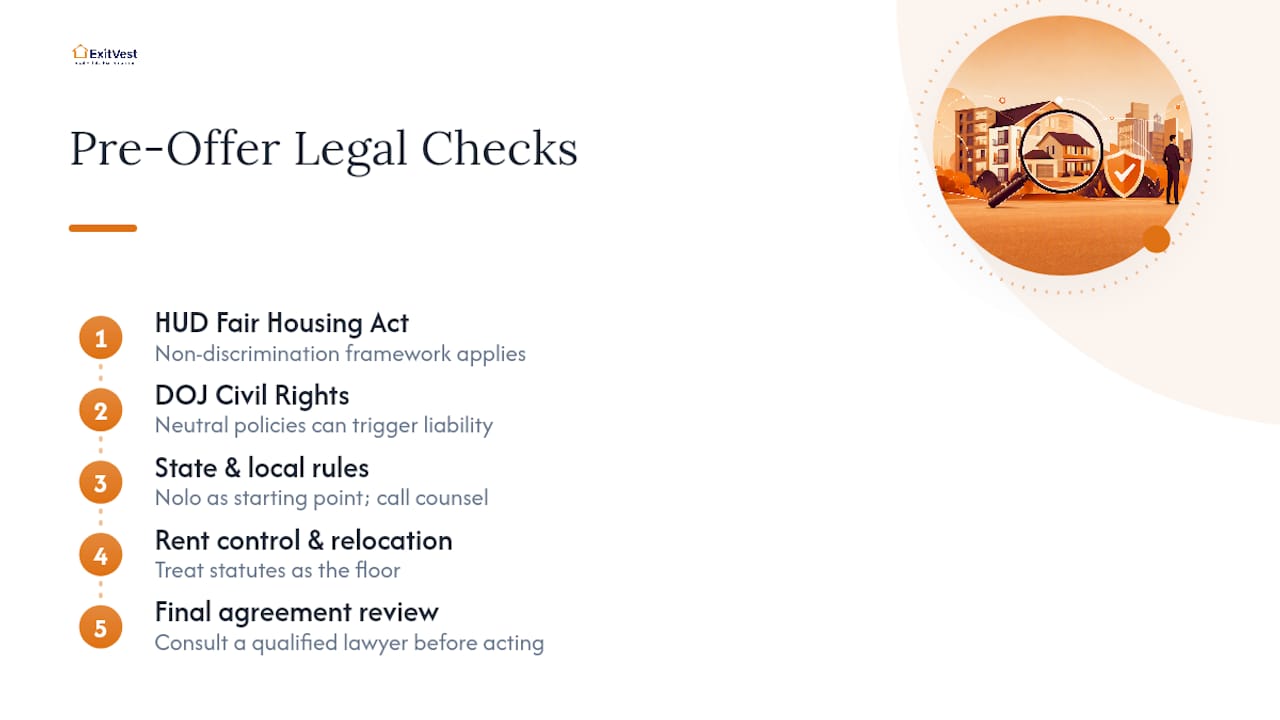
For the mechanics of your specific state, Nolo's landlord-tenant library offers a practical starting point, though state and city ordinances change often enough that a quick call to local counsel before finalizing terms is worth the cost. If your city has rent control or relocation-assistance rules, treat those statutes as the floor for any offer, not a suggestion.
This article is general information, not a substitute for advice from a qualified lawyer. Consult a qualified legal professional about your own circumstances before acting on anything here.
Sources
- Fair Housing Act overview — HUD
- Fair Housing Act — U.S. Department of Justice Civil Rights Division
- What Is Cash for Keys? — Nolo
- Cash for keys: landlord playbook — DiscoveryMark
- Cash-for-Keys settlement in California unlawful detainer cases — Zak Fisher Law
FAQ
What Are the Risks of Cash for Keys?
The biggest risk is paying before the tenant actually vacates and hands over keys, which leaves you with no leverage to enforce the deal. Other risks include coercion claims if you pressure a tenant to sign, missing an occupant who isn't on the agreement, and running afoul of state relocation or fair housing rules if terms vary between tenants.
How Quickly Can You Get Paid With Cash for Keys?
Cash for keys typically moves in days to a few weeks once both sides agree on terms, far faster than a formal eviction that can take several weeks to months to reach a court-ordered outcome. The exact timeline depends on how quickly you and the tenant settle on an amount and a move-out date.
Is Cash for Keys Money Taxable?
For landlords, a cash-for-keys payment is generally a deductible business expense tied to regaining possession of a rental property, while tenants receiving the payment should treat it as reportable income; either party should confirm treatment with a tax professional since specifics depend on individual circumstances.
How Does the Cash for Keys Program Work?
A landlord offers a tenant a negotiated payment to vacate voluntarily by a set date, both sides sign a one-page agreement covering the amount, condition standard, and timing, and the landlord pays only after keys are returned and the unit passes a final walkthrough. It's a private negotiation between landlord and tenant, not a government program, and terms vary by state and local ordinance.