
Cash buyers purchase vacant lots because land transactions carry financing barriers that make cash the fastest, most reliable path to closing. Banks require 35–50% down payments on raw land loans, and lender approval timelines stretch deals to 30 or more days. Cash buyers sidestep all of that. The result is a transaction structure that gives investors speed, negotiating power, and margin advantages that financed buyers simply cannot match. Understanding these motivations helps both buyers and sellers make smarter decisions in the vacant land market.
Why cash buyers purchase vacant lots: the financing barrier
The single biggest reason cash buyers dominate vacant land transactions is that conventional financing for undeveloped lots is genuinely difficult to obtain. Most banks treat raw land as a high-risk asset with no income stream and no structure to collateralize. That risk gets passed directly to the borrower.
Here is what land loan requirements typically look like compared to a standard residential mortgage:
- Down payment: Banks require 35 to 50% down on raw land, versus 3 to 20% on a home purchase. That requirement alone disqualifies most buyers.
- Interest rates: Land loans carry higher rates than residential mortgages because lenders price in the absence of a structure and the longer development timeline.
- Lender availability: Most national banks do not offer raw land loans at all. Buyers are pushed toward local community banks or credit unions, which have limited capacity and slower approval processes.
- Appraisal complexity: Vacant lots are harder to appraise than homes because comparable sales data is thin. That uncertainty adds time and can kill deals entirely.
- Contingencies: Financed deals include appraisal contingencies, underwriting contingencies, and lender approval windows. Each one is a potential exit point for the deal to collapse.
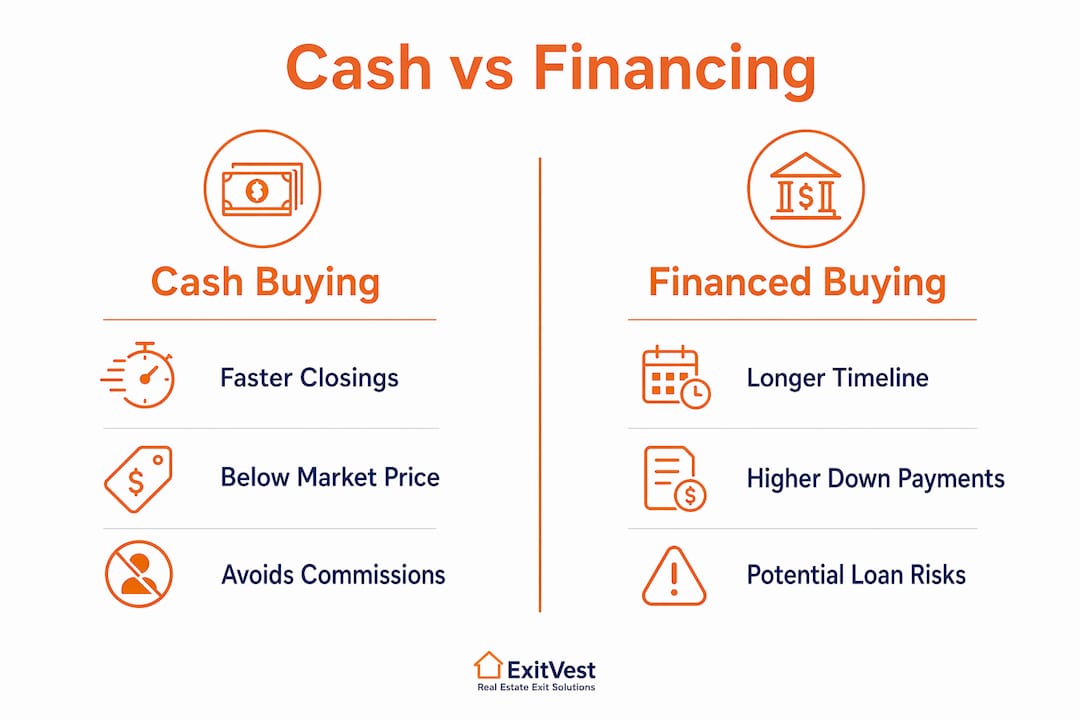
Cash buyers eliminate every one of those friction points. Cash transactions close in as little as 7 to 14 days, compared to 30 to 45 days for financed land purchases. That speed is not just convenient. It is a structural competitive advantage in markets where motivated sellers need to move quickly.
Pro Tip: If you are evaluating a vacant lot purchase and a financed buyer is also in the running, your cash offer does not need to match their price to win. Sellers frequently choose certainty over a higher number with strings attached.

What financial benefits do cash buyers gain from vacant lots?
Speed is the entry point, but the financial upside is what makes cash buying in vacant land markets a repeatable strategy. Cash buyers gain leverage at every stage of the transaction, from initial offer to final resale.
Negotiating below market value
Sellers discount 10 to 30% for cash offers because guaranteed closing is worth more to them than a higher price with financing risk attached. This is not a theory. It is a documented pattern across land markets in states like Texas, Florida, New Jersey, and Tennessee, where motivated sellers regularly prioritize deal certainty over maximum proceeds.
The wholesale model for vacant land
The most aggressive cash buyers use a wholesale acquisition model that generates returns through price arbitrage and light improvements:
- Acquire the lot at 20 to 40% of market value through direct seller negotiation.
- Resolve any title issues, confirm zoning, or secure utility access.
- Subdivide or reposition the lot for a different buyer profile.
- Resell at 70 to 90% of market value to a builder, developer, or end user.
That spread, between acquisition cost and resale price, is the margin engine. It only works because cash buyers can move fast enough to capture distressed or motivated seller pricing before the market corrects.
Avoiding agent commissions
Many cash investors negotiate directly with sellers and use title companies to handle closing, bypassing real estate agents entirely. On a $40,000 lot, a 6% commission is $2,400. That number sounds small until you are running 10 to 20 transactions per year. At that volume, commission savings alone can represent a significant portion of annual profit.
Here is a side-by-side look at how cash and financed purchases compare across key financial variables:
| Factor | Cash purchase | Financed purchase |
|---|---|---|
| Closing timeline | 7 to 14 days | 30 to 45 days |
| Down payment required | Full purchase price | 35 to 50% of price |
| Negotiated discount potential | 10 to 30% below market | Minimal leverage |
| Deal fall-through risk | Very low | Moderate to high |
| Agent commission exposure | Often avoidable | Typically required |
The table makes the financial case plainly. Cash buyers do not just close faster. They buy cheaper, spend less on transaction costs, and lose fewer deals to financing failures.
How do operational factors make vacant lots ideal for cash buyers?
Beyond the transaction mechanics, vacant land fits a specific investor profile: someone who wants asset appreciation without the operational burden of managing a property. Cash investors prioritize land's hands-off nature precisely because it removes the liabilities that come with residential or commercial buildings.
Consider what a vacant lot does not require:
- No tenants to screen, manage, or evict
- No building systems to maintain or repair
- No liability exposure from structures or occupants
- No contractor relationships or renovation timelines
- No property management fees
That list represents real cost and time savings. A cash buyer holding a vacant lot in a growing suburban corridor in Tennessee or a coastal market in Florida is not fielding maintenance calls. They are waiting for the market to move, and their holding costs are limited to property taxes and any HOA fees.
Expert cash investors also evaluate land differently than residential buyers. They analyze cost per acre and zoning status rather than after-repair value models. The question is not "what will this be worth after renovation?" It is "what does this land become worth when zoning changes, utilities arrive, or a builder needs this specific parcel?"
Pro Tip: Before making a cash offer on a vacant lot, pull the county zoning map and confirm utility availability at the parcel boundary. These two factors determine whether you are buying a passive hold or an active development opportunity, and they affect your exit strategy entirely.
Successful cash buyers often target undervalued lots with zoning or access challenges that can be resolved for resale. A lot that appears unbuildable due to a road access issue may only need a recorded easement to become a premium parcel. That kind of repositioning is only possible when you own the asset outright and can move on your own timeline.
What motivates sellers to accept cash offers on vacant lots?
Understanding why sellers accept cash offers is just as important as understanding why buyers make them. The seller's motivation is what creates the discount, and recognizing it early gives cash buyers a significant edge in negotiation.
Sellers with inherited land, high property tax burdens, or urgent liquidity needs are the most common counterparties in cash land transactions. These sellers are not primarily optimizing for price. They are optimizing for certainty and speed.
- Inherited land: Heirs often have no use for a vacant lot in another state and no interest in managing the sale process over months. A fast cash offer solves a problem they did not ask for.
- Property tax pressure: Vacant land generates no income but still carries annual tax obligations. Owners who cannot develop or sell through traditional channels often accept cash offers just to stop the bleeding.
- Divorce or estate settlement: Legal timelines create pressure to liquidate assets quickly. Cash buyers who can close in two weeks become the obvious solution.
- Absentee owners: Many vacant lot owners live far from the property and have no practical ability to list, show, or manage a traditional sale.
"Cash offers provide sellers with quick liquidity and avoid financing uncertainties that can derail deals at the last moment."
The speed of cash closings directly addresses the seller's core concern. When a deal can collapse because a lender pulls approval three days before closing, the certainty of a cash offer has real monetary value. Sellers who understand that dynamic will accept a lower price to eliminate the risk. Cash buyers who understand it can structure offers that win without overpaying.
Knowing why sellers accept lower prices is not just academic. It is the foundation of every successful cash land negotiation.
Key takeaways
Cash buyers purchase vacant lots because the combination of financing barriers, seller motivations, and operational simplicity makes cash the most effective acquisition strategy in undeveloped land markets.
| Point | Details |
|---|---|
| Financing barriers drive cash deals | Banks require 35 to 50% down on land loans, pushing serious buyers toward all-cash transactions. |
| Cash buyers close in 7 to 14 days | Speed creates competitive advantage and reduces the risk of deal collapse before closing. |
| Sellers discount 10 to 30% for cash | Guaranteed closing is worth more to motivated sellers than a higher financed offer with contingencies. |
| Vacant land requires zero management | No tenants, no buildings, and no maintenance make land the most passive real estate asset class. |
| Wholesale margins reach 50 to 70% | Buying at 20 to 40% of value and reselling at 70 to 90% is a repeatable cash investor strategy. |
What I have learned from watching cash buyers work vacant land markets
After years of working with property owners across New Jersey, Texas, Florida, and Tennessee, I have seen a pattern that most articles on this topic miss entirely. The investors who consistently win in vacant land are not the ones with the most capital. They are the ones who understand seller psychology better than anyone else in the room.
The conventional wisdom says cash buyers win because they close fast. That is true, but it is incomplete. The real advantage is that cash buyers can make a credible commitment in a market where most buyers cannot. When a seller in rural Tennessee has been paying taxes on an inherited lot for six years and finally decides to sell, a financed buyer offering 15% more is not actually offering more. They are offering a promise that depends on a bank they do not control. A cash buyer offering less is offering a guaranteed outcome. Those are not the same thing.
I also think investors underestimate the due diligence requirement in cash land deals. Because there is no lender involved, there is no appraisal, no underwriting review, and no third party checking your work. That operational freedom is exactly what makes cash buying attractive. It is also exactly what gets investors burned when they skip title searches, ignore zoning restrictions, or fail to confirm road access before closing.
The investors I have seen build real wealth through vacant land cash buying share one habit: they treat every deal as if a lender were watching, even when no lender is. They pull the title, confirm the zoning, verify the utilities, and model the exit before they wire a dollar. The speed advantage of cash is only valuable if the asset you are buying is actually what you think it is.
— Alek
Sell your vacant land fast with Exitvest
If you own a vacant lot you no longer want, Exitvest makes the process straightforward. Whether you inherited land, are dealing with back taxes, or simply want to move on without the delays of a traditional listing, Exitvest provides fair cash offers with no pressure and no realtor fees.
Exitvest buys vacant land, houses, and small apartment buildings nationwide, with strong coverage in New Jersey, Texas, Florida, and Tennessee. You choose the closing timeline. There are no repairs required, no agent commissions, and no financing contingencies that can derail the deal at the last moment. See how it works and find out what your property is worth, or get a cash offer today with no obligation.
FAQ
Why do cash buyers prefer vacant lots over homes?
Vacant lots carry no tenants, no maintenance obligations, and no building systems to manage. Cash buyers favor land because it is a passive asset that appreciates without the operational burden of residential or commercial property.
How fast can a cash buyer close on a vacant lot?
Cash transactions close in as little as 7 to 14 days, compared to 30 to 45 days for financed land purchases. That speed advantage is one of the primary reasons cash buyers dominate vacant land markets.
How much below market value do cash buyers offer for vacant lots?
Cash buyers typically offer 10 to 30% below market value, and motivated sellers frequently accept because guaranteed closing outweighs the risk of a higher financed offer falling through.
What types of sellers accept cash offers on vacant land?
Sellers dealing with inherited property, property tax burdens, divorce settlements, or absentee ownership situations are the most common. These sellers prioritize speed and certainty over maximum sale price.
Do cash buyers need an agent to purchase a vacant lot?
Most cash buyers negotiate directly with sellers and use a title company to handle closing, avoiding agent commissions entirely. This approach improves margins, especially on lower-value lots where commissions represent a larger percentage of the deal.