

Cash buyers purchase damaged properties because they can acquire them well below after-repair value, control renovation costs through contractor networks, and manufacture equity on a defined timeline rather than waiting for the market to move. For a seller, that investor motivation translates into three practical realities: you can close in days instead of months, sell the property exactly as it sits, and skip the financing contingencies that derail so many traditional deals.
- Speed: Cash sales typically close faster than financed sales, which usually require a month or more for underwriting, per NerdWallet.
- No repairs required: Investors price in the damage — you don't touch a thing.
- No financing risk: The buyer either has the money or they don't. Verified proof of funds means the deal closes.
Pro Tip: Before you entertain any offer, ask the buyer for written proof of funds — a bank statement or letter from a financial institution dated within the last 30 days. No legitimate cash buyer hesitates to provide it.
Table of Contents
- Why do cash buyers purchase damaged properties?
- What are the real benefits of selling a damaged home for cash?
- How do cash buyers calculate their offer on a damaged home?
- What does the timeline look like when selling to a cash buyer?
- What should you check before accepting a cash offer?
- Common myths and real risks about cash sales for damaged homes
- What are your alternatives to a cash sale?
- What does the research say about why investors prefer damaged homes?
- Key Takeaways
- How Exitvest approaches buying damaged properties
- Get a fast, transparent cash offer from Exitvest
- Useful sources for sellers researching cash offers
Why do cash buyers purchase damaged properties?
The short answer is profit, but the mechanics are worth understanding because they explain exactly why an investor's offer looks the way it does.
Investors target damaged properties because conventional buyers disappear from the pool. When a home has fire damage, a failing roof, or severe water intrusion, most buyers can't get a mortgage on it. Lenders routinely refuse to finance homes with extensive structural or safety issues, which means the seller's realistic buyer pool shrinks to cash investors and hard-money lenders. Less competition gives investors negotiating leverage and the ability to buy well below what the property will be worth after repairs.
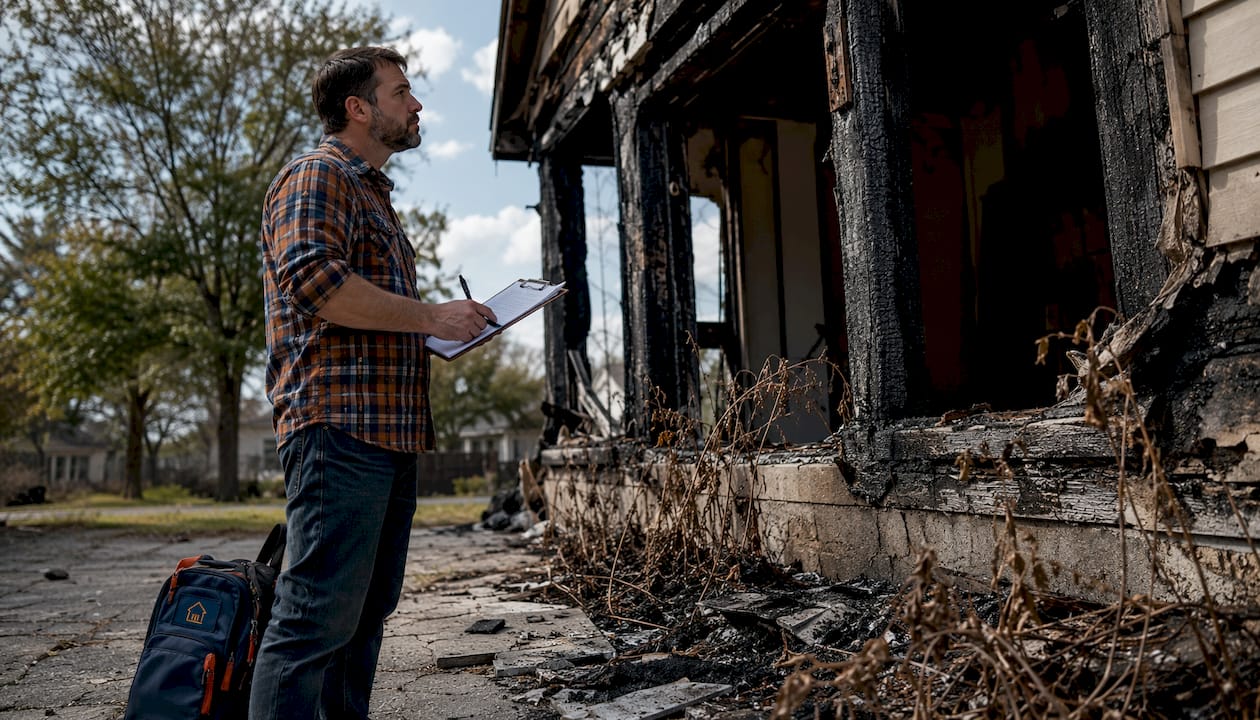
That gap between purchase price and after-repair value (ARV) is the engine of the business model. An investor who buys a fire-damaged home for $180,000, spends $60,000 on renovations, and sells for $290,000 has manufactured $50,000 in equity through deliberate action. Practitioners call this forced appreciation: instead of waiting for the neighborhood to appreciate, the investor creates value on a fixed timeline by renovating to build equity on purpose.
Experienced investors also carry an operational edge most homeowners don't have. They work with established contractor networks and buy renovation materials in volume, which lets them predict costs and compress timelines. That renovation expertise and volume purchasing power is what makes a condition-blind offer possible — the investor isn't guessing at repair costs the way a first-time buyer would.
One less-obvious factor: open insurance claims. If a property has an active claim from storm or fire damage, a seller can sometimes transfer that claim to the buyer. The investor then uses the insurance proceeds to fund part of the renovation, which improves cash-on-cash return and makes deals feasible that might otherwise be too capital-intensive. Not every transaction involves this, but it's a real mechanic that changes project economics when it applies.
Flip vs. buy-and-hold: Some investors renovate and resell quickly (a "flip"), targeting a one-time profit. Others renovate and rent, building long-term cash flow. Both strategies start with the same step: buy below ARV. The difference is in the exit, not the entry.
What are the real benefits of selling a damaged home for cash?
The investor's profit motive and the seller's convenience motive line up more neatly than most people expect. Here's what sellers actually gain.
- Immediate liquidity. You get a firm closing date, often within two to three weeks, rather than hoping a financed buyer's loan doesn't fall apart at the last minute.
- Sell as-is. No contractor bids, no repair escrows, no inspection repair requests. The investor prices in the condition.
- No holding costs. Every month a damaged property sits, you're paying property taxes, insurance (often at a higher distressed-property rate), and possibly utilities. A fast close stops that bleed.
- Fewer contingencies. Cash investors remove financing contingencies that commonly cause traditional sales to fall through, which is the single biggest source of deal uncertainty for sellers.
- Simplified closing. Without a lender in the transaction, there's far less paperwork and fewer parties who can slow things down.
The cash home sale benefits are especially pronounced in specific situations. If you're facing foreclosure, a fast cash close can stop the process before it hits your credit. Inherited a property you don't want to manage or repair? A cash buyer takes it off your hands without requiring you to become a project manager. Relocating for work? You don't have to carry two properties while waiting for a traditional sale. Dealing with problem tenants in a rental you want out of? Investors buy occupied properties regularly.
Pro Tip: Net proceeds matter more than offer price. A $210,000 cash offer with no agent commission (typically 5–6%), no repair credits, and a two-week close can net you more than a $240,000 financed offer that takes three months and requires $20,000 in repairs. Run the actual numbers before deciding.
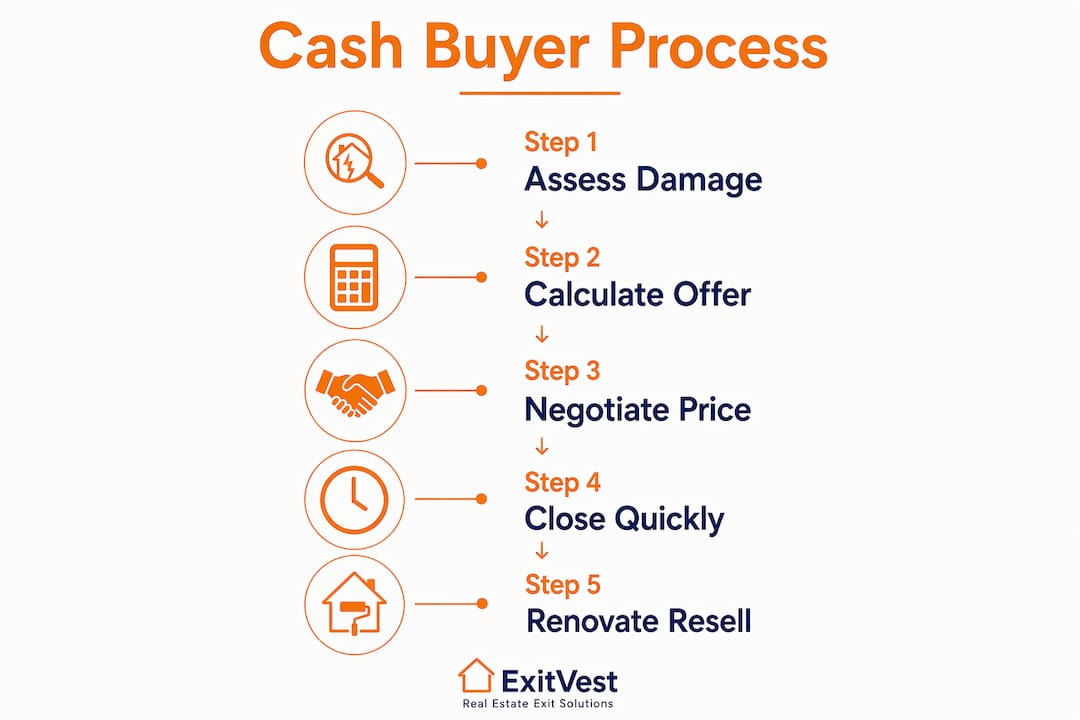
How do cash buyers calculate their offer on a damaged home?
The formula is straightforward, and knowing it helps you judge whether an offer is reasonable or low.
- Estimate the after-repair value (ARV). The investor pulls recent comparable sales for similar homes in good condition in your neighborhood. This is the ceiling — what the property will sell for once renovated.
- Estimate total repair costs. This includes materials, labor, permits, and a contingency buffer for unknowns (mold behind walls, outdated electrical, structural surprises).
- Add carrying costs. Property taxes, insurance, utilities, and loan interest (if the investor uses financing) during the renovation period.
- Add resale costs. Agent commissions, closing costs, and staging on the back end typically run 8–10% of ARV.
- Subtract the investor's required profit margin. Most investors target a margin that justifies the risk and capital tied up. This varies by market and deal complexity.
The formula: Offer = ARV − Repair Costs − Carrying Costs − Resale Costs − Investor Margin
In this example, the seller receives an offer substantially below the repaired home value as a discount. That range is typical for heavily damaged properties. Lightly damaged homes with cosmetic issues might see offers closer to a higher proportion of ARV. The bigger and more uncertain the repair scope, the wider the discount, because the investor is absorbing more risk.

Conservative repair estimates also drive offers down. Investors who've been burned by hidden costs — asbestos, structural failures, mold — build in buffers. That caution is rational, but it means sellers with genuinely straightforward damage sometimes get offers priced for worst-case scenarios. Getting two or three offers from different buyers is the best way to test whether an offer reflects your property's actual condition.
What does the timeline look like when selling to a cash buyer?
The speed advantage of a cash sale is real, but it's not magic. Here's what the process actually looks like, step by step.
- Day 1–2: Initial inquiry. You contact a cash buyer or submit a property inquiry online. Basic details — address, condition, situation — are collected.
- Day 2–5: Offer. The buyer reviews comps, estimates repairs (sometimes with a brief walkthrough, sometimes remotely for a preliminary offer), and presents a written offer. No obligation to accept.
- Day 5–10: Verification. If you accept, the buyer conducts a more detailed inspection or contractor walkthrough to confirm repair estimates. This is where the offer might be adjusted if major unknowns surface.
- Day 10–14: Title and paperwork. A title company runs a title search, confirms there are no unresolved liens, and prepares closing documents. Both parties review and sign.
- Day 14–21: Closing. Funds are wired or a cashier's check is issued. You hand over the keys.
Compare that to a conventional sale: a financed buyer's mortgage approval and underwriting alone typically takes 30–45 days, and that's after you've accepted an offer. Add listing time, inspection negotiations, and appraisal delays, and a traditional sale on a damaged home can stretch four to six months — if it closes at all.
Documents to have ready: your current deed or title information, any open insurance claim paperwork, a list of known repairs or defects, and your mortgage payoff statement if you still carry a loan. Having these on hand compresses the timeline further.
What should you check before accepting a cash offer?
A fast close is only valuable if the buyer actually closes. Run this checklist before you sign anything.
- Proof of funds. Request a bank statement or a letter from a financial institution showing liquid funds sufficient to cover the purchase price. Dated within 30 days. Non-negotiable.
- Buyer entity verification. Know who you're selling to — an individual, an LLC, or a corporation. Look up the entity with your state's secretary of state office. Legitimate buyers don't hide their business structure.
- Title and lien check. Your title company will run this, but you should know going in whether there are outstanding liens, judgments, or tax arrears on the property. Unresolved liens can delay or kill a closing.
- Insurance claim transfer terms. If you have an open claim, clarify in writing whether you're transferring it to the buyer and what that means for your liability. An inherited claim can be a legitimate deal sweetener, but the terms need to be explicit.
- Closing cost allocation. Ask who pays which fees. Some cash buyers cover all closing costs; others split them. Get it in writing.
- Contingency language. Read the purchase agreement for any clauses that let the buyer back out or reduce the price after signing. A clean cash offer has minimal contingencies — if the contract is full of escape hatches, treat it as a red flag.
- Timeline commitment. Get the closing date in writing. A buyer who won't commit to a specific date may be wholesaling your contract to a third party rather than buying it themselves.
For more on what selling as-is actually means in practice, it's worth reviewing what buyers can and can't require even in a no-repair transaction.
Common myths and real risks about cash sales for damaged homes
Myth: The cash offer is always the best net outcome. Not true. A cash offer on a damaged property is almost always below market value — that's the trade-off for speed and certainty. If your property has modest damage and you have time, a repair-and-list strategy might net significantly more. The cash route makes sense when speed, certainty, or your personal situation outweighs the price gap.
Myth: "All cash" means the buyer definitely has the money. The phrase means no mortgage financing, not that funds are verified. Some buyers use "all cash" loosely to mean they intend to use cash or hard-money lending. Always verify proof of funds independently.
Genuine risks to weigh:
- Lower net proceeds. Expect to receive less than you would from a repaired, listed property. The discount compensates the investor for risk, capital, and renovation work.
- Title surprises. Hidden liens or title defects can surface during the title search and complicate closing. Know your title status before you're under contract.
- Wholesalers vs. buyers. Some "cash buyers" are actually wholesalers who plan to assign your contract to a real buyer for a fee. This isn't inherently bad, but it can extend timelines and introduce uncertainty. Ask directly whether the person making the offer will be the one closing.
- Tax implications. A sale at a loss or a gain may have tax consequences depending on your basis, how long you've owned the property, and whether it's a primary residence. Consult a tax professional before closing.
Walk away if: the buyer pressures you to sign immediately, refuses to provide proof of funds, asks you to sign over a deed before closing, or the contract price drops significantly after the inspection without a clear, documented reason.
What are your alternatives to a cash sale?
A cash sale isn't always the right answer. Here's how the main alternatives compare.
- Repair and list: Invest in repairs, list with an agent, and target retail buyers. Highest potential net proceeds, but requires capital upfront, takes months, and carries the risk that repairs don't fully recover their cost in the sale price.
- Traditional sale as-is with an agent: List the property in its current condition through an agent. You'll reach more buyers than going directly to investors, but damaged homes often sit, and financed buyers may struggle to get mortgage approval.
- Auction: Fast and definitive, but prices are unpredictable and auction fees can be substantial. Works best when there's genuine competitive interest in the property.
- iBuyer: Algorithmic offers from tech-enabled buyers. Generally limited to properties in reasonably good condition — most iBuyers won't touch heavily damaged homes.
- Hold and repair over time: If you have the resources and no urgency, you can make repairs incrementally and sell later. Carries ongoing holding costs and market risk.
| Seller situation | Best option |
|---|---|
| Urgent timeline (foreclosure, relocation) | Cash buyer |
| Modest cosmetic damage, time to wait | Repair and list |
| Inherited property, no renovation budget | Cash buyer |
| Good condition, competitive market | Traditional sale with agent |
| Unique or high-value property | Auction or agent |
| Need financing for repairs first | FHA 203(k) renovation loan or fixer-upper financing |
The cash sale wins on certainty and speed. Every other option trades some of that certainty for a potentially higher price.
What does the research say about why investors prefer damaged homes?
The investor preference for damaged properties isn't anecdotal — it follows from a few well-documented mechanics.
First, reduced buyer competition around damaged homes gives investors negotiating leverage that simply doesn't exist in a normal sale. When conventional buyers and bank financing disappear from the pool, the seller's options narrow and the investor's position strengthens.
Second, forced appreciation gives investors a return driver they can control. Rather than depending on neighborhood appreciation, they create equity through renovation on a timeline they set. That predictability is why experienced investors often prefer damaged homes to move-in-ready properties — the upside is manufactured, not speculative.
Third, the certainty of close matters to both sides. Cash buyers remove appraisal and mortgage contingencies that commonly derail traditional closings. For a seller in distress, that reliability has tangible value that doesn't show up in the offer price.
On inherited insurance claims specifically: this mechanic is underappreciated by sellers. An open claim attached to a damaged property is a financial asset. Transferring it to a buyer can make a deal work that wouldn't otherwise pencil out, and sellers who understand this have a negotiating point most don't use. For a deeper look at how this works in practice, the investor's guide to inherited claims covers the mechanics in detail.
Key Takeaways
Cash buyers purchase damaged properties because the discount below ARV, combined with renovation expertise and reduced competition, creates a reliable profit path — and for sellers, that investor demand translates into a fast, as-is exit with no financing risk.
| Point | Details |
|---|---|
| Investor motivation | Buyers target damaged homes to buy below ARV, control repairs, and manufacture equity through renovation. |
| Seller speed advantage | Cash sales typically close in 7–21 days, versus 30–45 days or more for financed transactions. |
| Offer formula | Offer = ARV minus repair costs, carrying costs, resale costs, and investor margin — know the inputs before you evaluate any number. |
| Due diligence first | Always verify proof of funds, check for liens, and review contingency language before signing a purchase agreement. |
| Exitvest option | Exitvest buys damaged properties nationwide as-is, with fair cash offers and flexible closing timelines for sellers in difficult situations. |
How Exitvest approaches buying damaged properties
Exitvest was built specifically for the situations most real estate processes handle poorly: foreclosure timelines, inherited homes nobody wants to manage, properties with problem tenants, vacant houses racking up holding costs, and homes with damage that would stop a conventional sale cold. The goal isn't to squeeze the lowest possible price out of a difficult situation — it's to give sellers a clear, honest offer and a closing timeline that works for them.
What sellers can expect from Exitvest: a straightforward offer based on the property's actual condition, transparent communication about how that number was reached, and flexibility on the closing date. Exitvest buys properties nationwide, with particular depth in New Jersey, Texas, Florida, and Tennessee. If you want to see the range of situations Exitvest helps with, the list covers most of what sellers in difficult circumstances face.
For sellers who want to understand the process before committing to anything, the how it works page walks through each step without pressure.
Get a fast, transparent cash offer from Exitvest
Selling a damaged property doesn't have to mean months of uncertainty or a contractor parade through your home. Exitvest gives sellers a direct path: a fair cash offer, a clear timeline, and no pressure to accept.
Here's how to get started:
- Share your property details. Address, general condition, and your situation — that's all that's needed to begin.
- Receive a written offer. Exitvest reviews the property and presents a no-obligation cash offer, typically within 24–48 hours.
- Choose your closing date. If the offer works for you, pick a closing date that fits your timeline — whether that's two weeks or two months.
Ready to see what your property is worth as-is? Request your cash offer from Exitvest today — no repairs, no commissions, no surprises.
Useful sources for sellers researching cash offers
- Why Do Investors Target Damaged Properties? (KC Damage Restoration) — Explains the investor business model, ARV focus, and forced appreciation mechanics. Good starting point for understanding offer behavior.
- The Investor's Edge: Inherited Claims (Go for Real Estate) — Covers the mechanics of inherited insurance claims and how they affect deal economics for both buyers and sellers.
- Why Cash Home Buyers Buy Homes in Any Condition (Moving Millennials) — Explains the certainty and speed advantages from a seller's perspective, including how investor contractor networks enable condition-blind offers.
- Are Cash Offers Better for Sellers? (NerdWallet) — Balanced overview of cash offer advantages and what sellers should verify before accepting.
- Buying a House with Cash: Pros, Cons and Considerations (Chase) — Covers due diligence steps including lien checks and title verification — useful for sellers who want to understand what a careful buyer checks.
- 10 Tips for Buying Distressed Properties (HowStuffWorks) — Explains why lenders often won't finance heavily damaged homes, which clarifies why cash buyers dominate this segment.