

If speed and certainty are your top priorities, a direct cash sale to a buyer like Exitvest is the fastest route to closing. If you want the highest possible net proceeds and can wait, a traditional MLS listing with a land-specialist agent or a private approach to developers gives you the best shot at full market value. Every other method falls somewhere between those two poles.
Quick verdict by seller priority:
- Need cash fast, sell as-is: Direct cash buyer (Exitvest or similar) — closes in days to weeks, no repairs, no commissions
- Want maximum net proceeds: Traditional MLS with a land-specialist agent or private developer outreach — takes 3–12 months but typically yields the highest gross price
- Low effort, no agent: FSBO on specialized land platforms (LandWatch, Lands of America, Land And Farm) — saves commission but demands your time
- Expand buyer pool, earn interest: Seller financing / land contract — attracts buyers who can't get conventional loans, but payment arrives over years
When speed and certainty are non-negotiable, Exitvest buys vacant land for cash nationwide, with flexible closing timelines and no commissions.
Table of Contents
- How do the main vacant land sale methods compare?
- How each sale method actually works, step by step
- What should you prepare before listing or offering your land?
- Where should you list vacant land and how do you price it?
- What are the typical timelines and costs for each sale method?
- When does a direct cash sale make sense, and how does Exitvest work?
- What should you do this week to move forward?
- Key Takeaways
- What sellers consistently get wrong (a buyer's perspective)
- Exitvest buys vacant land fast, as-is, with no commissions
- Useful sources and next-step reading
How do the main vacant land sale methods compare?
This land sale strategies comparison covers the six methods most U.S. sellers actually use. Scan the table to find your fit, then read the deep-dive sections for the full picture.
| Method | Speed to close | Likely net proceeds | Closing certainty | Fees & costs | Seller control | Buyer pool | Paperwork complexity | Best for |
|---|---|---|---|---|---|---|---|---|
| Traditional MLS + agent | several months to about a year | Highest gross price but commissions reduce net proceeds | Moderate (financing contingencies common) | 6%–10% commission + closing costs | Low (agent-driven) | Broad retail buyers | High | Sellers with time, clear title, and market-ready land |
| FSBO | 3–12 months | High gross if priced right; saves commission | Low to moderate | Closing costs only | High | Moderate (limited reach) | High | Motivated sellers willing to manage marketing and paperwork |
| Land auction | 30–90 days | Variable; can exceed or fall below market | High once hammer falls | 5%–10% auctioneer fee + buyer's premium | Low | Competitive bidders | Moderate | Sellers who need a firm sale date and have unique or hard-to-price land |
| Cash buyer / direct investor | Days to weeks | Below market (typically 60%–80% of value) | Very high | Minimal (buyer often covers closing) | Moderate | Investors, developers | Low | Sellers who need speed, have title issues, or want zero hassle |
| Seller financing / land contract | Weeks to months (to find buyer); years to collect | Above market price + interest income | Moderate (default risk) | Minimal upfront | High | Buyers who can't get bank loans | Moderate | Sellers who don't need a lump sum and want income stream |
| Private sale to developer / institution | Weeks to months (relationship-dependent) | Potentially highest of all | High if buyer is motivated | Low to moderate | High | Narrow but motivated | Moderate | Sellers with development-ready or rezoning-potential parcels |
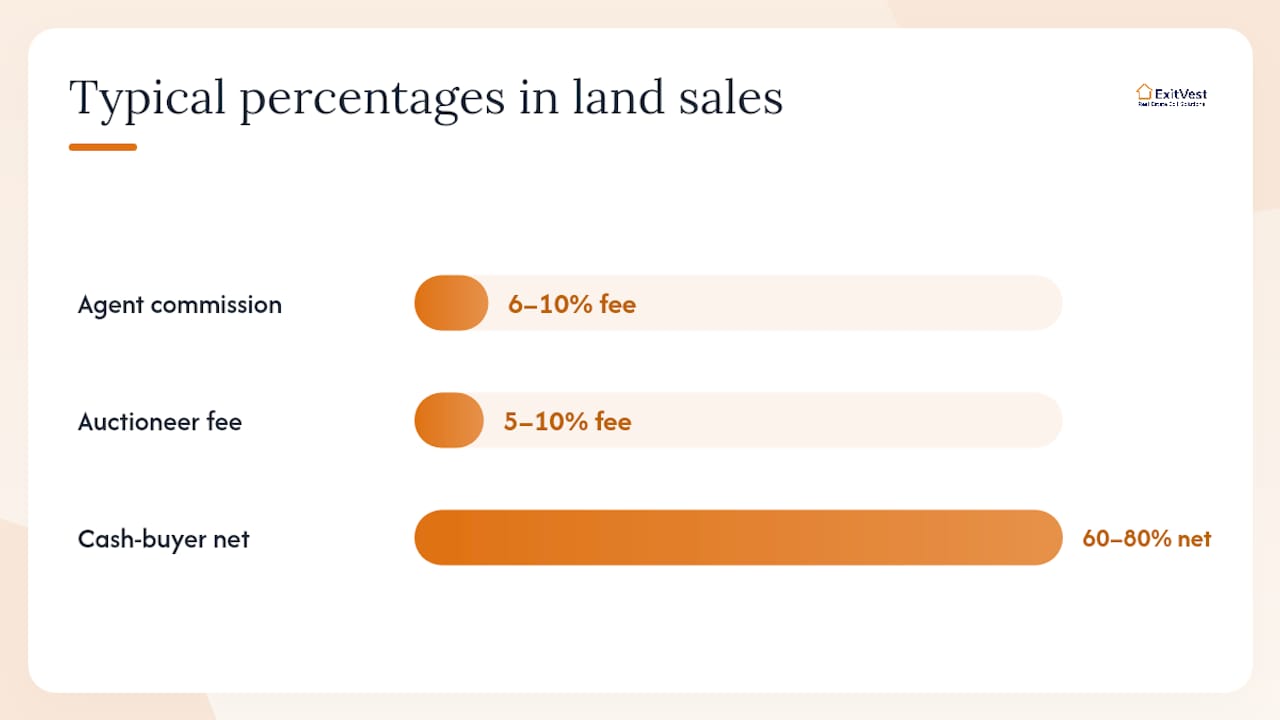
Land commissions commonly run 6%–10%, which hits hardest on smaller parcels where the gross price doesn't absorb that cost easily. That single fact reshapes the net-proceeds math for most sellers.
How each sale method actually works, step by step
Traditional MLS listing with a land-specialist agent
You hire a licensed agent who lists your parcel on the MLS, syndicates to Zillow and Realtor.com, and handles showings, offers, and negotiations. The process runs from listing agreement to closing in 3–12 months depending on location, zoning, and pricing accuracy.
Pros: Widest buyer exposure, professional negotiation, agent handles disclosures and contracts. Cons: Land commissions often run a substantial percentage, financing contingencies can kill deals, and most residential agents lack land-specific expertise.
Negotiation tip: Insist on an agent who has closed at least five land transactions in your county. A residential agent who dabbles in land will misprice it and mismarket it to the wrong buyers.
Red flag: If your agent suggests pricing based on nearby home sales rather than comparable land sales, find someone else.
FSBO (for sale by owner)
You handle everything: pricing, listing, buyer inquiries, contracts, and closing coordination. FSBO saves commission but requires the owner to manage pricing, marketing, and paperwork; agents are recommended for complex titles or remote parcels where local expertise matters.
Pros: No commission, full control over terms and timeline, works well for straightforward parcels with clear title. Cons: Limited buyer reach without paid listings, legal missteps are easy without a professional, and pricing errors are common.
Timeline: 3–12 months, depending on how aggressively you market. For a practical step-by-step breakdown, the FSBO selling process is worth reviewing before you list.
Risk mitigation: Always use a real estate attorney to review the purchase agreement, even if you handle everything else yourself.
Land auctions
You engage a licensed auctioneer, set a reserve price, and run a public sale event (live, online, or hybrid). Auctions are a formal sales channel governed by professional standards and certifications; they can drive competitive bidding but require correct reserve pricing and pre-sale marketing to succeed.
Pros: Creates urgency, firm sale date, competitive bidding can push price above expectations. Cons: Weak turnout means a below-reserve result or no sale; auctioneer fees typically run 5%–10% plus a buyer's premium.
Timeline: 30–90 days from engagement to close.
Reserve strategy: Set your reserve at the minimum you'll accept, not your target price. A reserve set too high kills bidding momentum and leaves you with an unsold parcel and a marketing bill.
Cash buyer / direct investor
You contact a cash buyer directly, provide basic property details, receive an offer (often within 24–72 hours), and close through a title company in days to weeks. Cash buyers are the fastest route to closing but typically purchase at a discount.

Pros: No financing contingencies, no repairs, no commissions, closes fast, works even with title complications. Cons: Offer price is typically 60%–80% of market value.
What to verify: Ask for proof of funds before signing anything. A legitimate cash buyer provides a bank statement or letter of credit without hesitation. For more on vetting cash buyers, the due-diligence checklist matters more than the headline offer number.
Seller financing / land contract
You act as the lender. The buyer makes a down payment and pays you monthly installments at an agreed interest rate until the balance is paid or they refinance. Seller financing increases the buyer pool because many buyers who want land cannot secure conventional mortgages for raw land.
Pros: Higher sale price, interest income, faster to find a buyer than waiting for bank-qualified buyers. Cons: You don't receive full proceeds upfront, default remediation is expensive and slow, and you carry risk for years.
Structuring tip: Require at least 10%–20% down, run a credit check on the buyer, and use a real estate attorney to draft the land contract. A balloon payment at year 3–5 protects you from an indefinite payment term.
Timeline: Weeks to find a buyer; years to collect full proceeds.
Private sale to developer or institution
You identify developers, homebuilders, solar companies, or adjacent landowners and approach them directly. No public listing, no auction, no agent required. This works best when your parcel has development potential or sits near active construction.
Pros: Potentially the highest price of any method, private transaction, no public listing. Cons: Requires research and outreach, can take months to find the right buyer, and deal terms are complex.
Negotiation tip: Developers price land based on what they can build on it. If you understand the zoning and density allowances before the conversation, you negotiate from a much stronger position.
What should you prepare before listing or offering your land?
Buyer uncertainty kills deals faster than bad pricing. Preparation, clear documentation, and addressing access and zoning questions upfront reduce buyer uncertainty and accelerate sales. Get these in order before any offer arrives.
Physical preparation
- Clear a path to the property boundary so buyers can walk it without a machete
- Mark corners with stakes or flagging tape so boundaries are visible on-site
- Photograph the parcel from the road, the interior, and aerial/drone angles
- Create a printable map with GPS coordinates, acreage, and road access labeled
- Note utility locations (electric, water, sewer, septic, well) on the map
- Install a visible "For Sale" sign with contact info if the parcel is road-accessible
Pro Tip: Bundle everything into a single PDF "data packet" — deed, survey, tax bill, zoning summary, and the aerial photo map — and attach it to every listing and email inquiry. Buyers who receive this upfront ask fewer questions, move faster, and make stronger offers. Transparency about known issues (seasonal flooding, no utilities, limited access) belongs in that packet too. Hiding problems doesn't prevent them from surfacing; it just kills the deal at inspection.
If you're not sure why your land has been sitting without offers, the reasons land stays unsold almost always trace back to missing documentation or unclear access.
Where should you list vacant land and how do you price it?
Correct pricing, listing on specialized land platforms, and offering owner financing are the fastest ways to sell. Platform choice determines which buyers even see your listing.
Platforms by buyer type
- LandWatch: Large national database; attracts recreational, agricultural, and investment buyers. Strong search filters by acreage and use.
- Lands of America / Land And Farm: Part of the same CoStar-owned network as LandWatch; specialized land marketplaces reduce friction and closing time compared to general real estate portals.
- Redfin land filter: Useful for suburban and semi-rural parcels where retail buyers are searching alongside homes. The Redfin land guide explains how land listings differ from home listings on the platform.
- Auction channels: — Live and online auctions through certified auctioneers (see Auctioneers.org) for unique, hard-to-price, or time-sensitive parcels.
Pricing rules
Pull comps on parcels that match yours on four dimensions: zoning/use type, acreage range, road access, and sales within the last 12 months within a 5-mile radius. Vacant land doesn't appraise like homes; the comp pool is smaller and older sales are less reliable.
Pricing for speed: Price 10%–15% below the lowest recent comp. Motivated buyers move immediately when they see value.
Pricing for maximum return: Price at or slightly above the highest recent comp and plan for 6–12 months on market. Include seller financing as an option to widen your buyer pool without dropping the price.
Listing description must-haves: Acreage, zoning classification, permitted uses, road access type (paved, gravel, easement), utilities available or nearest hookup distance, GPS coordinates, and county name. A headline that signals buyer type converts better than a generic one. Example: "12 acres, AG zoning, well/septic permitted, paved road frontage — ideal homestead or small farm, [County], TX."
What are the typical timelines and costs for each sale method?
Land typically takes 3–12 months to sell depending on location and readiness, but the range across methods is wide. Here's where each method actually lands.
| Method | Typical time to close | Agent/auctioneer fee | Closing costs (est.) | Transfer taxes | Who typically pays closing |
|---|---|---|---|---|---|
| Traditional MLS + agent | 3–12 months | 6%–10% of sale price | 1%–3% | Varies by state | Negotiable; often split |
| FSBO | 3–12 months | None | 1%–3% | Varies by state | Negotiable |
| Land auction | 30–90 days | 5%–10% + buyer's premium | 1%–2% | Varies by state | Buyer pays premium; seller pays auctioneer |
| Cash buyer | Days to weeks | None | Minimal; buyer often covers | Varies by state | Buyer often covers all |
| Seller financing | Weeks to find buyer; years to collect | None to low | 1%–2% at origination | Varies by state | Negotiable |
| Private developer sale | Weeks to months | None to low | 1%–3% | Varies by state | Negotiable |
Net-proceeds example
Take a $100,000 vacant parcel. With a traditional agent at 8% commission plus 2% closing costs, you net roughly $90,000 before carrying costs. If that sale takes 9 months, add property taxes, insurance, and any maintenance — call it $1,500 total. Real net: approximately $88,500.
A cash buyer offers $78,000, covers closing costs, and closes in three weeks. You net $78,000 with zero carrying cost and zero commission.
The gap is $10,500. Whether that gap is worth 9 months of waiting, contingency risk, and administrative work is a personal calculation. For a seller facing foreclosure, an inheritance they don't want, or land in a remote market, the cash route often wins on total value, not just speed.
Questions to ask when evaluating any offer
- Is this a cash offer or does it depend on financing?
- What is the earnest money deposit, and is it non-refundable after due diligence?
- What contingencies does the buyer require (survey, environmental, zoning)?
- Who pays closing costs and transfer taxes?
- What is the proposed closing date, and is it binding?
Red flags to watch for
- No legal road access or access only through an unrecorded easement
- Unresolved liens, IRS judgments, or probate complications
- Environmental issues (prior dumping, wetlands, contamination)
- Buyer can't provide proof of funds within 24 hours of request
- Earnest money below 1% of the purchase price
- Unusual contract language that lets the buyer extend indefinitely
- Agent or auctioneer who has never sold land in your county
Choose-your-path summary:
- Urgent cash need → Exitvest or direct cash buyer
- Want max price, have time → agent + MLS, or private developer outreach
- Want to avoid commissions and can manage it → FSBO on LandWatch or Lands of America
- Want income stream, don't need lump sum → seller financing / land contract
- Unique parcel, need firm sale date → certified auctioneer via Auctioneers.org
When does a direct cash sale make sense, and how does Exitvest work?
A cash sale isn't the right move for every seller. It's the right move when speed, certainty, or complexity outweigh the price gap. Listing options include MLS, private listings, and auctions, but land contracts and cash sales serve sellers who need different outcomes.
Fit scenarios for a cash sale
- Inherited land you've never seen and don't want to manage
- Foreclosure risk where a delayed sale means losing the asset entirely
- Title complications (liens, probate, unclear boundaries) that would stall a traditional sale
- Land in a remote or thin market where MLS exposure produces no qualified buyers
- Sellers who need liquidity now and can't absorb months of carrying costs
How the Exitvest process works
- Contact Exitvest with basic property details: address, acreage, zoning, and any known issues
- Send supporting documents: deed, survey if available, recent tax bill, and photos
- Receive a cash offer, typically within days
- Review terms: purchase price, closing timeline, who covers closing costs, as-is condition
- Close through a licensed title company with standard escrow; Exitvest handles coordination
Exitvest buys land nationwide, with particular focus on New Jersey, Texas, Florida, and Tennessee. Closings are flexible on timeline, and the as-is purchase means no repairs, no cleanup, and no commissions.
What to require from any cash buyer
- Written proof of funds (bank statement or lender letter), not a verbal assurance
- A clear purchase agreement stating price, closing date, and who pays which costs
- Confirmation that "as-is" means no repair requests after signing
- A title company or real estate attorney handling escrow (never wire money without one)
Pro Tip: Before accepting any cash offer, run a quick title search through your county recorder's office or a title company. Knowing your lien and encumbrance status before you're under contract gives you negotiating leverage and prevents surprises that delay closing.
For sellers weighing whether a cash sale or a longer-market approach fits their situation, the cash buyer motivations guide explains what investors are actually looking for and how they price offers.
What should you do this week to move forward?
Pick your method and take the first concrete step today.
By method
Cash sale (Exitvest or direct buyer):
- Pull your deed and most recent tax bill from the county recorder's office
- Take 10–15 photos of the parcel (road access, interior, any structures or utilities)
- Contact Exitvest or a vetted cash buyer with address, acreage, and a one-paragraph description of known issues
Traditional MLS with agent:
- Interview two or three agents who have closed land transactions in your county in the last 12 months
- Request a comparative market analysis based on land comps only (not home sales)
- Assemble your documents packet (deed, survey, tax records, zoning info) before signing a listing agreement
Auction:
- Contact two certified auctioneers via Auctioneers.org and request a proposal
- Ask each for their reserve-setting methodology and recent comparable auction results
- Confirm their pre-auction marketing plan before signing an engagement agreement
FSBO:
- Create paid listings on LandWatch and Lands of America with full data (zoning, access, utilities, GPS coordinates)
- Prepare your data packet PDF and attach it to every listing
- Consult a real estate attorney on your state's disclosure requirements before accepting any offer
Seller financing:
- Decide your minimum down payment requirement and target interest rate
- Draft a term sheet with a real estate attorney before marketing
- List on platforms that specialize in owner-financed land listings
Key Takeaways
Selling vacant land efficiently comes down to matching your method to your actual priority: speed, net proceeds, low effort, or income stream.
| Point | Details |
|---|---|
| Speed vs. net proceeds | Cash buyers close in days to weeks but typically offer 60%–80% of market value; MLS listings take 3–12 months but yield the highest gross price. |
| Commission impact | Land agent commissions run 6%–10%, which can significantly reduce net proceeds on smaller parcels compared to FSBO or cash sales. |
| Preparation accelerates every method | A data packet with deed, survey, tax records, zoning info, and aerial photos reduces buyer uncertainty and speeds closing regardless of which method you choose. |
| Seller financing expands your buyer pool | Many land buyers can't qualify for conventional loans; offering a land contract attracts those buyers and can produce above-market pricing plus interest income. |
| Exitvest for speed and certainty | Exitvest buys vacant land for cash nationwide, as-is, with no commissions and flexible closing timelines — the strongest fit when speed or title complexity is the deciding factor. |
What sellers consistently get wrong (a buyer's perspective)
The gap between preparation and price expectations
The sellers who lose the most money aren't the ones who pick the wrong method. They're the ones who pick the right method and then undermine it with avoidable mistakes.
Missing documents are the single biggest deal-killer in land transactions. A buyer gets excited, makes an offer, and then discovers the seller can't produce a current survey or doesn't know where the easement runs. The deal either dies or the buyer renegotiates down because the uncertainty is now priced into the offer.
Overpricing is the second issue, and it's more insidious because it's invisible until months have passed. Sellers price based on what they paid, what they need, or what a neighbor's house sold for. None of those numbers have anything to do with what a buyer will pay for raw land. Comps from actual land sales within 5 miles and the last 12 months are the only honest baseline.
The third mistake is presenting access as "easy" when it isn't. If your parcel requires crossing a neighbor's land on an unrecorded easement, that's not a minor detail. It's a title problem that will surface in due diligence and either kill the deal or cost you money. Disclose it upfront, get it resolved before listing if possible, and price accordingly if you can't.
One practical move that most sellers skip: call the county assessor's office before you list and confirm the legal description on file matches your deed. Discrepancies are common, cheap to fix before a sale, and expensive to fix under contract pressure.
Exitvest buys vacant land fast, as-is, with no commissions
If you've worked through this guide and your top priority is a fast, certain close without the friction of listings, showings, and contingencies, Exitvest is built for exactly that situation.
Exitvest purchases vacant land, houses, and small apartment buildings directly from owners for cash, in as-is condition, with no agent fees and no repair requirements. The process is straightforward: send your property details and documents, receive a cash offer within days, and close on a timeline that works for you. Exitvest operates nationwide, with strong local presence in New Jersey, Texas, Florida, and Tennessee.
To get started, visit Exitvest's how-it-works page and submit your property information. Have your deed, a recent tax bill, and a few photos ready. You'll hear back quickly with a no-pressure offer and clear next steps.
Useful sources and next-step reading
The sources below were used in preparing this guide and are worth bookmarking for deeper research.
- How to Sell Land
- How to sell land step-by-step guide
- How to Sell Land by Owner
- How to Sell Land Fast: Strategies That Actually Work in 2026 - Landmodo
- How to Sell Vacant Land in 2026: The Direct Seller’s Guide
- Getting The Best Price For Land: How Different Sales Methods Affect The Amount - The DailyMoss
- The Little-Known Strategies That Help Landowners Sell Land Fast - The Owner-Builder Network
- Auctioneers.org
For public records and surveys: Your county recorder's office (sometimes called the register of deeds) and county assessor's office are the authoritative sources for recorded deeds, plats, easements, and tax records. Most counties now offer online search portals. If your parcel has unresolved liens, unclear access, or a complicated title history, consult a licensed title company or real estate attorney before listing or accepting any offer.
This article is general information, not legal, tax, or financial advice. Confirm current rules, tax rates, and disclosure requirements with a qualified real estate attorney or tax professional in your state.