

What are the fastest ways for a tired NJ landlord to sell?
Selling a tenant-occupied rental in New Jersey does not require an eviction first. Cash offers can close in 2–4 weeks even with tenants in place, preserving the existing lease and keeping income flowing until the deal is done. For landlords who are burned out on maintenance calls, rent chasing, and rising costs, that speed is the whole point.
The two most relevant options for stressed property owners in New Jersey right now are Northbound Home Buyers and Exitvest. Both buy as-is, accept tenant-occupied properties, and skip the traditional listing process entirely.
| Provider | Closing Speed | Offer Type | Tenant Occupancy | Counties Served | Fees | Best For |
|---|---|---|---|---|---|---|
| Northbound Home Buyers | 2–4 weeks | Cash, as-is | Yes | Key NJ counties | None to seller | Fast close, tenant-occupied |
| Exitvest | Flexible/fast | Cash, as-is | Yes | NJ statewide focus | None to seller | Difficult tenant situations, flexible timeline |
Northbound Home Buyers focuses on competitive cash offers and local market knowledge across key New Jersey counties. Landlords who need a clean, fast exit with tenants still in place will find their process direct.

Exitvest is built specifically for the harder cases: problem tenants, deferred maintenance, financial pressure, and properties that a traditional agent would struggle to price or show. The closing timeline is flexible, which matters when your situation is complicated rather than clean.
Key advantages both options share:
- No eviction required before sale
- No repairs, staging, or open houses
- Leases transfer to the buyer intact
- No agent commissions charged to the seller
- Legal compliance handled as part of the process
Pro Tip: If your tenant is current on rent, disclose that upfront to cash buyers. A paying tenant in place is a cash-flow asset to an investor buyer, and it can strengthen your offer.
How does selling a tenant-occupied rental work in New Jersey?
The process is more manageable than most landlords expect, but it has specific legal steps that cannot be skipped. New Jersey law requires landlords to give reasonable notice before showings, typically 24 hours, and tenants retain the right to quiet enjoyment throughout the sale process.
Here is how a typical sale unfolds:
- Contact a buyer or agent and disclose tenant occupancy, lease terms, and rent amount upfront
- Provide required notices to tenants about the sale and any upcoming showings
- Schedule showings around tenant schedules, with proper advance notice each time
- Review the lease to confirm whether it transfers automatically or requires a new agreement at closing
- Handle security deposits correctly: they transfer to the new owner at closing, with written notice to the tenant
The security deposit transfer is one step landlords frequently mishandle. Under New Jersey law, the seller must notify the tenant in writing that the deposit has been transferred to the buyer, and the buyer assumes full responsibility for it from closing forward.
Poorly timed showings with uncooperative tenants can derail a sale entirely. The fix is early, professional communication. Tenants who understand the timeline and feel respected are far less likely to create friction during showings or at closing.
One practical option many overwhelmed landlords overlook: sell directly to an investor who wants the property tenant-occupied. No showings at all. The investor tours once, makes an offer, and the tenant never needs to know the property changed hands until closing day.
What NJ landlord-tenant laws affect your property sale?
New Jersey has some of the most tenant-protective statutes in the country, and they apply directly to how you can sell. Non-compliance risks costly legal challenges and gives tenants real leverage to slow or complicate a transaction.
| Legal Requirement | What It Covers | Timeline/Penalty |
|---|---|---|
| Anti-Eviction Act | Limits grounds for removal; lease must transfer on sale | Ongoing; violations expose seller to litigation |
| Security Deposit Act | Deposit transfers to buyer at closing with written tenant notice | Must occur at closing |
| Lead Paint Registration | Required for pre-1978 buildings; disclosure to buyers and tenants | Before listing or sale |
| Truth in Renting Act | Written disclosure of tenant rights required | At lease signing and on request |
| Local Rent Control | Newark, Jersey City, East Orange have separate ordinances | Varies by municipality |
The Anti-Eviction Act is the one that catches landlords off guard most often. You cannot simply decline to renew a lease because you want to sell to an owner-occupant. Removal requires a specific statutory cause, and the burden of proof sits entirely with you. Selling to an investor who keeps the tenant in place sidesteps this entirely.
Municipal variations add another layer. Legal requirements vary significantly across counties and cities, and what applies in Trenton differs from what applies in Hoboken. Rent control ordinances in Newark and Jersey City each operate under their own rules, affecting what you can charge, how you can raise rents, and what disclosures you owe a buyer.
Key compliance points for any NJ rental sale:
- Confirm whether your municipality has rent control before pricing the property
- Provide lead paint disclosures for any building constructed before 1978
- Transfer the security deposit in writing at closing, not after
- Verify lease terms before listing: month-to-month leases offer more flexibility than fixed-term ones
What are the tax and financial costs of selling a NJ rental?
The financial picture of selling a rental property in New Jersey involves more line items than most landlords anticipate. Getting a clear number before you sign anything prevents surprises at the closing table.
Capital gains tax is the biggest variable. If you have owned the property for more than one year, federal long-term capital gains rates apply. New Jersey also taxes the gain at the state level, so your total tax bill combines both. Depreciation recapture adds another layer: the IRS taxes the depreciation you claimed over the years at up to 25%, regardless of your income bracket.
Typical selling costs in NJ include:
- State transfer tax (paid by seller, rate varies by sale price)
- Agent commissions if using a traditional listing (typically 5%–6% of sale price, split between agents)
- Attorney fees (NJ real estate transactions customarily involve attorneys on both sides)
- Outstanding property taxes prorated to closing date
- Any agreed-upon repairs or credits to the buyer
Selling to a cash buyer eliminates the commission line entirely and often the repair credits too, since as-is sales transfer the property in its current condition.
The 1031 exchange is the most powerful tax tool available to NJ landlords who want to exit one property without a large tax bill. A 1031 exchange lets you defer capital gains taxes by reinvesting the proceeds into another qualifying investment property. Many landlords use this to move from an active rental into a more passive investment, such as a net-lease commercial property or a Delaware Statutory Trust. The IRS requires strict timelines: you must identify a replacement property within 45 days of closing and complete the purchase within 180 days.
Statistic callout: Expenses like taxes, insurance, and repairs often outpace rents, eroding cash flow to the point where selling or transitioning to passive investment becomes the stronger financial move.
One cost landlords consistently underestimate: the ongoing drag of a property that is not performing. Extended vacancies cost landlords thousands in lost rent each month, and deferred maintenance compounds fast. A $200 repair ignored becomes a $4,500 job. Selling now, even at a slight discount to market, often beats holding a property that is quietly bleeding cash.
How do Northbound Home Buyers and Exitvest compare for NJ landlords?
Both buyers serve the core need: a fast, as-is cash purchase of a New Jersey rental property without requiring the landlord to evict, repair, or list. The difference is in fit.
Northbound Home Buyers brings local NJ market expertise and a track record of purchasing tenant-occupied properties across key counties. Their process is built for speed, and landlords who have a relatively clean situation, a paying tenant, a clear title, and a property in decent shape will find the transaction straightforward. The offer is competitive and the closing timeline is tight.
Exitvest is the better fit when the situation is messier. Problem tenants, deferred maintenance, financial pressure, inherited properties, properties facing foreclosure: these are exactly the scenarios Exitvest was built for. The closing timeline is flexible rather than fixed, which matters when you need to coordinate with a tenant's lease expiration or resolve a title issue before closing. Exitvest operates with a strong focus on New Jersey alongside Texas, Florida, and Tennessee, so the local knowledge is genuine rather than generic.
For a landlord who simply wants out fast and the property is in reasonable shape, either buyer works. For a landlord dealing with a non-paying tenant, a property that needs significant work, or a complicated ownership situation, Exitvest's flexibility and experience with difficult property situations makes it the stronger choice.
Trust signals matter when you are handing over a significant asset. Both Northbound Home Buyers and Exitvest operate with transparent, no-fee processes and serve the NJ market with local expertise. Neither charges the seller commissions or closing costs, and both handle the legal coordination that a traditional sale would require you to manage yourself.
Best practices for exiting NJ rental property management
Leaving active landlord work behind is a process, not a single decision. How you handle the exit affects your final sale price, your legal exposure, and your relationship with tenants who may still be living in the property at closing.
Start with honest tenant communication. Tell tenants early that you plan to sell. Tenants who hear about a sale from a stranger at a showing are far more likely to become uncooperative. A direct, respectful conversation, explaining that their lease will transfer and their rights are protected, costs nothing and prevents a lot of friction.
Time your showings carefully. NJ law requires 24 hours' notice before entering for a showing, and scheduling around tenant work hours or family routines builds goodwill. Investors buying tenant-occupied properties often need only one walkthrough, so the showing burden is lighter than a traditional retail sale anyway.
Get your documentation in order before you list. Buyers, especially investors, want to see the rent roll, lease copies, security deposit records, and maintenance history. Having these ready shortens the due diligence period and signals a well-managed property, even if the physical condition is imperfect.
- Gather all lease agreements and confirm current rent amounts
- Document the security deposit amount and the bank holding it
- List any open maintenance issues honestly
- Pull your property tax bill and confirm there are no outstanding liens
Consider the non-paying tenant scenario separately. If your tenant is behind on rent, you have two paths: pursue eviction before selling, or sell to a cash buyer who accepts the property with the tenant situation unresolved. NJ eviction law allows landlords to file immediately for nonpayment without prior notice in most cases, but the court process takes time. Selling as-is to an investor is often faster and less expensive than completing an eviction first.
Pro Tip: Investors who specifically buy tenant-occupied properties often pay more than investors who plan to renovate and flip. A paying tenant is immediate cash flow. Market your property to that buyer pool, not the renovation crowd.
Transitioning from active management to passive investment is a financial decision, not a concession. Moving from landlord to passive investor often improves cash flow and reduces stress simultaneously, especially when the active management costs, your time, legal exposure, and deferred maintenance, are factored into the real return.
Exitvest offers NJ landlords a direct path out
Selling a rental property in New Jersey does not have to mean months of showings, tenant disputes, and agent negotiations. Exitvest buys properties directly from landlords facing exactly the situations described in this article: problem tenants, financial pressure, deferred repairs, inherited properties, and rentals that simply are not worth managing anymore.
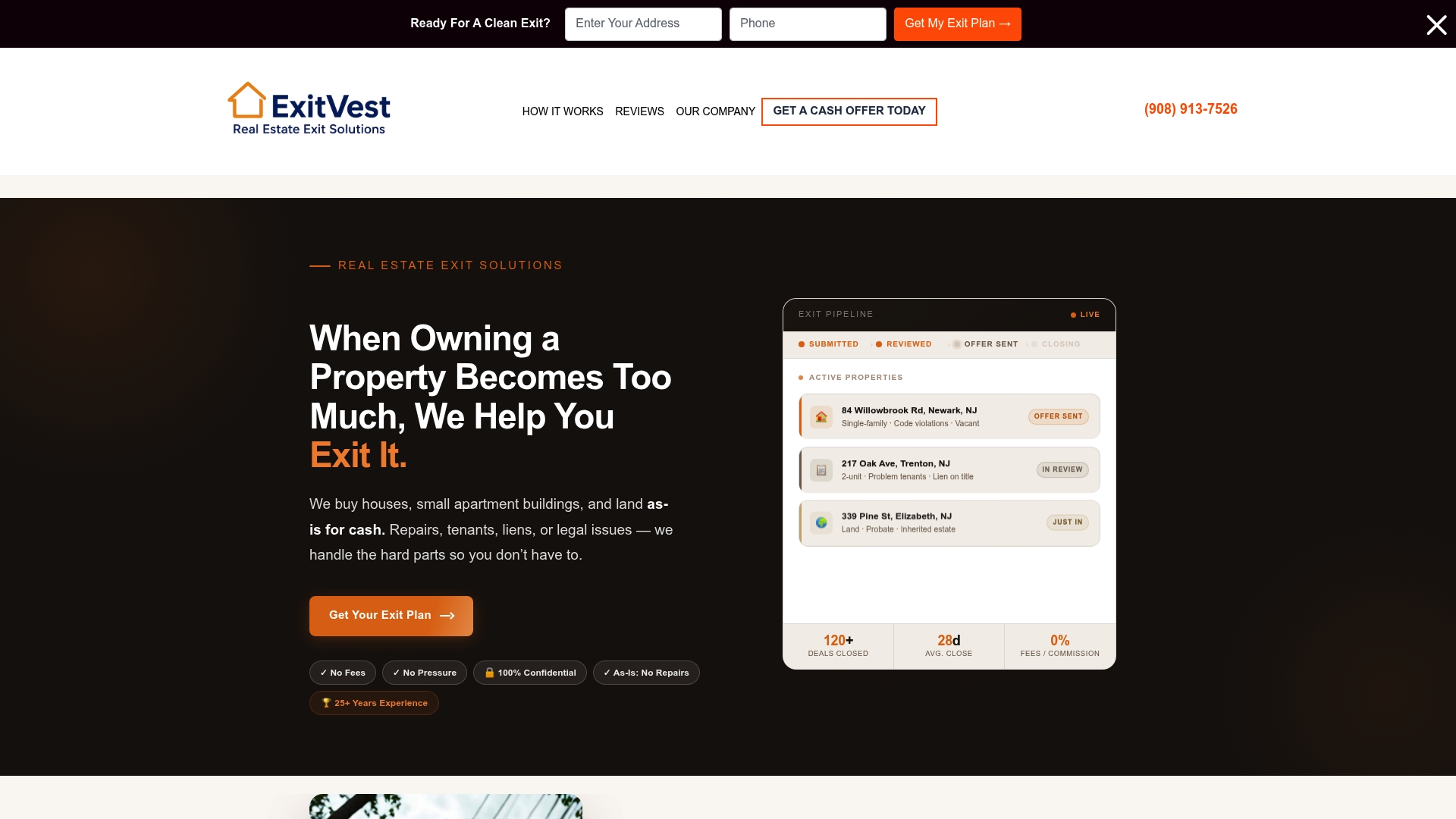
The process is built around your timeline, not a standard 60-day escrow. You get a fair cash offer, no commissions, no repair requirements, and a closing date that works for your situation. Exitvest's focus on New Jersey means the team understands the Anti-Eviction Act, local rent control ordinances, and the specific county-level nuances that trip up out-of-state buyers. If you are ready to stop managing and start moving on, get a cash offer from Exitvest and see what your property is worth without the pressure.
Key Takeaways
For tired landlords in New Jersey, selling to a cash buyer who accepts tenant-occupied properties is the fastest, lowest-friction exit available in 2026.
| Point | Details |
|---|---|
| Cash buyers close fast | Sales to cash investors can close in 2–4 weeks, even with tenants in place. |
| No eviction required | Leases transfer to the buyer at closing; the Anti-Eviction Act does not block the sale. |
| Tax planning matters | A 1031 exchange lets you defer capital gains taxes by reinvesting in a qualifying property within 180 days. |
| Legal compliance is non-negotiable | Security deposit transfers, lead paint disclosures, and 24-hour showing notices are required by NJ law. |
| Exitvest fits complex situations | Exitvest buys NJ rentals as-is with flexible timelines, suited for problem tenants and difficult property conditions. |