

Yes, in most cases you can sell a house with a judgment or lien on it. The lien has to be satisfied or released before the buyer receives clear title, but that payoff almost always happens at the closing table, funded by your sale proceeds. Exceptions exist when liens exceed your equity, a lien is contested, or you need an IRS discharge processed in advance.
TL;DR:
- Most liens are paid off at closing with sale proceeds, but liens exceeding equity or contested liens may delay or complicate the process.
- A title search reveals all recorded liens, and payoff letters specify exact amounts needed for release, which escrow pays directly at closing.
- Sellers can list properties with liens still recorded, as payoff occurs during closing, though early verification prevents last-minute surprises.
- Cash buyers typically pay off liens at closing and may offer lower prices for faster, private transactions, especially when facing foreclosure.
- Verifying lien validity and payoff figures through the title company or county records is essential to avoid delays, disputes, or scams during the sale.
Table of Contents
- Types of Judgments and Liens That Show Up on a Title Search
- How Title Companies and Escrow Resolve Liens at Closing
- Do You Have to Pay Off a Judgment Before You List?
- Selling As-Is to a Cash Buyer When a Judgment Complicates Things
- Paying Off a Judgment at Closing: What Actually Happens on Paper
- How Long Do Liens Last, and When Should You Dispute One?
- Your Realistic Options When a Judgment Threatens the Sale
- How ExitVest Handles Liened and Judgment-Encumbered Properties
- The Trade-Off Nobody Talks About Enough
- Get a Cash Offer Even With Liens on the Title
- Where to Verify These Rules Yourself
- Sources
- FAQ
Types of Judgments and Liens That Show Up on a Title Search
A title search can turn up several different creatures, and they don't all behave the same way. A judgment lien comes from a court ruling against you and attaches to whatever real estate you own in that county, sometimes without you even knowing it's there until a buyer's attorney flags it. A judgment lien can be voluntary or involuntary, and it stays attached until it's paid, released, or expires.
The main categories you'll encounter:
- Judgment liens from lawsuits, unpaid debts, or court awards
- Mechanics or construction liens filed by contractors who weren't paid for work on the property
- Property tax liens and IRS liens, which typically jump to the front of the payoff line
- HOA liens, which in some states carry "super-lien" priority that can outrank even your mortgage
Knowing which type you're dealing with changes how fast it can be resolved and who has to sign off.
How Title Companies and Escrow Resolve Liens at Closing
Once you sign a purchase agreement, the title company runs a full title search. That search is what surfaces every recorded lien, correct or mistaken, against your property.
- The title company orders payoff letters from each lienholder listed
- The payoff letter states the exact amount owed and where to send it
- Escrow collects the money at closing and pays every lienholder directly from your proceeds
- The title company records the satisfaction or release, and the buyer takes clear title
IRS liens follow a slightly different path. Discharging a federal tax lien from a specific property requires filing Form 14135, and the IRS recommends submitting it well ahead of your closing date so the paperwork doesn't hold up settlement.
Pro Tip: Ask your title company for a preliminary title report the day you decide to sell, not the week before closing. Surfacing a lien early gives everyone time to fix it instead of scrambling.
Do You Have to Pay Off a Judgment Before You List?
No. You can list a house with a judgment on it right now. The clearing has to happen before the buyer takes title, not before you put a sign in the yard.
- Most sellers never pay a lien out-of-pocket. The payoff comes straight from sale proceeds at closing.
- Listing while a lien sits on record is routine. Title companies handle this constantly.
- Early action matters when a lien is contested, when you're pursuing an IRS discharge on a tight timeline, or when the total owed exceeds what the sale will net you.
If your case involves bankruptcy or a Chapter 13 filing, the sale usually needs court approval before it can close, which adds a procedural layer most straightforward sales skip.
Selling As-Is to a Cash Buyer When a Judgment Complicates Things
A cash buyer can move fast, but liens don't disappear just because there's no mortgage lender in the mix. Clear title is still the goal.
- Cash buyers or their escrow companies pay off liens at closing, same as a traditional sale, unless the buyer specifically agrees to take the property subject to the lien
- Some cash offers get adjusted downward to account for what's owed, so you see the math up front instead of a surprise deduction
- The trade-off is straightforward: a lower price in exchange for speed, privacy, and skipping months of buyer financing contingencies and repair negotiations
For sellers staring down foreclosure or a lien that's about to swallow their equity, that trade often makes sense.
Paying Off a Judgment at Closing: What Actually Happens on Paper
Getting from "there's a lien on my house" to "we closed on time" comes down to paperwork discipline more than legal maneuvering.
- Request payoff letters from every lienholder as soon as you list, not after you get an offer
- Send those payoff figures to your title or escrow company and confirm exactly who needs to sign the release
- Review your settlement statement carefully. Payoffs appear as line-item deductions before you see your net check
- If a lien amount is disputed, ask escrow about holding back the contested amount rather than delaying the whole closing
Pro Tip: If a lienholder is slow to respond, your title company can usually push harder than you can. Loop them in immediately instead of chasing payoff letters solo.
How Long Do Liens Last, and When Should You Dispute One?
Judgment liens don't last forever. Duration varies by state, and many expire if the creditor never takes steps to enforce or renew them.
- A surprising number of recorded liens are already paid, expired, or attached to the wrong person entirely
- Title companies clear these clerical and name-match errors quickly, often within days
- Genuinely contested liens, or an IRS discharge application, may require an attorney and more lead time before closing
Don't assume every lien on the report is legitimate. Verify before you panic.
Your Realistic Options When a Judgment Threatens the Sale
The path you choose depends mostly on your equity and your timeline.
- Pay from proceeds: the fastest option if your equity covers the debt
- Negotiate a reduced payoff or payment plan: often needs an attorney, but can shrink what you owe
- Escrow the disputed amount: keeps the closing moving while the dispute gets sorted separately
- Short sale or deed-in-lieu: worth considering if you're underwater on the mortgage itself
- Sell to a cash buyer: trades some sale price for speed and privacy, especially useful when liens have piled up
None of these is universally "best." Each one solves a different version of the same problem.
How ExitVest Handles Liened and Judgment-Encumbered Properties
A cash buyer might purchase houses, small apartment buildings, and land nationwide, often focusing on particular states. Judgments and liens are part of the routine for these transactions, not a dealbreaker.
The buyer coordinates with title companies and lienholders to obtain payoff figures, structure the offer around what's owed, and keep the closing on schedule. This tends to fit sellers dealing with foreclosure pressure, inherited property tangled in probate, vacant homes racking up violations, problem tenants, or repairs too costly to take on before listing.
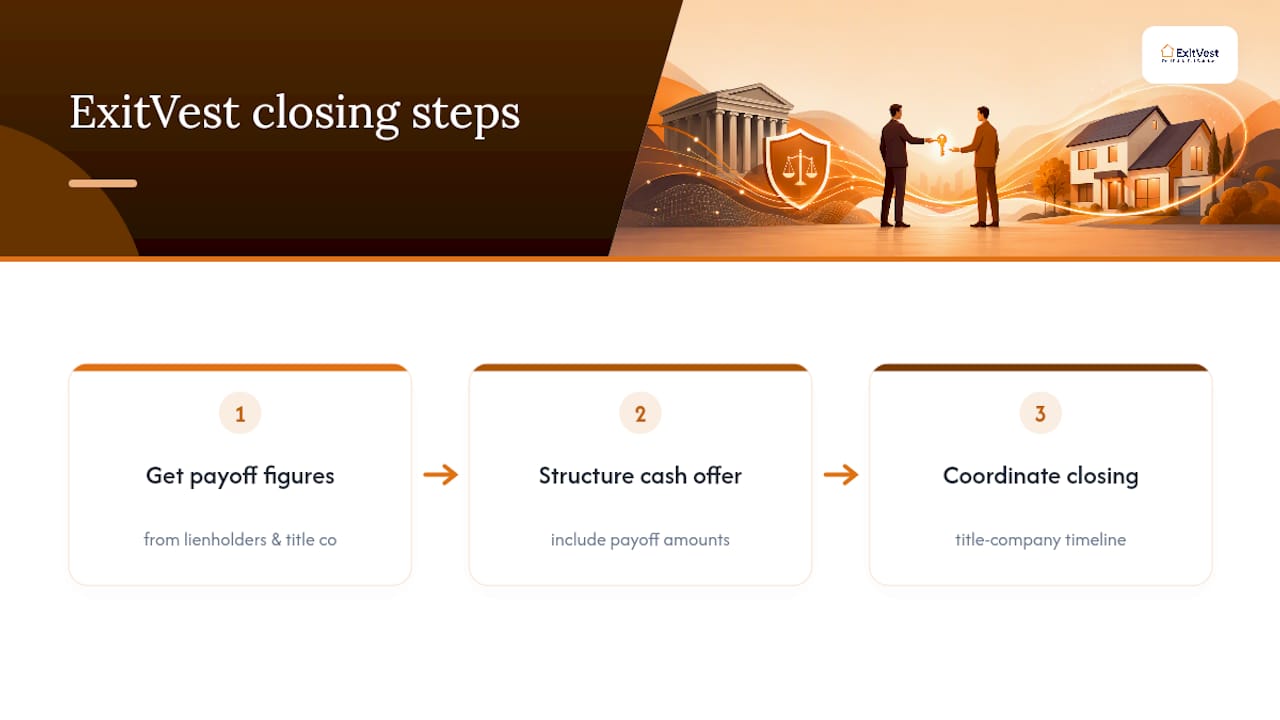
Expect a straightforward ask for basic property and lien documentation, a cash offer explained in plain numbers, and a closing timeline built around your situation rather than a lender's.
The Trade-Off Nobody Talks About Enough
Selling fast almost always means selling for less. That's not a flaw in the system. It's the price of avoiding foreclosure, stopping interest and penalties from compounding, or getting out from under a property that's bleeding you dry every month it sits.
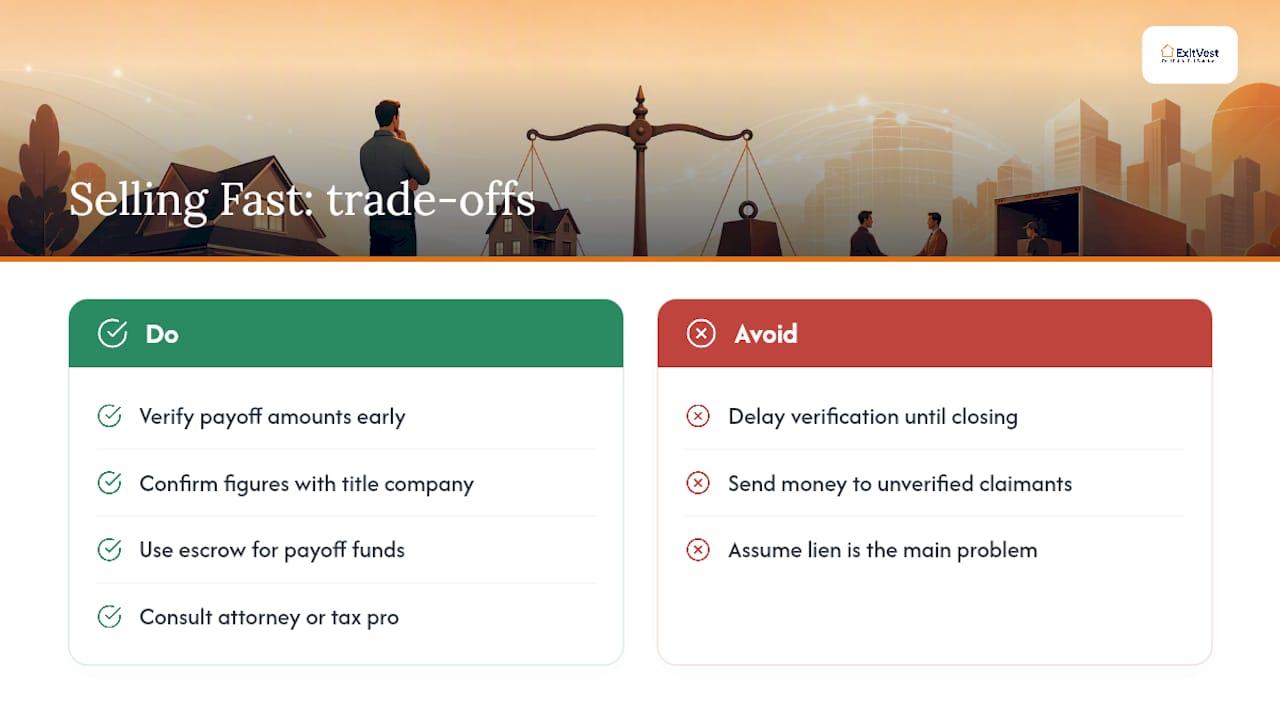
The real risk isn't the lien itself. It's sellers who don't verify payoff amounts early and get blindsided at the closing table, or worse, who send money to someone claiming to be a lienholder without going through escrow. Verifying figures through your title company protects you from both mistakes and scams.
Selling to erase debt should still be a last resort, not a first move, unless the property itself is the problem. If you're upside-down, facing a contested lien, or unsure whether bankruptcy rules apply to your sale, talk to an attorney or tax professional before you sign anything. That conversation costs far less than a closing that falls apart.
— Alek
Get a Cash Offer Even With Liens on the Title
Cash buyers offer an option for sellers who don't want to wait on lienholder paperwork or risk a financed buyer walking away when the title search reveals complications. Instead of listing and waiting for offers, these buyers can make direct cash offers and coordinate lien payoffs.

That means no commissions, no agent fees, and no pressure to accept a number that doesn't work for you. If your property is facing foreclosure, Exitvest's Cash Offer Program is built specifically around that timeline. For every other liened or judgment-encumbered property, whether it's a house, a small apartment building, or vacant land, you can request a no-obligation cash offer at Exitvest and find out what your equity actually looks like once the numbers are on the table.
Where to Verify These Rules Yourself
Before you sign anything, cross-check the specifics with a primary source. Cornell's Legal Information Institute has a clear breakdown of how judgment liens work, and Investopedia covers the different lien types in plain language. Nolo's guide explains what a judgment lien is and when disputing one requires an attorney, and Cash Title Express keeps a library of articles on title and payoff issues worth reading if you want more on the financing side.
Your county recorder's office and your local title company remain the two best sources for the actual liens on your specific property. Nothing online replaces a real title search.
This article is general information, not a substitute for advice from a qualified lawyer. Consult a qualified legal professional about your own circumstances before acting on anything here.
Sources
- Judgment lien — Cornell Legal Information Institute (Wex)
- Should you sell your home to knock out debt? — Ramsey Solutions
- Realtor
- Lien definition and types — Investopedia
- What is a judgment lien? — Nolo
FAQ
Will a Judgment Affect Selling a House?
A judgment lien can affect the process, but it does not stop you from listing or selling. It has to be satisfied or released before the buyer receives clear title, and that payoff typically happens at closing using your sale proceeds.
Does Dave Ramsey Recommend Selling Your House to Pay Off Debt?
Ramsey Solutions treats selling your home to pay off debt as a last resort, not a first step. If your mortgage payment isn't the core problem, selling can leave you with higher housing costs and the same underlying debt issue unresolved.
Why Are Homes With Liens on Them Hard to Sell?
Homes with liens aren't inherently hard to sell. They just require extra coordination between the seller, the lienholder, and the title company to confirm payoff amounts before closing. Title companies handle this routinely, though disputed or IRS liens can add lead time.
Can You Still Buy a House if You Have a Judgment Against You?
Yes, a judgment against you personally doesn't automatically block you from purchasing a home. Lenders will factor the judgment into their underwriting, and it can affect your credit and debt-to-income calculations, but it isn't an automatic disqualifier.
Does ExitVest Buy Houses With Judgments or Liens on Them?
Yes. Exitvest regularly buys properties with judgments, mechanics liens, tax liens, and HOA liens attached, coordinating the payoff directly with the title company as part of the closing. Current offer terms are available by requesting a cash offer through Exitvest.