

Yes, in most U.S. states you can sell a house during probate once the executor or administrator has legal authority through Letters. What matters most is whether the estate has independent administration (skip court approval) or supervised administration (a confirmation hearing may apply), and whether you prioritize price or speed. A cash buyer like Exitvest can close fast, but usually below retail market value.
TL;DR:
- States with independent administration allow executors to sell property without court approval, reducing the sale timeline by four to eight weeks compared to supervised administration.
- Proof of legal authority, such as Letters Testamentary or Court Orders, is essential; ordering the appraisal within the first week can prevent delays.
- Court-confirmed sales often set a minimum price near the appraisal value, with supervised sales typically fetching lower prices due to limited buyer pools.
- Sale proceeds are used first for closing costs, mortgage balances, and creditors before reaching heirs, with final accounting often required in supervised states.
- Most heirs owe little tax because of the stepped-up basis, but accurate documentation and timely appraisal ordering are critical to avoid costly mistakes.
Table of Contents
- What Does It Mean for a House to Be "in Probate"?
- Can You Sell a House While It's Still in Probate?
- What Documents Do Title Companies and Buyers Expect?
- Step-by-Step Checklist to Sell a House During Probate
- How Do State Rules Change Probate Sale Timing?
- How Do Appraisals and Court Confirmation Affect Price?
- Where Does the Sale Money Actually Go?
- What Taxes Apply When You Sell an Inherited House?
- What Usually Delays a Probate Sale?
- How Should You Communicate With Heirs During the Sale?
- What Happens if an Heir Contests the Sale?
- What Disclosures Are Required in a Probate Sale?
- What Matters Most When You're the One Signing the Papers
- Getting a Cash Offer From Exitvest During Probate
- Where to Verify State-Specific Probate Rules
- Sources
What Does It Mean for a House to Be "in Probate"?
When someone dies owning a house in their own name, that property becomes part of the estate, not the property of any individual heir. The executor named in the will, or an administrator appointed by the court when there's no will, manages the estate. They don't own the house personally; they hold legal authority to act on the estate's behalf until the court closes the case.
Some families never deal with this at all. A living trust, joint tenancy with right of survivorship, or a transfer-on-death deed can move a house directly to a beneficiary without probate.
When probate does apply, expect paperwork friction:
- Title companies won't insure a sale without proof of executor authority.
- Appraisers and lenders often require certified court documents before proceeding.
- Buyers' attorneys typically ask for the same proof before allowing funds to move.
Can You Sell a House While It's Still in Probate?
You cannot close a sale before the court issues Letters Testamentary or Letters of Administration. That's the hard line. But you can often list, negotiate, and even sign a purchase agreement before probate fully closes, once you have that authority in hand. Courts in most states expect the process to run through the following stages.
- File the petition to open probate and request appointment as executor or administrator.
- Attend the appointment hearing, which most courts schedule within a few weeks of filing.
- Receive Letters from the court, which is the moment you gain legal selling authority.
- Order the appraisal and run a title search on the property.
- List the property or accept a direct offer.
- Petition the court for confirmation if the estate requires supervised administration.
- Attend the confirmation hearing, if one is required, then close and distribute proceeds.
Smart executors don't wait on step 3 to start step 4. Cleanout, valuation calls, and title searches can happen while the petition is pending, which shaves real time off the back end.
What Documents Do Title Companies and Buyers Expect?
Every party in the transaction, from the title company to the buyer's lender, will ask for proof that you're legally allowed to sell. The probate process outlined by the American Bar Association confirms that executors must follow state-specific rules when handling estate real property, and documentation is how that gets verified.
Here's what typically gets requested:
- Letters Testamentary or Letters of Administration, the court-issued document naming you the estate's authorized representative. Title companies check the issue date and confirm it hasn't been revoked.
- A court order authorizing sale, required in supervised states before you can accept an offer.
- Published or mailed creditor notice, since many states require creditors get a window to file claims before closing.
- A date-of-death appraisal and estate inventory, used to prove fair market value and satisfy the court's filing requirements.
Pro Tip: Order the appraisal the same week you file your petition. Appraisers often have multi-week waitlists, and this is one delay you can eliminate entirely by not waiting on the court.
Step-by-Step Checklist to Sell a House During Probate
Executors who move fastest through probate sales tend to follow the same rough sequence. Here's the practical version.
- Get appointed and hire a probate attorney. Petition the court, obtain your Letters, and bring in an attorney who handles probate real estate specifically, not just general estate work.
- Secure the property immediately. Change the locks, confirm the homeowner's insurance policy is still active (many lapse after a death goes unreported), and check on vacancy risks. Practical guides recommend securing the property right away to avoid vandalism or weather damage eating into the estate's value before a sale even starts.
- Order the appraisal and title search, then decide your sale route: list with an agent experienced in probate transactions, or sell as-is to a cash buyer if the estate needs speed or the property needs work it can't afford.
- Accept an offer, file for court confirmation if required, close, and distribute proceeds according to the priority the court and state law establish.
Pro Tip: If more than one heir will need to sign off on decisions, get everyone's contact information and expectations documented in writing during step 1. Waiting until an offer is on the table to discover a disagreement is how closings fall apart in week eleven.
How Do State Rules Change Probate Sale Timing?
The single biggest variable in how long a probate sale process florida, texas, tennessee, or new jersey executor faces is whether the state grants independent administration authority. Under independent (also called unsupervised) administration, the executor sells the property much like a normal owner would, no judge, no hearing, no confirmation delay. Under supervised administration, every sale needs a judge's sign-off.
- Independent administration (common in Texas and many states following the Uniform Probate Code) lets executors sign a purchase agreement and close without ever stepping into a courtroom for the sale itself.
- Supervised administration requires filing a petition after accepting an offer, then attending a confirmation hearing where the judge approves or rejects the sale, sometimes weeks after the offer was signed.
- That gap between authority types routinely adds four to eight weeks to a transaction, purely from hearing scheduling.
Ask your attorney directly: does this estate have independent authority in writing, or will every offer need court approval? The answer determines your entire timeline before you list a single photo.
How Do Appraisals and Court Confirmation Affect Price?
The date-of-death appraisal does more than set the estate's tax basis. In court-confirmed sales, it often sets a price floor the court won't go below. Some states cap private probate sales at a fixed percentage of that appraised value, an example being California's rule requiring at least 90% of appraised value for certain confirmed private sales.
Why supervised sales often sell for less: Court-supervised sales limit the buyer pool because retail buyers risk being outbid at a public confirmation hearing after they've already committed time and inspection money. Investors comfortable with that risk step in instead, and prices often land below what an independent, unsupervised sale would fetch.
That structure scares off casual retail buyers but draws cash-ready investors who expect it.
- If your estate has independent authority, market the house normally, photos, showings, open houses, to capture retail-level demand.
- If you're stuck in a supervised sale, expect your buyer pool to skew toward investors from the start.
Where Does the Sale Money Actually Go?
Sale proceeds don't go straight to heirs. They flow through a required payment order that protects creditors and the estate first. Legal and financial explainers agree on the general sequence: closing costs and any outstanding mortgage balance get paid first, straight out of escrow, the same as in any home sale.
After that, the executor uses remaining proceeds to settle valid creditor claims and pay estate-level taxes, if any are owed. Only after debts and taxes clear does money move to heirs, and even then it usually follows the will's instructions or, without a will, your state's intestate succession statute.
This order matters practically. If the estate owes more than expected, an heir who was counting on a specific dollar figure might get less than they assumed, and it's not because anyone made an error. It's because debts sit ahead of inheritance in line, always.
Executors should keep a clean accounting ledger from the moment the sale closes. Courts in supervised states often require a final accounting before the case closes, showing exactly where every dollar of proceeds went. Even in independent administration states where no accounting gets filed with the court, heirs can legally request one, and providing it proactively heads off a lot of suspicion and conflict later.
If the mortgage balance exceeds what the sale will bring, that's a different problem entirely, one your probate attorney needs to flag early, since it can affect whether the sale even proceeds as planned.

What Taxes Apply When You Sell an Inherited House?
Here's the good news first: most heirs owe little to no capital gains tax on an inherited house sale, and that surprises almost everyone the first time they hear it.
The reason is the stepped-up basis rule. Instead of using what the deceased originally paid for the house, the IRS lets the estate use the property's fair market value on the date of death as the new tax basis. If the house sells close to that appraised value shortly after death, taxable gain is often minimal or zero.
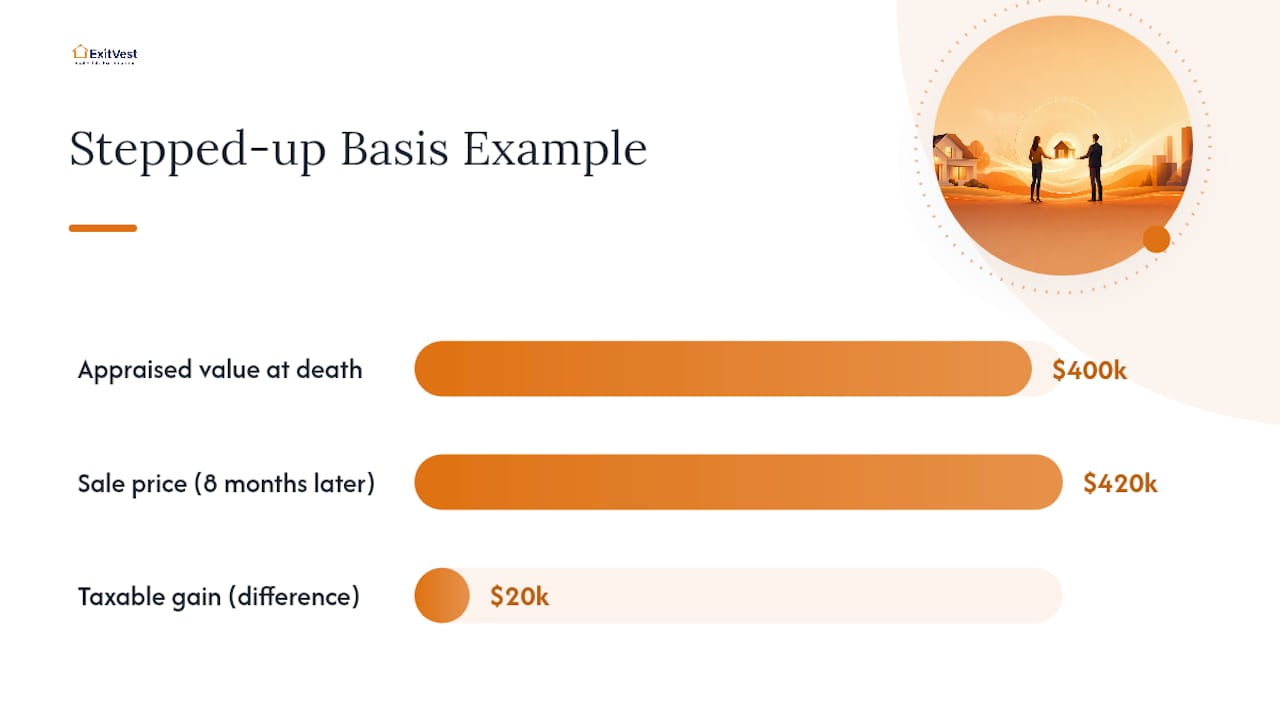
Gain only shows up on appreciation between the date of death and the closing date. If a house is appraised at $400,000 at death and sells eight months later for $420,000, the estate or heir may owe capital gains tax on roughly that $20,000 difference, not the full sale price.
Two separate tax questions can apply here, and they're not the same thing:
- Capital gains tax applies at the estate or individual level depending on how the sale is structured, and is calculated against the stepped-up basis.
- Federal estate tax only applies to estates above a large exemption threshold that affects a small fraction of estates nationally, so most families never encounter it.
Executors handling the sale should consult IRS Publication 559, which covers estate administration and the tax reporting responsibilities tied to selling estate property, including how basis, gain, and estate-level filings interact. A CPA familiar with estate work is worth the fee here. Getting the basis calculation wrong is one of the more common, and expensive, mistakes executors make.
What Usually Delays a Probate Sale?
Most delays trace back to a handful of predictable causes, and knowing them ahead of time lets you plan around them instead of getting blindsided.
Court scheduling backlogs top the list. Some counties take weeks longer than others to schedule appointment hearings or confirmation hearings, and there's little an executor can do except file early and follow up regularly with the clerk's office.
Missing or disputed heirs stall everything. If someone entitled to notice can't be located, or if a potential heir surfaces after the process starts, the court often pauses proceedings until that's resolved.
Property condition surprises cause a different kind of delay. A buyer's inspection turns up a foundation issue or an old oil tank, and now you're renegotiating or losing the buyer entirely, restarting the marketing clock.
Creditor claim periods built into state law require a waiting window after notice is published, often 60 to 120 days depending on the state, before the estate can safely distribute or finalize certain transactions.
The mitigation strategy is largely the same across all four: start early, communicate constantly with the court clerk and your attorney, and don't let the property sit vacant and deteriorating while these processes run. A detailed legal requirements checklist can help you spot which of these risks apply to your specific estate before they turn into six-week setbacks.
How Should You Communicate With Heirs During the Sale?
Silence is what breaks trust between executors and heirs, not the decisions themselves. Most disputes trace back to someone feeling blindsided rather than someone genuinely disagreeing with the outcome.
Set expectations early. Before you even list the property or field an offer, tell every heir what the timeline realistically looks like, what the appraisal came back at, and what factors (mortgage balance, repair needs, market conditions) will shape the final number. People tolerate a lower-than-hoped sale price far better when they understood the reasoning going in.
Put major updates in writing, even a group text or email works, so there's a record everyone can point back to. Verbal updates get misremembered, especially in families already under the stress of a death in the family.
Share the offer terms before you accept, when your state and the estate's structure allow it. Even a courtesy heads up ("I'm planning to accept this offer at this price unless someone raises a concern by Friday") heads off a lot of resentment, even in states where you have full independent authority to decide alone.
What Happens if an Heir Contests the Sale?
Disputes usually fall into one of two categories: someone thinks the price is too low, or someone objects to the sale happening at all. Handle each differently.
If the disagreement is about price, your appraisal and any competing offers become your evidence. Showing a disgruntled heir the comparable sales data and the appraiser's reasoning often resolves it without escalation. Courts also lean on this documentation heavily if the dispute reaches a hearing.
If an heir formally contests the sale itself, filing an objection with the probate court, the transaction typically pauses until the judge rules. This is where supervised administration's slower pace actually offers protection: the court becomes the tiebreaker instead of the executor and heir battling it out directly. Resources on beneficiary rights during probate walk through what standing an heir actually has to object, and it's often narrower than people assume; disagreeing with a decision isn't the same as having legal grounds to block it.
Executors who document their reasoning contemporaneously, not after a complaint arrives, tend to fare far better if a dispute escalates.
What Disclosures Are Required in a Probate Sale?
Selling as an estate doesn't exempt you from your state's property disclosure laws. Most states still require disclosing known material defects, roof age, foundation issues, past water damage, even when the seller is an estate rather than a person who lived in the home.
The complication is that executors often didn't live in the house and may not know its full history. Disclose what you know, and where you genuinely don't know (common with inherited property), many states allow you to state that directly rather than guessing. Misrepresenting a known issue is a legal risk regardless of who's selling; claiming ignorance you didn't actually have is not a safe workaround.
Buyers typically still get their standard inspection period, even in a probate transaction. Don't assume an as-is sale eliminates a buyer's right to inspect; it usually just means you're not obligated to make repairs based on what they find. Confirm your specific state's disclosure form requirements with your probate attorney before signing anything, since the forms and mandatory disclosures shift from state to state.
What Matters Most When You're the One Signing the Papers
The single most common mistake I see executors make isn't legal, it's sequencing. They start calling agents or cash buyers before they've secured the property, confirmed insurance, or even talked to a probate attorney about whether their state requires court confirmation. Fix that order first: property secured, counsel engaged, Letters obtained. Everything else moves faster once that foundation is in place.
The second decision, speed versus price, deserves an honest answer early, not a default. If the estate can absorb a few months of carrying costs and the property shows well, list it. If the mortgage is bleeding the estate dry or the house needs work nobody wants to fund, a direct cash sale isn't a compromise; it's often the right fiduciary call. Exitvest's guide on fast-sale options for inherited homes breaks down that tradeoff in more detail than most executors get from their attorney alone.
— Alek
Getting a Cash Offer From Exitvest During Probate
Exitvest buys inherited houses directly, as-is, which means you skip the repairs, the staging, and the months of showings that a traditional probate listing usually demands. That matters most when an estate is bleeding cash on a vacant property, or when an out-of-state executor can't realistically manage a months-long sale process from another time zone.

Exitvest works with executors and heirs facing probate delays, code violations, problem tenants, or homes that simply need too much work to list traditionally. The process starts with a conversation about the property and its condition, followed by a cash offer, and a closing timeline built around what the estate actually needs, not a standard 30 to 45 day mortgage timeline. There are no commissions and no agent fees eating into what heirs eventually receive. Exitvest also serves a nationwide footprint, with particular focus in New Jersey, Texas, Florida, and Tennessee.
If carrying costs, repairs, or a slow court calendar are working against your estate, visit Exitvest's situations page to see if your circumstances fit, or check how the offer and closing process works before you commit to a traditional listing.
Where to Verify State-Specific Probate Rules
Every state handles confirmation hearings, notice periods, and independent administration differently, so treat this article as a starting map, not a substitute for county-specific verification.
- IRS Publication 559 for tax and estate reporting obligations tied to selling property.
- Your state's probate code (available through your state courts' website) for confirmation, notice, and appraisal-floor rules specific to where the property sits.
- A local probate attorney, since county-level scheduling and filing quirks rarely show up in general guides.
Sources
- Buying and selling probate property (LegalZoom)
- Publication 559 (IRS)
- Probate listing: executor guide (Houwzer)