
Yes, you can sell a house during bankruptcy, but the trustee or the court usually has to sign off first. Whether you need a formal motion, a simple notice, or almost no oversight at all depends on three things: which chapter you filed, how much nonexempt equity sits in the property, and whether a sale actually helps your creditors. Any sale of estate property falls under 11 U.S.C. §363, which requires notice and often a hearing before a judge approves the deal.
- Chapter 7: the trustee controls the sale decision if your equity exceeds your exemption.
- Chapter 13: the home often stays in your plan, and selling it usually means filing a motion.
- Either chapter: skipping court approval risks having the sale unwound later.
Key Takeaways
Selling a house during bankruptcy is legal and often practical, but it hinges on your chapter, your exemption amount, and getting the trustee or court's sign-off before you close.
| Point | Details |
|---|---|
| Chapter determines control | Chapter 7 puts the trustee in charge of the sale decision; Chapter 13 usually leaves you in control after plan confirmation. |
| Court order comes before closing | Never fund or close a sale without a signed order under §363; unauthorized sales can be voided. |
| Exemptions decide your payout | Your state's homestead exemption sets how much equity you keep after liens and creditors are paid. |
| Pre-filing sales carry risk | A rushed, undervalued sale before filing can be unwound under the trustee's avoidance powers. |
| Exitvest offers a fast, as-is exit | For sellers racing foreclosure or juggling liens, Exitvest provides a cash buyer once your legal steps are cleared. |
Statutes and Resources Worth Bookmarking
- 11 U.S.C. §1306, §1327: define estate property and plan effects in Chapter 13.
- Official bankruptcy court forms: use for filing sale motions and notices correctly.
Table of Contents
- How to Sell a House in Bankruptcy Under Chapter 7 vs. Chapter 13
- What Do Trustees and Judges Look for Before Approving a Sale?
- Where Does the Money Go After You Sell?
- Can You Sell Before Filing to Avoid These Rules?
- Your Step-by-Step Checklist for Selling During Bankruptcy
- What Mistakes Get Bankruptcy Home Sales Blocked?
- Frequently Asked Questions
- Sources
How to Sell a House in Bankruptcy Under Chapter 7 vs. Chapter 13
The two chapters treat your house almost like different assets entirely. Under Chapter 7, the trustee temporarily controls estate property, including your home, and decides whether selling it makes sense. Under Chapter 13, you typically keep control of the property while making plan payments, but that control comes with strings attached.
In Chapter 7, a trustee moves toward a sale only when your equity clears your homestead exemption by enough to actually pay unsecured creditors after liens, closing costs, and the trustee's own fee, according to Nolo's overview of Chapter 7 home sales. No spare equity, no sale. In Chapter 13, the home usually remains part of your repayment plan, and selling it while the case is open normally requires a motion and creditor notice, per LegalClarity's breakdown of Chapter 13 sales.
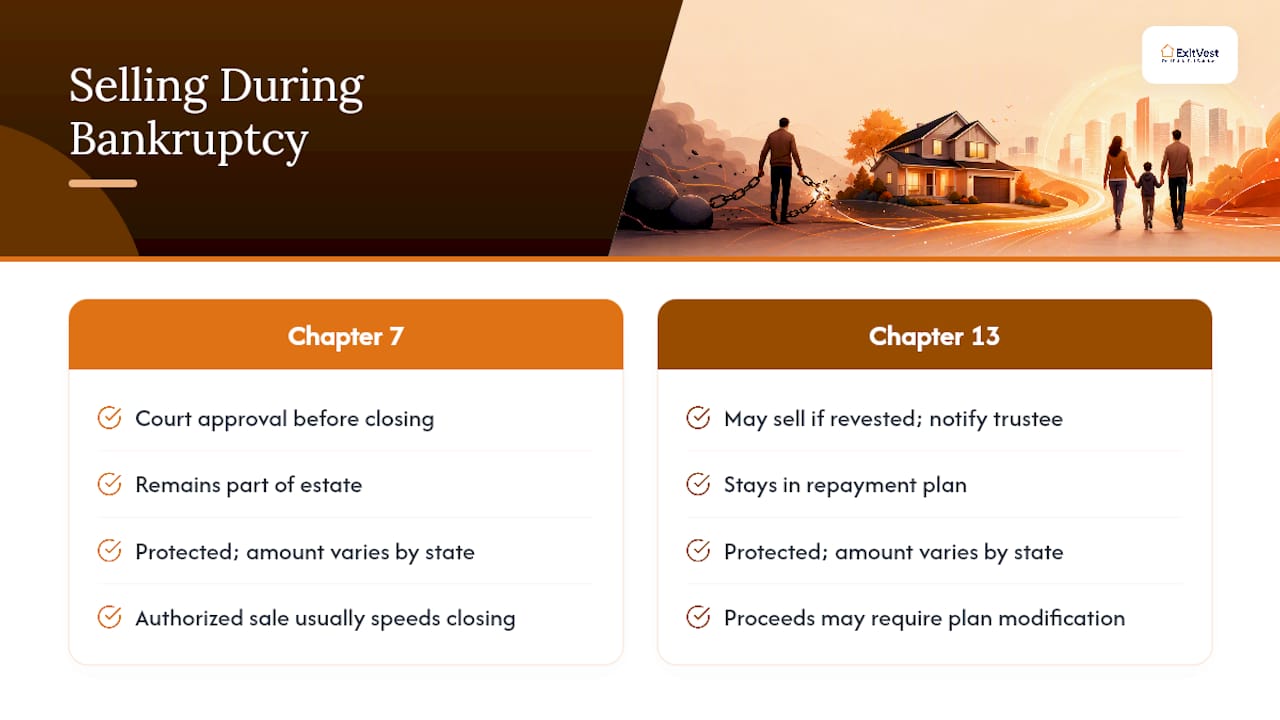
| Factor | Chapter 7 | Chapter 13 |
|---|---|---|
| Who controls the sale decision | Trustee, while equity exceeds exemptions | Debtor, once the plan is confirmed |
| Court approval needed | Yes, if trustee pursues the sale | Usually yes, via motion |
| Effect on case | Sale proceeds often close out the case faster | May trigger a plan modification |
Here's a wrinkle most guides skip: once your Chapter 13 plan is confirmed, the property can "revest" in you, meaning legal ownership technically returns to you rather than staying with the estate. A recent bankruptcy court opinion found that a debtor in that position doesn't necessarily need fresh court permission to sell, but still has to notify the Chapter 13 Trustee and may need to modify the plan under 11 U.S.C. §1329. That single distinction, revested versus not, changes your entire to-do list.
What Do Trustees and Judges Look for Before Approving a Sale?
Getting a signed order isn't a rubber stamp; following the role of disclosures in selling your home ensures transparency during bankruptcy-related sales. Trustees and judges are checking whether the deal is fair, transparent, and actually good for the people owed money.
The filer (or their attorney) submits a motion to sell under §363, attaching the purchase agreement, mortgage payoff statements, and a proposed settlement statement. Notice typically goes out to creditors with roughly 21 days to object, following the procedural mechanics in official bankruptcy court forms. During that window:
- Trustees verify fair market value, often against a recent appraisal or comparable sales.
- They cross-check every lien and payoff figure against county records.
- Judges look for an arm's-length price, full disclosure, and a clear accounting of where proceeds go.
Experts caution against treating court approval as a mere formality. A LegalClarity analysis notes that judges and trustees conduct a real strategic review of how the sale affects both plan payments and creditor recovery, not just whether the paperwork is complete.
Pro Tip: Order your payoff statements from every lienholder before you file the motion. Stale or missing payoff numbers are the single most common reason judges kick a sale motion back for revision.
The general sequence runs: file motion → 21 day notice period → objection window closes → court issues an order → closing proceeds. Miss a step, and closing gets pushed back weeks.
Where Does the Money Go After You Sell?
Proceeds don't land in your pocket first. They flow through a strict payment order, and understanding it tells you exactly how much you'll actually walk away with.
Gross sale proceeds typically get applied in this sequence: secured liens (your mortgage, any junior liens, property taxes), then closing costs and agent commissions, then trustee fees, then priority unsecured debts, then your protected homestead exemption amount, with anything left over going to general unsecured creditors.
- Your state's homestead exemption (or, in some states, a federal exemption option) determines how much home equity you keep outright.
- Exemption amounts vary enormously by state, so check your specific state's statute or ask your attorney before assuming a number.
- In Chapter 7, nonexempt equity typically flows straight to creditors once the trustee sells.
- In Chapter 13, proceeds may need to be redirected into your plan or trigger a plan modification instead of a lump payout.
Pro Tip: Document your exemption claim with your state statute cited by name and section. A vague "I think I'm exempt" claim invites objections that slow everything down.
Can You Sell Before Filing to Avoid These Rules?
Selling before you file doesn't put you outside the court's reach. It can actually invite more scrutiny. Trustees hold avoidance powers under 11 U.S.C. §548, letting them unwind transfers made shortly before filing if the price was below market value or the deal looks designed to dodge creditors.
- Courts weigh intent, whether you sold for less than fair value, and any sign of collusion with the buyer.
- A documented appraisal and an arm's-length buyer are your best evidence the sale was legitimate.
- If you're selling proceeds before filing, keep the funds in a segregated account and disclose the sale fully to your attorney.
Pro Tip: If you can, wait until you've documented fair-market value steps (appraisal, MLS listing history, multiple offers) before closing. A rushed pre-filing sale with no paper trail is exactly what invites a preference challenge later.
Your Step-by-Step Checklist for Selling During Bankruptcy
Selling a house while your case is active isn't complicated once you know the order of operations. Follow this sequence and you'll avoid most of the delays that trip up first-time filers.
- Confirm your chapter and exemption amount. Pull your state's homestead exemption figure and gather mortgage payoff statements plus a current lien search.
- Loop in your bankruptcy attorney and trustee early. In Chapter 13, notify the trustee before you sign anything; in Chapter 7, ask your attorney whether the trustee has already claimed the asset.
- Build the sale package. You'll need the signed purchase agreement, a title report, and a proposed settlement statement showing exactly how proceeds get distributed.
- File the motion or notice, then prepare for objections. Have an independent appraisal ready in case a creditor challenges your valuation.
- Close only after you have a signed court order. Hand that order to the title company, distribute proceeds exactly as ordered, and file any required plan modification in Chapter 13.
Pro Tip: Give your title company the court order before scheduling closing, not after. Some closers won't fund a bankruptcy-related sale without it in hand, and that single document is often the last thing filers remember to send.
Local trustee practices vary, so a practical guide for U.S. filers covering the documentation checklist is worth a read alongside your attorney's advice.
What Mistakes Get Bankruptcy Home Sales Blocked?
- Closing without a signed court order, which can leave the sale void and create title problems down the line.
- Handing the trustee incomplete lien or payoff information.
- Pricing the home below market value, which invites objections and delays.
- Failing to notify creditors or the trustee at all, even when you technically hold the property.
Trustees function as watchdogs over estate assets. An unauthorized sale can be voided outright, and it can expose closing agents to real liability if they funded the deal without proper court sign-off.
Pro Tip: Get an independent, licensed appraisal rather than relying on a buyer's own number. It's the fastest way to head off a valuation dispute before it starts.
When Selling During Bankruptcy Actually Makes Sense
Selling isn't a failure move. Sometimes it's the smartest one available. When foreclosure is closing in, or the home is bleeding equity through repairs and back taxes, a court-approved sale can protect more value than riding out the case. The legal steps exist to protect creditors, but they don't have to work against you if you plan around them and move with full transparency.
A Faster Path When You Need Certainty, Not Delay
Court approval takes time you might not have, especially if foreclosure is closing in fast. Exitvest buys houses, land, and small apartment buildings directly for cash, in as-is condition, including properties tangled up in liens, code violations, probate, or a bankruptcy case. That means no repairs to make, no agent commissions eating into your proceeds, and a closing timeline built around your court dates rather than a buyer's mortgage approval.
You'll still need to follow the legal steps in this guide, filing the right motion, getting trustee sign-off, disclosing everything to your attorney, before any sale closes. Exitvest doesn't replace that process; it gives you a buyer who can move fast once the court clears the way. If foreclosure is the real deadline you're racing, start with Exitvest's foreclosure relief options to see what a cash offer looks like for your specific situation.
Frequently Asked Questions
Can I sell my house during bankruptcy without the trustee's approval? Only in narrow situations, such as a Chapter 13 case where the property has revested in you after plan confirmation. Even then, you typically must notify the trustee. In most other cases, you need explicit court approval before closing.
What happens to my house if I don't sell it during bankruptcy? It stays part of the estate (Chapter 7) or your repayment plan (Chapter 13) until the trustee abandons it, the case closes, or you receive your discharge. A case can remain open even after discharge while the trustee finishes administering assets.
Do I lose all my equity if the trustee sells my house? No. Your state's homestead exemption protects a portion of your equity before any funds go to creditors. The exact protected amount depends entirely on where you live, so check your state's statute directly.
Is it better to sell my house before or after filing for bankruptcy? It depends on your equity position and timing. Selling before filing carries fraudulent-transfer risk if the deal looks rushed or undervalued. Selling after filing means following the court process, but it comes with clearer legal protection against a later challenge.
Will selling my house affect my bankruptcy discharge? It can, particularly in Chapter 13 where proceeds may require a plan modification. In Chapter 7, a properly authorized sale usually moves the case toward closing rather than delaying discharge.
This article is general information, not a substitute for advice from a qualified lawyer. Consult a qualified legal professional about your own circumstances before acting on anything here.
Sources
- Crowder Opinion (Bankr. N.D. Ill.)
- What Happens If You Sell Your House During Chapter 13? - LegalClarity
- Official bankruptcy court form B107 (sample)