

A quitclaim deed transfers only the ownership interest the grantor actually holds, with no warranties on title, liens, or encumbrances. That single fact is the source of nearly every quit claim deed issue in NJ property transactions. Unlike a warranty deed, a quitclaim deed gives the recipient exactly what the grantor has, nothing more and nothing less. New Jersey property owners use them for family transfers, divorce settlements, and title corrections. But in the wrong situation, they create serious legal and financial exposure.
What common issues arise with quit claim deeds in NJ?
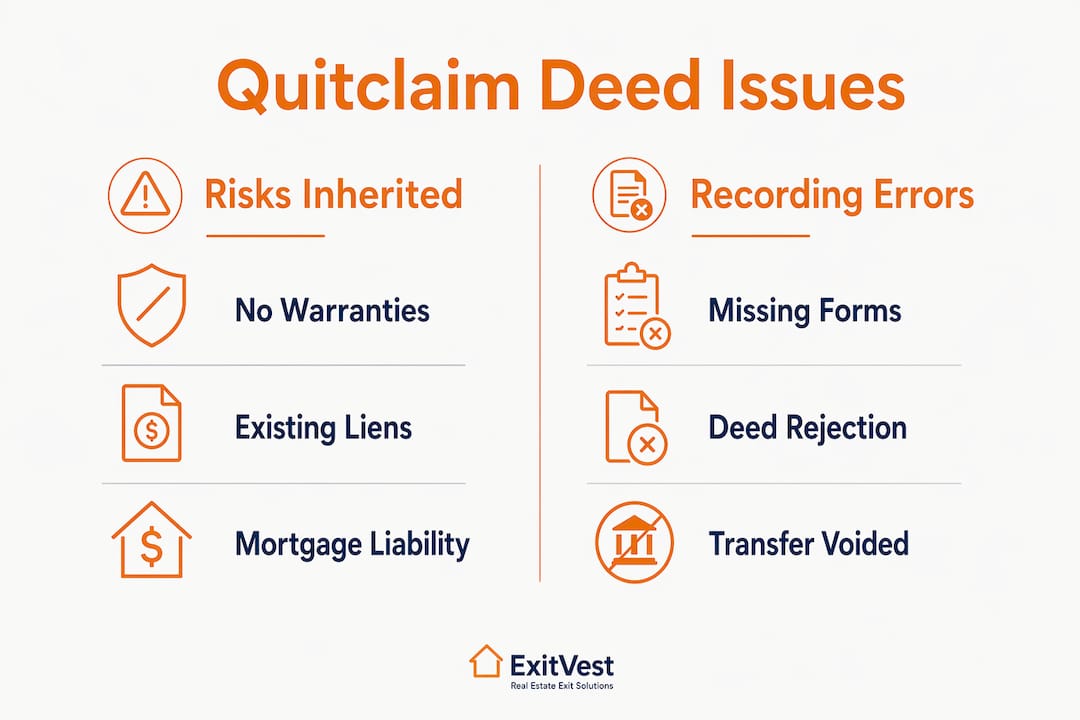
The core problem with quitclaim deeds is what they do not do. A quitclaim deed transfers no warranties about the title's condition, meaning the recipient inherits every defect, lien, and encumbrance attached to the property. If the grantor had a clouded title, the grantee now owns that clouded title.
Liens are the most common financial trap. Existing liens stay attached to the property after a quitclaim transfer. Mortgages, tax liens, judgment liens, and easements do not disappear when ownership changes hands. The new owner must resolve them, often at significant cost.

Mortgage liability adds another layer of risk. Quitclaim deeds do not transfer mortgage obligations. The original borrower stays legally responsible for the loan unless the lender approves a release or the new owner refinances. This can lead to foreclosure if the original borrower stops paying after transferring the property.
Title insurance compounds the problem further. Title insurance companies treat quitclaim transfers as high risk, often refusing coverage or imposing exclusions and higher premiums. Without title insurance, refinancing or reselling the property becomes much harder. Lenders typically require clean title insurance before approving a mortgage.
Common quit claim deed problems in NJ include:
- Hidden liens and judgments that transfer with the property and become the grantee's responsibility
- Unresolved mortgages where the original borrower remains liable after the transfer
- Tax liens from unpaid property taxes or IRS obligations attached to the property
- Easements and restrictions that limit how the new owner can use the land
- Title defects that block refinancing or resale years after the transfer
- Lack of title insurance leaving the grantee with no financial protection against claims
Pro Tip: Before accepting a quitclaim deed, order a full title search through a licensed New Jersey title company. A title search costs a few hundred dollars and can reveal liens or defects that would cost tens of thousands to resolve later. Learn more about how liens affect property transfers before you sign.
How do recording requirements affect quit claim deeds in New Jersey?
Recording a quitclaim deed in New Jersey is not as simple as signing a document and filing it. The county clerk's office applies strict requirements, and a single error causes rejection. That rejection delays ownership transfer and can derail time-sensitive transactions.
New Jersey requires these elements for a valid recording:
- Full legal property description taken directly from the prior deed or survey
- Accurate grantee information including full legal name and mailing address
- Block and lot parcel identifiers matching county tax records
- Notarized grantor signature meeting New Jersey notarization standards
- GIT/REP-3 form (Seller's Residency Certification or Exemption) filed with the deed
- RTF-1 form (Realty Transfer Fee) calculating and documenting any applicable transfer tax
Missing tax forms like GIT/REP-3 and RTF-1 cause county clerks to reject the deed outright. The table below shows the most common recording errors and their consequences.
| Recording Error | Consequence |
|---|---|
| Missing legal description | Deed rejected; ownership transfer void |
| Defective notarization | County clerk refuses to record the deed |
| Absent GIT/REP-3 form | Recording delayed until form is submitted |
| Missing RTF-1 form | Transfer fee unpaid; recording blocked |
| Incorrect parcel identifier | Deed recorded against wrong property |
Recording packet completeness is as critical as the deed itself. A rejected packet in the middle of a sale can push closing dates back by weeks and give buyers grounds to walk away.
Pro Tip: Have a New Jersey real estate attorney review the full recording packet before submission. Attorneys catch notarization defects and missing forms that non-attorneys routinely miss. The role of a title company in this process is equally important for catching errors before they reach the clerk's office.
What challenges arise when trying to reverse or correct a quit claim deed?
Once a quitclaim deed is properly signed and recorded, reversing it is genuinely difficult. A recorded deed is generally final. The grantee owns the property, and the grantor cannot simply take it back by filing another document.
Reversal requires one of two paths. The grantee can voluntarily sign a new deed transferring the property back. Or the grantor must file a lawsuit and prove the original deed was legally defective. Courts do not undo valid deeds simply because one party regrets the transfer.
The legal grounds for challenging a quitclaim deed are specific. Challengeable defects include fraud, forgery, duress, and undue influence. A forged deed is void from the start, meaning it never legally transferred ownership. A deed signed under duress is voidable, meaning a court can cancel it if the affected party proves the circumstances.
Key points about reversing or correcting quit claim deed problems in NJ:
- Void deeds (forged or signed by someone without legal capacity) can be challenged at any time
- Voidable deeds (fraud, duress, undue influence) require a lawsuit filed within the applicable statute of limitations
- Quiet title actions are the standard legal process for resolving disputed ownership after a bad transfer
- Authority disputes involving power of attorney require an attorney to evaluate whether the transfer can be voided
- Undoing a quitclaim deed is often slow and costly, requiring either cooperation or court action based on recognized defects
The practical reality is that most reversal attempts take months and cost thousands in legal fees. If the grantee has already sold or mortgaged the property to a third party, recovery becomes even harder. Prevention is far cheaper than litigation.
How should property owners approach quitclaim deed transfers practically?
The right approach to a quitclaim deed depends entirely on the situation. These deeds serve legitimate purposes in the right context. They are appropriate for transferring property between family members, correcting a name error on a title, moving property into a trust, or resolving ownership after a divorce. They are the wrong tool for arm's-length sales where the buyer expects clean title.
Practical steps for owners using or receiving quitclaim deeds in New Jersey:
- Order a title search before any transfer to identify liens, judgments, and encumbrances
- Consult a New Jersey real estate attorney to draft or review the deed and recording packet
- Request title insurance even if the insurer imposes exclusions; partial coverage beats none
- Understand the tax implications before signing, as quitclaim transfers can trigger capital gains tax based on the original cost basis and may carry unexpected transfer tax consequences
- Verify mortgage status with the lender to confirm whether the original borrower's liability transfers or remains
- Watch for red flags such as a seller in financial distress, recent judgment liens, or a property with a history of multiple quitclaim transfers
Attorneys treat quitclaim deeds as risk transfers to buyers, which is why due diligence like title searches and insurance matters most when clean title is needed. Families comparing quitclaim transfers versus inheritance should weigh the tax impact carefully before deciding. A property transferred by quitclaim deed carries the grantor's original cost basis, which can mean a larger capital gains tax bill when the recipient eventually sells.
Pro Tip: If you are receiving a property through a quitclaim deed and the grantor has financial trouble, check for foreclosure implications before accepting the transfer. A property in pre-foreclosure carries risks that a quitclaim deed does nothing to eliminate.
Key Takeaways
A quitclaim deed in New Jersey transfers only what the grantor owns, with no title warranties, making thorough due diligence, proper recording, and legal counsel non-negotiable before any transfer.
| Point | Details |
|---|---|
| No title warranties | Grantees inherit all liens, defects, and encumbrances attached to the property. |
| Recording must be complete | Missing GIT/REP-3 or RTF-1 forms cause county clerk rejection and delay ownership transfer. |
| Reversal is difficult | Undoing a recorded deed requires grantee cooperation or a lawsuit proving fraud, forgery, or duress. |
| Mortgage liability stays | The original borrower remains responsible for the loan unless the lender approves a release. |
| Due diligence is the defense | A title search and attorney review before signing prevent most common quitclaim deed problems. |
What I have learned about quit claim deed issues in New Jersey
The biggest mistake I see property owners make is treating a quitclaim deed like a warranty deed with fewer steps. It is not. It is a completely different instrument with a fundamentally different risk profile. Owners who use quitclaim deeds in situations that call for warranty deeds are not saving time. They are deferring a problem that will surface at the worst possible moment, usually during a refinance or resale.
The second mistake is underestimating how long recording errors take to fix. A missing form or a defective notarization sounds minor. In practice, it can hold up a closing for weeks while the parties scramble to correct and resubmit the packet. New Jersey county clerks do not accept partial packets, and they do not call to warn you before rejecting.
The third thing worth saying plainly: if you received a property through a quitclaim deed and you now have title problems, you are not necessarily stuck. A quiet title action, a lien payoff, or a cash sale to a buyer who understands the situation are all real options. The path forward exists. You just need to know which one fits your situation before you act.
— Alek
Selling a property with quit claim deed complications in NJ
Quit claim deed problems do not have to mean a dead-end sale. Exitvest works with New Jersey property owners who are dealing with title defects, inherited properties, liens, and deed complications that make traditional sales difficult.

Exitvest buys properties as-is for cash, which means title issues, deferred repairs, and complicated ownership histories do not stop the process. If you are holding a property with a messy quitclaim deed history and need to sell without months of legal back-and-forth, see how Exitvest can help. The process is straightforward, the offer is fair, and the timeline fits your situation. You can also learn how the process works before making any decisions.
FAQ
What is a quitclaim deed in New Jersey?
A quitclaim deed transfers only the ownership interest the grantor holds, with no warranties on title or liens. It is commonly used for family transfers, divorce settlements, and title corrections in New Jersey.
Does a quitclaim deed remove liens from a property?
No. Quitclaim deeds do not remove existing liens or encumbrances. Mortgages, tax liens, and judgment liens stay attached to the property and become the new owner's responsibility.
Can a recorded quitclaim deed be reversed in NJ?
A properly recorded deed is generally final. Reversal requires either the grantee's voluntary cooperation or a successful lawsuit proving fraud, forgery, duress, or undue influence.
What forms are required to record a quitclaim deed in New Jersey?
New Jersey requires the deed itself, a GIT/REP-3 form, and an RTF-1 form. Missing any of these causes the county clerk to reject the recording.
When should you use a quitclaim deed vs. a warranty deed in NJ?
Use a quitclaim deed for transfers between trusted parties such as family members, divorcing spouses, or trust transfers. Use a warranty deed for arm's-length sales where the buyer needs title protection and expects clean ownership.