

If you missed your first mortgage payment recently, plan on roughly 5 to 8 months before a sale date in most cases, though the final stretch moves fast once statutory notices start. The most critical window comes early: federal Regulation X (12 C.F.R. § 1024.41) generally bars your servicer from starting the foreclosure process until you're more than 120 days behind, giving you a real shot at loss mitigation. Once that window closes, Tennessee law only requires the first sale notice to publish 20 days before the auction, so the back half of the timeline can move in weeks, not months.
TL;DR:
- Borrowers have about 90 days to seek loss mitigation options once they are more than 120 days delinquent, but urgency is critical during this window.
- Tennessee law requires at least 20 days’ notice before sale publication, with some deeds demanding up to three publications and online posting.
- Servicers cannot initiate foreclosure until over 120 days delinquent, and incomplete applications for hardship relief reset the foreclosure clock.
- The foreclosure sale occurs in about 5 to 8 months, but post-notice deadlines can accelerate the process to mere weeks once notices are published.
- Homeowners facing foreclosure should act immediately by calling their servicer, considering bankruptcy, or obtaining a cash offer to avoid losing their property.
Table of Contents
- Tennessee Foreclosure Timeline at a Glance
- Statutory Notice Requirements Under Tennessee Law
- The Federal 120-Day Rule and How to Use It
- What Happens at the Sale and Afterward
- What to Do This Week if You're Facing Foreclosure
- Why Speed and Clarity Matter More Than Anything Else
- Get a Cash Offer Before Your Sale Date Gets Set
- Sources
- FAQ
Tennessee Foreclosure Timeline at a Glance
Tennessee runs one of the faster foreclosure processes in the country because almost every residential loan here uses a deed of trust with a power-of-sale clause, not a court case. That means no judge, no hearing, and no waiting on a court docket. The Tennessee Housing Development Agency (THDA) lays out the typical escalation, and the practical timing usually looks like this:
- Day 1: missed payment. Your servicer logs the missed payment; most loans allow a short grace period before a late fee hits.
- Day 16 to 30: outreach begins. Expect calls, letters, and a formal late notice. This is also when servicers must attempt "early intervention" contact under federal servicing rules.
- Day 45 to 90: demand letters. You'll get written notice about the amount owed and warnings about acceleration of the full loan balance.
- Day 90 to 120: last chance for loss mitigation. This is the window to submit a complete application for a modification, repayment plan, or forbearance before the servicer can start foreclosure.
- Day 120 to 150: referral to foreclosure counsel. Once you're past 120 days delinquent, the servicer can legally refer the file to a trustee or foreclosure attorney.
- 60 days before publication: right-to-foreclose notice. The trustee sends formal notice under Tenn. Code Ann. § 35-5-117(e).
- 20 days before sale: first publication. Notice runs in a local newspaper and online.
- Sale day: auction. Held at the county courthouse or another advertised location.
- After sale: eviction or REO transition. The new owner (often the lender) can begin eviction proceedings.
The single biggest lever you control is what happens between day 90 and day 120. Call your servicer the moment you miss a payment, not after the third notice arrives, and start gathering pay stubs, bank statements, and a hardship letter now.
Statutory Notice Requirements Under Tennessee Law
Tennessee's foreclosure statutes concentrate almost all of the borrower protections into two notice requirements, and both come with hard minimum timelines that trustees cannot shorten.
The first is the right-to-foreclose notice under Tenn. Code Ann. § 35-5-117(e), which requires the trustee to mail you written notice at least 60 days before the first publication of the sale. This notice tells you the lender intends to foreclose and gives you contact information for the trustee or their attorney.
The second is the publication requirement under Tenn. Code Ann. § 35-5-101, which sets the minimum timing for public notice of the sale itself. The trustee must publish notice in a newspaper of general circulation in the county where the property sits, and that first publication has to run at least 20 days before the sale date. The trustee also has to mail you a copy of that notice on or before the day it first publishes.
Tennessee updated this framework with H.B. 1155, which reduced the statutory minimum publication count from three notices to two in many cases and added a requirement that trustees post the sale notice online at foreclosuretennessee.com. That said, plenty of deeds of trust still contain their own contractual language requiring three publications regardless of what the statute now allows, so the practical timeline can vary depending on the exact wording in your loan documents. Pull your deed of trust and check the notice section if you want to know exactly how many publications your lender is obligated to run.
The trustee's duties break down into a fairly rigid checklist: mail notice on or before the first publication, publish the required number of times in the correct county, post the notice on the state's online portal, and hold the sale in the county where the property is physically located, even if the loan was serviced from out of state.
| Notice type | Statutory minimum timing | Governing statute |
|---|---|---|
| Right-to-foreclose notice (mailed) | At least 60 days before first publication | Tenn. Code Ann. § 35-5-117(e) |
| First publication of sale notice | At least 20 days before sale date | Tenn. Code Ann. § 35-5-101 |
| Publication count | Two publications under current statute; some deeds require three | Tenn. Code Ann. § 35-5-101; H.B. 1155 |
| Online posting | Required at foreclosuretennessee.com | H.B. 1155 |
A trustee who skips a required notice or publishes short of the 20 day minimum can expose the sale to a legal challenge, and Tennessee courts have taken procedural notice disputes seriously in contested foreclosure cases. If you believe your lender skipped a step, that's a reason to talk to a Tennessee foreclosure attorney immediately, not after the sale.
The Federal 120-Day Rule and How to Use It
Regulation X exists specifically to stop servicers from rushing borrowers into foreclosure before they've had a fair shot at keeping the loan current. Under 12 C.F.R. § 1024.41, a servicer generally cannot make the first notice or filing required to begin foreclosure until you're more than 120 days delinquent, and the rule also requires early-intervention contact and live outreach well before that deadline hits.
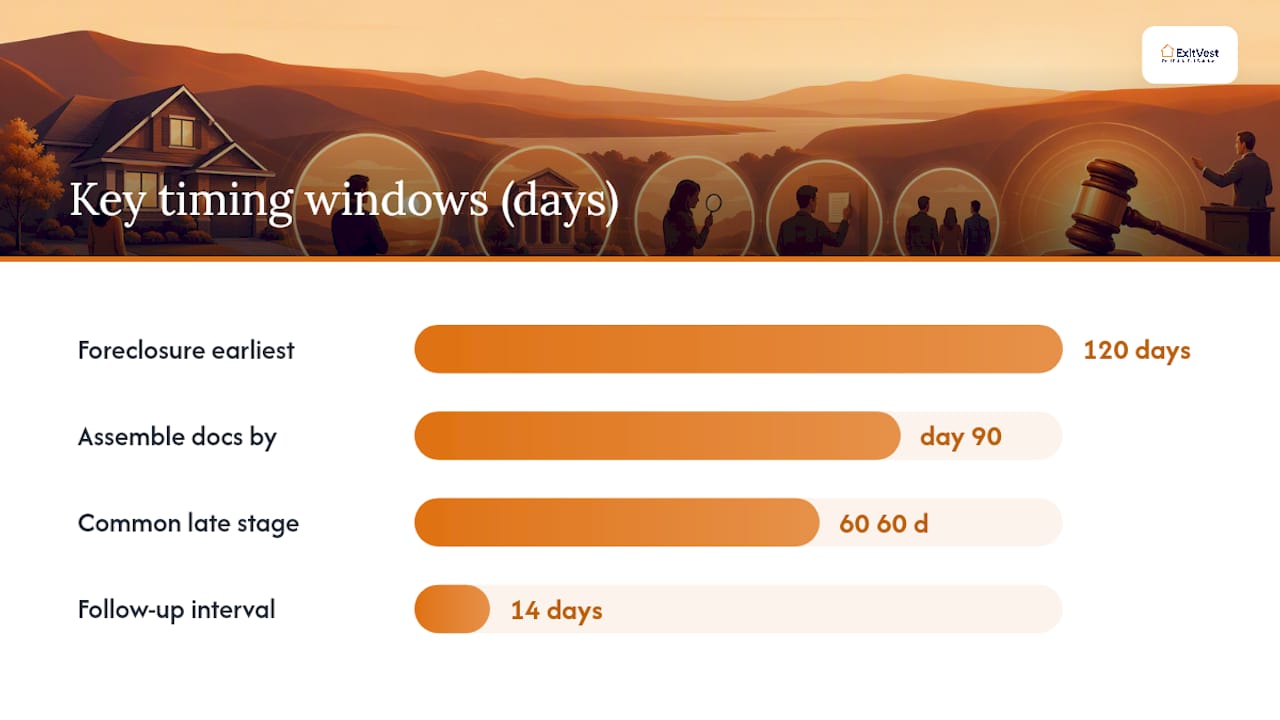
Once you submit a complete loss-mitigation application before the 120-day mark, the servicer has to evaluate it and cannot proceed with the first foreclosure filing while that review is pending. "Complete" is the operative word here. An incomplete application buys you nothing, and servicers routinely reject packages missing a single document.
Here's the sequence that gives you the best shot at using this window effectively:
- Call your servicer the day you know you'll miss a payment, not after you're already 60 or 90 days behind.
- Request the loss-mitigation application packet in writing and ask exactly what counts as "complete" for your loan type.
- Assemble your documents before day 90 so you have a buffer if something gets rejected or lost.
- Submit the application and get written confirmation it was received and marked complete.
- Follow up in writing every two weeks until you get a decision, and appeal immediately if denied.
Pro Tip: A loss-mitigation package usually needs recent pay stubs, two to three months of bank statements, a signed hardship letter explaining what changed, and your most recent tax return. Missing any one of these resets your servicer's clock and can push you past the 120-day deadline before they even start reviewing.
What Happens at the Sale and Afterward
The sale itself is an auction, typically held at the courthouse in the county where the property sits, run by the substitute trustee named in your deed of trust. The lender almost always enters a credit bid based on what you owe, and third-party bidders can outbid that number if they want the property badly enough.
- Tennessee law gives borrowers a statutory two-year redemption period under Tenn. Code Ann. §§ 66-8-101 to 66-8-103, letting you buy the property back after the sale.
- Most residential deeds of trust waive that redemption right in the fine print, so check your loan documents before assuming you have it.
- Surplus proceeds, meaning money left over after the lender and any junior lienholders are paid, do sometimes exist, but they're uncommon and you have to actively claim them.
- Eviction typically follows within weeks of the sale if you're still living in the home, often through a detainer warrant process, so plan your move before the auction date rather than after.
What to Do This Week if You're Facing Foreclosure
You have three realistic paths, and picking the right one depends on whether you want to keep the home, avoid an eviction on your record, or just get out with cash in hand.
- Call your servicer today and request your reinstatement amount and a loss-mitigation application. Read the Tennessee-specific action steps if you want a document checklist tailored to this state.
- Talk to a bankruptcy attorney if you want to keep the house. Filing before the sale date triggers an automatic stay that halts the auction, and Chapter 13 can let you cure the arrears over time.
- Get a cash offer if you'd rather sell than fight the clock. A cash buyer can often close in as little as one to two weeks, well ahead of a scheduled auction.
Why Speed and Clarity Matter More Than Anything Else
Every homeowner we talk to at Exitvest underestimates how fast the back half of this process moves once the statutory clock starts. The 120-day federal window feels slow until it's gone, then Tennessee's 20-day publication rule closes the gap in a hurry. What actually helps is documentation done early and a decision made before the trustee mails that right-to-foreclose notice, not after.
— Alek
Get a Cash Offer Before Your Sale Date Gets Set
You can get a cash offer on your house, land, or small apartment building as-is, with no repairs, no agent commissions, and a closing date built around when you actually need to be out.

The process starts with a quick look at your property and loan situation. You share basic details about the home and where things stand with your lender, and Exitvest gets back to you with a straightforward cash number, explained plainly rather than buried in fine print. Because there's no bank financing, no inspection contingencies, and no open-house delays, closing timelines can move fast when you need speed more than a market-rate sale. If you're weighing whether to keep fighting the clock or sell for cash and move on, request a no-pressure offer today and find out what your timeline could actually look like.
This article is general information, not a substitute for advice from a qualified financial advisor. Consult a qualified financial professional about your own circumstances before acting on anything here.
Sources
- Tennessee foreclosure process and laws — Nolo
- Stages of Foreclosure — Tennessee Housing Development Agency (THDA)
- 12 C.F.R. § 1024.41 — Consumer Financial Protection Bureau (Regulation X)
- Tncourts
FAQ
How long does the foreclosure process take in Tennessee?
Most Tennessee foreclosures run about 5 to 8 months from the first missed payment to the sale date, though the final stretch after the 120-day federal window closes can move in as little as a few weeks once notices are published.
How many missed payments before foreclosure starts in Tennessee?
Federal rules generally require you to be more than 120 days delinquent, roughly four missed payments, before your servicer can send the first foreclosure notice. Some servicers move immediately once that threshold passes, meaning foreclosure generally starts after missing around four payments.
What is the 120-day rule for foreclosure?
The 120-day rule comes from Regulation X (12 C.F.R. § 1024.41) and generally prohibits your mortgage servicer from making the first official foreclosure filing or notice until you're more than 120 days behind on payments. It exists to give you time to apply for a loan modification or other loss-mitigation options first.
What is the redemption period for a foreclosure in Tennessee?
Tennessee law provides a statutory two-year redemption period after a sale under Tenn. Code Ann. §§ 66-8-101 to 66-8-103, but most standard deeds of trust waive this right in the loan paperwork. Check your specific deed of trust rather than assuming you have redemption rights.
Can I sell my house instead of letting it go to foreclosure?
Yes, and selling before the sale date is often the fastest way to avoid an eviction and protect your credit. Exitvest buys Tennessee properties for cash and can move toward closing well ahead of a scheduled foreclosure auction, with current offer details available through the Cash Offer Program.