

Yes, an HOA can foreclose on your home if your CC&Rs and state law permit it. That's the short answer. The longer one is that you have real options, and the earlier you act, the more of them remain available. Your three most immediate paths are: pay or cure the debt before the sale, negotiate a repayment plan with the association, or sell the property (including to a cash buyer) if you can't afford to cure it.
The clock matters here. HOA foreclosure processes move faster in some states than others, and missing a notice deadline or ignoring a recorded lien can eliminate options that would otherwise be yours. Here's what to do in the next 48–72 hours:
- Locate and read every notice you've received. Date-stamp them and keep originals.
- Confirm the exact amount owed. Request an itemized accounting from the HOA in writing.
- Pull your CC&Rs and check your state statutes. These documents define what the HOA can and cannot do.
- Contact the HOA or its management company in writing. Email or certified mail creates a paper trail.
- Call your mortgage lender's loss-mitigation department. Your lender has a financial interest in stopping an HOA foreclosure and may intervene.
- Reach out to a real estate attorney or HUD-approved housing counselor before the next scheduled deadline.
Pro Tip: Save every piece of mail from your HOA, even envelopes. Postmarks can become critical evidence if you later challenge whether proper notice was given.
Key Takeaways
Facing HOA foreclosure, your best outcomes come from acting before the sale date: cure the debt, negotiate a repayment plan, or sell the property for cash to stop the process entirely.
| Point | Details |
|---|---|
| Act within 48–72 hours | Preserve all notices, request an itemized accounting, and contact the HOA and your lender in writing immediately. |
| State law controls your options | Super-lien rules, minimum thresholds, and redemption windows vary by state; check your statutes or consult an attorney before assuming what's available. |
| Procedural defects can stop a sale | Improper notice, unauthorized fees, and skipped CC&R steps are real defenses, but must be raised through the correct legal pathway and quickly. |
| A cash sale stops foreclosure with certainty | Selling to a cash buyer pays the HOA lien at closing, leaves no foreclosure on your credit, and can close in 7–21 days. |
| Exitvest buys as-is with active liens | Exitvest provides fast cash offers for properties facing HOA foreclosure, with no commissions and flexible closing timelines. |
Table of Contents
- What an HOA lien and foreclosure actually mean
- How state laws differ: super-liens, thresholds, and redemption rights
- Judicial vs. nonjudicial foreclosure: spotting procedural failures you can challenge
- How an HOA foreclosure affects your mortgage lender
- Common homeowner defenses and how to challenge an HOA foreclosure
- Practical options to stop or resolve an HOA foreclosure
- What to do in the next 48–72 hours: a step-by-step checklist
- Typical timelines, fees, and financial consequences
- When to hire an attorney and how to find low-cost help
- How selling to a cash buyer works and when it's the right move
- What I've seen working with distressed homeowners
- Facing a sale date? Here's how Exitvest can help
- Sources
What an HOA lien and foreclosure actually mean
An HOA lien is a legal claim recorded against your property title. Most CC&Rs create what's called an automatic or "self-executing" lien the moment assessments go unpaid, meaning the association doesn't need a court order to record it. Once recorded at the county recorder's office, the lien clouds your title and prevents a clean sale or refinance until it's paid.
From there, associations typically have two enforcement paths:
- Lawsuit for a money judgment. The HOA sues you in civil court, wins a judgment, and then converts that judgment into a lien. This route requires more time and legal expense for the association.
- Direct lien foreclosure. In states that allow it, the HOA can foreclose on its recorded assessment lien directly, either through a judicial process (court-supervised) or a nonjudicial process (trustee sale, no court required). Which path is available depends on your state's statutes and what your CC&Rs authorize.
Here's a typical escalation scenario: You miss two quarters of dues. The HOA sends a delinquency notice. After 30–60 days, it refers the account to a collection attorney. The attorney records a lien. After additional notices (required by most state statutes), the association authorizes foreclosure proceedings. By the time a notice of sale appears, you may owe two to three times the original assessment amount in attorney fees, late charges, and collection costs. The CFPB's foreclosure guidance explains the general mechanics of how lien-based foreclosures proceed and what consumer protections apply.
How state laws differ: super-liens, thresholds, and redemption rights
Not all HOA foreclosures work the same way. State law controls the most consequential variables: whether the HOA's lien can jump ahead of your mortgage, how much you must owe before foreclosure is even permitted, and whether you can reclaim your home after a sale.
Super-priority liens. About half of U.S. states have enacted super-priority HOA lien rules that allow a limited number of months of unpaid assessments to take priority over a first mortgage. The practical effect is significant: if the HOA forecloses on that super-priority portion, it can potentially extinguish the first mortgage for that capped amount. Lenders in super-lien states monitor HOA delinquencies closely and often pay the capped amount themselves to protect their security interest.
Minimum delinquency thresholds. California's Davis-Stirling Act prohibits an HOA from initiating foreclosure until the homeowner owes at least $1,800 in assessments or is at least 12 months delinquent. Many other states have similar floors, though the amounts vary.
Redemption rights. Several states give homeowners a window after the foreclosure sale to pay off the debt and reclaim the property. California provides a 90-day redemption period after certain nonjudicial HOA sales under Cal. Civ. Code § 5715. Texas provides 180 days for most HOA foreclosures and 90 days for condominiums in specific circumstances, as detailed in the Texas State Law Library's HOA foreclosure guide. These windows are real opportunities, but they require you to pay the full foreclosure sale price plus costs, not just the original debt.
Pro Tip: Your state's legislature website is the fastest free source for current statutes. Search "[your state] HOA foreclosure statute" and look for the property code or common interest community act. Bring the relevant sections to your first attorney meeting.
Key state-law questions to answer for your situation:
- Does your state have a super-priority lien rule?
- What is the minimum delinquency threshold before foreclosure is permitted?
- Is judicial or nonjudicial foreclosure the default in your state?
- Does your state provide a post-sale redemption right, and for how long?
Judicial vs. nonjudicial foreclosure: spotting procedural failures you can challenge
Whether your state uses judicial or nonjudicial foreclosure shapes both the timeline and your ability to fight back.
Judicial foreclosure requires the HOA to file a lawsuit, serve you with process, and obtain a court judgment before the property can be sold. You have the right to file an answer, raise defenses, and present evidence in court. The process is slower (often 12–24 months in contested cases) but gives you a formal forum to challenge the association's claims.
Nonjudicial foreclosure (also called a trustee sale or power-of-sale foreclosure) does not require a court. The HOA or its trustee follows a statutory notice-and-waiting process, then sells the property at auction. If you want to stop a nonjudicial sale, you typically must file a separate lawsuit to obtain a temporary restraining order before the sale date. Waiting until after the sale is usually too late.
Common procedural failures homeowners can challenge:
- Improper notice address. Notices sent to an old address or not sent by the method required by your CC&Rs or state statute can invalidate the process.
- Defective accounting. The lien amount must be accurate. Unauthorized fees, inflated attorney charges, or miscalculated interest are grounds to dispute the lien.
- Failure to follow CC&R pre-foreclosure steps. Many CC&Rs require the board to offer a payment plan or hold a hearing before authorizing foreclosure. Skipping those steps is a procedural defect.
- Insufficient waiting periods. Most states mandate specific waiting periods between notices. Compressing those timelines is a defect.
- Lack of association standing. If the HOA is not properly formed, its CC&Rs were not validly recorded, or the board lacked authority to authorize foreclosure, standing can be challenged.
In judicial states, you raise these defenses in your answer to the lawsuit. In nonjudicial states, you must file an affirmative lawsuit to stop the sale, which is why speed matters so much. The Nolo guide on HOA foreclosure defenses outlines the most common grounds and explains how courts have treated them.
How an HOA foreclosure affects your mortgage lender
Your mortgage lender is not a passive bystander. When an HOA forecloses, the outcome for your lender depends on lien priority, and that dependency often changes how the lender behaves.

In states without super-lien rules, an HOA lien is generally junior to a first mortgage. An HOA foreclosure sale in those states transfers the property subject to the existing mortgage, meaning the buyer at auction takes on your mortgage debt. That dynamic tends to suppress auction bids, since few buyers want to inherit a large mortgage, and it limits how much the HOA actually recovers.
In super-lien states, the calculus shifts. The super-priority portion of the HOA lien can be senior to the first mortgage, and a foreclosure on that portion can extinguish the mortgage for that capped amount. Lenders in those states routinely monitor HOA delinquency filings and often pay the super-priority amount themselves, sometimes without telling you, to protect their security interest. The practical result: the lender pays off the HOA's super-priority claim, the HOA's foreclosure threat is neutralized for that amount, and you still owe the lender.
What this means for you:
- Notify your mortgage lender in writing as soon as you receive an HOA foreclosure notice.
- Ask specifically whether your state has a super-lien statute and whether the lender intends to intervene.
- Get the lender's loss-mitigation department involved early. They have more leverage with the HOA than you do.
- Understand that lender intervention protects the lender's interest, not yours. You still owe the assessments and the lender may add its payment to your mortgage balance.
When an HOA forecloses and the property sells at auction, buyers often take the property subject to existing mortgage debt, which can depress auction outcomes and reduce what the HOA recovers, as outlined in consumer law guidance on HOA foreclosures.
Common homeowner defenses and how to challenge an HOA foreclosure
Procedural defenses work. Legal experts consistently note that homeowners succeed on procedural grounds, but only when those defenses are raised through the correct legal pathway and quickly enough to matter.
Common defenses:
- Improper notice. The HOA failed to send required notices by certified mail, to the correct address, or within the required timeframe.
- Accounting errors. The lien includes fees the CC&Rs don't authorize, interest calculated at the wrong rate, or charges for services not rendered.
- Unauthorized charges. Attorney fees that exceed what the CC&Rs or state statute permit are a recurring issue.
- Failure to follow CC&R procedures. The board did not offer a payment plan, hold a required hearing, or obtain the required vote before authorizing foreclosure.
- Lack of standing. The association is not properly organized, or the person who signed the lien lacked authority.
- Statute of limitations. In some states, an HOA has a limited window to enforce a lien, and old debts may be time-barred.
Evidence you need to gather:
- All notices received, with envelopes and postmarks
- Your complete payment history and bank records
- The HOA's itemized accounting statement
- A copy of the recorded CC&Rs and any amendments
- All written correspondence with the HOA or its management company
- The recorded lien document from the county recorder
Practical steps to take now:
Send a written dispute to the HOA by certified mail, identifying each charge you contest and requesting a corrected accounting. In California, Davis-Stirling Act protections give homeowners specific rights to request mediation and assert cure rights before a trustee sale. In other states, you may need to file a lawsuit to quiet title or obtain a temporary restraining order to stop a nonjudicial sale. Bankruptcy (Chapter 13) can also trigger an automatic stay that halts foreclosure proceedings, though it comes with its own costs and timeline.
Pro Tip: Send every dispute and payment offer by certified mail with return receipt requested. A signed green card is evidence the HOA received your communication, which matters if you later argue they ignored a good-faith cure attempt.
Practical options to stop or resolve an HOA foreclosure
HOA boards generally prefer repayment to foreclosure. Foreclosure is expensive for the association, time-consuming, and often doesn't fully recover the debt, especially when the property carries a large mortgage. Making an early written proposal often changes the board's approach. Here are your realistic options, roughly in order of least to most disruptive:
Pay in full or cure the debt. The cleanest resolution. If you can pay the full amount owed (including attorney fees and collection costs), the lien is released and the foreclosure stops. Best for homeowners who have access to funds or can borrow against other assets. Credit impact: minimal if resolved before a judgment. Time to resolution: immediate.
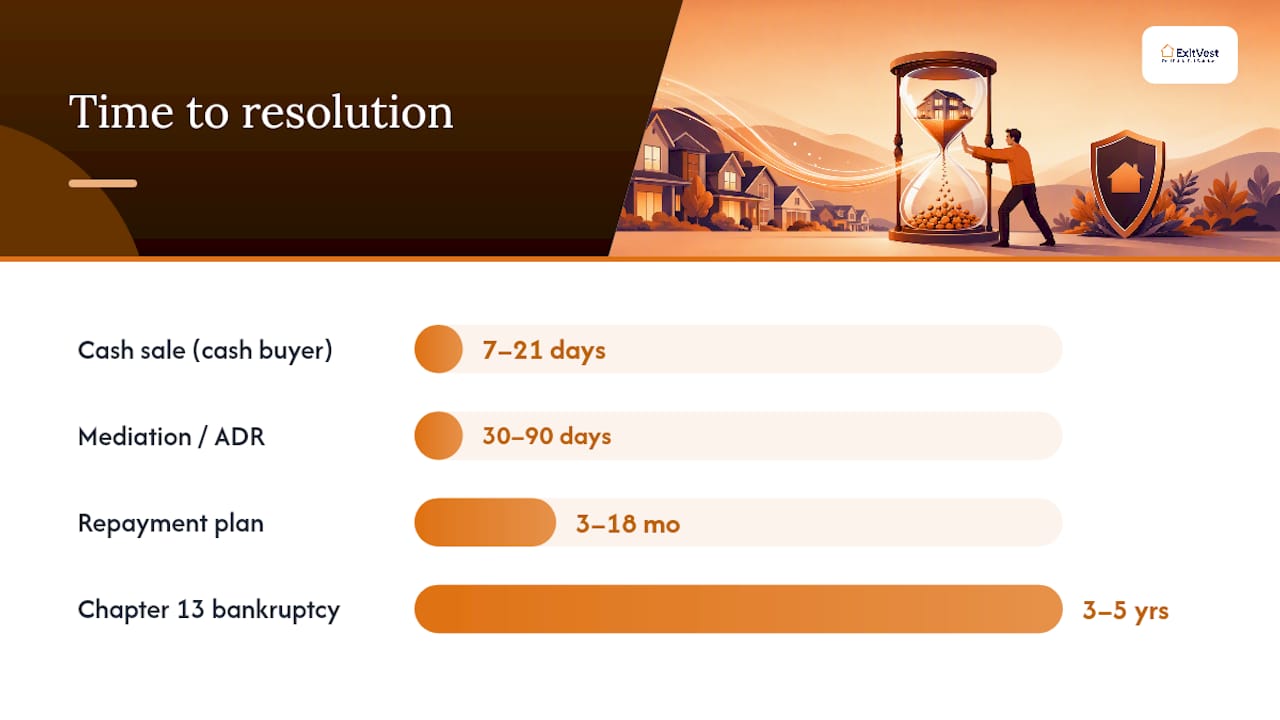
Negotiate a repayment plan. Most HOAs will accept a written repayment agreement if you approach them before the sale is scheduled. Propose a realistic monthly amount above your regular assessment to pay down the arrears. Best for homeowners with steady income who fell behind temporarily. Credit impact: depends on whether the HOA has already reported to a collection agency. Time to resolution: 3–18 months depending on the balance.
Mediation or ADR. Some states require or encourage mediation before foreclosure. California's Davis-Stirling Act specifically provides for this. Mediation is faster and cheaper than litigation and often produces a workable repayment agreement. Best for homeowners in states with mandatory ADR provisions. Time to resolution: 30–90 days.
Sell the property (traditional or cash sale). If you have equity, selling stops the foreclosure, pays off the HOA lien and mortgage at closing, and puts any remaining proceeds in your pocket. A traditional listing takes time you may not have. A cash sale to a buyer like Exitvest can close in days or weeks, which matters when a sale date is approaching. Best for homeowners who cannot cure the debt and want to preserve equity. Credit impact: no foreclosure on record. Time to resolution: as fast as 7–21 days with a cash buyer.
Deed in lieu of foreclosure. You voluntarily transfer the property to the lender (not the HOA) in exchange for release of the mortgage debt. The HOA lien still needs to be resolved separately. Best for homeowners with little equity who want to avoid a foreclosure record. Credit impact: significant but less severe than a completed foreclosure.
Chapter 13 bankruptcy. Filing triggers an automatic stay that immediately halts all collection actions, including HOA foreclosure. Chapter 13 allows you to propose a repayment plan over 3–5 years to catch up on arrears. Best for homeowners with regular income who need time to reorganize debt. Credit impact: serious and long-lasting (7–10 years on credit report). Time to resolution: 3–5 years.
Wait for redemption after the sale. If your state provides a statutory redemption period (California: 90 days; Texas: 180 days for most HOA sales), you can reclaim the property after the auction by paying the full sale price plus costs. This is a last resort and requires significant cash. Best for homeowners who expect a windfall or asset liquidation within the redemption window.
| Option | Best For | Time to Resolution | Credit Impact | Likelihood of Stopping Sale |
|---|---|---|---|---|
| Pay in full | Homeowners with available funds | Immediate | Minimal | Certain |
| Repayment plan | Steady income, temporary hardship | 3–18 months | Moderate | High if agreed before sale |
| Mediation/ADR | States with ADR requirements | 30–90 days | Low to moderate | High |
| Cash sale | Equity exists, time is short | 7–21 days | None (no foreclosure record) | Certain |
| Chapter 13 bankruptcy | Regular income, large debt | 3–5 years | Severe | High (automatic stay) |
| Post-sale redemption | Expects funds within redemption window | 90–180 days | Foreclosure already recorded | N/A (post-sale) |
What to do in the next 48–72 hours: a step-by-step checklist
- Gather and preserve every notice. Collect all mail from the HOA, its management company, and any collection attorney. Keep envelopes. Photograph them with your phone for a timestamped backup.
- Request an itemized accounting in writing. Send a certified letter to the HOA or management company asking for a complete breakdown of every charge, fee, and interest amount on the account.
- Confirm the recorded lien. Search your county recorder's website (most are free) for your property address. Download and save a copy of the recorded lien document.
- Contact the HOA or management company in writing. State that you are aware of the situation, that you are seeking to resolve it, and that you request a payment plan or meeting. Certified mail only.
- Call your mortgage lender's loss-mitigation department. Tell them an HOA foreclosure notice has been issued. Ask whether your state has a super-lien statute and whether the lender plans to intervene.
- Document the property's condition. If the HOA claims code violations or maintenance issues as part of the dispute, photograph every area of the property with date-stamped images.
- Contact a real estate attorney or HUD-approved housing counselor. Many offer free or low-cost initial consultations. Bring every document you've gathered. You can find HUD-approved counselors at hud.gov.
- If selling quickly is on the table, contact Exitvest. Exitvest buys properties as-is, including those with active HOA liens, and can provide a cash offer fast enough to matter before a scheduled sale date. You can explore your situation with Exitvest to see whether a cash sale fits your circumstances.
Document preservation tip: Request your certified mail tracking records from USPS and save them alongside your green cards. If the HOA claims it sent required notices, your own certified mail records showing when you sent disputes can establish a timeline.
Typical timelines, fees, and financial consequences
HOA foreclosure is rarely fast, but it's faster than most homeowners expect. Here's a general timeline for both paths:
Judicial foreclosure (court-supervised):
- Notice of delinquency and demand letter: Month 1
- Lien recorded at county recorder: Month 1–3
- Lawsuit filed and served: Month 2–6
- Court judgment obtained: Month 6–18 (contested cases longer)
- Notice of sale and auction: Month 18–24+
Nonjudicial foreclosure (trustee sale):
- Notice of delinquency: Month 1
- Lien recorded: Month 1–3
- Notice of default issued: Month 3–6
- Statutory waiting period before sale: 30–120 days depending on state
- Trustee sale/auction: Month 4–9
The CFPB's foreclosure overview explains how these timelines interact with consumer protections and lender obligations.
Costs that compound quickly:
- Unpaid assessments (the original debt)
- Late fees (often 10–18% annually per CC&Rs)
- Collection agency fees
- HOA attorney fees (often $2,000–$8,000 or more by the time of sale)
- Trustee fees (nonjudicial states)
- Court filing costs (judicial states)
- Redemption costs (full auction price plus costs, if you exercise redemption)
State-specific thresholds to know:
California's Davis-Stirling Act requires a minimum of $1,800 in unpaid assessments or 12 months of delinquency before foreclosure can begin. California also provides a 90-day redemption window after certain nonjudicial HOA sales.
Texas law, detailed in the Texas State Law Library's HOA foreclosure guide and the Texas Property Code Chapter 209, provides a 180-day redemption period for most planned community HOA foreclosures and 90 days for condominiums.
The right of redemption after HOA foreclosure is a genuine safety net in states that provide it, but it requires paying the full auction price, not just the original debt.
When to hire an attorney and how to find low-cost help
Some situations call for legal help immediately. Others give you a few weeks to find the right resource. Here's how to tell the difference.
Get an attorney now if:
- A sale date has been scheduled or a notice of trustee sale has been issued
- The accounting includes charges you don't recognize and the HOA won't correct them
- The association skipped required pre-foreclosure procedures (no hearing, no payment plan offer)
- Your state has a super-lien statute and your mortgage could be affected
- You've received a lawsuit and need to file an answer within a court deadline
What to bring to your first consultation:
- All HOA notices and correspondence (originals and copies)
- The recorded lien document from the county recorder
- Your CC&Rs and any amendments
- Your complete payment history and bank records
- The HOA's itemized accounting statement
- Your mortgage statement
Questions to ask:
- Does my state use judicial or nonjudicial foreclosure for HOA liens?
- Are there procedural defects in the notices I've received?
- What is the realistic cost and timeline to challenge this?
- Is a repayment plan or mediation more practical than litigation?
- Does my state's super-lien statute affect my mortgage?
Where to find low-cost or free help:
- HUD-approved housing counselors: Free, available at hud.gov, and experienced with foreclosure situations
- Local legal aid organizations: Income-qualified homeowners can often get free representation
- State bar association lawyer referral services: Many offer a free or low-cost initial consultation
- Law school clinics: Several law schools operate housing clinics that take real cases
- Limited-scope representation: Some attorneys will review documents or draft a single letter for a flat fee, rather than full representation
How selling to a cash buyer works and when it's the right move
Selling to a cash buyer is not giving up. For many homeowners facing HOA foreclosure, it's the most financially rational decision available, especially when the debt has compounded beyond what a repayment plan can realistically address or when a sale date is weeks away.
Here's how the process works:
- Initial inquiry and offer. You contact the cash buyer (like Exitvest), describe the property and situation, and receive a no-obligation cash offer, typically within 24–48 hours. No repairs, no staging, no open houses.
- Title and lien review. The buyer's title company pulls a title search, identifies all recorded liens (including the HOA lien and your mortgage), and confirms what needs to be paid at closing.
- Escrow and closing. The HOA lien, mortgage balance, and any other encumbrances are paid directly from the sale proceeds at closing. You receive whatever equity remains. Closings with cash buyers often happen in 7–21 days, compared to 30–60 days or more for a traditional sale.
- Lien payoff and title transfer. The HOA receives its full payoff at closing, the lien is released, and title transfers clean. The foreclosure process stops because the debt is paid.
Pros of a cash sale:
- Stops the foreclosure with certainty
- No agent commissions or repair costs
- Flexible closing timeline you control
- No foreclosure record on your credit
- Eliminates all future HOA exposure on that property
Cons to weigh honestly:
- Net proceeds will likely be lower than a retail sale on the open market
- You give up any future appreciation on the property
- If you have significant equity, a traditional sale (even on a compressed timeline) might net more
A cash sale tends to be the right move when: the sale date is close, the debt has grown too large to cure, you've exhausted negotiation options, or the property has deferred maintenance that would complicate a traditional listing. If you're weighing whether to sell a house already in foreclosure, the key question is whether your equity exceeds the total debt. If it does, selling is almost always better than letting the auction happen.
Documents to prepare before calling a cash buyer:
- Most recent HOA statement showing the amount owed
- Recorded lien document from the county recorder
- Most recent mortgage statement
- Any notice of sale or trustee sale notice you've received
- Property deed or title information
What I've seen working with distressed homeowners
Most homeowners who contact us are not in crisis because they stopped caring about their home. They're in crisis because something went wrong: a job loss, a medical bill, a divorce, a death in the family. The HOA debt is usually the smallest number on the page by the time we talk, buried under attorney fees and collection costs that tripled the original balance.
What I've noticed is that the homeowners who come out best are the ones who treat selling as a real option early, not a last resort. Waiting for a repayment plan that never gets approved, or hoping the lender will intervene, or assuming the sale will be postponed, costs weeks that can't be recovered. A cash sale isn't a failure. It's a decision to take control of the outcome rather than let the auction decide it for you.
Selling with HOA violations or an active lien is entirely possible. The lien gets paid at closing. The violations don't transfer to you. You walk away with whatever equity remains, and the foreclosure never appears on your credit report. That's a better outcome than most homeowners expect when they first call us.
Facing a sale date? Here's how Exitvest can help
When the foreclosure clock is running, the last thing you need is a process that takes months. Exitvest buys houses, land, and small apartment buildings directly from homeowners for cash, as-is, with no agent commissions and no repair requirements. We work specifically with homeowners in difficult situations: active HOA liens, code violations, deferred maintenance, and properties that wouldn't survive a traditional listing.

Getting a cash offer from Exitvest takes 24–48 hours. If the offer works for you, we handle the title review, coordinate with the HOA to confirm the payoff amount, and close on a timeline that fits your situation, sometimes in as little as a week. The HOA lien is paid directly at closing, the foreclosure stops, and you receive whatever equity remains after all payoffs. No commissions, no agent fees, no open houses.
To move quickly, have your HOA lien statement, most recent mortgage statement, and any notice of sale ready when you reach out. You can get a cash offer and see how it works or learn more about the situations Exitvest handles. We serve homeowners nationwide, with strong operations in New Jersey, Texas, Florida, and Tennessee.
Sources
These are the primary sources that back the legal points in this article. Bring the relevant ones to your attorney consultation.
Statutory references:
- HOA Foreclosure When Mortgage Is Current
- HOA Foreclosures - Texas State Law Library
- California Civil Code (Davis-Stirling Act) - statutes overview
- How does foreclosure work? - CFPB
Consumer and legal guides:
How to use these sources:
Start with your state's statute to confirm the minimum delinquency threshold and notice requirements. Cross-reference with the Nolo guides to understand how courts have interpreted those rules. Bring printed copies of the relevant statutory sections to your attorney consultation. If you're in California or Texas, the state-specific resources above are the most directly applicable.
This article provides general information about HOA foreclosure options and is not a substitute for legal advice. Laws vary significantly by state, and your specific situation may involve rights and deadlines not covered here. Consult a licensed real estate attorney or HUD-approved housing counselor to confirm the rules that apply to your case.