

A clouded title is a recorded legal encumbrance or claim that raises serious doubt about who actually owns a piece of New Jersey real estate. For any clouded title property buyer in NJ, that uncertainty isn't just a paperwork annoyance. It can block financing, delay or kill a sale, and in some cases leave you personally liable for debts you never agreed to take on.
Here's what a cloud on title typically looks like in practice:
- Undischarged mortgages: A prior loan was paid off, but no formal discharge was ever recorded, so the lien still appears active in public records.
- Mechanic's liens: A contractor filed a construction lien for unpaid work. Under New Jersey's Construction Lien Law, contractors have 90 days on residential properties to file.
- Judgment liens: A court judgment against a prior owner automatically attaches to every property that person owns statewide, and stays active for 20 years.
- Tax liens and tax sale certificates: Unpaid property taxes can result in the municipality selling a tax sale certificate, which must be redeemed to clear the title.
- Ownership disputes and forged deeds: A forged deed is void from inception and transfers nothing, yet it still sits in public records creating a cloud that only a court can remove.
- Lis pendens: A notice of pending litigation filed against the property freezes most transactions until the lawsuit resolves.
New Jersey follows the principle of caveat emptor. Under that rule, liens attach to the land, not the person, so a buyer who closes without clearing these clouds can inherit the seller's debts outright.
What causes a clouded title in New Jersey?
Title clouds in New Jersey come from a wider range of sources than most buyers expect. Some are obvious; others hide in decades-old records.
- Unpaid mortgages never formally discharged: The loan was paid, but the lender never filed a satisfaction piece with the county clerk.
- Mechanic's and contractor liens: Unpaid subcontractors or suppliers file liens that run with the property.
- Civil judgment liens: Any judgment entered against a property owner in any New Jersey county becomes a statewide lien on all their real estate.
- Federal and state tax liens: The IRS can place a federal tax lien that attaches to all property and doesn't expire automatically for 10 years after assessment.
- Child support liens: New Jersey treats unpaid child support as a lien against real estate.
- Errors in deeds or recordings: Wrong parcel numbers, misspelled names, or missing signatures break the chain of title.
- Inherited defects from prior transfers: A sale, divorce, or inheritance handled years ago with incomplete documentation can leave gaps that surface only during a title search.
- Forged or fraudulent deeds: Identity theft has made forged deeds more common. Because a forged deed is void, the true owner's claim survives intact in the background.
- Lis pendens filings: Any pending lawsuit affecting ownership gets recorded and effectively freezes the property.
- Tideland claims: In coastal and marshy areas, the State of New Jersey may hold a claim to land based on historical waterways.
Knowing these sources helps you ask the right questions before you ever make an offer.
How a clouded title affects ownership and transactions in NJ
The practical consequences of buying properties with clouded title in New Jersey are severe and immediate.
- No traditional financing: Lenders won't issue a mortgage against a property with unresolved title clouds. If you need a bank loan, a clouded title stops the deal cold.
- Sale and refinancing delays: Even a minor cloud discovered mid-transaction can push closing back weeks or kill the deal entirely.
- Inherited liability: Because liens follow the land under New Jersey law, a buyer who closes without clearing a judgment or construction lien becomes responsible for that debt.
- Reduced market value: Properties with title uncertainties sell at a discount, if they sell at all, because buyers price in the legal risk.
- Estate complications: A cloud you ignore today forces your heirs to resolve it after your death, often at greater cost and complexity.
Sellers in New Jersey are legally required to deliver clear and marketable title at closing. If they can't, buyers have the right to cancel, delay funding, or refuse to close.
How to identify a clouded title before buying property in New Jersey
New Jersey's decentralized land records make a thorough title search harder here than in most states. Searching by address alone is not enough.
- Get a professional title search: A licensed title company or real estate attorney examines county land records, tracing deeds, mortgages, liens, easements, and judgments back at least 60 years.
- Use Block and Lot numbers: Never rely on a street address. Use the municipality's tax map to find the specific Block and Lot numbers, then search the Grantor/Grantee index by those identifiers.
- Run a statewide judgment search in Trenton: Civil judgments attach statewide, so a clean county record doesn't mean the property is clear. A separate search of Superior Court records in Trenton is required.
- Verify every mortgage discharge: If a mortgage was recorded in 2010, confirm a corresponding discharge or satisfaction piece was also recorded. No discharge means the lien is legally active.
- Check for lis pendens: Look for any notice of pending legal action, which signals a foreclosure or ownership dispute in progress.
- Review the title commitment and exceptions list: The exceptions list in a title commitment is a direct inventory of every unresolved cloud. Treat each exception as a problem that needs a resolution plan before closing.
- Order a survey: A current survey reveals boundary issues, encroachments, and easements that don't always appear in written records.
Pro Tip: Industry experts warn that ignoring exceptions listed in a title commitment leads to costly post-closing problems. Read every line of that exceptions list with your attorney before you sign anything.

Steps to clear a clouded title in New Jersey
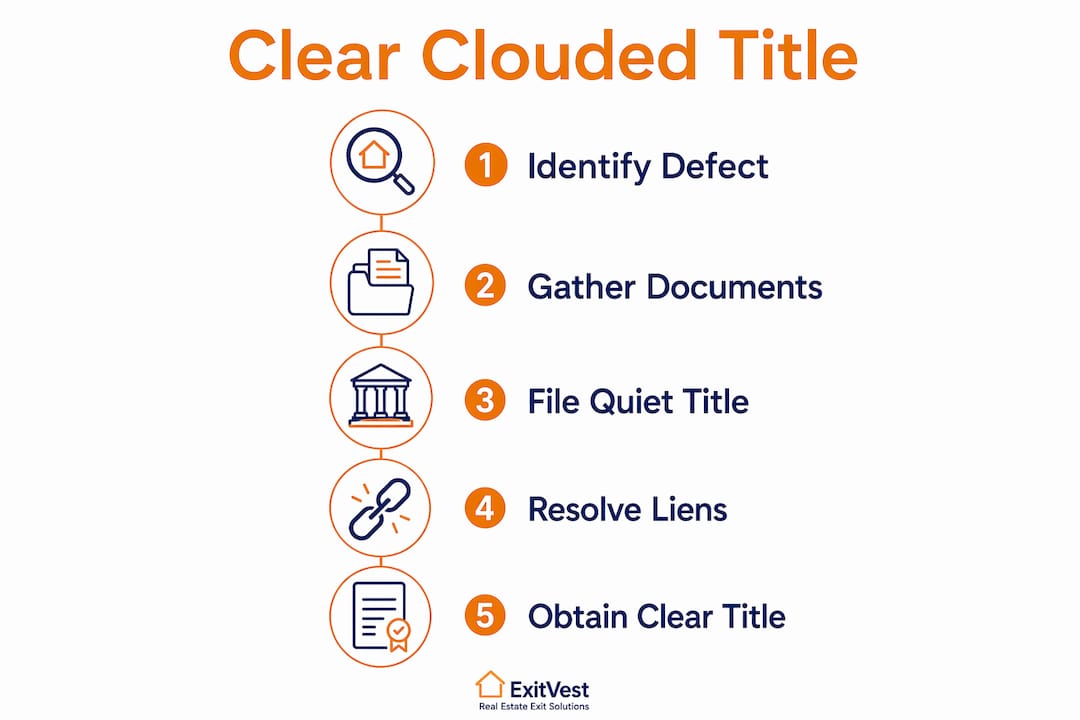
Clearing clouded title real estate in NJ follows a logical sequence, starting with the simplest fix and escalating to litigation only when necessary.
- Obtain corrective documents first: A quitclaim deed works when someone needs to formally release a claim. A lien release works when a debt has been paid. Both must be notarized and recorded with the county clerk.
- Resolve liens at closing using seller proceeds: When a seller has an active lien, a title agent can pay it off at closing directly from the seller's proceeds, so the buyer receives clear title without the seller needing to act beforehand.
- File a quiet title action when cooperative fixes aren't possible: If a lender is defunct, a party can't be located, or competing claims exist with no clear resolution, a quiet title lawsuit filed in New Jersey Superior Court is the definitive remedy.
- Name all parties with potential claims: The petition must identify every person or entity that could assert an interest in the property.
- Serve defendants, including by publication: If parties can't be found, New Jersey courts allow service by publication, essentially running a legal notice in a newspaper.
- Obtain and record the court decree: Once the judge rules, the decree is recorded in the land records, permanently extinguishing the competing claims.
- Run an updated title search after resolution: Confirm the public record reflects the fix before requesting title insurance. An improperly indexed correction can leave the original cloud visible to future searchers.
For tax-related clouds specifically, the process for selling with back taxes in New Jersey follows its own set of steps worth reviewing separately.
What happens during a New Jersey quiet title action
A quiet title action is a formal civil lawsuit, not an administrative process. Understanding the steps helps you set realistic expectations.
- Filing the complaint: Your attorney files a petition in New Jersey Superior Court naming every party with a potential claim as a defendant.
- Service of process: Each defendant must be formally served. For missing or unknown parties, the court permits service by publication in a local newspaper.
- Default judgment for non-responding parties: If a defendant doesn't respond within the required period, the court can enter a default judgment extinguishing their claim.
- Hearing for contested cases: When defendants actively dispute the claim, the case proceeds to a hearing where both sides present evidence and arguments.
- Judge's decree: The judge issues a ruling declaring the rightful owner and extinguishing all competing claims. That decree is then recorded in the county land records.
- Timeline: Uncontested cases typically resolve in 4–6 months from filing. Contested cases involving missing heirs or competing ownership claims can take a year or longer.
- Costs: Court filing fees generally run a few hundred dollars. Attorney fees for an uncontested action typically range from a few thousand dollars, not counting service costs. Contested cases cost considerably more.
The recorded decree serves as a permanent, judicially confirmed resolution. It's the most definitive outcome available for a title dispute.
How title insurance protects New Jersey buyers against title risks
Title insurance is the financial safety net for NJ title issues for buyers, but it works differently than most people assume.
- Owner's policy vs. lender's policy: Lender's title insurance is required in New Jersey to protect the bank's interest. An owner's policy is separate and protects you, the buyer, from past liens or clouds.
- What owner's insurance covers: Hidden defects such as forged deeds, undisclosed heirs, recording errors, and fraud are covered under a standard owner's policy. These are the clouds that a title search can miss entirely.
- What it doesn't cover: Known clouds are excluded. If the title commitment lists an exception and you close anyway without resolving it, your policy won't cover that specific issue.
- One-time premium, lifetime coverage: The owner's premium is paid once at closing and the policy lasts as long as you or your heirs hold any interest in the property.
- It doesn't fix the cloud: Title insurance compensates you financially if a covered claim arises. It doesn't remove the cloud from public records. Clearing the cloud still requires the corrective steps described above.
- Lender's policy duration: The lender's policy shrinks as the mortgage is paid down and disappears when the loan is paid off. If you refinance, you need a new lender's policy.
Skipping an owner's policy to save money at closing is a gamble that looks fine until a forged deed or undisclosed heir surfaces years later.
How Exitvest helps New Jersey sellers with clouded title properties
Sellers facing properties with title problems in NJ often feel stuck between an expensive legal process and a deal that won't close. Exitvest works directly with property owners in exactly these situations.

- Exitvest buys properties as-is: Sellers don't need to clear title defects, make repairs, or navigate a quiet title action before selling. Exitvest handles the complexity on the back end.
- Cash offers with flexible closing timelines: Because Exitvest doesn't rely on traditional bank financing, a clouded title doesn't automatically kill the deal the way it would with a conventional buyer.
- Experience with legally complicated properties: Exitvest works with sellers facing foreclosure, inherited property disputes, judgment liens, and other title challenges across New Jersey.
- No pressure, no drawn-out process: Instead of months of litigation and uncertainty, sellers get a straightforward cash offer and a closing timeline that fits their situation.
- Strong New Jersey focus: Exitvest understands the specific quirks of NJ's decentralized recording system, statewide judgment liens, and local title practice.
If you're holding a property with a clouded title and want to avoid a costly legal battle, explore your options with Exitvest directly. Getting a cash offer costs nothing and takes the guesswork out of what happens next.
Pro Tip: If you've inherited a property with an unclear chain of title, contact Exitvest before spending money on litigation. A direct cash sale may resolve your situation faster and at lower cost than a quiet title action.
Key Takeaways
Clearing a clouded title in New Jersey requires identifying the specific defect, pursuing corrective documents or a quiet title action, and confirming the fix with an updated title search before closing.
| Point | Details |
|---|---|
| Liens follow the land in NJ | Under caveat emptor, buyers inherit unresolved liens and judgments attached to the property at closing. |
| NJ title searches require two steps | County land records plus a statewide judgment search in Trenton are both required for a complete search. |
| Quiet title timeline | Uncontested quiet title actions typically resolve in 4–6 months; contested cases take longer and cost more. |
| Owner's title insurance covers hidden defects | Forged deeds, undisclosed heirs, and recording errors are covered; known exceptions listed in the commitment are not. |
| Exitvest buys clouded title properties as-is | Sellers can avoid litigation and close quickly with a cash offer, without clearing title defects first. |