
If you need cash fast or can't front repair money, selling as-is usually wins. If you have time, cash reserves, and a house with high-ROI problems (bad paint, dead curb appeal, a failing roof), repairing first typically nets more. The gap between those two paths comes down to a simple trade: price versus time, and Exitvest exists for sellers who'd rather skip that gamble entirely.
TL;DR:
- Selling as-is is typically preferable when immediate cash needs or severe property issues make repairs costly and unlikely to add enough value to justify the upfront expense.
- Homes requiring FHA-mandated repairs often face a smaller buyer pool, as buyers needing FHA financing will expect fixes before closing, reducing market options.
- Repair projects like painting, roofing, and curb appeal tend to offer the best return on investment, while high-end remodels rarely recoup their costs.
- If estimated repair costs eat up a third or more of the potential value increase, or if net proceeds after repairs are less than a $10,000 gain, selling as-is usually makes better financial sense.
- Exitvest offers a straightforward cash purchase option that bypasses repair and financing hurdles, making it a fast solution for distressed, inherited, or foreclosure properties.
Table of Contents
- As-Is vs Repairs: The Real Trade-Offs
- What's the Real Discount for Selling a House As-Is?
- How Does FHA Financing Limit Your Buyer Pool?
- Which Repairs Actually Pay You Back?
- A Quick Checklist to Decide As-Is vs Repairs
- How Exitvest Approaches As-Is Sales
- The Math Usually Beats the Instinct
- Sell As-Is Without the Repair Gamble
- Sources
- FAQ
As-Is vs Repairs: The Real Trade-Offs
Selling as-is means listing your house exactly how it stands and letting the buyer absorb the risk and the fix-up costs. Repairing first means you spend money and time now, hoping the market pays you back at closing. Neither is automatically smarter. It depends on your cash position, your timeline, and what's actually wrong with the house.
Selling as-is works in your favor when:
- You need to close in weeks, not months.
- You don't have cash to front repairs, or don't want to take on contractor risk.
- The property has serious issues (foundation, mold, major electrical) that would cost more to fix than they'd add in value.
- You're managing an estate, a foreclosure, or a property with tenant problems and just want it gone.
The downside: as-is listings pull a smaller buyer pool, since many financed buyers can't get approved on a property that fails minimum lending standards. Inspection reports also tend to become a negotiating weapon. Buyers who do bite often expect a discount, and inspection findings frequently trigger a renegotiation or a walked deal once the report lands.
Repairing first works in your favor when:
- The fixes are cosmetic or high-utility (paint, flooring, curb appeal) rather than structural.
- Your market has tight inventory, so a move-in-ready home stands out and commands a premium.
- You have the cash or credit to cover repairs without straining your timeline.
The downside: repairs cost money upfront, contractors run late, and every month the house sits under renovation is a month you're paying the mortgage, insurance, and taxes on a property you're not living in.
Think of it this way: an inherited house nobody wants to manage usually points toward as-is. A foreclosure with a hard deadline points toward as-is. A house that just needs fresh paint and a decluttered yard before a hot spring market? That one probably deserves the repair route.
What's the Real Discount for Selling a House As-Is?
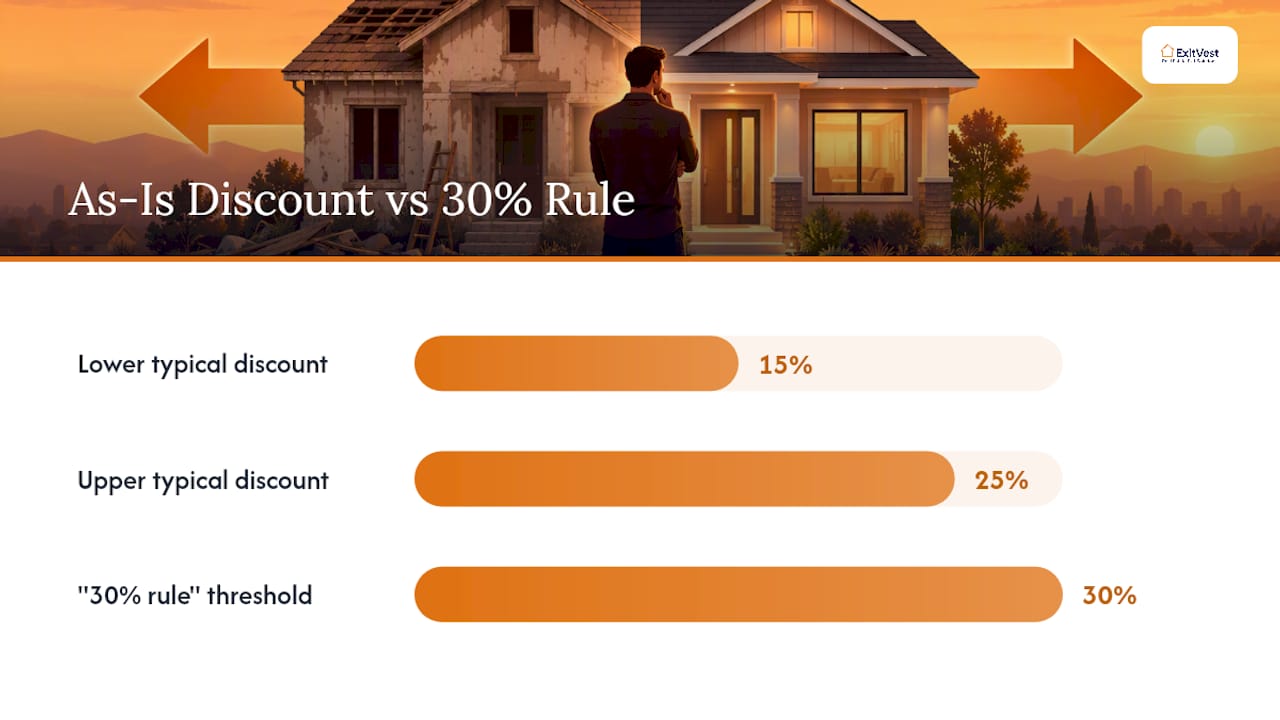
As-is properties typically sell for 15% to 25% less than comparable move-in-ready homes, though that range shifts with the market.
Here's how to run the math yourself:
- Estimate your after-repair sale price using recent comps of updated homes in your area.
- Subtract realistic repair costs, including a buffer for surprises (add 15% to whatever your contractor quotes).
- Subtract carrying costs for every month the repairs and re-listing take (mortgage, taxes, insurance, utilities).
- Compare that number to a real as-is cash offer.
Statistic Callout: As-is discounts commonly run 15% to 25% below move-in-ready comps, which is exactly why repair math has to include carrying costs, not just materials and labor.
A rough threshold worth using: if the projected net gain after all those subtractions is under $5,000 to $10,000, repairs usually aren't worth the stress. That's the logic behind the informal "30% rule," which says that if estimated repair costs eat up roughly a third or more of a project's expected added value, selling as-is is often the better call. It's a useful gut check, but it breaks down on properties where repairs are mandatory for financing rather than optional for value, which is where appraisal rules come in.
How Does FHA Financing Limit Your Buyer Pool?
FHA-backed loans require a property to pass what appraisers call the three S's: safety, security, and soundness. That standard, laid out in HUD's appraisal guidance, means a house with exposed wiring, a leaking roof, or missing handrails can fail appraisal outright, and the buyer's loan won't close until it's fixed.
That single rule quietly shrinks your buyer pool. Every FHA buyer who wants your house now needs the seller to fix the issue, or the deal collapses before closing. Cash buyers and conventional buyers with larger down payments aren't bound by the same restrictions, which is part of why distressed properties skew toward cash sales.
If repairs are required, HUD's handbook lists a few paths to get the loan across the finish line without a full renovation:
- An escrow holdback, where repair funds are set aside and released once work is done.
- A compliance inspection confirming the fix meets minimum standards.
- A mortgagee certification from the lender accepting an alternate resolution.
Pro Tip: Get a pre-listing inspection or a quick chat with an appraiser before you set your price. If your house can't clear FHA standards as-is, you'll know exactly which buyers to expect, and you can price accordingly instead of getting surprised at the appraisal stage.
Which Repairs Actually Pay You Back?
Not every fix is worth the money. Realtors® consistently point to painting, roofing (if it's failing), and entry or garage door replacement as the projects with the most reliable payback.
Before you spend a dollar, sort your to-do list into three buckets:
- High ROI, do these first: fresh interior paint, a new garage or entry door, basic landscaping and curb cleanup, and roof repair if it's actively failing.
- Inspection killers, fix or disclose: termite damage, major electrical faults, plumbing leaks, and any structural cracking. These tend to derail deals if ignored.
- Skip unless comps demand it: a full high-end kitchen or bathroom remodel. Full-scale remodels usually recoup less than they cost, and few buyers will pay dollar-for-dollar for someone else's design choices.
If your budget is limited, sequence it: safety and structural issues first, curb appeal second, visible cosmetic touches last. A cheap door swap from a service like One Day Doors & Closets can do more for a buyer's first impression than a new backsplash ever will.
A Quick Checklist to Decide As-Is vs Repairs
Run through these five questions before you commit to either path:
- How much time do you actually have? If you need to close inside 30 to 45 days, repairs probably aren't realistic.
- Do you have cash on hand for repairs, or would you need a loan or credit card to fund them?
- How severe are the defects? Cosmetic issues favor repairing; structural or systems failures often favor as-is.
- What do local comps show? Pull a quick comparative market analysis (CMA) from an agent to see what move-in-ready homes are actually fetching right now.
- Run the net-proceeds comparison: after-repair sale price, minus repair costs, minus carrying costs, versus a real as-is cash offer on the table.
If the math is close, talk to two people fast: an agent for a CMA, and a cash buyer for a firm as-is number. When you're dealing with major unknown remediation, an urgent liquidity need, or a multi-heir estate where everyone needs to agree and move on, a cash sale without repairs is usually the more rational choice, not just the faster one.
How Exitvest Approaches As-Is Sales
A company buys houses, land, and small apartment buildings directly from owners, in as-is condition, no exceptions required. That includes foreclosure situations, inherited property nobody wants to manage, vacant homes, code violations, liens, and properties with problem tenants still in place.
Most sellers who land here fit a pattern: an heir who lives out of state and doesn't want to coordinate contractors, a landlord tired of a tenant situation, or a homeowner behind on payments who needs certainty more than a maximum price. In each case, the as-is sale process skips the inspection negotiation entirely, because there's no repair contingency to negotiate.
Before you decide, run the net-proceeds math from the checklist above. Compare a real as-is offer against what a repair-and-list strategy would actually net after costs and carrying time, then choose with real numbers instead of a guess.
The Math Usually Beats the Instinct
Most sellers decide emotionally first and justify it with numbers later. That's backwards, and it's the biggest thing conventional advice gets wrong: articles love to say "repairs add value" without mentioning that carrying costs and contractor delays can erase that value before you ever list.
The NAR Remodeling Impact Report and HUD's appraisal standards agree on something most sellers miss: the projects that pay back reliably are cheap, visible, and fast. Paint, doors, and curb appeal. The projects sellers get excited about, full kitchen overhauls, luxury bathroom remodels, are the ones most likely to underperform relative to their cost.
If you take one thing from this, take the checklist, not the emotion. Run your actual numbers: repair cost, carrying cost, projected sale price, against a real as-is offer. The seller who does that math before falling in love with a renovation plan almost always makes the better call, whether that call is to repair or to walk away as-is.
— Alek
Sell As-Is Without the Repair Gamble
Exitvest is the direct alternative to the repair-and-list gamble: no contractor bids, no financing contingencies, no waiting on a buyer's FHA appraisal to clear. If your house has real problems, a tenant you'd rather not deal with, or an inheritance situation with too many moving parts, a cash offer with no commissions or agent fees is often the faster path to actually being done.

Getting started is simple: request a cash offer through Exitvest's main site and expect a straightforward number, not a lowball opener buried in fine print. If your timeline is being driven by foreclosure, the Cash Offer Program is built specifically for that pressure, with flexible closing dates once you're ready to move. Either way, you'll know your options before you spend a dollar on repairs you didn't need to make.
Sources
- 12 remodeling projects that offer the best value at resale — NAR
- APPENDIX D: Valuation protocol — HUD
- Is Selling Your House As-Is Worth It? Repair ROI vs. As-Is Discounts — EffectiveAgents
- What to Fix Before Selling Your House — Prioritized by ROI (2026)
FAQ
Is It Better to Sell Your Home As-Is or Fix It Up?
It depends on your timeline and cash position. If you need speed or can't fund repairs, selling as-is usually makes more sense; if you have time and the defects are cosmetic, repairing high-ROI items first tends to net more money.
How Much Less Does an As-Is House Sell For?
As-is homes typically sell for 15% to 25% less than comparable move-in-ready properties, though the gap narrows in hot markets and widens when defects are severe. Local comps and buyer demand ultimately decide where in that range your house falls.
Is It Wise to Sell a House As-Is?
It's a wise choice when repair costs, financing constraints, or your timeline make renovation impractical, particularly for inherited, distressed, or foreclosure properties. A direct cash sale through a company like Exitvest can also make sense when the buyer pool for a repaired listing would still be thin.
What Is the 30% Rule for Renovations?
The 30% rule is a rough guideline suggesting that if projected repair costs consume roughly a third or more of the value those repairs would add, selling as-is is usually the smarter financial move. It's a useful gut check for optional cosmetic work, but it doesn't apply cleanly to repairs required for loan approval, since those aren't optional for a financed sale.