

The clock starts the moment title transfers on your relinquished property. From that closing date, you have exactly 45 calendar days to identify replacement property in writing and 180 calendar days total to close on it, or the earlier due date of your federal tax return, whichever comes first. Both deadlines run concurrently, not back to back, and neither one bends for weekends, holidays, or bad luck. Hire a qualified intermediary before you close, not after.
TL;DR:
- Failure to start the process before Day 45 risks missing the identification deadline unless you file an IRS extension before the 180-day window ends.
- You cannot identify new replacement properties after Day 45, so pre-approval of backup options is essential to avoid losing the exchange.
- The 180-day closing window is limited to 180 days or the tax return due date, whichever occurs first, requiring careful planning if closing late in the year.
- Late-year sales require filing IRS Form 4868 to extend the tax return deadline and preserve the full 180-day exchange period.
- Missing any exchange deadline typically results in paying capital gains tax on the entire property sale amount, with constructive receipt being a key risk.
Table of Contents
- Understanding the 1031 Exchange Timeline: Day 0 Through Day 180
- Identification Rules: Picking the Right Method for Your Deal
- Reverse and Improvement Exchanges: Different Clocks Entirely
- Extensions, Disasters, and the Tax-Return Deadline Trap
- When You Miss a Deadline: The Real Consequences
- Build Your Own Timeline Planner Before You List
- When a 1031 Exchange Timeline Just Doesn't Work
- Can't Meet the Timeline? Sell to Exitvest Instead
- Where to Verify These Rules Yourself
- Sources
Understanding the 1031 Exchange Timeline: Day 0 Through Day 180
Every 1031 exchange timeline runs off a single fixed point: the day title actually transfers on the property you're selling. Real estate professionals call this Day 0, and it's not the contract date, not the day you sign the purchase agreement, and not the day you hand over keys. It's the recorded closing date. Get this wrong and every downstream deadline shifts with it.
Day 0: Closing day. The moment your relinquished property transfers, both statutory clocks start simultaneously. This is also the day your qualified intermediary needs to already be holding your sale proceeds in a segregated exchange account. If you or your closing attorney touch that money directly, even for a few hours, you risk constructive receipt, and constructive receipt can unravel the entire exchange. Confirm your escrow company has the QI's wiring instructions locked in before you sign anything.
Days 1 through 45: Identification window. This is your busiest stretch, and it's shorter than most sellers expect once they factor in title work, inspections, and financing pre-approval on the replacement side.
- Days 1 to 15: Finalize your list of candidate replacement properties. If you haven't already lined up options before closing, you're behind. Practitioners consistently recommend building this pipeline four to eight weeks before the sale closes, not after.
- Days 15 to 30: Narrow to your final identification list and start due diligence, inspections, title searches, on your top choices.
- Days 30 to 45: Draft your written identification, deliver it to your qualified intermediary (never verbally, never by casual email to a broker), and get written confirmation of receipt. FS-2008-18 makes clear this deadline is absolute except for federally declared disasters.
Days 46 through 180: Closing window. Once identification is filed, the pressure shifts to actually closing.
- Move immediately on financing for your identified property; lenders don't care about your IRS deadline.
- Watch contingencies closely. A financing fall-through at Day 150 leaves you little room to pivot.
- If your primary identified property stalls, this is when you activate a backup from your original identification list. You cannot add a new property after Day 45. You can only fall back to something you already identified.
- Close by Day 180 or by your tax return due date, whichever lands first.
A useful reframe here: the 45-day and 180-day periods aren't sequential. They run at the same time, so identification is a checkpoint inside the 180-day window, not an addition to it. CBIZ notes that investors regularly miscalculate this and assume they get 225 total days. You don't. After Day 45, you have 135 days left, not another fresh 180.
Identification Rules: Picking the Right Method for Your Deal
The IRS gives you three ways to identify replacement property, and picking the wrong one can quietly disqualify an otherwise clean exchange.
- The 3-property rule. You can identify up to three properties regardless of their combined value. This covers most single-property exchanges and is the default choice for investors targeting a specific house or building.
- The 200% rule. You can identify more than three properties as long as their combined fair market value doesn't exceed 200% of what you sold. Useful when you're diversifying into several smaller assets, like trading one apartment building for a handful of single-family rentals.
- The 95% exception. If you blow past both limits above, you can still salvage the exchange, but only if you actually acquire 95% of the total value you identified. This is a narrow safety valve, not a planning strategy.
Your written identification has to unambiguously describe the property, street address or legal description, and it must go to your qualified intermediary or another party involved in the exchange, never just sit in your own files. Baker 1031's practitioner guide recommends submitting identifications well before Day 45, not on it, and getting written confirmation the QI received them.
Pro Tip: Identify at least one backup property under the 3-property rule even when you're confident about your top choice. If financing or inspection issues kill your primary deal on Day 170, a pre-vetted backup, including a Delaware Statutory Trust option, can save the exchange when there's no time left to start over.
Reverse and Improvement Exchanges: Different Clocks Entirely
Not every exchange follows the standard sell-first, buy-second order, and the timing rules shift when it doesn't.
- Reverse exchanges flip the sequence: you buy the replacement property first through an Exchange Accommodation Titleholder (EAT), then sell your relinquished property within 180 days of that acquisition. The clock still starts at a transfer, just the opposite one.
- Improvement exchanges let you use exchange funds to build or renovate the replacement property, but all construction and funding must be completed within the same 180-day window. There's no extension for a contractor running behind schedule.
- Both structures demand a qualified accommodator lined up weeks before you'd need one in a standard exchange. Reverse and improvement exchanges are not something you back into after a deal falls through. They require planning before you make an offer.
Extensions, Disasters, and the Tax-Return Deadline Trap
Here's a trap that catches sellers who close late in the year: your 180-day period isn't guaranteed. Under Treasury Regulation §1.1031(k)-1, the exchange period ends at the earlier of 180 days or the due date, with extensions, of your federal tax return for the year of sale.
- Sell property in November, and your 180th day might land after April 15. Without an extension, your actual deadline shrinks to whatever's left before your tax return is due.
- Filing IRS Form 4868 (or the entity equivalent) pushes your return deadline to October, which preserves your full 180 days regardless of when in the year you sold.
- The only other routine extension comes from Revenue Procedure 2018-58, which grants automatic extensions to both the 45-day and 180-day periods for taxpayers in federally declared disaster areas.
Late-year sellers who forget to file the extension are one of the most preventable ways to accidentally shorten their own exchange.
When You Miss a Deadline: The Real Consequences
Missing either deadline generally invalidates the entire exchange, not just the portion that's late. The IRS then treats the transaction as an ordinary sale, and you owe capital gains tax on the full amount, plus any "boot," cash or debt relief you received that wasn't reinvested, in the year of sale.
- Constructive receipt is the quiet killer. If you have any ability to access the exchange funds, even without withdrawing them, the exchange can fail on the spot. This is why the intermediary rules exist and why certain people (your attorney, accountant, or real estate agent from the prior two years) are barred from serving as your QI.
- Late or vague identification is the most common paperwork failure. "A four unit property in Austin" isn't specific enough; the IRS wants an address or legal description.
- QI insolvency happens more than sellers expect. Vet your intermediary's bonding and insurance before you wire a dollar to them.
- Tax-return timing mistakes, closing late in the year without filing an extension, quietly shrink your 180 days without you realizing it until it's too late.
Build Your Own Timeline Planner Before You List
Preparation beats improvisation on every exchange that succeeds. Before you even list the property, assemble your team: a tax advisor familiar with Section 1031, a qualified intermediary, and a buyer's agent who understands exchange deadlines. Start building your replacement property pipeline four to eight weeks before your anticipated closing, not afterward.
A working schedule looks like this:
- Day 15: First round of replacement candidates narrowed.
- Day 30: Due diligence underway on top two or three choices.
- Day 40: Written identification drafted and reviewed.
- Day 45: Identification delivered to your QI, confirmed in writing.
- Day 90: Financing and inspections locked on your primary choice.
- Day 150: Final closing documents in motion; backups activated if needed.
Pro Tip: Confirm your QI's wire transfer cutoff times before Day 175, not on Day 179. Banks have same-day cutoffs, and a closing scheduled for a Friday afternoon can blow the whole exchange if the wire doesn't land until Monday.
When a 1031 Exchange Timeline Just Doesn't Work
Some sellers are staring down foreclosure, a probate court schedule, a property with tenants who need to be legally removed, or repairs too extensive to finish before a buyer walks. In those situations, chasing a 45-day identification window on top of everything else usually isn't realistic, and forcing it can cost more in stress and risk than the tax deferral is worth. A 1031 exchange only pays off if you can actually hit both deadlines. If you can't, a guaranteed cash sale removes the timing pressure entirely. Talk to a tax advisor before deciding, and know that a straightforward sale is a legitimate option, not a failure.
— Alek
Can't Meet the Timeline? Sell to Exitvest Instead
If foreclosure, an inherited title, problem tenants, or a pile of repairs makes the 45-day and 180-day clocks feel impossible, Exitvest offers a different path: a cash sale with a closing date you pick, not one dictated by IRS deadlines.
We buy houses, land, and small apartment buildings directly from owners, as-is, with no repairs, no agent commissions, and no waiting on a buyer's financing to fall through at Day 170. We work with sellers nationwide and are comfortable with situations that make a 1031 exchange impractical, like liens, code violations, probate, or properties that owners simply want to sell quickly. If your title is tangled up in an estate, our guide on selling an inherited house without probate delay covers the groundwork before you even get to a sale. When you're ready to see what a no-pressure cash offer looks like for your specific property, visit our how-it-works page and get a straightforward answer instead of a 45-day scramble.
Where to Verify These Rules Yourself
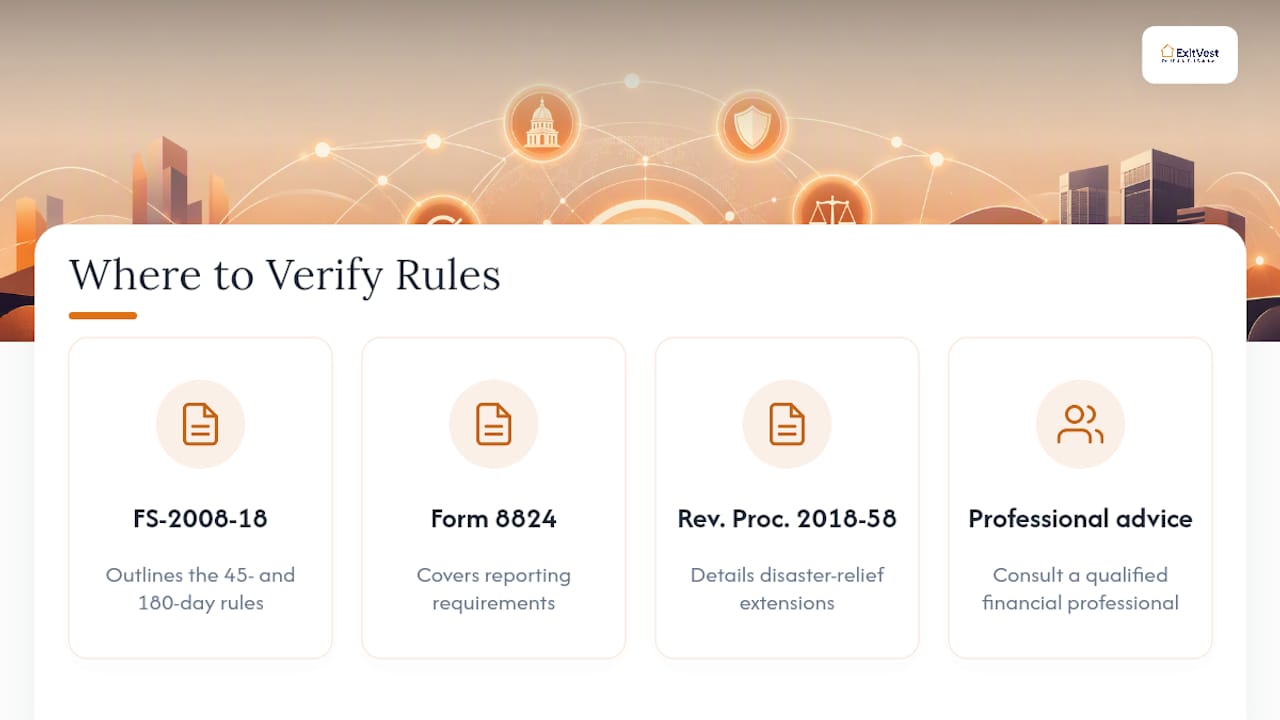
Confirm every deadline directly from the source before you act: the IRS's fact sheet FS-2008-18 outlines the 45- and 180-day rules, Form 8824 instructions cover reporting requirements, and Revenue Procedure 2018-58 details disaster-relief extensions.
This article is general information, not a substitute for advice from a qualified financial advisor. Consult a qualified financial professional about your own circumstances before acting on anything here.