
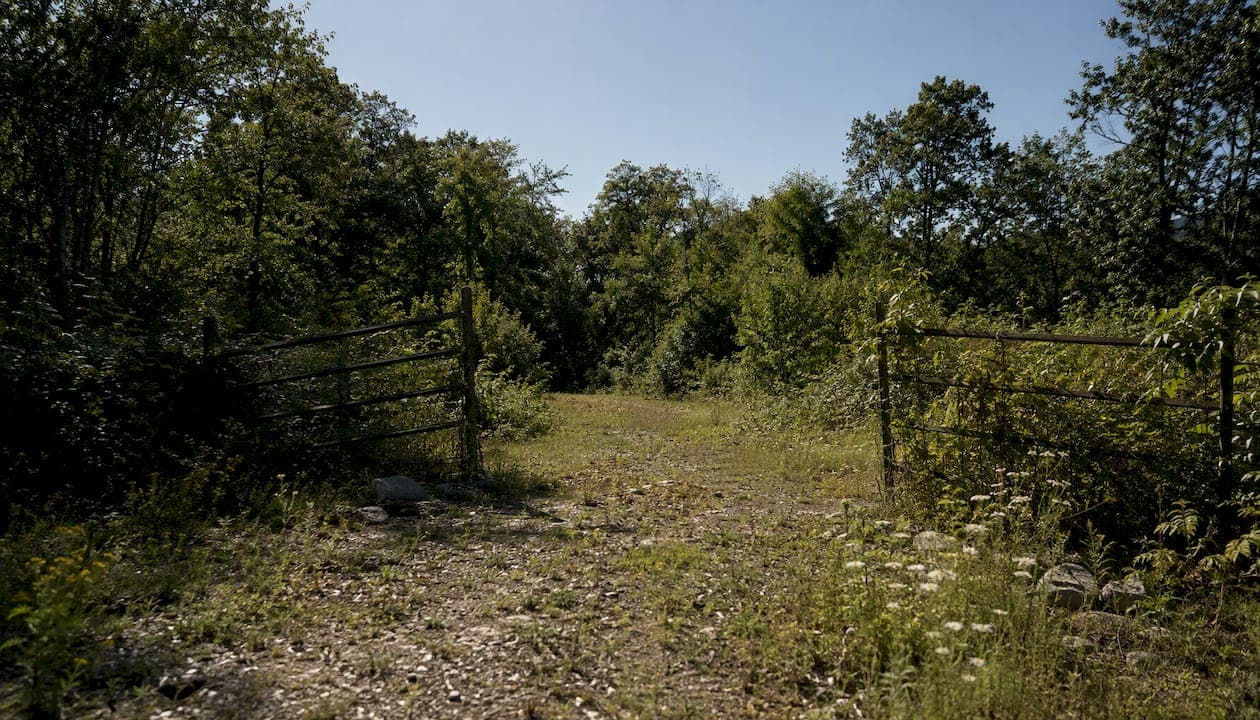
You can sell landlocked land. The process is harder than a standard parcel sale, but it's far from impossible. The two paths that work for most owners are: (A) secure a recorded access easement before listing, which typically expands your buyer pool and improves price, or (B) sell as-is to a cash buyer if speed and certainty matter more than squeezing out maximum value. According to Landmodo, landlocked land typically sells at a discount and attracts a smaller buyer pool, but a recorded easement can dramatically improve both.
Your immediate to-do list:
- Order a title search to confirm what access rights, if any, are already recorded
- Commission a boundary survey to establish exact parcel lines
- Identify and contact neighboring landowners about a potential access easement
- Consult a real estate attorney who knows your state's easement and private-road statutes
Quick comparison of the two main paths:
- Fix access first: Timeline of 2–6 months for a negotiated easement, longer if litigation is involved; costs range from a few hundred to several thousand dollars; price impact can be significant, recovering much of the landlocked discount
- Sell as-is to a cash buyer: Timeline of 2–8 weeks; no upfront legal costs; lower sale price, but a guaranteed, certain close
Pro Tip: Accept a lower cash offer when holding costs (property taxes, estate fees, carrying costs) are eating into your net proceeds faster than a negotiated easement would recover value. If the parcel has clear development upside and a willing neighbor, fix access first.
Key Takeaways
Selling landlocked land is achievable through two main paths: securing a recorded easement to maximize price, or selling as-is to a cash buyer for speed and certainty.
| Point | Details |
|---|---|
| Recorded easement is the value lever | Even a low-cost easement expands your buyer pool and can recover much of the 20–30% landlocked discount. |
| Cash sale closes in 2–8 weeks | Selling as-is to a cash buyer skips legal costs and uncertainty; the trade-off is a lower sale price. |
| Litigation is a last resort | Easement by necessity and prescriptive easement cases run 6–24+ months and carry no guaranteed outcome. |
| Tax treatment requires a CPA | Permanent easement sales may be treated like a property sale and can trigger Form 1099-S reporting. |
| Exitvest buys as-is, nationwide | Exitvest makes cash offers on landlocked parcels with no commissions, no repairs, and flexible closing timelines. |
Table of Contents
- What does "landlocked" mean and why does it affect your sale?
- What legal routes can create or confirm access to your parcel?
- How do you negotiate a voluntary access easement with a neighbor?
- What are your options if you can't secure access before selling?
- How much is landlocked land worth and who will pay more?
- How do you prepare and market a landlocked parcel to get the best price?
- What documents, timelines, costs, and tax notes should you plan for?
- When a fast cash sale is the right call
- Exitvest buys landlocked land for cash, as-is
- Sources
What does "landlocked" mean and why does it affect your sale?
A landlocked parcel is one that has no legal, recorded access to a public road or right-of-way. Note the distinction: a dirt track someone has used informally for decades is not the same as a deeded, recorded easement. Lenders and most retail buyers require the latter. Investopedia confirms that easements are the primary legal tool for providing access to landlocked parcels, and that recorded easements are what make access reliable for future buyers and lenders.
The practical consequence is that most conventional mortgage lenders will not finance a purchase of land without deeded access. That single fact narrows your buyer pool to cash buyers and neighbors, which is why the landlocked label carries real market weight.
Red flags to watch for in a title search:
- No recorded easement or right-of-way in the chain of title
- Overlapping or conflicting survey descriptions from adjacent parcels
- Claims of long-term informal use by neighbors (potential prescriptive easement disputes)
- Liens, back taxes, or probate complications layered on top of the access problem
- Boundary gaps or "gore" strips between your parcel and the nearest public road
Who actually buys landlocked parcels? Mostly neighbors who want to expand their holdings, investors who specialize in distressed or unconventional land, hunters and recreational users who don't need road access, and developers who can solve the access problem themselves. Each of these buyers expects a discount, but the size of that discount varies considerably depending on what you bring to the table.
What legal routes can create or confirm access to your parcel?
There are five main legal pathways. Each has a different cost, timeline, and certainty level.
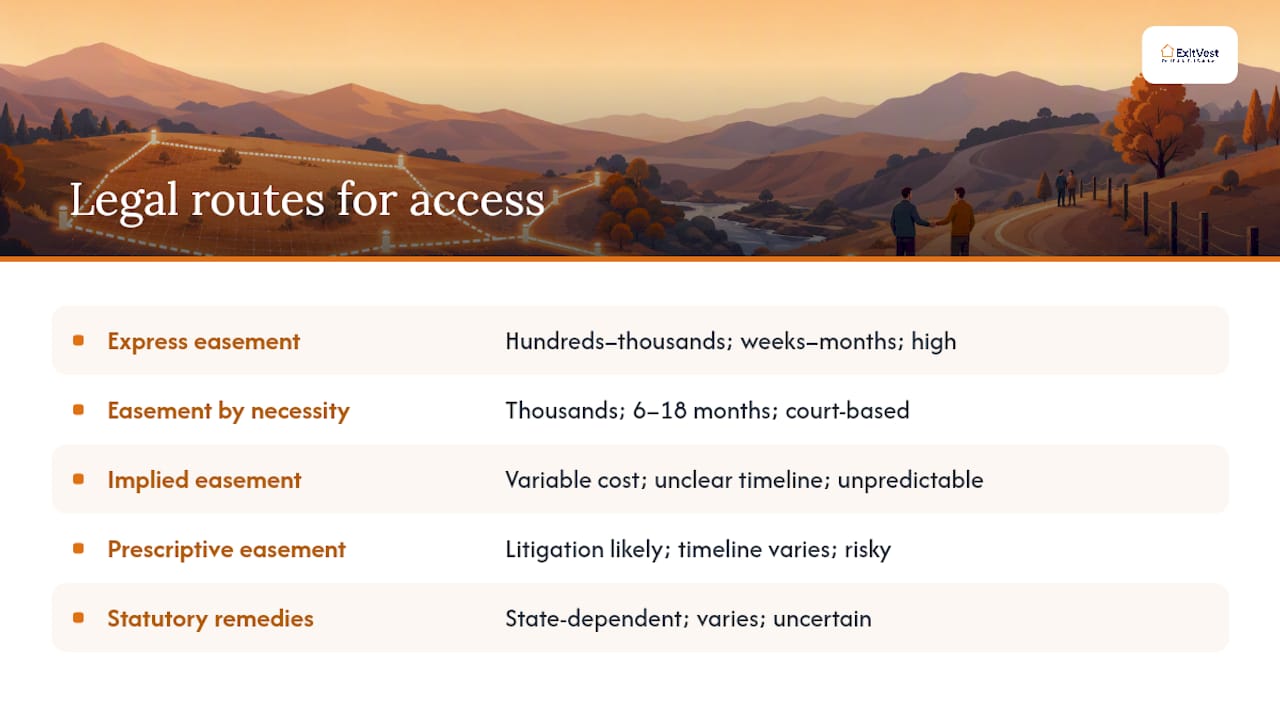
Express (written and recorded) easement is the gold standard. You negotiate a written agreement with a neighboring landowner, a real estate attorney drafts the easement deed, and you record it with the county. Costs typically include a boundary survey, attorney drafting fees, recording fees, and a one-time payment to the neighbor. Budget several hundred to several thousand dollars depending on your state, parcel size, and terrain. Timeline: weeks to a few months if the neighbor cooperates.
Easement by necessity applies when your parcel was once part of a larger tract that had road access, and the subdivision cut off your lot. Courts can grant this type of easement without the neighbor's consent, but you need to prove common ownership at the time of subdivision. Litigation costs and timelines vary widely, often running 6–18 months and several thousand dollars in attorney fees.
Implied easement is similar to easement by necessity but rests on the parties' apparent intent at the time of the original conveyance. Courts look at how the land was used before the split. These cases are fact-intensive and unpredictable.
Prescriptive easement is the riskiest route. If someone has used a path openly, continuously, and without the owner's permission for the statutory period (which varies by state), a court may recognize a prescriptive easement. The problem: proving it requires litigation, the neighbor will fight it, and the outcome is uncertain. State statutes and case law vary significantly, so consult a local attorney before relying on this path.
Private-road statutes and public-road petitions exist in many states and allow landlocked owners to petition a court or county commission for a statutory right-of-way. Some states have strong private-road statutes; others offer almost no relief. Eminent domain for private access is rare and typically reserved for public-use projects, not individual landowners.
Before spending money on any litigation strategy, order a full title search and a current boundary survey. A real estate attorney who handles easement cases in your county can tell you within one consultation whether a court remedy is realistic or whether negotiating with the neighbor is the faster path.
How do you negotiate a voluntary access easement with a neighbor?
A friendly negotiation almost always beats litigation on cost and timeline. Here's how to approach it.
Preparation before you knock on anyone's door:
- Get a current boundary survey with a parcel exhibit showing the proposed easement route
- Pull the neighbor's contact information from county records
- Research what the easement strip would cost to improve (gravel, culvert, clearing)
- Know your walk-away number: what's the most you'd pay for access versus selling as-is?
What to offer: A one-time cash payment is the most common consideration. Owners on real estate forums also report success with shared driveway maintenance agreements, cost-splitting on culvert or gravel installation, and liability/insurance clauses that protect the neighbor from claims arising from your use of the easement. Start with a modest offer and leave room to negotiate upward.
Opening script prompts that tend to work:
- "I own the parcel behind yours and I'm looking to sell it. I'd like to discuss whether there's a fair arrangement that works for both of us."
- "I'm not asking for anything that would disrupt your property. A narrow, limited-use easement along your fence line would be enough."
- "I can cover the cost of the survey and the attorney fees so there's no out-of-pocket cost for you."
Documentation you must insist on: A written easement deed, recorded with the county recorder's office, with clear language describing the route, permitted uses, width, and maintenance responsibilities. A handshake deal or an email chain is not enough. Future buyers and their lenders will require a recorded instrument.
Pro Tip: Offer a limited-purpose easement (ingress and egress only, no utilities, specific vehicle types) rather than a broad one. Neighbors resist broad easements because they worry about future uses. A narrow, clearly defined easement is easier to say yes to.
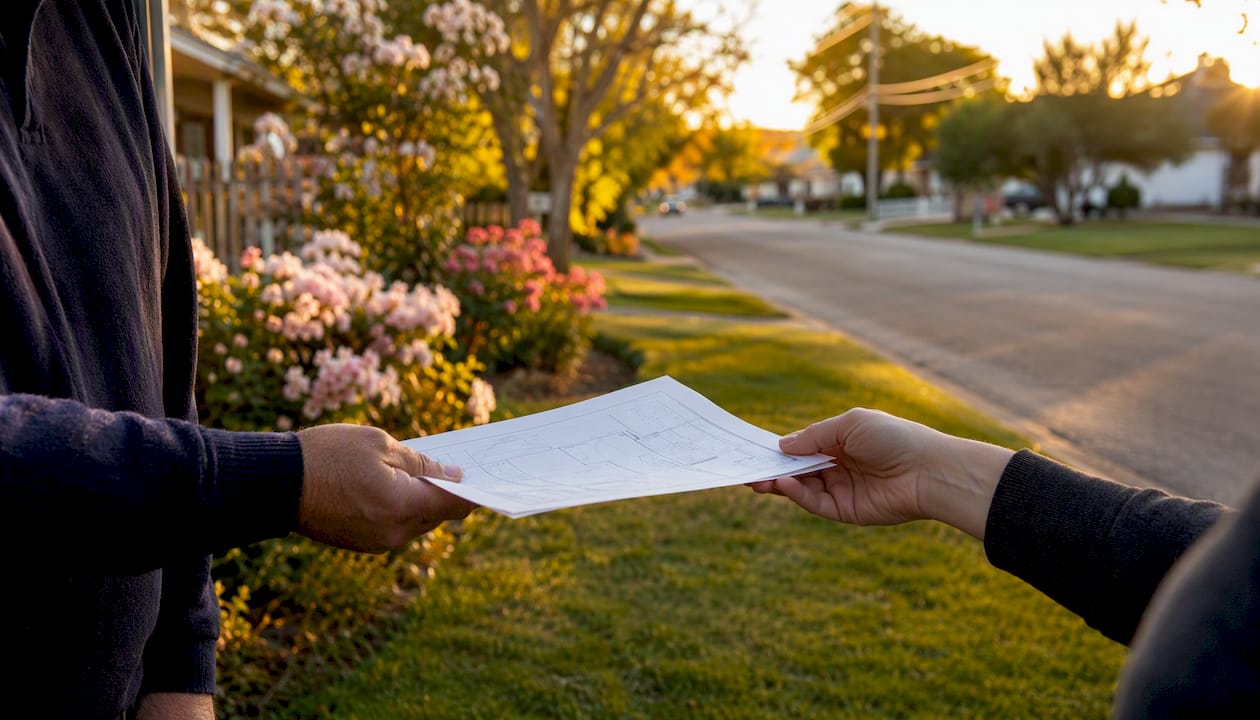
Stop negotiating and hire an attorney when the neighbor demands an amount that exceeds what access is worth, when they want vague or unenforceable language, or when they refuse to engage at all.
What are your options if you can't secure access before selling?
Not every access problem gets solved before the listing goes up. Here are the realistic strategies when that's your situation.
Sell as-is to a cash buyer or investor. This is the fastest path. Cash buyers who specialize in land accept the access risk because they have the legal resources and patience to solve it themselves. You'll take a discount, but you close in weeks rather than months. Finding a cash buyer for unused land is more straightforward than most owners expect when you target the right buyer pool.
Sell to the adjacent neighbor. The neighbor who benefits most from owning your parcel is often willing to pay more than a random investor. They already have access, they know the land, and absorbing your parcel into theirs may be worth a premium to them. Price it based on comparable accessible lots minus a reasonable discount, and let the neighbor's interest in avoiding a third-party buyer work in your favor.
Sell after creating access. If you can buy a narrow strip of land connecting your parcel to a public road, or negotiate a low-cost easement, the price improvement can more than cover the cost. This path takes 2–6 months for a cooperative neighbor scenario, longer if you're buying a strip through a separate transaction.
Alternative monetization options worth considering when a sale isn't urgent:
- Conservation easement or sale to a land trust (can generate income and tax benefits)
- Hunting or recreational lease (generates annual income without selling)
- Timber harvest rights or solar lease (specialty buyers for these uses don't always need road access)
Lenders typically won't finance a purchase of land that lacks deeded access, which concentrates your buyer pool among cash buyers and neighbors regardless of which strategy you choose. Landmodo's buyer's guide notes that selling with a recorded easement greatly improves marketability, but selling without one is still viable when you price and market correctly.
How much is landlocked land worth and who will pay more?
Practitioner sources commonly cite a discount in the 20–30% range compared with comparable accessible lots, though local variation is substantial. A parcel with timber value, mineral rights, or recreational appeal in a high-demand rural market may see a smaller discount. A bare lot in a slow market with no alternative uses may see a steeper one.
Variables that shrink the discount:
- Presence of an informal physical access route (even without legal status, it signals a path to a solution)
- Timber, mineral, or water rights that generate standalone value
- Proximity to utilities or a public road (a short easement strip is easier to negotiate)
- Strong recreational demand (hunting, fishing, ATV use)
- Solar or wind lease potential on open acreage
Variables that widen the discount:
- Completely surrounded parcels with no obvious easement route
- Title defects or competing claims layered on top of the access problem
- Remote location with no comparable sales data
- Small parcel size with limited alternative uses
Who pays more? Neighbors typically pay the most because they eliminate a boundary problem and gain land they can actually use. Specialty land investors pay less but close faster. Developers may pay a premium if they can solve the access problem and unlock a larger project, but they'll price in their legal risk. Finance Strategists notes that landlocked status is not a permanent value killer. Alternative uses and negotiated easements can preserve or recover significant value for niche buyers.
Securing even a low-cost recorded easement before listing can shift your parcel from a cash-only, deeply discounted sale to one that attracts a broader buyer pool at a meaningfully higher price.
How do you prepare and market a landlocked parcel to get the best price?
Preparation matters more for landlocked parcels than for standard lots because buyers are taking on more uncertainty. Reduce that uncertainty and you reduce the discount they demand.
- Order a current title report and boundary survey. Record the survey as a plat exhibit with the county. Buyers and their attorneys will ask for this immediately.
- Get aerial and drone photos. Landlocked parcels are often remote and hard to visit. High-quality aerial imagery showing the parcel's shape, terrain, and relationship to neighboring roads is one of the highest-ROI prep steps you can take.
- Map and mark the proposed access route. Show buyers exactly where an easement would run, how long it is, and what it would cost to improve. A visual makes the abstract concrete.
- Estimate usable acreage and topography. Buyers want to know how much of the parcel is flat, wooded, wetland, or buildable. A topo map or GIS printout answers this without a site visit.
- Highlight alternative uses in your listing. Recreational, timber, solar, and conservation uses attract buyers who don't need conventional road access. LandApp's seller tips recommend full disclosure about access combined with clear marketing of alternative uses and high-quality aerial visuals.
- List on niche land marketplaces in addition to the MLS. Specialty platforms attract buyers who specifically seek unconventional parcels and can evaluate them quickly.
- Consider owner financing. Offering seller financing expands your buyer pool to buyers who can't get a conventional loan on a landlocked parcel, which is most of them.
- Price for the actual buyer pool. Don't price at comparable accessible lots and hope. Price at a realistic discount, then let the access package justify a tighter spread.
Pro Tip: Assemble an "access package" to hand every serious buyer: a copy of the boundary survey, a map showing the proposed easement route, a draft easement description, and a rough cost estimate for improving the route. Buyers who can see a clear path to access make higher offers and fewer contingency demands. Landgate's listing platform and similar niche marketplaces are built for exactly this kind of specialty buyer.
For more on selling vacant land without a traditional agent, this guide covers the key decision points that apply directly to landlocked parcels.
What documents, timelines, costs, and tax notes should you plan for?
Standard documents you'll need regardless of path:
- Current title report (ordered from a title company)
- Boundary survey with recorded plat or exhibit
- Easement deed (if you're creating access), recorded with the county
- Seller's disclosure form (required in most states; disclose access status clearly)
- Settlement statement at closing
Realistic timelines by strategy:
- Sell as-is to a cash buyer: 2–8 weeks from first contact to closing
- Negotiated easement, then sell: 2–6 months, assuming a cooperative neighbor
- Easement by necessity or prescriptive easement litigation: 6–24+ months, with no guaranteed outcome
Cost ranges to budget:
- Boundary survey: varies by acreage and terrain; plan on several hundred to several thousand dollars
- Attorney fees for drafting and recording an easement: typically $500–$2,500 depending on complexity and state
- County recording fees: usually $25–$150 per document
- One-time payment to neighbor for easement rights: highly variable, from a few hundred dollars to tens of thousands depending on the parcel and the neighbor's leverage
- Litigation contingency: $5,000–$25,000+ if court proceedings are required
Tax notes: The sale of a permanent easement can be treated for tax purposes similarly to the sale of a property interest, and certain transactions may require Form 1099-S reporting. Conservation easement donations carry their own tax treatment. Before finalizing any easement sale or conservation transaction, consult both a real estate attorney and a CPA. The interaction between easement proceeds, capital gains, and basis allocation is not straightforward, and the wrong assumption can cost more than the attorney's fee.
When a fast cash sale is the right call
There's a version of this situation that gets overlooked in most guides: the owner who inherited a remote parcel, owes estate taxes, and has no interest in spending 18 months negotiating with a neighbor they've never met. Or the owner who bought land years ago as an investment, has been paying property taxes on something they can't use, and just wants out.
For those owners, the calculus is simple. The expected value of a negotiated easement plus a retail sale, discounted by the time, legal fees, and uncertainty involved, often comes out close to or below a clean cash offer today. Speed and certainty have real monetary value, especially when holding costs are accumulating or an estate needs to be settled.
That said, a cash sale is not the right answer when the parcel has clear development potential, a willing neighbor who would grant an easement for a reasonable sum, and an owner who has the time and resources to pursue it. In that scenario, the price difference between a fixed-access retail sale and an as-is cash offer can be substantial. The decision comes down to your timeline, your risk tolerance, and what the access fix actually costs versus what it recovers in price.
Exitvest buys landlocked land for cash, as-is
Landlocked parcels sit in a category most buyers and agents don't know how to handle. Exitvest does. As a national cash buyer of land and problem properties, Exitvest makes straightforward offers on parcels exactly like yours: no deeded access, no improvements, no agent, no waiting.
The process is direct. You share basic details about the parcel, Exitvest evaluates it and provides a fair cash offer, and you choose a closing timeline that fits your situation. No commissions, no repair demands, no financing contingencies that fall through. If you're dealing with an inherited parcel, an estate with carrying costs, or a property that's been sitting unsold because of access issues, see how the process works and request a no-pressure cash offer to know exactly where you stand.
Sources
These primary sources are worth bookmarking depending on where you are in the process:
- Landlocked: Definition in Real Estate and Easement Solution
- What Is a Landlocked Property? A Land Buyer's Guide to Access, Easements, and Due Diligence (2026) - Land Landmodo Blogs - Landmodo
- Tips For Selling Landlocked Property - LandApp
- How Much is Landlocked Property Worth? - Eric Andrews Realtor
- Landlocked | Definition, Steps, Legal Aspects, & Strategies
- Tax Considerations for a Contract with a Pipeline Company
This article provides general information about selling landlocked land in the United States and is not a substitute for legal, tax, or real estate advice. Consult a licensed real estate attorney and a CPA for guidance specific to your parcel, state, and situation.