

Inheriting a house does not trigger an immediate federal tax bill in most cases. The real tax exposure shows up later, when you sell the property, rent it out, or run into state-level death taxes. Before you do anything else, check two things: whether the estate is filing Form 706, and what the home's fair market value was on the date of death. That number, known as the stepped-up basis, decides almost everything about your future tax bill.
TL;DR:
- Most inheritors avoid immediate federal taxes unless the estate exceeds the $15 million exemption, which is unlikely for the majority of cases.
- The property's fair market value at the date of death, known as the stepped-up basis, primarily determines capital gains tax liability upon sale.
- Filing Form 706 by the estate indicates a specific valuation of the house that heirs must match on their tax reports, making appraisal accuracy crucial.
- Renting out the inherited house triggers taxable rental income and depreciation recapture, affecting future tax bills and highlighting the need for careful planning.
- Holding costs such as property taxes, insurance, and maintenance can escalate quickly, making swift sale options more appealing when dealing with financial pressure.
Table of Contents
- Inherited House Taxes: Which Ones Actually Apply
- Stepped-Up Basis: The Number That Decides Your Tax Bill
- Selling an Inherited House: Gains, Forms, and Special Rules
- State Estate Tax vs. Inheritance Tax: Know the Difference
- The Hidden Cost: Holding an Inherited House
- Your First-Weeks Checklist as an Heir
- Sell, Rent, or Move In: Comparing the Tax Outcomes
- Rental Income Before the Sale: What Heirs and Tenants Owe
- Disclaiming an Inherited House: When It Makes Sense
- Community Property Rules and How They Change Your Basis
- How ExitVest Sees the Reality Heirs Face
- Sell Your Inherited House Fast, As-Is, No Repairs Needed
- Where to Verify the Details
- Sources
Inherited House Taxes: Which Ones Actually Apply
Heirs often assume "inheritance" means a tax event by itself. It usually doesn't. Here's how the four relevant taxes break down:
- Federal estate tax: Paid by the estate, not the heir, and only when the estate's total value exceeds the exemption. In 2026, that exemption is $15 million per person, so the vast majority of estates owe nothing at the federal level.
- State inheritance tax: A handful of states tax the beneficiary directly, with rates and exemptions that vary widely by relationship to the decedent.
- Capital gains tax: Only triggered when you sell, and calculated against the stepped-up basis rather than what the original owner paid.
- Property tax: Not tied to inheritance itself, but many counties reassess value when title transfers, which can raise your annual bill fast.
Pro Tip: Ask the executor or estate attorney, in writing, whether Form 706 is being filed. That single answer determines whether the consistent-basis rule applies to you.
Stepped-Up Basis: The Number That Decides Your Tax Bill
Stepped-up basis means your cost basis in the inherited property resets to its fair market value on the date the previous owner died, not what they originally paid for it. If your grandmother bought her house in 1985 for $40,000 and it was worth $410,000 the day she passed, your basis is $410,000, not $40,000. That single adjustment often wipes out decades of taxable appreciation.
There's a catch. When an estate files Form 706, the IRS requires heirs to use the exact value the estate reported, a rule enforced through Schedule A of Form 8971. Report a higher basis than the estate did, and you risk a mismatch that draws IRS attention.
- Confirm whether Form 706 was filed and request a copy of Schedule A (Form 8971) from the executor.
- Order a professional appraisal dated as close to the date of death as possible.
- Keep the appraisal report permanently. It's your primary evidence if the IRS ever questions your basis.
A Zillow estimate or an old tax assessment won't hold up the same way a dated, signed appraisal will if your basis ever gets challenged.
Selling an Inherited House: Gains, Forms, and Special Rules
The math is simpler than most heirs expect. Taxable gain equals your sale price, minus selling costs, minus your stepped-up basis. Sell soon after inheriting, and that gain is often close to zero because the market hasn't moved much from the date-of-death value.
- Calculate the gain. Net proceeds minus selling costs minus stepped-up basis equals your taxable gain or loss.
- Report it correctly. Inherited property is always treated as long-term for capital gains purposes, regardless of how long you personally held it, and it gets reported on Form 8949 and carried to Schedule D.
- Check the primary residence exclusion. Section 121's $250,000/$500,000 exclusion requires living in the home as your primary residence for 2 of the 5 years before the sale. Inheriting the property doesn't hand you this exclusion automatically, and most heirs who sell quickly won't need it anyway since the step up already limits the gain.
- Watch for depreciation recapture. If the home was rented at any point, prior depreciation deductions get recaptured as taxable income at sale.
State Estate Tax vs. Inheritance Tax: Know the Difference
These two terms get confused constantly, and the confusion costs people money. Estate tax is billed to the estate before assets are distributed. Inheritance tax is billed directly to you, the beneficiary, after you receive the property.
- Some states apply inheritance tax with exemptions far below the federal $15 million threshold, particularly for distant relatives or unrelated heirs.
- A handful of states apply their own estate tax, separate from and often more aggressive than the federal exemption.
- Rules depend on both the decedent's state of residence and, for real estate, the state where the property sits.
Call the tax authority in the decedent's home state and the county where the property is located. Don't rely on a general web search. Thresholds and rates change, and state rules are far more likely to bite you than the federal exemption ever will.
The Hidden Cost: Holding an Inherited House
Nobody sends you a bill labeled "holding costs," but they add up fast. Property tax, homeowner's insurance, utilities, and basic maintenance don't pause while you decide what to do with the house. Advisors who work with heirs regularly warn that these ongoing expenses catch people off guard and can quietly drain an estate's value while decisions stall.
- Ownership transfers frequently trigger a property tax reassessment, which can raise the bill well above what the previous owner paid, especially if they'd held the home for decades under an assessment cap.
- Check whether the county allows a homestead exemption if you plan to occupy the property.
- Secure the home immediately, update the insurance policy to reflect vacancy status if applicable, and get that appraisal scheduled before market conditions shift.
Your First-Weeks Checklist as an Heir
The first few weeks after title transfers set the tone for everything that follows. Move through this in order:
- Order a date-of-death appraisal. This is your single most important document for basis purposes.
- Contact the executor for Form 8971 / Schedule A details and confirm whether Form 706 was filed.
- Gather the paperwork: deed, title documents, mortgage statements, insurance policy, property tax bills, and any receipts for capital improvements the decedent made.
- Decide your path: sell, rent, or move in, and weigh the tax consequences of each before you commit.
Pro Tip: Improvement receipts add to your basis even after inheritance, so if you replace the roof before selling, keep every invoice. That expense reduces your taxable gain.
Sell, Rent, or Move In: Comparing the Tax Outcomes
Each path carries a distinct tax profile, and the right choice depends on your finances more than your emotional attachment to the property.
- Selling soon usually produces minimal capital gains, since the sale price and the stepped-up basis tend to be close together. Document the fair market value carefully regardless.
- Renting it out means reporting rental income annually, depreciating the property, and facing recapture tax when you eventually sell. It can work financially, but it turns a simple inheritance into an ongoing tax and management obligation.
- Moving in can eventually qualify you for the Section 121 exclusion once you've lived there 2 of the prior 5 years, but that timeline rarely fits heirs who want to resolve the estate quickly.
Rental Income Before the Sale: What Heirs and Tenants Owe
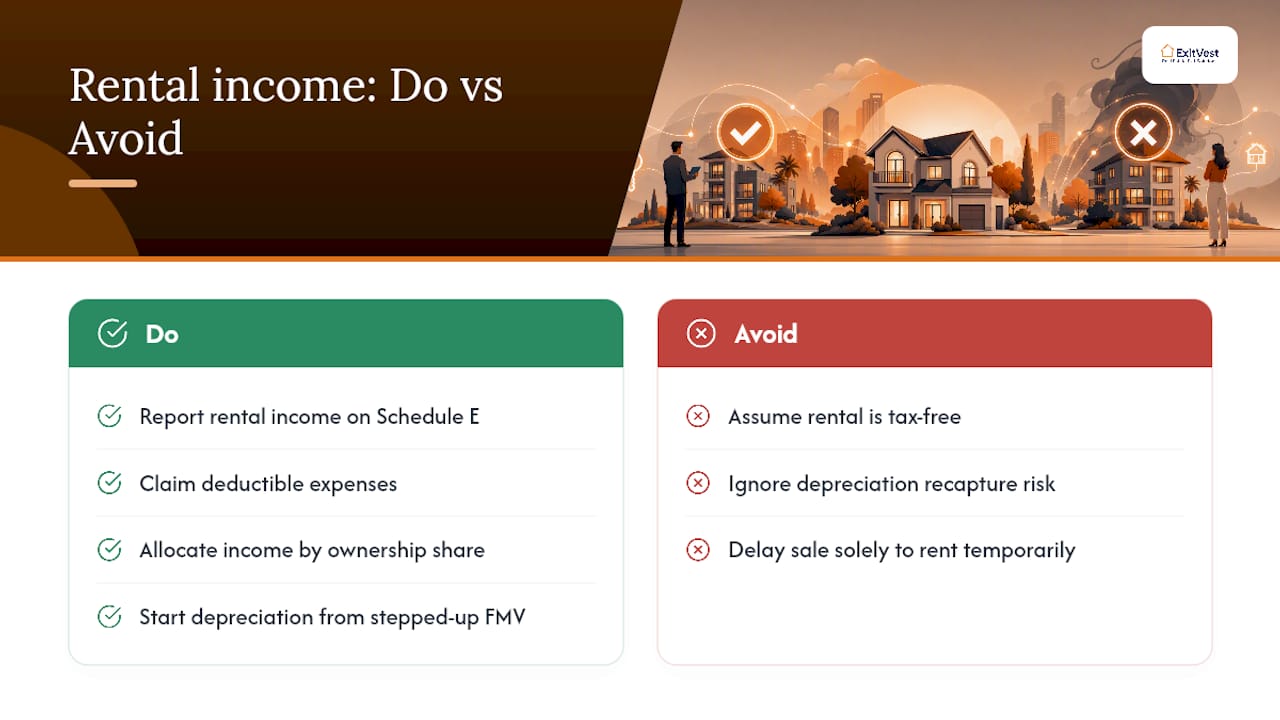
If the inherited house already has tenants in it, or you decide to rent it out while you sort out your options, the tax picture shifts the moment rent starts hitting a bank account. Rental income is taxable in the year it's received, and it goes on Schedule E regardless of how briefly you plan to hold the property.
Heirs frequently assume that because the underlying inheritance wasn't taxed, rental proceeds from that same property get some kind of pass. They don't. Every dollar of rent, minus deductible expenses like insurance, repairs, and property management fees, counts as ordinary income on your return. If multiple heirs co-own the property before a sale, each one typically reports their proportional share of rental income based on ownership percentage.
Depreciation adds another layer. Once a property held for personal use converts to a rental, you start a new depreciation schedule based on the stepped-up fair market value at the date of death, not the decedent's original cost. That depreciation lowers your taxable rental income year over year, but it comes back to bite you later. When you sell, the IRS recaptures those depreciation deductions as taxable income, taxed at a rate that can run higher than standard long-term capital gains rates. Heirs who rent for a year or two "just to figure things out" often discover this recapture bill only after the closing paperwork is signed.
If you're already dealing with tenants and just want the property sold rather than managed, that recapture math is one more reason a quick, clean sale sometimes beats a temporary rental strategy.
Disclaiming an Inherited House: When It Makes Sense
You are not required to accept an inheritance. A qualified disclaimer lets you refuse the property entirely, and for tax purposes, it's treated as though you never received it.
People disclaim for a few practical reasons. Sometimes the property carries more debt, liens, or repair obligations than it's worth, and accepting it would mean inheriting a financial liability rather than an asset. Sometimes an heir is already in a high tax bracket and would rather see the property pass to a family member in a lower bracket who can absorb any future capital gains more efficiently. Sometimes it's simpler: multiple siblings inherit a property none of them want to manage, and one steps aside to avoid a drawn out ownership dispute.
To disclaim correctly, you have to act fast and follow strict formalities. The disclaimer must be in writing, delivered to the executor or trustee within nine months of the decedent's death, and you cannot have already accepted any benefit from the property, no rent collected, no repairs directed, no acting as if you own it. Miss that window or take any action that implies acceptance, and the disclaimer option disappears.
Disclaiming isn't free of consequences either. If you disclaim and the property passes to your own child instead of a sibling or other relative, that shift could carry gift tax implications depending on how the disclaimer is structured. This is one area where getting an estate attorney involved before the nine-month clock runs out matters more than almost any other decision on this list.
Community Property Rules and How They Change Your Basis
If the decedent was married and lived in a community property state (think Texas, California, Arizona, Nevada, and a handful of others), the basis calculation on an inherited house can actually work in your favor more than in common law states.
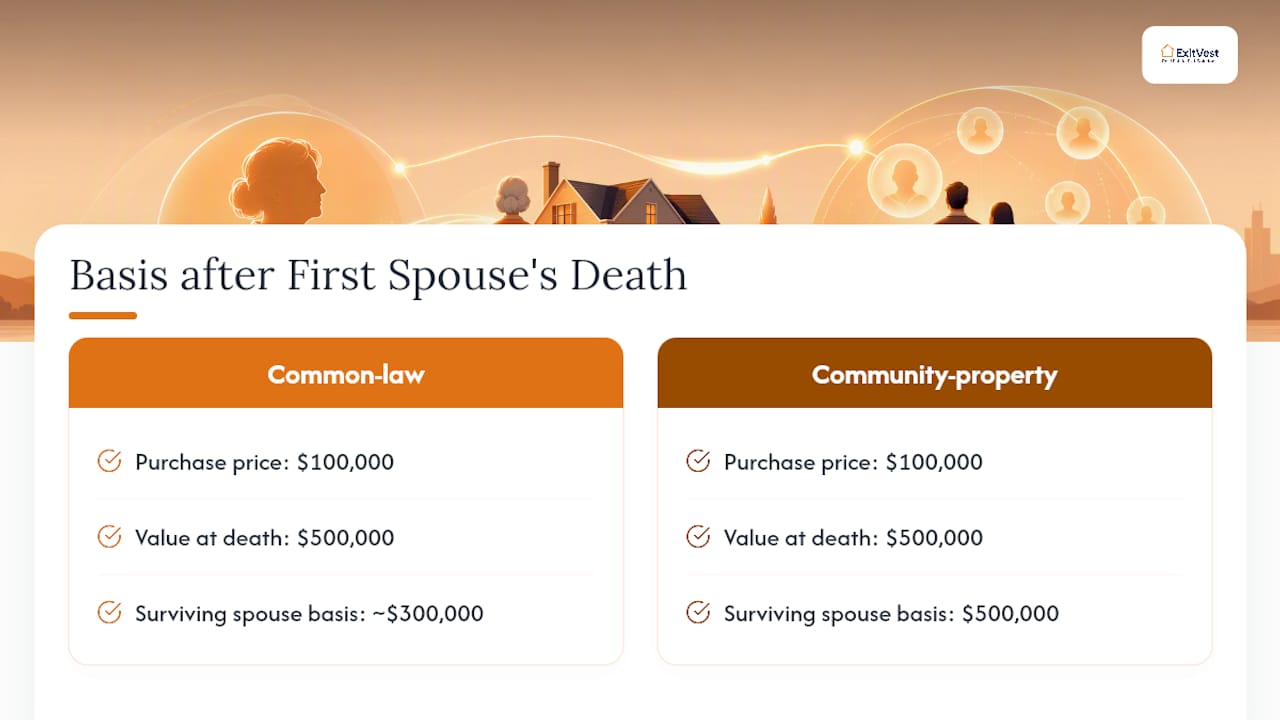
In most common law states, when one spouse dies, only that spouse's half of a jointly owned property gets a stepped-up basis. The surviving spouse's half keeps its original cost basis. In community property states, the rule is different: the entire property typically receives a full step up to fair market value at the date of the first spouse's death, even though the surviving spouse already owned half of it.
Here's why that matters in dollars. Say a married couple bought a house decades ago for $100,000, and it's worth $500,000 when one spouse dies. In a common law state, the surviving spouse's basis becomes roughly $300,000 (their original $50,000 half, plus a stepped-up $250,000 half from the deceased spouse). In a community property state, the surviving spouse's basis becomes the full $500,000. If that surviving spouse then sells the house, or an heir inherits and sells it after the second spouse's death, the community property step up can eliminate far more taxable gain.
This distinction gets more complicated with property acquired before marriage, property held in a trust, or couples who moved between community property and common law states during the marriage. If you're an heir dealing with a community property estate, ask the executor specifically how basis was calculated for jointly held real estate. It's a detail many general tax preparers overlook, and it can change your taxable gain by tens of thousands of dollars.
How ExitVest Sees the Reality Heirs Face
Probate delays, mounting holding costs, and disagreements between siblings are the three problems we see most often with inherited property. When carrying costs and looming capital gains exposure outweigh sentimental value, a fast, documented cash sale often protects more of the estate than waiting on a traditional listing.
— Alek
Sell Your Inherited House Fast, As-Is, No Repairs Needed
Every strategy above assumes you have time: time to get an appraisal, coordinate with an executor, weigh renting against selling, maybe even navigate a disclaimer. Not every heir has that luxury. If holding costs are stacking up, siblings can't agree, or the house needs repairs nobody wants to fund out of pocket, waiting for a traditional buyer to close in 60 or 90 days can cost more than it saves.

Houses can be sold directly, in as-is condition, with no repairs, no agent commissions, and closing timelines built around your situation rather than a buyer's mortgage approval. That flexibility matters most when the tax clock and the holding-cost clock are already running. If you want to see what a no-obligation cash offer looks like for your property, get a free cash offer and compare it against the cost of holding on while you sort out the rest.
Where to Verify the Details
For the specifics that matter most, go straight to the source: the IRS estate tax page, Publication 551 on basis of assets, and Topic No. 701 on home sales. For readers dealing with property or heirs outside the U.S., this overview of Italian inheritance tax for non-resident heirs is a useful reference for how differently other jurisdictions handle the same questions.
This article is general information, not a substitute for advice from a qualified financial advisor. Consult a qualified financial professional about your own circumstances before acting on anything here.
Sources
- Estate tax | Internal Revenue Service
- Topic No. 701 Sale of Your Home | Internal Revenue Service
- Inherited home: What to know before selling, renting or keeping it | CNBC