

Selling a distressed house in New Jersey is achievable through three proven paths: selling as-is to cash buyers, listing through Flat Fee MLS, or working directly with real estate investors. The industry term for this process is "distressed property disposition," and it applies to homes with deferred repairs, financial liens, inherited titles, or foreclosure risk. New Jersey homeowners who need to sell distressed house NJ situations quickly face a specific set of legal, financial, and market challenges that differ from standard home sales. This guide covers every step, from legal preparation to closing, so you can move fast without costly mistakes.
What qualifies as a distressed house in New Jersey?
A distressed property is any home where the owner cannot maintain it, afford repairs, or keep up with financial obligations tied to it. The category is broader than most homeowners realize.
Common types of distressed properties in New Jersey include:
- Inherited homes requiring probate or estate resolution before sale
- Foreclosure-risk properties where mortgage payments are overdue
- Homes with deferred maintenance such as roof damage, mold, or structural issues
- Vacant properties accumulating tax debt and code violations
- Rentals with problem tenants that reduce marketability
The reason speed matters in these situations is financial. Every month a distressed property sits unsold, it generates carrying costs: property taxes, insurance, utilities, and potential fines. Selling quickly stops that drain. Cash buyers for distressed homes close in as little as 7 to 14 days in cities like Newark, cutting months of ongoing expense.
Pro Tip: If your property has code violations or unpaid taxes, request a municipal lien search before listing. Buyers will find these anyway, and knowing the numbers upfront lets you price accurately from day one.
What legal and financial steps do you need before selling?
Legal preparation is the step most sellers skip, and it causes the longest delays. Getting this right before you list saves weeks of back-and-forth at closing.
Probate and inherited properties
If you inherited the property, probate is your first hurdle. New Jersey probate timelines typically run 6 to 18 months depending on case complexity. That range reflects the difference between a simple single-heir estate and a contested multi-beneficiary situation. Court filing fees generally run between $150 and $200, but the real cost is time.
The good news: you do not have to wait for probate to finish before marketing the home. Executors can list the property once they receive Letters Testamentary from the Surrogate's Court. Early coordination with an estate attorney aligns your sale timeline with the legal process and avoids unnecessary delays.
Documents you need to gather
- Death certificate (for inherited properties)
- Letters Testamentary or Letters of Administration
- Proof of ownership or deed
- Mortgage payoff statement
- Municipal lien search results
- Seller disclosure forms required under NJ law
Taxes that affect your net proceeds
New Jersey does not impose a state estate tax, but three taxes apply to most distressed property sales: transfer tax, property tax, and capital gains tax. Direct descendants and spouses are exempt from NJ inheritance tax. Federal estate tax only applies to estates above $15 million, which affects very few sellers.
Transaction costs for selling an inherited property in New Jersey typically run 11% to 14% of the sale price. On a $549,100 home, that equals roughly $59,633 in combined agent commissions, taxes, and closing fees. Choosing a cash sale or FSBO route can save more than $10,000 by eliminating agent commissions.
Pro Tip: Ask your estate attorney to provide a net proceeds estimate before you accept any offer. Knowing your after-tax number prevents surprises at the closing table.
How do you sell your distressed NJ property fast, step by step?
The fastest sales follow a clear sequence. Skipping steps creates delays; following them in order keeps momentum.
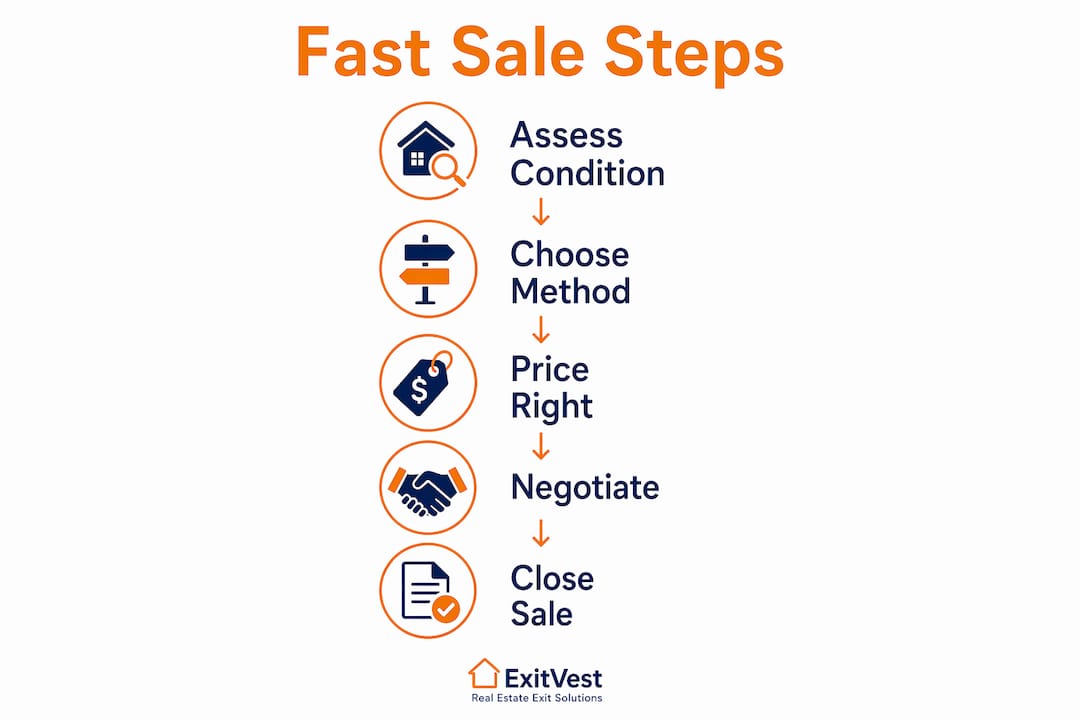
Step 1: Assess condition and decide on repairs
Walk the property with a contractor before listing. Get repair estimates for anything structural, safety-related, or code-violating. Then compare those costs against your expected sale price. Minor cosmetic fixes like cleaning, painting, and landscaping improve appeal without large investment. Major renovations rarely increase estate sale value proportionally. Most distressed property sellers are better off pricing the condition into the asking price rather than spending money on repairs.

Step 2: Choose your selling method
Three main options exist for selling a fixer-upper or distressed home in New Jersey:
- Cash sale to a real estate investor or buyer network. Fastest close, typically 7 to 14 days. No repairs, no staging, no financing contingencies. You accept a below-market price in exchange for speed and certainty.
- FSBO or Flat Fee MLS listing. FSBO and Flat Fee MLS services get listings live within 1 to 2 days and save up to 3% in agent commissions. You control the process but handle negotiations yourself.
- Traditional agent listing. Broadest buyer exposure, but average days on market in New Jersey stretch the timeline significantly. Best suited for properties in better condition.
| Method | Typical timeline | Repair requirement | Commission cost |
|---|---|---|---|
| Cash buyer | 7–14 days | None | None |
| Flat Fee MLS | 30–60 days | Minimal | Flat fee only |
| Traditional agent | 60–120+ days | Often required | 5–6% |
Step 3: Price accurately for condition
Overpricing a distressed property is the single most common mistake. Price it based on comparable sales of similar condition homes, not renovated properties in the same neighborhood. Real estate investors NJ-wide use the 70% rule: they pay no more than 70% of after-repair value minus estimated repair costs. Understanding that formula helps you evaluate whether a cash offer is fair.
Step 4: Negotiate and close efficiently
When you receive offers, prioritize certainty over top dollar. A cash offer with no contingencies at 85% of asking price closes faster and more reliably than a financed offer at full price. Coordinate your closing date with your estate attorney if probate is still in progress. Selling without probate delays is possible when you have Letters Testamentary in hand and a buyer who understands the process.
Pro Tip: Request proof of funds from any cash buyer before signing a purchase agreement. Legitimate investors provide this immediately. Anyone who hesitates is a red flag.
What mistakes do sellers make with distressed NJ properties?
Most sellers lose time and money to the same avoidable errors. Knowing them in advance puts you ahead.
"Selling an inherited property as-is is the pragmatic path that avoids repair costs and stress, converting liabilities to cash efficiently." — Jorge Ramirez, NJ real estate professional
Overpricing based on emotion, not data. Sellers often anchor to what a property was worth before it fell into disrepair, or what a neighbor's renovated home sold for. Neither number reflects your property's actual market value in its current condition.
Failing to disclose defects. New Jersey law requires sellers to disclose known material defects. Skipping this creates legal liability after closing. Disclose everything in writing, even if it feels like it will hurt your price.
Waiting too long on probate. Many sellers assume they cannot act until probate closes. That assumption costs months. Work with your estate attorney to begin marketing as soon as Letters Testamentary are issued.
Underestimating cleanout costs. A distressed property often contains years of accumulated belongings, debris, or hazardous materials. Budget for professional cleanout before listing, or factor it into your asking price.
Dismissing cash offers too quickly. Many sellers reject investor offers because they seem low, then spend six more months paying carrying costs on a property that still hasn't sold. The quick home sale options available through cash buyers often produce better net results once carrying costs are factored in.
Key Takeaways
Selling a distressed property in New Jersey fast requires choosing the right method, completing legal preparation early, and pricing accurately for condition rather than sentiment.
| Point | Details |
|---|---|
| Cash buyers close fastest | Real estate investors in NJ typically close in 7 to 14 days with no repair requirements. |
| Start legal prep before listing | Obtain Letters Testamentary early so you can market the property before probate concludes. |
| Transaction costs run 11–14% | Budget for taxes, commissions, and closing fees to avoid surprises at the closing table. |
| Price for condition, not comparables | Use distressed-property comps, not renovated neighbor sales, to set a realistic asking price. |
| Skip major repairs | Minor cosmetic fixes help; major renovations rarely return their cost on distressed or estate sales. |
What I've learned from watching sellers wait too long
Working with New Jersey homeowners in difficult property situations has taught me one consistent lesson: the sellers who wait for the "perfect" offer almost always end up worse off than those who move decisively.
I've seen families hold onto inherited homes for 18 months, paying taxes and insurance on a vacant property, because they were convinced a retail buyer would eventually appear. In most cases, the carrying costs consumed whatever premium they were holding out for. The math rarely works in favor of waiting.
The sellers who come out ahead are the ones who treat the property as a financial problem to solve, not an emotional asset to protect. That means getting legal paperwork in order immediately, pricing based on real data, and taking a serious cash offer seriously even when it feels low on paper.
One thing I tell every seller: calculate your monthly carrying cost first. Property taxes, insurance, utilities, and maintenance add up fast in New Jersey. Multiply that by the number of months you expect to wait for a retail sale. Then compare that number to the discount a cash buyer is asking for. The gap is almost always smaller than sellers expect.
Selling as-is is not giving up. It is a calculated decision to stop the bleeding and move forward.
— Alek
How Exitvest helps NJ homeowners sell distressed properties
Exitvest works directly with New Jersey homeowners who need to sell property as-is without repairs, staging, or drawn-out negotiations. The process is straightforward: you describe your situation, receive a fair cash offer, and choose a closing date that fits your timeline.

Exitvest buys houses in any condition across New Jersey, including inherited homes, properties with liens, vacant houses, and rentals with difficult tenants. There are no agent commissions, no repair requirements, and no financing contingencies that can fall through at the last minute. If you are ready to stop carrying a property that is costing you money every month, see your options and get a no-pressure cash offer from Exitvest today.
FAQ
What does "distressed property" mean in New Jersey?
A distressed property is any home the owner cannot maintain, afford to repair, or keep financially current. This includes inherited homes, foreclosures, properties with liens, and homes with significant deferred maintenance.
Can I sell an inherited house in NJ before probate is complete?
Yes. Executors can begin marketing an inherited property once they receive Letters Testamentary from the Surrogate's Court, even before probate fully concludes. Coordinating with an estate attorney keeps the sale timeline aligned with the legal process.
How fast can I sell a distressed house in New Jersey?
Cash buyers for distressed homes typically close in 7 to 14 days. Traditional listings take 60 to 120 or more days, depending on property condition and market activity.
Do I have to pay taxes when I sell a distressed house in NJ?
New Jersey sellers must account for transfer tax, property tax, and potentially federal capital gains tax. NJ does not impose a state estate tax, and direct descendants are exempt from NJ inheritance tax.
Is selling as-is worth it compared to making repairs first?
For most distressed properties, selling as-is produces better net results. Major renovations rarely return their full cost on distressed or estate sales, and the time spent on repairs adds months of carrying costs.