

Add commissions only if you choose to use a listing agent. That's a fraction of the 6%–10% traditional sellers often pay, and it comes out of your proceeds before you see a check.
TL;DR:
- Closing costs for a cash sale usually do not differ significantly from financed transactions, except for the absence of lender-related fees like origination and appraisal charges.
- Seller's costs include typical fees such as title insurance, transfer taxes, escrow, recording, and prorated property taxes, which vary by location but are generally predictable.
- To accurately estimate net proceeds, sellers should deduct mortgage payoffs, liens, closing service costs, and commissions (if applicable) early, using current payoff and title data.
- Hidden costs like unpaid liens, HOA assessments, or title defects can unexpectedly reduce the final amount, so pre-closing title and HOA checks are advisable.
- Negotiating fee coverage and obtaining a pro forma settlement statement before accepting an offer allows sellers to minimize surprises and maximize net profit.
Table of Contents
- What Closing Costs Look Like Line by Line
- Cash Sale Vs. Financed Sale: What Actually Changes
- How to Estimate Your Net Proceeds Before You Sign
- Hidden Costs That Can Shrink Your Check
- Steps to Lower Costs Before You Accept an Offer
- Timing and the Final Settlement Statement
- Why the Simple Math Gets Overcomplicated
- How Exitvest Keeps Your Closing Costs Predictable
- Sources
What Closing Costs Look Like Line by Line
Every cash sale has the same basic ledger, even though the amounts shift by state and by deal. Here's what typically shows up on the settlement statement, and whether it applies to you.
- Agent commissions: If you skip a listing agent entirely, this line disappears. If you use one, expect typical listing side commissions consistent with common local practices, since buyer-agent commission usually doesn't apply when there's no financed buyer involved.
- Owner's title insurance: Runs roughly 0.5% of the sale price, though whether the seller or buyer pays it depends heavily on local custom. In some counties it's automatic seller coverage; in others, it's negotiable.
- Transfer taxes and documentary stamp fees: This is where location does the most damage. Some states charge nothing at the state level. Others tack on fees that scale with sale price, occasionally pushing past 1% once county surtaxes stack on top.
- Escrow and settlement fees: Typically a few hundred dollars up to 1%–2% of price, depending on the provider and state.
- Recording fees: Usually a flat charge per document, generally a modest amount to record the deed and satisfaction of mortgage.
- Prorated property taxes and HOA dues: You owe your share through the day before closing, calculated as a proration and deducted directly from proceeds.
- Attorney fees: Common in attorney-closing states (much of the Northeast), typically a few hundred to a few thousand dollars for review and representation.
- Mortgage payoff, second liens, HELOCs, and prepayment penalties: These come out first, before anything else touches your bank account.
Pro Tip: Order your mortgage payoff letter the same week you accept an offer. Payoff quotes expire, and outdated figures at the closing table are one of the most common reasons a settlement statement gets revised at the last minute.
Cash Sale Vs. Financed Sale: What Actually Changes
A cash sale doesn't erase closing costs. It erases a specific category of them: the ones tied to a lender.
Fees that typically disappear:
- Loan origination fees and lender underwriting charges
- Appraisal fees required by a mortgage lender
- Lender's title insurance policy (there's no lender to protect)
Fees that usually stay the same no matter how the buyer pays:
- Transfer taxes, documentary stamp fees, and recording charges
- Title search costs and municipal lien searches
- Property tax and HOA prorations
Agent commissions are a separate question entirely. If you're selling directly to a cash buyer without listing on the open market, that commission line often vanishes too, not because it's a "cash sale" perk but because there's no agent in the transaction at all. The other real advantage of speed: a two-week close instead of a 45-day financed close means fewer mortgage payments, less lawn-mowing on a vacant property, and no risk of a buyer's loan falling through after you've already moved out.
How to Estimate Your Net Proceeds Before You Sign
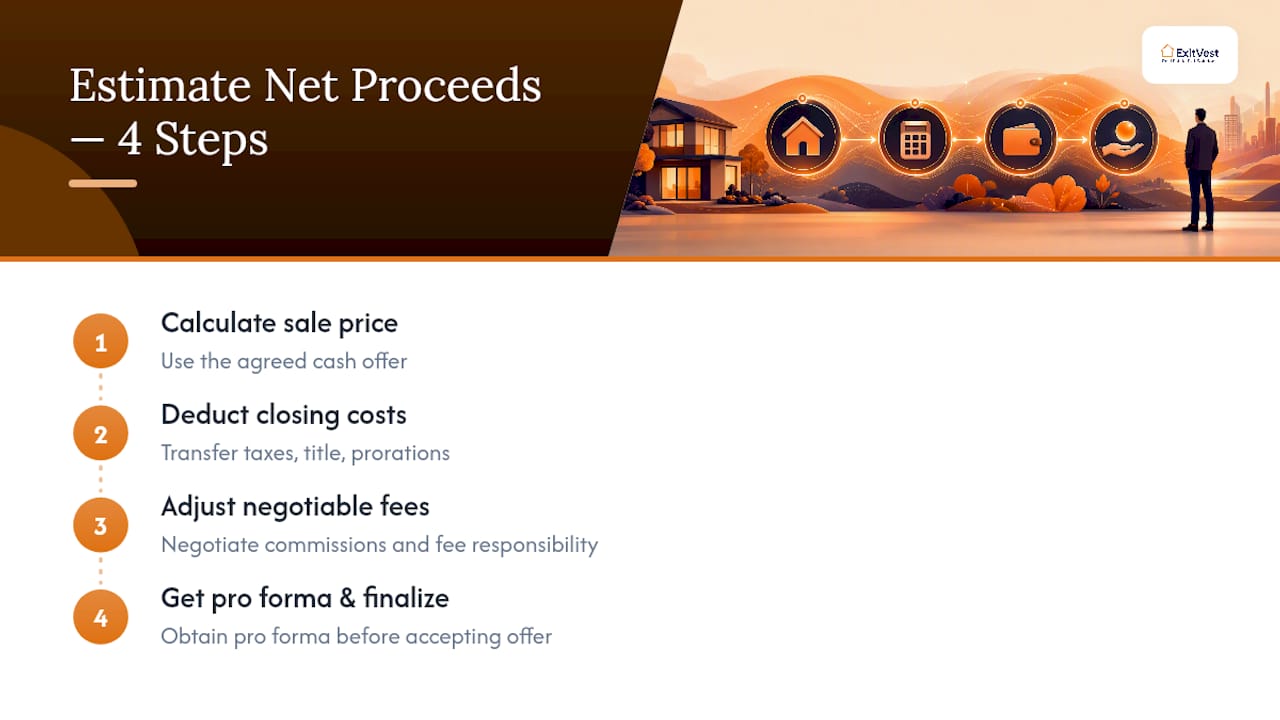
You don't need a spreadsheet to get a reasonably accurate number. Four steps get you close enough to negotiate with confidence.
- Start with the agreed sale price. This is your top-line number before anything gets subtracted.
- Subtract mortgage payoff, liens, and prepayment penalties. Pull actual payoff letters rather than guessing from your last statement, since interest accrues daily and old balances mislead you.
- Subtract title, escrow, recording, transfer tax, prorations, attorney fees, and any repair credits. Budget roughly 1%–3% of price for this bucket in a cash sale.
- Subtract commissions or concessions only if they apply to your deal.
Two quick examples: on a $300,000 sale with a $180,000 payoff and $6,000 in closing-service costs, proceeds land around $114,000. On a $500,000 sale with a $310,000 payoff, $12,000 in closing costs, and a $5,000 repair credit, proceeds come to roughly $173,000. Ask any buyer for a pro forma settlement statement before you sign anything, so these numbers stop being estimates.
Hidden Costs That Can Shrink Your Check
A clean-looking offer can still hide deductions that surface during the title search or final walkthrough. Watch for these before you're locked into a closing date.
- Unpaid tax liens, court judgments, or mechanic's liens that must be paid off or subordinated
- HOA transfer fees and special assessments, which many associations require paid in full at closing
- Escrow holdbacks or repair credits negotiated after an inspection
- Prepayment penalties or reconveyance fees buried in your original mortgage documents
- Costs to clear title defects, including corrective deeds, surveys, or probate filings on inherited property
Pro Tip: Pull your HOA's most recent ledger and a title report before you accept any offer. Special assessments and old liens are the two surprises most likely to eat into proceeds you already mentally spent.
Steps to Lower Costs Before You Accept an Offer
A little homework upfront prevents most bad surprises at the closing table.
- Request an itemized pro forma settlement statement or net sheet early in negotiations, not the week before closing.
- Ask about title reissue rates if you bought the property recently. Some title companies discount the owner's policy if the prior policy is still on file.
- Provide current payoff letters and HOA statements right away so figures don't go stale.
- Negotiate which fees the buyer covers, whether that's transfer tax, certain recording charges, or attorney costs, and get it in writing.
- Weigh repair costs against buyer credits before agreeing to fix anything. Sometimes a credit costs you less than the repair itself.
Pro Tip: If a buyer offers to cover the transfer tax or escrow fee, get that commitment written into the purchase agreement, not just discussed on a phone call. Verbal concessions have a way of disappearing by closing day.
Timing and the Final Settlement Statement
Cash closings often wrap up in days to a few weeks, far faster than a financed sale. What slows things down is almost never the cash itself. It's title problems, complicated payoffs, or an estate that needs probate clearance first.
Before you sign anything, check the settlement statement against these items:
- The mortgage payoff amount matches your lender's current letter, not an old one
- Lien releases are documented for every loan or judgment against the property
- Transfer tax and recording lines match your state and county's actual rates
- Prorated taxes and HOA dues are calculated through the correct closing date
Funds typically disburse within one to two business days after signing, sometimes same-day for cash deals. Always confirm wire instructions by phone using a number you already have on file, not one from an email, since wire fraud targeting closings has become common. Complex situations, probate sales, multiple liens, or unclear title, are worth involving an attorney or a title company's escrow officer directly.
Why the Simple Math Gets Overcomplicated
Most advice on this topic buries the real number under a wall of caveats about regional variation, and while location does matter, sellers don't need forty scenarios. They need one honest range and a clear list of what's negotiable.
The conventional wisdom oversells how much control a seller loses in a cash deal. In reality, transfer taxes and title costs are often the same regardless of how the buyer pays, but who covers them is frequently up for discussion, especially with a direct buyer who isn't juggling a lender's checklist. What gets underrated is timing. A slow financed close racks up carrying costs, mortgage interest, insurance, utilities, that quietly erode the same proceeds sellers are trying to protect by negotiating over a $200 recording fee.
If you take one thing from this, prioritize getting a real pro forma settlement statement before you accept any offer. Everything else, commissions, title costs, prorations, is negotiable detail once you have that number in hand.
— Alek
How Exitvest Keeps Your Closing Costs Predictable
Exitvest is the alternative to listing with an agent and absorbing commission and lender-driven fees: you get a cash offer with no agent commission, no appraisal contingency, and a settlement statement you can review before you ever sign.
Exitvest buys houses, land, and small apartment buildings directly, as-is, nationwide, with a strong focus on New Jersey, Texas, Florida, and Tennessee. That means no repair negotiations, no waiting on a buyer's financing, and no surprise deductions buried in fine print. Every offer comes with a clear breakdown of what's being deducted at closing, whether that's a mortgage payoff, a lien, or prorated taxes, so you know your net number before you agree to anything. Closing timelines flex to your situation, whether you need to close in ten days or need a few extra weeks to move out.
If you're weighing what a cash sale actually nets you, request a cash offer from Exitvest and compare it against your own settlement estimate. There's no obligation to accept, and no fee to find out.
Sources
- What Are the Closing Costs for a Home Seller? - NerdWallet
- How to Sell Your House for Cash: From Offer to Closing - LegalClarity
- How Much Are Closing Costs for Sellers? | Zillow