

Treat every unsolicited cash offer with the same scrutiny you'd give a stranger asking for your bank account number. Verify proof of funds by calling the issuing bank directly, insist on a licensed title or escrow company for closing, and never wire money based on emailed instructions alone. If something already feels wrong, stop the deal, document everything, and report it to the FBI's Internet Crime Complaint Center, the Federal Trade Commission, or your state attorney general. Legitimate buyers expect this level of caution and won't rush you past it.
TL;DR:
- Verifying proof of funds requires calling the bank directly using an independent number and confirming the buyer’s liquid assets meet the offer amount.
- Legitimate buyers route earnest money through a licensed escrow or title company, never into personal accounts or via unverified online transfers.
- Any last-minute wiring instructions or pressure to sign quickly should trigger immediate pauses and thorough verification through separate channels.
- Fraudulent offers often target distressed sellers through mailers and robocalls, exploiting urgent situations like foreclosure or recent bereavement.
- Rapid response within 24 to 48 hours is crucial; reporting fraud early significantly improves chances of recovering funds and prevents further loss.
Table of Contents
- Common Cash Buyer Scams You're Likely to See
- Red Flags Checklist: Should You Walk Away?
- How to Verify a Cash Buyer Before You Sign Anything
- Safe Closing Steps That Stop Wire Fraud Cold
- What to Do If You Suspect a Cash Buyer Scam
- Wholesalers vs. Scammers: Know the Difference in Your Contract
- What Trustworthy Cash Buyers Actually Do
- The Speed Versus Safety Trade-Off Every Seller Faces
- How ExitVest Helps You Sell Safely for Cash
- Where to Report Fraud or Get Verified Guidance
- Sources
- FAQ
Common Cash Buyer Scams You're Likely to See
Most fraud in this space follows a handful of recognizable patterns. Once you know the shape of them, the individual red flags start jumping out on their own.
The most familiar version starts in your mailbox. "We Buy Homes" postcards, yard signs, and robocalls flood neighborhoods where sellers are likely under pressure, and consumer advocates have flagged this tactic for years. AARP's coverage of these mailers notes that the campaigns often target people facing foreclosure, divorce, or a recent death in the family, precisely the moments when someone is least equipped to negotiate carefully.
From there, the scams branch into a few distinct categories:
- Fake proof-of-funds letters. A forged bank statement or a letter from a bank that doesn't exist, designed to make an offer look real without any actual money behind it.
- Wire fraud and business email compromise. A scammer intercepts or spoofs closing correspondence, then sends "updated" wiring instructions that route your proceeds straight into their account.
- Deed and title fraud. Someone impersonates a property owner, forges a deed, or files fraudulent paperwork to claim ownership or lien rights they don't have.
- Ghost buyers. A "buyer" who signs a contract with no intention of closing, often to tie up your property while they shop it to someone else.
- Bait-and-switch offers. An attractive initial number that shrinks after "inspection," paired with vague or missing earnest money commitments.
Forbes' reporting on rising real estate fraud points to business email compromise as one of the fastest-growing threats in this list, largely because it exploits the one moment sellers let their guard down: the wire transfer at closing.
Red Flags Checklist: Should You Walk Away?
Run any offer through this quick checklist before you sign anything or hand over information.
- Are they rushing you? Pressure to sign within hours, skip a home inspection, or waive standard contingencies is one of the clearest warning signs in the entire industry.
- Are they asking you to pay them? Legitimate cash buyers pay you. If anyone asks for a fee, deposit, gift cards, or cryptocurrency from you, stop immediately.
- Can you find them? No verifiable business address, no working corporate domain, or an LLC formed weeks ago with zero online footprint should raise real doubt.
- Can you confirm the money? If you can't call the bank on the proof-of-funds letter and get a human to verify it, treat the letter as worthless.
- Is earnest money actually in escrow? If there's no licensed third party holding a deposit, there's nothing stopping the buyer from walking away.
- What does the contract actually say? Watch for "and/or assigns" language, no expiration date, or one-sided cancellation clauses that let the buyer off the hook anytime.
Pro Tip: Keep a folder, digital or physical, with every email, text, and document from the moment a buyer first contacts you. If a deal turns fraudulent, that timeline becomes the single most useful thing you hand investigators.
How to Verify a Cash Buyer Before You Sign Anything
Verification isn't paranoia. It's the same due diligence any experienced attorney or title officer runs on every transaction, scam or not.
Start with the proof-of-funds letter. It should list the buyer's name and show liquid funds at or above the offer amount, and you should call the issuing bank using a phone number you find independently, not one printed on the letter itself, according to LegalClarity's guide on cash offer fraud. A bank that can't confirm the letter, or a number that rings a personal cell phone instead of a branch, tells you everything you need to know.
From there, run a few more checks:
- Look up the buyer's LLC or company name in your state's business registry to confirm it's active and find out who's authorized to sign.
- Insist that earnest money goes into a licensed title company's escrow account, never a personal bank account or app-based payment.
- Ask which title company is running the transaction, then confirm that company's license status independently rather than trusting a name on a contract.
- Request a video call or in-person meeting if the buyer has been entirely faceless up to that point.
FBI complaint data cited by Forbes shows business email compromise remains a leading driver of real estate losses nationwide, which is exactly why the phone call to the bank matters more than the paperwork itself.
Safe Closing Steps That Stop Wire Fraud Cold
The closing table is where most cash buyer scams actually cash out, so this is where your caution needs to peak, not fade.
- Call before you wire, every single time. Use a phone number for the title company or bank that you find independently, never one from an email signature, and confirm every digit of the routing and account number out loud.
- Treat any last-minute change as an automatic pause. If wiring instructions shift the day before or the day of closing, stop the transaction until you've verified the change through a separate channel.
- Require licensed escrow, no exceptions. Funds should move through a title company or escrow agent, and you should walk away with a written settlement statement and title insurance.
- Refuse to be rushed. Verification takes time, and a buyer who can't tolerate a 24-hour delay for you to confirm wiring details is telling you something important.
- Save every confirmation. Screenshots, emails, and wire receipts create the paper trail you'll need if anything goes wrong later.
Pro Tip: If a title company or bank employee sounds annoyed that you're double checking wire details, that's not a reason to skip the call. It's a reason to find a different title company.
What to Do If You Suspect a Cash Buyer Scam
Speed determines whether you get your money back. Forbes reports that funds identified as fraudulent within the first 24 to 48 hours have a meaningfully better chance of recovery than those reported even a few days later.
The moment something looks wrong, work through this list without waiting:
- Call your bank or payment provider immediately and request a wire recall or stop-payment.
- Preserve every email, text, screenshot, contract, and wire receipt tied to the deal.
- File a report with the FBI's Internet Crime Complaint Center (IC3), the FTC, and your state attorney general's consumer protection office.
- Contact local law enforcement and file a police report, which many banks require before pursuing recovery.
- Notify the title company or escrow agent involved and ask them to freeze any pending disbursement immediately.
- Talk to a real estate attorney about civil remedies, especially if a deed or title was involved.
The CFPB's guidance on mortgage and foreclosure scams is a useful resource specifically if the fraud touched a foreclosure or loan modification situation.
Wholesalers vs. Scammers: Know the Difference in Your Contract
Wholesaling itself is legal in most states: a buyer signs a contract to purchase your home, then sells or "assigns" that contract to another investor before closing, often pocketing a fee for finding the deal. Some states now require these buyers to disclose their intent to assign, according to LegalClarity, but plenty still don't.
The risk isn't wholesaling itself. It's the contract language that hides it.
- Watch for "and/or assigns" next to the buyer's name, which signals the contract can be sold to someone you've never vetted.
- Reject contracts with no expiration date, since AARP's reporting links open-ended contracts to wholesalers tying up properties indefinitely.
- Ask directly: "Do you intend to assign this contract, and to whom?" A buyer who dodges that question is telling you the answer.
- Have an attorney review any contract with broad buyer cancellation rights before you sign.
What Trustworthy Cash Buyers Actually Do
Legitimate buyers make verification easy, not adversarial. They provide proof of funds you can confirm with a phone call, route earnest money into licensed escrow, and work with a title company that runs a full title search and issues title insurance.

Some buyers build their process around those same safeguards, with flexible closing timelines for sellers dealing with foreclosure, inherited property, or problem tenants, and clear documentation expectations from the first conversation. Sellers can review what paperwork to expect using this documents checklist before any offer reaches the table.
The Speed Versus Safety Trade-Off Every Seller Faces
Urgency is real. A seller facing foreclosure or an inherited property with mounting bills doesn't have months to negotiate, and that urgency is exactly what scammers count on. The instinct to skip verification because a buyer "seems nice" or the offer "seems fair" is understandable, and it's also how equity-stripping schemes succeed against people who can least afford it. Speed and safety aren't opposites. A legitimate buyer can close in days and still tolerate a phone call to confirm proof of funds. If a deal can't survive basic verification, it was never really a deal. When the numbers or the pressure feel off, a real estate attorney is worth the delay.
— Alek
How ExitVest Helps You Sell Safely for Cash
If you're weighing a cash offer against months of showings, repairs, and financing contingencies, some companies offer a faster path without asking you to skip the safeguards this article just walked through. Some companies buy houses, land, and small apartment buildings directly, as-is, including properties tied up in foreclosure, probate, problem tenancies, or code violations, often with no commissions or agent fees.

Offers often come with verifiable proof of funds and a closing process built around licensed title company involvement, so sellers are not asked to trust a stranger's word over a documented process. Whether you're facing a tight timeline or just want out of a property that's become a burden, you can see how the process works and check whether your situation fits before you commit to anything. If you're not sure your circumstances qualify, ExitVest's situations page breaks down exactly who the service is built for.
Where to Report Fraud or Get Verified Guidance
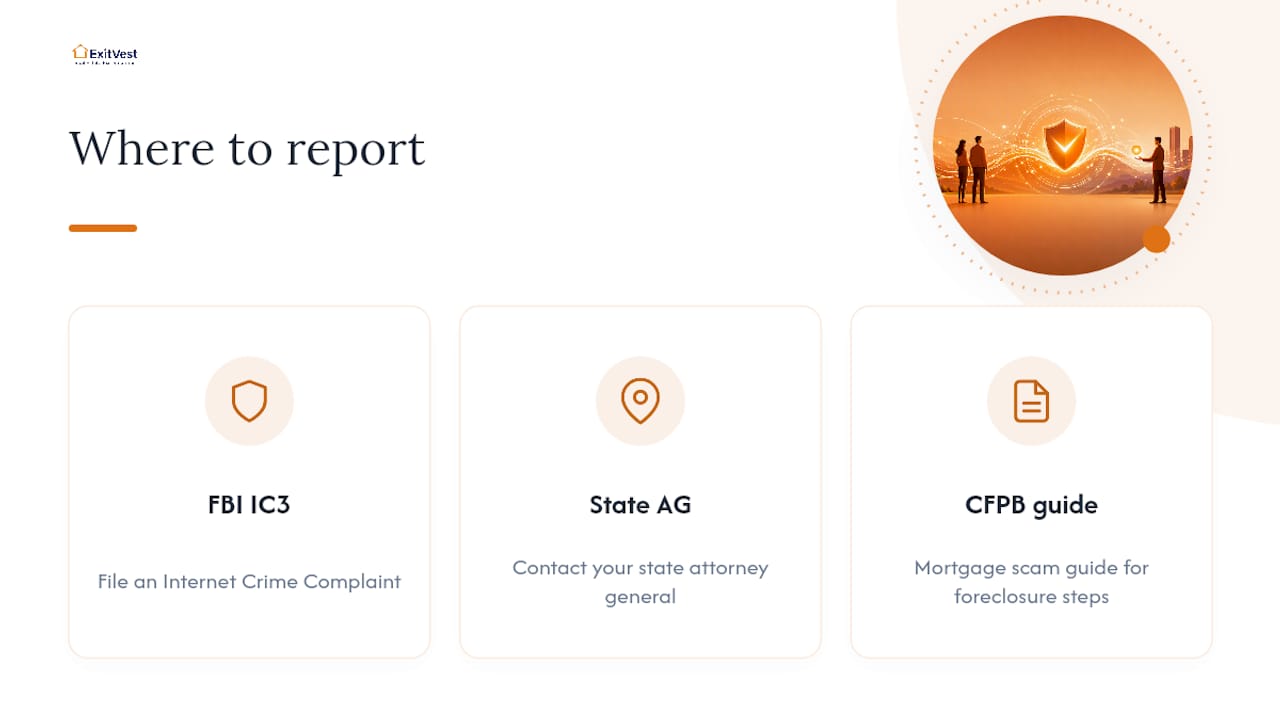
Report suspected fraud to the FBI's Internet Crime Complaint Center or your state attorney general. For foreclosure-specific scams, the CFPB's mortgage scam guide explains your rights and next steps.
Sources
- Beware of ‘Let Us Buy Your Home’ Ads — AARP
- FTC consumer alerts: How to spot scams
- Real estate scams are on the rise. Here’s what you need to know — Forbes
- Fake sellers, real risk — National Association of REALTORS® (NAR)
FAQ
How do you know if a cash buyer is legit?
A legitimate buyer provides proof of funds you can verify by calling the issuing bank directly, uses a licensed title company to hold earnest money in escrow, and never pressures you to skip inspections or sign within hours.
What real estate scams are common in the U.S. right now?
Wire fraud and business email compromise targeting closing instructions, fake proof-of-funds letters, and deed or seller-impersonation fraud are among the fastest-growing schemes, according to Forbes and NAR.
Why do people keep calling or mailing me about selling my house?
Investors and wholesalers use mass mailers, signs, and robocalls to find distressed sellers quickly, and AARP's research shows these campaigns disproportionately target homeowners facing foreclosure, probate, or financial hardship.
Is ExitVest a legitimate cash home buyer?
Some legitimate cash home buyers purchase properties directly from owners, provide verifiable proof of funds, and work with licensed title companies to handle escrow and closing, the same safeguards this guide recommends checking for with any buyer.
What should I do first if I think I've been scammed?
Contact your bank immediately to attempt a wire recall, then report the incident to the FBI's Internet Crime Complaint Center, the FTC, and your state attorney general before evidence goes stale.