

Selling an inherited house in St. Louis is defined as the legal transfer of estate property to a buyer after a decedent's death, typically requiring probate court authorization before any sale can close. The process involves three distinct phases: establishing legal authority, choosing a sale method, and managing costs. Cash buyers, traditional listings, and estate sale specialists each offer different tradeoffs in speed and net proceeds. This guide covers every step, from probate requirements to tax implications, so you can make a confident decision without losing money to delays or avoidable fees.
What legal steps must you complete before selling an inherited house in St. Louis?
Legal authority is the single most important prerequisite when you sell an inherited house in St. Louis. Without it, no title company will close the transaction. The probate process in St. Louis is the court-supervised procedure that confirms who has the right to manage and sell estate property.
Probate in St. Louis County typically takes 6–12 months, with complex cases stretching to 18 months. That timeline directly affects your holding costs, your ability to list the property, and how quickly heirs receive proceeds.
How to get legal authority to sell
The Missouri probate court appoints an executor or personal representative and issues Letters Testamentary. That document is your legal license to sign contracts and transfer title. Without Letters Testamentary, no buyer, lender, or title company will proceed.
Court approval is required for any sale of inherited property not held in a living trust or covered by a transfer-on-death deed. If the property was placed in a revocable trust before death, probate is skipped entirely. A transfer-on-death deed, recorded before the owner died, also bypasses the court process.
When can probate be simplified or skipped?
Missouri offers a simplified small-estate affidavit process for estates below a certain value threshold. If the total estate qualifies, heirs can transfer property without full probate. A local probate attorney can confirm eligibility within days.
Pro Tip: File for Letters Testamentary as early as possible. Confirming legal authority early is the critical step to cutting months off your total timeline and reducing holding costs.
Common probate delays include missing heirs, contested wills, outstanding debts, and incomplete estate inventories. Preparing a full asset list and locating all beneficiaries before filing reduces the risk of court-ordered delays.
- Obtain a certified death certificate immediately after death
- File a petition with the St. Louis County Probate Court
- Notify all creditors and beneficiaries as required by Missouri law
- Receive Letters Testamentary from the court
- Get a certified appraisal to establish the date-of-death fair market value for accurate tax reporting
What selling options are available for inherited houses in St. Louis?
Three primary methods exist for selling an inherited home in St. Louis: traditional listing with a real estate agent, selling as-is to a cash buyer, and a fix-and-sell approach. Each has a different risk profile, timeline, and cost structure.
Traditional listing with a real estate agent
A traditional listing targets retail buyers through the MLS and typically produces the highest gross sale price. The tradeoff is time. Preparing the home, listing it, negotiating offers, and waiting for buyer financing can take 60–120 days after probate closes. Agent commissions and closing costs reduce net proceeds significantly.

Selling as-is to a cash buyer
Cash sales close in 7–30 days but typically come in below market value. The speed advantage is real. For heirs paying monthly holding costs on a vacant property, a fast close at a modest discount often produces a better net outcome than a slow retail sale.
Pro Tip: Get at least two or three cash offers before accepting. Offer prices vary widely among buyers, and a 10-minute comparison can add thousands to your net proceeds.
Fix-and-sell approach
Renovating before listing can raise the sale price in high-demand St. Louis neighborhoods like Clayton, Webster Groves, or Kirkwood. The risk is cost overruns and extended timelines. This approach works best when the property needs only cosmetic updates and heirs have the capital and time to manage a renovation.
| Method | Timeline | Typical Cost | Net Proceeds |
|---|---|---|---|
| Traditional listing | 3–6 months post-probate | 8–10% of sale price | Highest gross, slower net |
| Cash buyer (as-is) | 7–30 days post-probate | Minimal fees | Below market, fast delivery |
| Fix-and-sell | 4–8 months post-probate | Renovation plus 8–10% | Highest potential, highest risk |
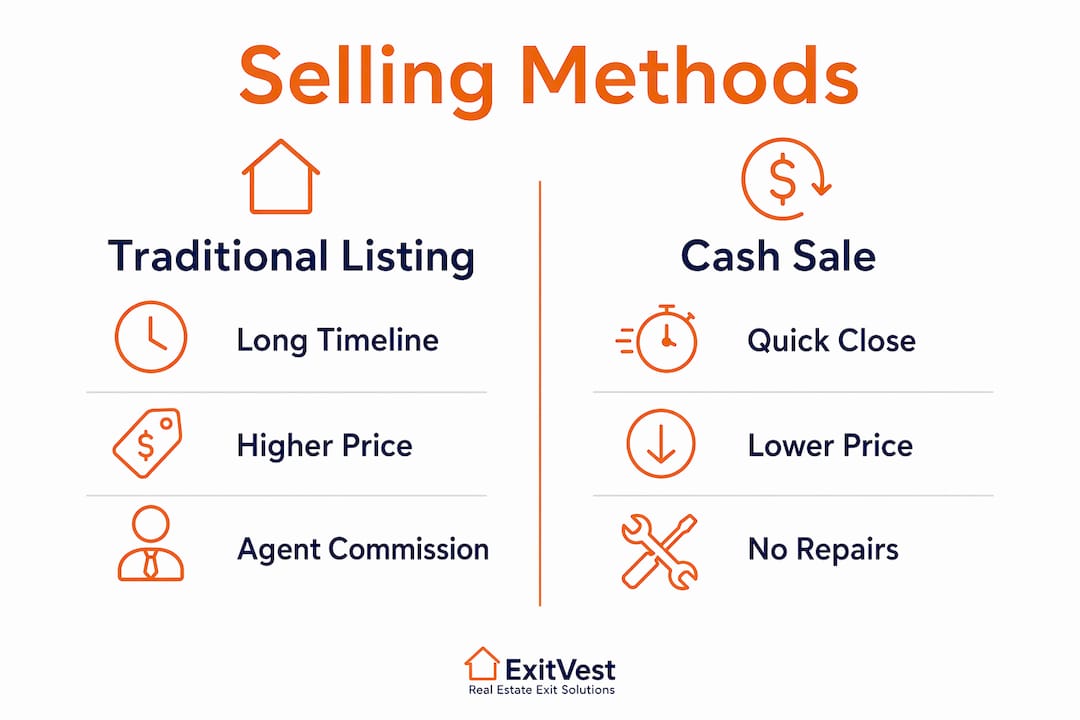
The best way to sell an inherited house depends on your timeline, the property's condition, and how urgently heirs need liquidity. A vacant home in a neighborhood with slow buyer demand is almost always a better candidate for a cash sale than a renovation project.
What are the key financial considerations when selling an inherited house in St. Louis?
Costs erode proceeds faster than most heirs expect. Closing costs average 8–10% of the sale price in St. Louis. On a $271,100 sale, that equals roughly $29,441 in fees before taxes. Understanding where that money goes lets you make smarter decisions about which sale method to choose.
Typical cost breakdown
- Agent commissions: 5–6% of sale price
- Missouri transfer taxes and title fees: 1–2%
- Probate attorney fees: varies by estate complexity
- Repairs and staging (traditional listing): variable
- Property taxes, insurance, and utilities during probate: accruing monthly
Holding costs accumulate every month during probate. An estate paying $1,000 per month in carrying costs loses more than $12,000 over a year. That math often makes a fast cash sale the financially superior choice, even at a modest discount from market value.
The step-up in basis tax benefit
The step-up in basis resets the property's tax value to its fair market value on the date of death. This means heirs who sell quickly after inheriting often owe little or no capital gains tax. A home purchased by the decedent for $80,000 decades ago but worth $270,000 at death gets a new basis of $270,000. Selling at $275,000 creates a taxable gain of only $5,000, not $195,000.
Depreciation recapture risk
Renting an inherited property before selling triggers depreciation recapture on the sale. The IRS taxes that recaptured depreciation as ordinary income, not at the lower capital gains rate. Heirs who consider renting the property while waiting for the market to improve should factor this cost into the decision. Selling promptly after probate closes avoids this tax exposure entirely.
You can reduce total fees by avoiding agent commissions through a direct cash sale or a flat-fee MLS listing. Both options cut the largest single cost in a traditional sale.
How can you navigate common challenges when selling inherited property in St. Louis?
Multiple heirs are the most common source of delay and conflict in inherited property sales. All beneficiaries must agree to sell before a transaction can close. When one heir wants to sell and another wants to keep the property, the process stalls.
Handling disagreements among heirs
A family buyout is the cleanest solution when one heir wants to retain the property. The heir who wants to keep it buys out the others at fair market value, typically using a home equity loan or cash. This avoids court involvement and preserves family relationships.
Partition actions are the legal alternative when heirs cannot agree. A partition suit forces a court-ordered sale, but the result is usually a below-market price plus substantial legal fees for all parties. Partition actions are expensive, slow, and damaging to family dynamics. They are a last resort, not a first step.
- Hold a family meeting early and document each heir's goals and timeline
- Hire a neutral mediator if disagreements arise before filing any legal action
- Get a certified appraisal so all heirs share the same baseline value
- Agree on a sale method in writing before engaging any buyer or agent
- Consult a Missouri probate attorney before pursuing a partition action
Managing property condition and repairs
Deciding whether to repair or sell as-is depends on the gap between the as-is offer and the post-repair retail price. Get both numbers before committing. A contractor estimate plus a realistic retail price from a local agent gives you the data to make that call in an afternoon.
Pro Tip: Request a cash offer first, before spending any money on repairs. The offer tells you the floor. Then get a repair estimate and a retail price estimate. If the math favors repairs, proceed. If not, you have a ready buyer waiting.
Vacant properties in St. Louis also attract code violations, vandalism, and deferred maintenance costs. The longer a property sits empty, the more it costs. Speed matters more than most heirs realize at the start of the process.
Key Takeaways
Selling an inherited house in St. Louis requires legal authority from probate court, a clear-eyed comparison of sale methods, and active cost management to protect net proceeds.
| Point | Details |
|---|---|
| Probate is mandatory in most cases | Get Letters Testamentary early to avoid months of unnecessary delay. |
| Cash sales beat retail on speed | A 7–30 day close often nets more than a slow listing when holding costs are high. |
| Step-up in basis reduces taxes | Selling soon after inheritance minimizes capital gains exposure for most heirs. |
| Multiple heirs require written agreement | Document all heir decisions early to prevent partition suits and legal fees. |
| Holding costs erode proceeds fast | Monthly carrying costs of $1,000 or more make a fast sale the financially sound choice. |
What I've learned helping St. Louis families sell inherited homes
The biggest mistake I see heirs make is waiting. They assume more time means more options. In practice, more time usually means more costs, more conflict among heirs, and more deferred maintenance on a property nobody is actively managing.
The second mistake is treating every property the same. A well-maintained brick bungalow in Maplewood and a neglected two-flat in north St. Louis County are completely different sales. One might justify a full retail listing. The other almost certainly belongs in a cash sale. Matching the strategy to the property and the neighborhood is what separates a good outcome from a frustrating one.
I have seen families lose tens of thousands of dollars waiting for a retail price on a property that needed $40,000 in repairs. I have also seen heirs accept a lowball cash offer on a move-in-ready home in a hot zip code because they did not know the retail value. Both errors are avoidable with two phone calls: one to a local agent for a price opinion, and one to a cash buyer for an offer. Get both numbers before deciding anything.
The step-up in basis benefit is also underused. Most heirs do not realize they can sell a property their parents bought for $60,000 in 1975 with almost no capital gains tax, as long as they sell promptly after inheriting. That tax advantage disappears if they rent the property first. Sell quickly, keep the tax benefit.
— Alek
Exitvest can help you sell your inherited St. Louis home fast
Exitvest works directly with heirs in St. Louis who need to sell inherited property without the delays of a traditional listing. The process is straightforward: you describe the property, Exitvest provides a fair cash offer, and you choose a closing date that fits your timeline.

No repairs, no agent commissions, and no waiting on buyer financing. Exitvest buys properties as-is, which means the condition of the home does not affect your ability to close quickly. For heirs managing probate, coordinating with multiple family members, or simply ready to move on, get a no-pressure cash offer and see what your inherited property is worth today.
FAQ
How long does probate take before I can sell in St. Louis?
Probate in St. Louis County typically takes 6–12 months, with complex estates reaching 18 months. Filing early and resolving creditor claims promptly shortens the timeline.
Do I owe capital gains tax when I sell an inherited house?
The step-up in basis resets the property's tax value to its fair market value at the date of death. Heirs who sell soon after inheriting typically owe little or no capital gains tax.
Can I sell an inherited house as-is without making repairs?
Yes. Cash buyers purchase inherited homes as-is, with no repairs required. The tradeoff is a below-market offer price, but the speed and cost savings often offset the difference.
What happens if one heir refuses to sell the inherited property?
All heirs must agree to sell. If agreement is not reached, a partition action can force a court-ordered sale, but the process is costly and typically results in a below-market price.
What are the typical closing costs when selling an inherited house in St. Louis?
Closing costs average 8–10% of the sale price, covering agent commissions, transfer taxes, title fees, and probate attorney costs. On a $271,100 sale, that equals roughly $29,441.